
• Insights & Workforce Architecture
The Jack-of-All-Trades Marketing Org: Why AI Is Killing Headcount and Rewarding Orchestration
The question isn’t whether you can run a lean marketing engine with one generalist and a fleet of agents. You can. The question is whether you want to be that generalist.
By Suchetana Bauri · 20 Min Read · Published in AI Strategy & Growth
Marketing leaders keep saying the same thing in different ways: “We’re using AI to be more efficient.” The job boards tell a harsher version of the story. Fewer junior roles. More listings for a single “Head of Marketing” expected to run everything through AI-powered workflows rather than bodies.
If you make a living in marketing, this isn’t a theoretical shift. It’s the new operating model. And it’s arriving faster than most teams are willing to admit.
The uncomfortable part is that it really does work. The question isn’t whether you can run a lean marketing engine with one generalist and a fleet of agents. You can. The question is whether you want to be that generalist — and what happens to everyone who doesn’t.
01 –
The cuts already happened
Start with the numbers, not the vibes.
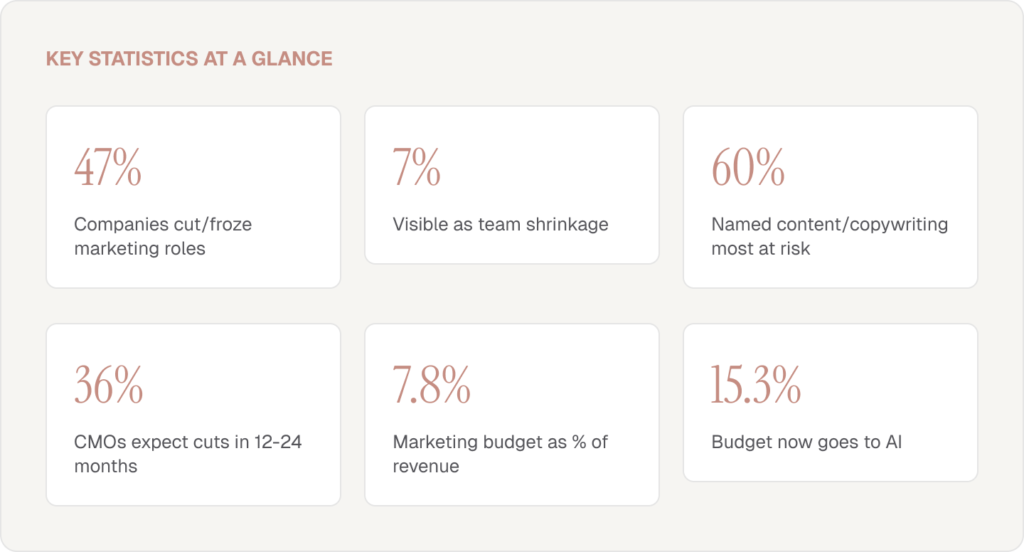
A running analysis of AI and marketing jobs from State of AI Marketing tracks the employment data behind the headlines. Wynter’s May 2026 survey of 100 directors, VPs and heads of marketing at mid-market and enterprise B2B SaaS companies found that 47 per cent had eliminated, reduced or stopped backfilling marketing roles because of AI in the previous 12 months. Only seven per cent of those cuts showed up as visible team shrinkage. The rest disappeared through attrition and unfilled openings.
When leaders were asked which functions were most exposed, the ranking was blunt: content and copywriting came first (named by 60 per cent of respondents), design and creative second (37 per cent), followed by product marketing, junior roles, ops and analytics. Execution work took the hit. Strategy stayed.
Spencer Stuart’s survey of senior CMOs tells you how that feels from the top. In the past year only 17 per cent of CMOs reported actually reducing headcount due to AI; 69 per cent kept team numbers flat while shifting capabilities towards AI. In the next 12-24 months, though, 36 per cent expect to cut people as AI and redundancy elimination bite, rising to 47 per cent at very large companies with revenues above $20bn.
Gartner’s 2026 CMO Spend Survey adds a budget lens. Marketing spend sits flat at 7.8 per cent of company revenue while 15.3 per cent of budget now goes to AI initiatives. Budgets didn’t swell to fund AI; AI was layered into existing spend. Thirty-nine per cent of CMOs plan to cut agency and labour costs, using AI-driven productivity as the excuse.
“AI didn’t collapse marketing. It rearranged it. It kept senior judgement, raised the price of people who can direct AI, and quietly removed seats underneath them.”
The important detail is the method. Layoff trackers miss this because most of it happens through non-events: a coordinator leaves and isn’t replaced, a copywriting role gets “absorbed into the team”, a content budget becomes a tooling budget by stealth.
02 –
The one-operator plus agents org chart
Look at how the new model actually behaves and you can see why those boxes disappeared.
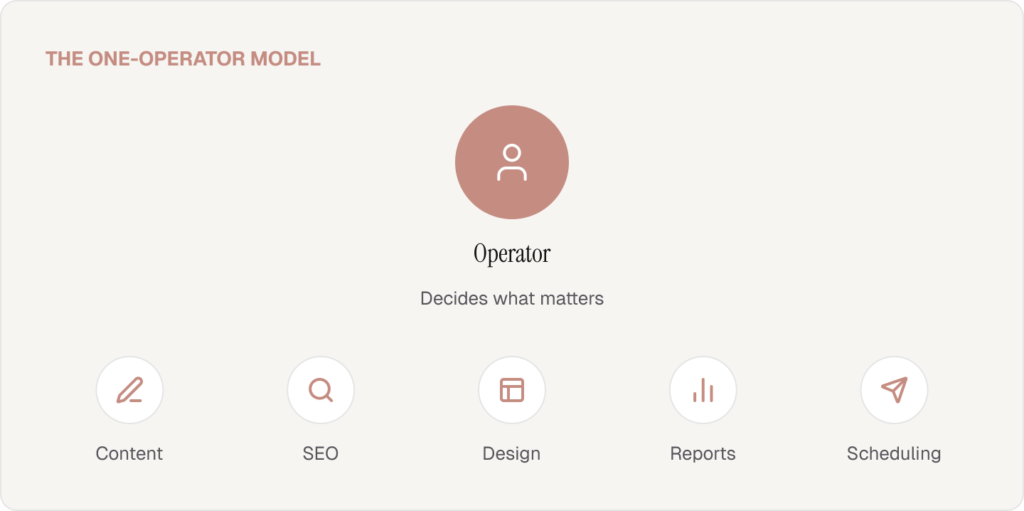
At the centre sits a single human operator: head of marketing, growth lead, sometimes a founder wearing the hat. Around them sits a ring of tools and agents handling what used to be separate jobs: content drafting and variant generation, SEO research and clustering, basic design and layout, reporting and dashboards, distribution and scheduling.
The operator does three things: 1. Decides what matters. 2. Defines the voice. 3. Writes the rules the agents follow. Everything else runs on flows.
It’s the “jack of all trades, master of systems” version of the old proverb: a master of one won’t survive here unless that “one” is judgement.
There are only two real categories: work that follows rules someone could write down; and work where a bad decision would materially hurt the business. The first is stable territory for machines. The second is where the operator must live.
03 –
We’ve seen this restructuring pattern before
Marketing is simply catching up with other white-collar functions that have already been through adjacent shifts.
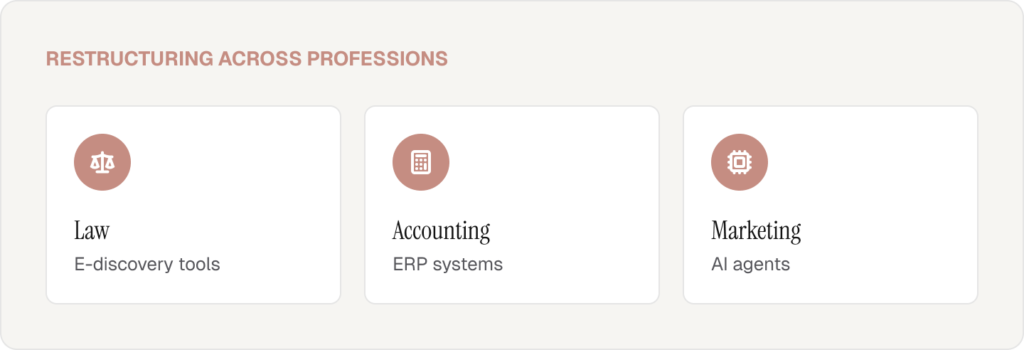
Law went first. Document-review software and e-discovery tools shrank the hours once spent on manual reading. Partners remained; associate ranks thinned.
Accounting followed with spreadsheets and then ERP systems. The ledger work that used to occupy rows of trainees became formulae and database entries.
In both cases, the technology moved execution out of human hands. The profession then had to invent new ways for people to learn how the work actually worked.
Marketing is in the same place. AI has taken the repetitive production tasks that once taught junior people how campaigns functioned and crushed them into prompt libraries and flows. The apprenticeship model hasn’t yet found its replacement.
04 –
Why generalists suddenly matter
Here’s the twist: this environment is genuinely good for a certain kind of marketer — the one who naturally wanders across domains.
The career that used to look unfocused (“a bit of content, a bit of UX, some ops, some AI”) is becoming the exact profile the one-operator model calls for.
That trajectory — from specialist craft to systems-curious to orchestration-capable to judgement-dense generalist — is becoming a viable template.
“Jack of all trades stops being an insult. A jack of all trades with strong judgement and a bias for systems is, quite literally, the job description.”
05 –
Coordination wasn’t just overhead; it was training
Traditionally, 60-70 per cent of marketing time really did drown in alignment: briefs, status calls, approvals, rewrites, reporting loops. AI and automation can cut a lot of that.
The risk isn’t the loss of meetings; it’s the loss of apprenticeship.
Those messy interactions were where juniors learnt how strategy worked. They watched a campaign get killed because the positioning was wrong. They saw a senior leader refuse to publish something that “felt off” even though the metrics looked fine.
A one-operator model can’t recreate that dynamic by accident. It has to do it on purpose.
If you see yourself as the future head-plus-agents, you’re also the future teacher.
06-
Measurement: the quiet headcount weapon
Gartner’s analysis of 401 CMOs shows budgets stuck at 7.8 per cent of company revenue, with 15.3 per cent now allocated to AI. Labour’s share of spend actually rose from 21.9 to 24.5 per cent, because the people who can direct AI have become more expensive, not less.
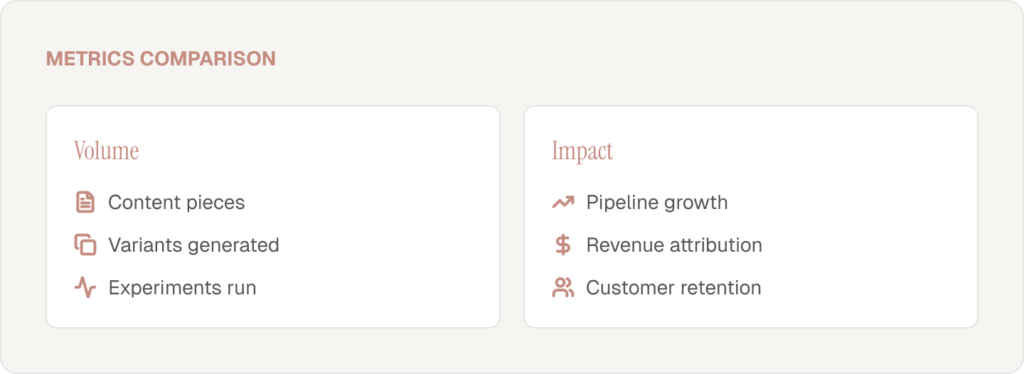
When marketing reports only efficiency metrics it’s handing the CFO an easy argument: execution is cheap now. So are the people defined by execution.
A useful rule of thumb: If a metric describes volume, it’s an argument for machines. If a metric describes impact, it’s an argument for humans.
“If you’re the person designing those dashboards, you’re quietly deciding whether your own job looks like a cost or a lever.”
07 –
The Brand DNA problem and judgement density
One of the most persistent failure modes in AI-powered marketing isn’t technical. It’s taste.
Give a large language model a generic prompt and it will write a generic answer. Without a rich, curated knowledge base feeding the generation layer — real guidelines, past campaigns, explicit preferences — AI defaults to generic noise.
The valuable skill is the ability to look at that noise and say, precisely and quickly, why it can’t go live.
“The instinct to spot a confident abstraction with nothing underneath it. That’s pattern recognition. That’s the scarce skill.”
08 –
How marketers actually evolve into orchestrators
There is no formal ladder labelled “Orchestrator”. You have to build it yourself.
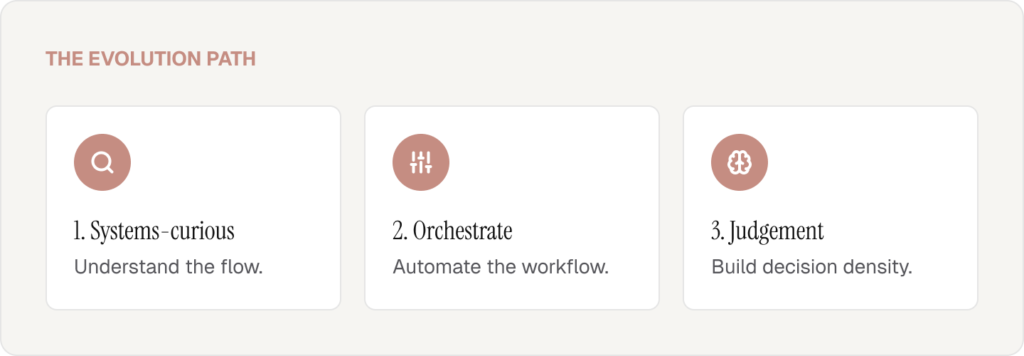
1. Become systems-curious — Stop asking only “is this a good post?” and start asking “where does this sit in the system?”
2. Learn to orchestrate — Treat AI as infrastructure, not novelty. Pick a single, high-frequency workflow and automate it end-to-end.
3. Build judgement density — Invest in how you think, not just what you produce. Read widely. Practise explaining your decisions.
Over time, you become the person who can see how content, workflows, incentives and AI tools interact. In the orchestration era, that’s the seat with leverage.
09 –
What this means for everyone else
The brutal truth is that not everyone wants that seat. Some people genuinely prefer depth in one craft.
The honest response is to stop pretending the old career grammar still exists in its previous form. If execution is being automated, then craft specialists will need either organisations that explicitly protect depth, or hybrid roles where craft is paired with a second discipline.
AI isn’t politely asking marketing whether it would like to restructure. It’s doing it anyway.
10 –
If you’re reading this and worried
If you’re a junior marketer: Stop optimising only for shipped campaigns. Start collecting stories of where you improved AI output and why. Look for projects that cross boundaries.
If you’re a head of marketing: Audit your org chart for roles that exist mainly to do execution. Redesign your dashboards so they measure outcomes, not volume.
If you’re a CEO: Ask your team not “how can AI cut marketing costs?” but “where does human judgement drive growth in this function?”
The one-operator model isn’t going away. The only thing still up for grabs is who gets to be the operator.
“A jack of all trades is a master of none, but oftentimes better than a master of one. In an AI-orchestrated marketing team, the jack of all trades is no longer a warning. It’s the job description.”
[1] State of AI Marketing, “AI and marketing jobs: the running data on cuts and roles”, summarising Wynter’s May 2026 survey of 100 B2B SaaS marketing leaders.
[2] Spencer Stuart, “The AI Reckoning: Why Marketers Think 2026 Is a Make-or-Break Year” (2025).
[3] Spencer Stuart / Wolfe Pereira, LinkedIn summary of the AI reckoning survey (January 2026).
[4] Gartner press release, “Gartner 2026 CMO Spend Survey Finds CMOs Allocate 15.3% of Marketing Budgets to AI” (May 2026).
[5] Gartner, “CMO Spend 2026” and “Insights From the 2026 CMO Spend Survey” (2026).
[6] Marketing Helm, “Marketing budgets flat, AI cuts agencies and headcount” (June 2026).
[7] The Ad Spend, “Marketing Org Design in the AI Era: The CMO’s Guide” (July 2026).
[8] Toffu AI, “How a 3-Person Marketing Team Outperforms a 12-Person One with AI Agents” (2026).
[9] Various analyses of law-firm restructuring under e-discovery tools (2010s-2020s).
[10] Historical work on accounting automation under spreadsheets and ERP systems.
Need help designing your AI-native marketing structure?
If you share the rough size of your support team and current channels, I can sketch a tailored hybrid workflow map for your own case study.