
• AI & Workplace Communication
AI Adoption Is a Communication Challenge, Not Just a Technology Rollout
by Suchetana Bauri • 12 min read
The most consequential AI decision made inside many companies this year will not be which model they buy. It will be what employees hear about it first.
Will they hear that AI is arriving to “unlock productivity”, in the language of a vendor slide deck? Will they find a new copilot button in a familiar tool and infer its purpose from the rumour mill? Or will someone explain, in ordinary words, what is changing, why it is changing, what will remain human, and what support will be available when the technology gets things wrong?
The difference is not cosmetic. It determines whether AI becomes a useful part of the working day or another corporate system people quietly work around.
AI is already reshaping the texture of knowledge work. It drafts the awkward first version of an email, reduces a meeting transcript to six bullet points, produces alternative headlines, finds patterns in a spreadsheet, translates a document, writes code, answers a customer query and, increasingly, completes multi-step tasks through agents. In a 2025 survey of 31,000 workers across 31 markets, Microsoft found that 45% of leaders saw expanding capacity through “digital labour” as a priority over the following 12–18 months.
That phrase — digital labour — should give us pause.
It is tidy, executive-friendly language for a messy human question: what happens to a job when some of its tasks are handed to software? Employees understand this immediately, even when leadership does not say it aloud. They do not need another announcement about “the future of work”. They need a truthful account of their present work: which tasks might change, which decisions they will still own, how their performance will be judged, whether their data is being used, and what happens if the machine is confidently wrong.
Too many AI programmes treat this as a training problem. Buy licences. Run a webinar. Publish a prompt library. Measure usage. Declare adoption.
That is not adoption. That is distribution.
Adoption is what happens when people alter their habits because a tool makes their work meaningfully better, without making them feel exposed, dispensable or foolish. Communication is not the decorative layer around that process. It is the operating system for it.
• THE NARRATIVE GAP
The announcement is already happening
Most organisations think they are in control of the AI narrative until they discover they are not.
Silence creates its own narrative
Employees encounter AI through their own devices, social feeds, clients, job listings and children’s homework. They see headlines predicting job losses alongside videos promising that one person can now do the work of ten. They hear senior leaders use terms such as “agents”, “automation” and “transformation”, then watch budgets tighten and vacancies go unfilled. In that atmosphere, silence does not create calm. It creates a story — usually a darker one.
Reassurance is not a strategy
The predictable corporate response is reassurance. “AI will augment, not replace, our people.” Sometimes that is true. Sometimes it is only a sentence people have learned to say because it sounds humane.
The evidence is more complicated. Anthropic’s analysis of millions of anonymised Claude.ai conversations found that AI use leaned towards augmentation — collaboration with people — rather than direct automation, at 57% versus 43%. But that is not a permanent settlement between worker and machine. It is a snapshot of how the technology was being used at a particular time, largely in areas such as software development and technical writing.
Meanwhile, the World Economic Forum reports that 86% of surveyed employers expect AI and information-processing technologies to transform their business by 2030. Its respondents also identify skills gaps as the principal barrier to business transformation, while 85% anticipate upskilling their workforce.
This is why polished reassurance fails. People can sense the gap between an abstract promise and a changing workload. They know that “augmentation” can mean relief from drudgery. It can also mean that the work previously done by three people is now expected from two.
The answer is not to frighten people pre-emptively. It is to stop treating uncertainty as a communications failure. Uncertainty is a real condition of AI adoption. A credible organisation says what it knows, says what it does not yet know, and returns with an answer when the answer changes.
That may sound obvious. It is surprisingly rare.
Leaders Say
“AI will unlock productivity.”
Employees Hear
“Will this replace my work?”
Employees Need
Clear alignment on role changes, safeguards, and tangible support.
The adoption problem often begins in the gap between an executive message and an employee’s lived interpretation.
• SPECIFICITY OVER SLOGANS
Stop talking about AI as if it were one thing
“AI” is a category error in most internal communications. It is too broad to be useful.
A customer-service assistant that drafts replies, a model that ranks job applicants, a meeting summariser, a coding agent, a fraud-detection system and an enterprise chatbot are not one intervention. They carry different risks, affect different people and require different kinds of oversight. Bundling them into one grand AI story makes leaders sound evasive because it prevents employees from asking the questions that matter.
Start with the workflow, not the tool
The most useful communication begins with the work, not the tool.
Take a marketing team. A generic announcement might say that generative AI will help the team “create content faster and improve campaign performance”. That message contains no information. What content? Faster by how much? Who is responsible for checking facts? Can staff use public tools with client information? Does “improve performance” mean that fewer people will be needed for production work?
‘Adoption is what happens when people alter their habits because a tool makes their work meaningfully better.’
A more honest version might say:
Example: Pilot Announcement
“From next month, the team will test an approved AI workspace for first drafts of campaign copy, research summaries and content variations. It must not be used for confidential client data or final factual claims. Editors and account leads remain responsible for accuracy, brand judgement and approval. We will review the pilot after eight weeks, including its effect on workload, quality and roles.”
That is not thrilling language. It is useful language. It tells people what the tool is for, where its boundaries lie, who retains accountability and when the organisation will revisit the decision.
Good AI communication favours nouns and verbs over abstractions. Be specific about the workflow, the task at hand, who owns the decision and where the limits lie.
Make role impact specific
The same is true for job impact. People do not need a promise that their role will “evolve”. Every role evolves. They need to know whether they will spend less time making slide decks and more time advising clients; whether they will review AI outputs; whether they will learn a new system; whether output expectations will rise; and whether the organisation is planning to redesign the team.
This is not merely kinder. It is strategically smarter. Employees who understand the limits of a tool are better able to spot its failures. Employees who know that human judgement still matters are more likely to use it critically rather than either rejecting it outright or trusting it blindly.
• TEAM COMMUNICATION
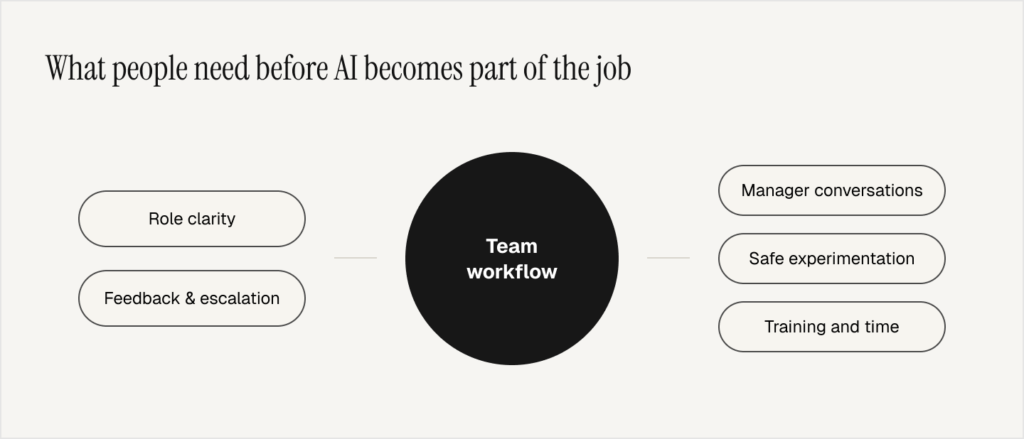
The real unit of change is the team
The all-hands meeting is not the rollout
The town hall has become the ceremonial home of AI communication: a chief executive announces a big partnership, a short demo produces the required look of astonishment, and someone says that the company will “lead responsibly”.
Then the meeting ends. A finance manager is asked whether their team can close the month faster. A designer wonders whether the new image tool will become compulsory. A recruiter asks whether the screening process has already changed. A customer-support lead has to answer questions they were never briefed to answer.
This is where adoption succeeds or fails: not in the all-hands meeting, but in the ordinary team conversation afterwards.
Managers are interpreters, not messengers
Managers are often treated as a channel — people who will simply relay the approved message.Their role goes beyond relaying the approved message. They make a company-level decision legible in the everyday realities of workload, priorities, performance and care. If they have not been given honest answers, they will improvise. Their teams will notice.
A good AI rollout therefore needs a manager briefing that is more substantial than a Q&A document. It should include: the business problem in plain language; what has been decided vs still being tested vs not decided; the likely workflow changes; the specific rules on data, QA, IP and escalation; a usable answer to the job-security question; and a route for managers to report confusion, resistance, unexpected benefits and harms.
People experience AI locally
This matters because people assess an AI programme through local experience. They do not experience “enterprise transformation”. They experience a tool that saves them forty minutes on a tedious report, or one that generates a plausible error they have to spend two hours correcting.
One study of internal communication during AI-driven organisational change found that transparent and empathetic communication, practical demonstrations and direct engagement with job-security concerns helped reduce uncertainty and resistance. This should not be surprising. AI is often discussed as though it is immaterial — a cloud-based intelligence, a layer, a capability. But its effects are tangible: time, status, confidence, accountability and pay.
The team is where those effects become legible.
• COMPETENCE BUILDING
Demonstrate the work, not the magic
AI vendors are remarkably good at the reveal. A task happens in seconds. A blank page fills with elegant text. A spreadsheet produces an insight. The audience applauds the collapse of effort.
The work around the work
What the demo does not show is the work around the work.
The demo hides the labour around the output: employees check confident but incorrect answers; managers decide whether it is safe to share; designers rescue generic visuals; analysts trace sources; lawyers ask where the data has gone; and junior colleagues lose the messy early work through which they build expertise.
The risk is not that AI will make work frictionless. The risk is that it will move friction to the least visible people in the system.
This is why organisations should use demonstrations differently. Do not only showcase the success case. Include the moments when the system produces the wrong result.
Use examples that expose the tool’s weak points: an AI-generated customer response that invents a policy, a meeting summary that misses the decision that mattered, or a draft that reproduces a hidden bias. Then show the safeguard: the review step, the source check, the escalation route, the person who has authority to stop the workflow.
Teach judgement, not prompts
This is not an argument for making employees afraid of the tool. It is an argument for making them competent around it.
Competence is not the same as prompt-writing. Prompt-writing is a useful but temporary label for the ability to give a system context and direction. The more durable skill is judgement: knowing when to use AI, what information not to share, how to verify an output, when to override it, and when a task requires a human conversation rather than a generated answer.
The World Economic Forum’s 2025 findings point in the same direction. AI and big data skills are expected to grow quickly, but so are creative thinking, resilience, flexibility, leadership and collaboration. The fashionable version of this insight is that “human skills will matter more than ever”. The more useful version is that organisations must create time and incentives for people to practise those skills.
Critical thinking cannot thrive in a workplace that rewards speed alone; careful review will not happen when an AI pilot is judged only by usage; and judgement cannot develop if the junior work through which it is learned disappears.
• MEASURING WHAT MATTERS
The metric that matters is not usage
Usage is seductive because it is easy to count. Licences activated. Prompts submitted. Documents generated. Hours saved.
These numbers can be useful. They are also vulnerable to theatre.
A company can produce high usage by making a tool mandatory, putting it inside existing software or repeatedly urging employees to “try AI”. None of that proves that the work has improved. It may only prove that people have learned how to perform enthusiasm.
Measure workflow outcomes
The better question is: what has changed in the workflow, and for whom?
For each AI use case, leaders should measure at least four things: Quality (Is the output more accurate, more useful or more consistent?), Time (Has time genuinely been saved, or has it shifted into checking and repairing?), Equity (Who benefits from the tool and who carries the new burden?), and Capability (Are people becoming better at the work, or simply more dependent on a system they cannot question?).
Trust is an operational metric
There is also a fifth measure that usually sits outside the dashboard: trust.
Trust is not a warm feeling generated by an executive email. It is the accumulated evidence that an organisation tells the truth before it has to; that it admits when a tool fails; that it does not use “innovation” as camouflage for decisions it is unwilling to explain.
When a company says AI will make work better, employees will compare that claim with their lived experience. If the result is more surveillance, less autonomy or higher output targets without support, the next announcement will be met with understandable cynicism. No internal campaign can repair that on its own.
Communication cannot compensate for a bad operating model. But it can reveal one early enough to change it.
• TRANSPARENCY INFRASTRUCTURE
Build a public record of decisions
The most practical thing an organisation can create during an AI rollout is not a glossy playbook. It is a living record.
Make AI decisions visible
Call it an AI change log, a workplace AI hub, or simply a page that people can find without asking permission. Its job is to make decisions visible.
It should include the approved tools, the teams using them, the tasks they support, the rules for data and review, pilot dates, named owners, known limitations and a record of changes. It should include a plain-language FAQ that is updated when new questions emerge — not when the communications calendar allows it.
Treat difficult questions as legitimate
Most importantly, it should include the questions leadership would rather avoid.
Will AI affect hiring? Will it alter performance expectations? Can employees opt out of a pilot? What happens if an AI system makes a harmful recommendation? Which work remains human by policy, not merely by habit? How can someone report a concern without becoming known as “anti-AI”?
The point is not to have a perfect answer on day one. It is to show that the questions are legitimate and that someone is responsible for answering them.
Organisations often fear that acknowledging uncertainty will create anxiety. The opposite is usually true. People are anxious when they suspect a decision is being made elsewhere, in a language designed to prevent them from understanding it.
A living record changes the tone of adoption. It says: this is not magic, and it is not a finished decree. It is a set of choices we are making in public, with consequences we intend to examine.
That is a much better basis for change than hype.
• PRACTICAL FRAMEWORK
A better script for the next AI announcement
The next time a leader has to speak about AI, they should resist the urge to sound visionary. Employees have enough visions. What they need is a plan they can test against reality.
A credible announcement can fit into six sentences:
Practical Tool Ref: Rollout Template
A better script for the next AI announcement
01. Here is the problem we are trying to solve.
02. Here is the specific workflow we will change first.
03. Here is what will not change, including where human accountability remains.
04. Here are the risks we are watching and the rules we are applying.
05. Here is the support available, including time to learn.
06. Here is how you can challenge, improve or stop this if it is not working.
Save this for your next AI rollout briefing.
That last sentence is the most important. AI adoption is often framed as inevitable, which is a convenient way to avoid responsibility for its design. But nothing about a workplace rollout is inevitable. A company chooses which processes to automate, what to measure, which safeguards to fund, how it treats affected employees, and whether it mistakes activity for progress.
Those are human choices. They should be communicated as such.
‘Communication is how an organisation decides whether AI becomes a tool people can use — or a decision done to them.’
The companies that navigate AI well will not be the ones with the loudest transformation narrative. They will make change open to discussion, explain the work before the technology, prepare managers for difficult conversations, and show employees the system’s limits as clearly as its capabilities. And they will understand that a person who raises a concern is not delaying adoption. They may be preventing a costly mistake.
AI is not just arriving in the workplace. It is redistributing attention, judgement and power inside it.
That is why communication cannot be an afterthought. It is how an organisation decides whether AI becomes a tool people can use — or a decision done to them.
References
1. Microsoft (2025). Work Trend Index 2025: The Year the Frontier Firm Is Born.
2. Anthropic (2025). Introducing the Anthropic Economic Index.
3. World Economic Forum (2025). The Future of Jobs Report 2025: Workforce Strategies.
4. World Economic Forum (2025). The Future of Jobs Report 2025: Skills Outlook.
5. Emery, L. R. (2025). ‘Don’t Panic, it’s Just AI’: A Qualitative Study on Internal Communication Strategies for Managing AI-Driven Change. Illinois State University.
6. Digital Workplace Group (2025). Talking to Employees About AI Without Hype or Fear.
7. OEC Insights (2025). Communicating AI Change.
Looking for clearer thinking on AI adoption?
Read the latest notes, or get in touch if you are trying to turn AI interest into something your team can actually use.