
• Insights & Operating Models
Beyond Chatbots: How AI Is Rewiring Digital Service Operations
Why CX teams need a new kind of digital product ops role—and what it actually does all day.
By Suchetana Bauri · 14 Min Read · Published in AI Strategy
01 –
The tension: AI CX is sold as magic, experienced as maintenance
Most organisations now have an AI story for customer experience: a chatbot, a recommendation engine, a pilot project in the contact centre.
But if you sit inside the workflows, you see something less glamorous: fragmented systems, thin content, reactive dashboards, and teams quietly trying to make sense of a growing pile of “AI-powered” features while keeping service quality intact.
This article is about that layer of work—the emerging role inside digital operations that does not build models, but decides how AI actually shows up in customer journeys, content systems, and agent workflows.
02 –
The question: What does “AI-powered CX operations” really mean?
It’s tempting to describe AI-powered CX in terms of channels: web, app, chat, contact centre. But the reality is messier and more human. Customers experience journeys—discover, decide, onboard, get support, stay informed—not channels.
As AI moves from experiment to infrastructure, organisations are being forced to rethink how those journeys are designed, governed, and tuned. The question isn’t “Do we have AI in CX?” but “Who is responsible for the way AI interacts with our customers, our agents, and our content, every day?”
03 –
The context: Human-led, AI-powered CX as operating system
Capgemini’s 2026 Reimagining Customer Experience: Human-led, AI-powered report captures this shift clearly: AI is no longer a side experiment; it is becoming a core pillar of the CX operating model, even as trust and execution gaps remain large.
The report draws on thousands of consumers and frontline employees and highlights two tensions: customers still value human interaction deeply, while simultaneously expecting AI-enabled speed, personalisation, and continuity across journeys.
The recommendation isn’t “automate everything”; it’s “design CX for both humans and AI,” with unified data, observability, and feedback loops that allow organisations to sense and adapt in real time.
This is where a new kind of role starts to become visible: an AI-enabled CX operations function that sits between strategy decks and product teams, quietly orchestrating how AI interacts with real people.
04-
The analysis: From channels to journeys, from dashboards to decision engines
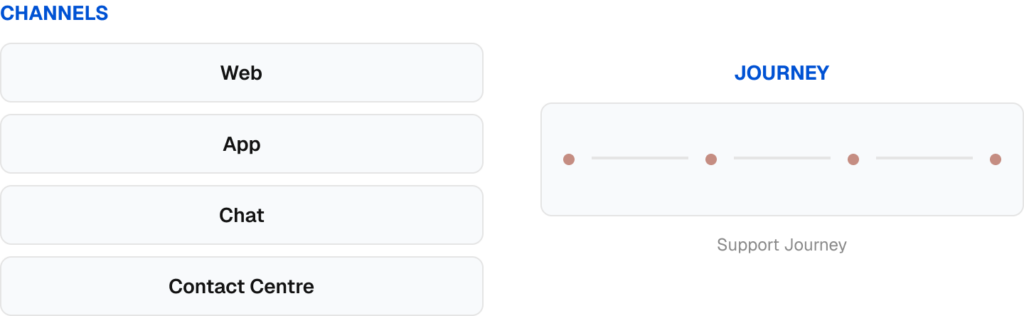
4.1 Channels vs journeys: the real unit of work
Traditional digital operations teams are organised by channel: one group for web, another for app, another for messaging, another for the contact centre.
Customers do not care who owns which system. They judge the organisation based on whether their journey feels coherent: does the information match, does the context carry over, does the AI that greeted me in chat know what I just did on the website?
Modern CX work therefore pushes for journey-centric operating models supported by AI-ready data and content, rather than silo-centric models with thin integrations.
4.2 AI’s role: woven into the operating system, not bolted on
Early AI CX projects were usually isolated features: a bot for FAQs, a recommender for products, a churn model for retention campaigns.
- Predictive models forecast demand and detect anomalies.
- AI-driven analytics interpret behaviour and sentiment across channels.
- GenAI copilots help agents interpret context and make better decisions.
- Orchestration layers coordinate content, personalisation, and routing.
Put together, these patterns show AI as infrastructure-an agentic coworker embedded in workflows-rather than a standalone gadget.
That raises a practical question: who owns this infrastructure from the CX side, and who ensures that these models and agents are integrated, observable, and usable?
05 –
The incentives: Why this role exists (and why it’s under-named)
This section covers what organisations actually reward.
5.1 What organisations want
Executives and CX leaders typically want three things from AI:
Cost
Reduced costs through automation and case deflection.
Experience
Better experience through personalisation and faster resolution.
Data
More reliable data for decisions and experimentation.
Vendors respond with platforms that promise unified data, AI orchestration, and embedded agents across CMS, analytics, experimentation, and contact centre tools.
This is the strategic story most decks tell. Inside the organisation, however, someone has to translate these capabilities into day-to-day operations: which journeys change, which microcopy updates, which rules get enforced, and which signals trigger a human override.
5.2 What actually gets rewarded
The incentives on the ground are subtler. Teams are rewarded for:
- Uptime, SLA adherence, and CSAT.
- Measurable improvements in journey metrics.
- Avoiding visible AI failures or trust breaches.
This makes the emerging AI-enabled CX operations role both critical and invisible. When they do their job well, nothing explodes, journeys feel smoother, and AI features quietly work in the background.
When they are missing, AI projects look impressive in slides but feel disjointed, brittle, or unnerving to customers the moment they touch a real journey.
It is the kind of role you usually only notice when it isn’t there.
06 –
The framework: What an AI-powered CX operations role actually does
This section maps the five core responsibilities of the role.
Across job descriptions and platform narratives, you can see consistent clusters of responsibility. Together, they form an “insight-to-action” loop at the core of AI-powered CX.

6.1 Journey oversight and release choreography
First, someone needs an end-to-end view of customer and agent journeys. AI-enabled CX operators partner with product, engineering, and architecture teams so that releases and fixes land coherently across channels.
If a contact centre AI assistant is updated, they check how that affects web self-service, messaging flows, and knowledge content. The goal is to avoid the classic “we fixed it here, broke it there” outcome.
6.2 Experience measurement and observability
Second, someone owns CX-specific measurement. These roles maintain metrics such as experience scores, CSAT, first-contact resolution, case deflection, handle time, and uptime.
In practice, this looks like:
- Defining which signals matter for each journey.
- Wiring dashboards and alerts to those signals.
- Coordinating triage when something breaks or feels off.
Recent CX guidance emphasises real-time observability and feedback loops that can adapt AI behaviours as they interact with customers at scale.
6.3 Integrating AI decision engines into workflows
Third, AI decision engines need to be woven into actual workflows. The operations role here is to:
- Decide where AI can safely act autonomously.
- Define when human review is mandatory.
- Set thresholds for escalation and override.
This is less about data science and more about operational judgment: understanding the consequences of false positives, false negatives, and misaligned recommendations in live customer journeys.
Taken together, these decisions define the safety envelope for AI in CX.
6.4 Content systems as AI substrate
Fourth, content systems become an AI substrate. Modern content operations for AI-powered CX usually require:
- Structured, componenti-sed content with clear metadata and hierarchy.
- Unified content engines that connect CMS, DAM, commerce, and AI agents.
- Governance rules for prompts, content variants, and reuse.
AI-enabled CX operators often sit inside CMS and messaging operations, which makes them uniquely placed to ensure that content is usable by both people and machines.
6.5 Ethics, trust, and micro-explanations
Finally, there is the trust surface: ethics and explainability in everyday CX.
You can think of it in two layers:
MONITORING & CONTROLS
System Guardrails
Bias and drift monitoring for models touching routing and offers.
Lifecycle controls to prevent data leakage and hallucination-driven errors.
EXPLAINABILITY
Micro-Explanations
Language that makes system logic transparent (“Why am I seeing this?”).
Clear signals about limitations and override options.
This is where CX operations becomes narrative work. Someone writes the copy that explains AI, sets the tone for apologies, and defines how limits are acknowledged-this is not a trivial afterthought; it is a trust surface.
Journey
End-to-end oversight across channels.
Metrics
CX-specific measurement and observability.
Decision
Integrating AI engines into workflows.
Content
AI-ready content systems and governance.
Trust
Ethics, explainability, and guardrails.
07 –
The decision: Who thrives in this role-and how to grow into it
This section covers the skills required for the role.
Three profiles tend to converge in these roles.
01. Journey and narrative instincts
People with backgrounds in customer research, UX, service design, or consulting. They understand that metrics are stories in disguise: a spike in drop-offs is a narrative about confusion, misaligned expectations, or invisible constraints.
02.Analytics and observability fluency
Practitioners who are comfortable with dashboards, anomaly detection, experimentation, and performance reporting. The skill is knowing which questions to ask of the data and distinguishing signal from noise.
03. Content and systems thinking
People who have run CMS, messaging platforms, or content operations are used to dealing with versioning, taxonomies, permissions, and workflows-the unglamorous infrastructure that makes AI-powered experiences coherent.
Combine these strands with a working understanding of AI concepts and governance, and you get an operator who can translate between data science, product, and frontline teams.
Journeys
- Journey mapping
- Handoff design
- • Narrative logic
Analytics
- Signal detection
- Dash-boarding
- Anomaly triage
Content
- Structured metadata
- Taxonomy
- Governance
08 –
The resonance: What this means for AI adoption work
This section covers the practical implications for organisations and practitioners.
This emerging role is a blueprint for where AI adoption actually becomes real: in the operational layer where journeys are observed, content is maintained, and decisions are made under constraint.
“We redesigned our support workflows so AI and humans work together. AI handles the repetitive work; humans handle the decisions that matter.”
– CASE STUDY PROJECT LEAD
For organisations:
If you treat AI as a feature rather than an operating system, you will keep shipping disconnected pilots and wondering why trust, continuity, and experience metrics lag behind the hype.
For practitioners:
Journey-minded professionals can deepen their analytics and AI observability skills.
Content and CMS leaders can redesign operations so that content is AI-ready.
Content and CMS leaders can redesign operations so that content is AI-ready.
If you’re in content, CX, or ops – start here
Journey-minded professionals can deepen their analytics and AI observability skills. Content and CMS leaders can redesign operations so that content is AI-ready. AI-curious operators can specialise in governance and decision design for live systems.
For AI enablement work, this role is the bridge between “we bought tools” and “AI is part of how good work gets done-clearly, responsibly, and repeatably.
Ready to design your hybrid workflow map?
If you share the rough size of your support team and current channels, I can sketch a tailored hybrid workflow map for your own case study.