
• INSIGHTS — AI ADOPTION
Your Company’s AI Rollout Is Probably Failing Employees
By Suchetana Bauri • AI adoption · 15 min read · 14 August 2026
THE CHALLENGE
Companies are treating enterprise AI as a product launch — buying licences, announcing tools and running introductory training — then wondering why usage stalls.
THE OPPORTUNITY
Organisations that design for real work — with clear context, supported experimentation and continuous enablement — turn AI tools into durable work practices.
On a typical Monday morning, an announcement goes out to thousands of employees. A major software suite has been updated, or a new corporate LLM portal has been turned on. There is an all-staff email celebrating the “transformative milestone,” a brief video demonstrating the technology’s flawless logic, and a calendar invite to an optional introductory webinar.
Then, the silence begins. Weeks pass, and the executive dashboard tells a sobering story: only a tiny fraction of active accounts show repeatable, daily utilisation. Most users logged in once out of curiosity, pasted a test prompt, looked at the dry, default output, and quietly returned to their old manual spreadsheets and documents.
This is not a technical failure. The model didn’t crash; the security architecture held; the licenses were provisioned perfectly. Yet, this represents the standard outcome of modern enterprise rollouts. A recent study by McKinsey reveals that only 7% of organisations have successfully scaled generative AI use cases beyond simple pilot phases.
IN THIS INSIGHTS PIECE:
01 — A licence is not a working habit
02 — ‘Just experiment’ is not a strategy
03 — Training is not the same as enablement
04 — Stop treating champions as free promotional labour
05 — Measure what changes, not what looks good
06 — The real work begins after launch
01 –
A licence is not a working habit
Consider the day-to-day reality of a communications manager. She is assigned to write a quarterly internal update. Under immense pressure, she opens the new AI workspace tool. She types “write a quarterly update,” hits enter, and watches as the system drafts four paragraphs.
The output is grammatically flawless, yet visually dry, entirely generic, and missing any real understanding of her team’s specific political context or ongoing struggles. Recognizing that rewriting this generic draft will take longer than starting from scratch, she closes the tab, logs out, and never opens it again.
This highlights the massive gap between access and actual adoption. Providing a licence to a powerful model does not magically install the cognitive transition required to utilize it.
“An activated account is not adoption. A prompt is not a changed workflow. A completed training module is not confidence.”
02-
‘Just experiment’ is not a strategy
To bypass the lack of structured guidance, many management teams fall back on a common instruction: “just go play with the tool and experiment.” While well-intentioned, this is not a strategy—it is an abdication of leadership.
When left to blind experimentation without rules or guardrails, employees quickly run into complex structural, ethical, and organizational questions that they are entirely unprepared to answer on their own. Their hesitation is not resistance; it is caution. They understand that the stakes are incredibly high.
What information is safe?
Is our proprietary client data protected, or will it leak into public training sets?
Who is accountable?
If a model generates a subtle but critical error in a financial forecast, who takes the fall?
Will this raise output expectations?
If I complete my core work 30% faster, will my targets simply be increased without a path to promotion?
How does this affect my value?
Am I training the system that will eventually make my specific human expertise redundant?
03 –
Training is not the same as enablement
Most organisations tick the “readiness” box by launching mandatory, one-hour training courses. These courses inevitably focus on the anatomy of the model: explaining tokenisation, context windows, and generic prompt formulas. This is equivalent to teaching someone the internal combustion engine when they just need to learn how to safely drive a delivery truck.
GENERIC TRAINING
REAL ENABLEMENT
Focuses on tool anatomy, LLM theory, and abstract model parameters.
Grounded in actual, everyday tasks (e.g., how to draft a specific report).
Instructs users on “button clicking” and prompt engineering hacks.
Teaches employees how to critically edit, verify, and validate AI output.
Treats AI as a technical replacement or a standalone engine.
Treats AI as a collaborative partner integrated into a redefined workflow.
PRACTICAL ENABLEMENT RESOURCES LOOK LIKE:
- Pre-built, verified system prompts tailored to your department’s compliance rules.
- Shared, open prompt-libraries featuring concrete “before-and-after” work drafts.
- Weekly peer-led “office hours” where teams troubleshoot failed outputs together.
04 –
Stop treating champions as free promotional labour
To generate organic momentum, many IT teams establish a “Champion Network.” They find the naturally enthusiastic, tech-forward employees across different business units, hand them a badge, and ask them to evangelise the tool to their peers.
But without formal structure, this champion network quickly disintegrates. These early adopters are asked to run training, build custom prompt templates, and reassure nervous colleagues—all on top of their demanding day jobs, without any reduction in their core targets, and with zero recognition during performance reviews.
“A champion who has no early access, no practical materials, no time allocation, no escalation route and no visible influence is not a change agent. They are free promotional labour.”
– Suchetana Bauri
05 –
Measure what changes, not what looks good
When assessing rollout success, most metrics are incredibly superficial: total logins, active licensing rates, and total prompts executed. These are “measurement theatre”—designed to prove that money wasn’t wasted, rather than checking if work actually improved. McKinsey notes that fewer than 1 in 5 companies track KPIs for generative AI programs.
USEFUL SIGNALS TO TRACK ADOPTION HEALTH:
Workflow task completion rate
How many standard departmental tasks are now partially or fully executed using the custom compliance framework?
Shift in cognitive load
Are employees redirecting the time saved from drafting administrative documents into deeper client analysis or strategy work?
Adoption drag metrics
Are specific departments showing near-zero repeatable usage? This is your signal that the local workflow has a hidden block.
06 –
The real work begins after launch
Launching an AI program is incredibly exciting. The press release is drafted; the ribbon is cut; the introductory video looks spectacular. But the actual adoption curve of generative AI does not happen on the day of the launch. It happens on a quiet Thursday afternoon three months later, when an analyst is trying to complete a difficult task under a tight deadline.
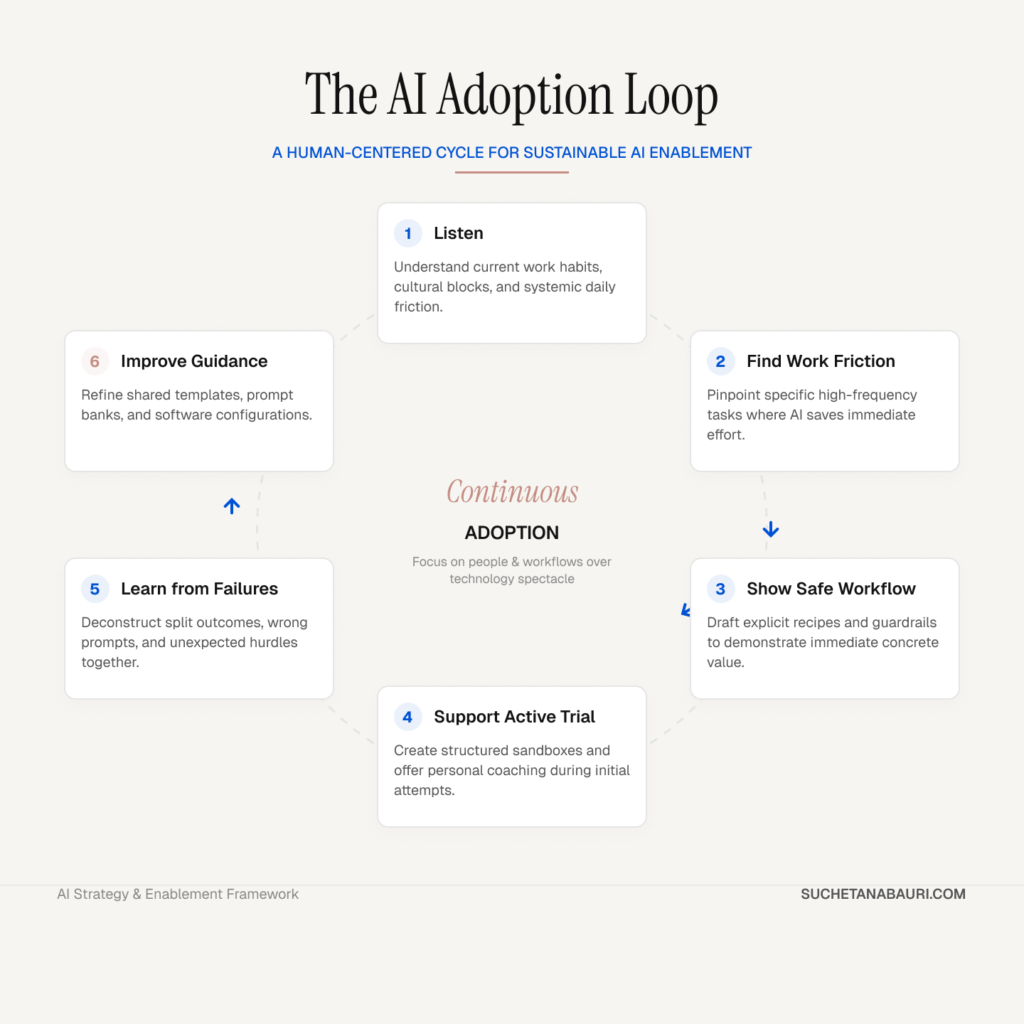
AI does not become transformative because it is switched on. It becomes transformative when people have the context, confidence, time, support and permission to use it with judgement. That is the work.
About Suchetana Bauri
Suchetana is an AI enablement consultant and communications strategist. She helps organisations make AI adoption understandable, practical and human-centred.
- McKinsey & Company, “The State of AI in 2025: Scaling Gen AI Value,” May 2025.
- Gallagher, “AI Adoption in Corporate Communications and Organizational Governance,” July 2025.
- Wharton School of Business, “The Enablement Gap: Why AI Training Programs Fall Short,” September 2025.
- Microsoft WorkLab, “The Real Work of Gen AI: How Employee Agency Drives Actual Utility,” October 2025.
- McKinsey & Company, “The 2025 Annual AI Adoption and Execution Review,” November 2025.
READY TO MAKE AI ADOPTION WORK FOR YOUR EMPLOYEES?
Let’s talk.
I help leadership, communications and learning teams turn AI ambition into practical understanding, useful stories and confident adoption.