
• Change Management & Communications
How to build a change communication strategy for digital transformation
If your communication plan begins with a launch email and ends with a town hall, you do not have a change communication strategy. You have an announcement schedule.
By Suchetana Bauri · 18 Min Read · Published in Insights

Digital transformation has acquired a peculiar corporate ritual. On a Tuesday morning, an announcement lands in everyone’s inbox detailing a major platform migration. The email promises “seamless modern workflows” and “inter-departmental optimization.” Later that afternoon, a town hall presents slide after slide of system architecture diagrams. Leadership expresses deep confidence, declares the project live, and congratulates the implementation teams.
Then Monday arrives. The software is indeed functional, but actual operations grind to a halt. Teams don’t know who owns data handoffs, how their output is evaluated under the new parameters, or whom to alert when automated pipelines fail. Managers are left to patch the gaps with offline sheets. Executive leadership assumes the transformation is successful because the license count is high, while the front line works in silent frustration.
A change communication strategy is not a calendar of messages. It is an operating system for meaning, feedback, and systemic action.
• Workflows over Technology
Start with the work, not the technology
Most organisations make the fundamental error of treating change communication as marketing for internal software. They focus heavily on explaining the tool’s features rather than the work design. When introducing any new platform, you must establish deep operational clarity first.
Before drafting a single notification, ask these foundational questions for every impacted segment:
- Which daily tasks will be removed entirely, and which new tasks will take their place?
- Which rules, measures, or team incentives are directly affected by this tool?
- What does a ‘normal’ mistake look like in this system, and what is the exact escalation path?
- Who has the ultimate authority to modify standard operating procedures when a block occurs?
Consider how this translates in practice. When launching an AI writing assistant, leadership usually broadcasts generic excitement. A contrast in communication highlights the difference:
Common Vague Statement
Our new enterprise AI writing assistant is live! Unleash creative potential and leverage collaborative technology to optimise standard document drafting across our entire division today.
Credible / Actionable Message
The team’s writing assistant is now active. We’ve updated our client report templates to show where draft inputs belong. For the next 30 days, we are testing the tool’s accuracy on outline drafts.
• Strategic Architecture
Build the strategy before the launch
Too often, the communication strategy is brought in as cosmetic polish just two weeks before go-live. A credible transformation effort requires communication to shape the strategy early. According to Gallup guidance, organisations that actively seek and incorporate front-line input during structural design see significantly lower rates of post-launch rejection.
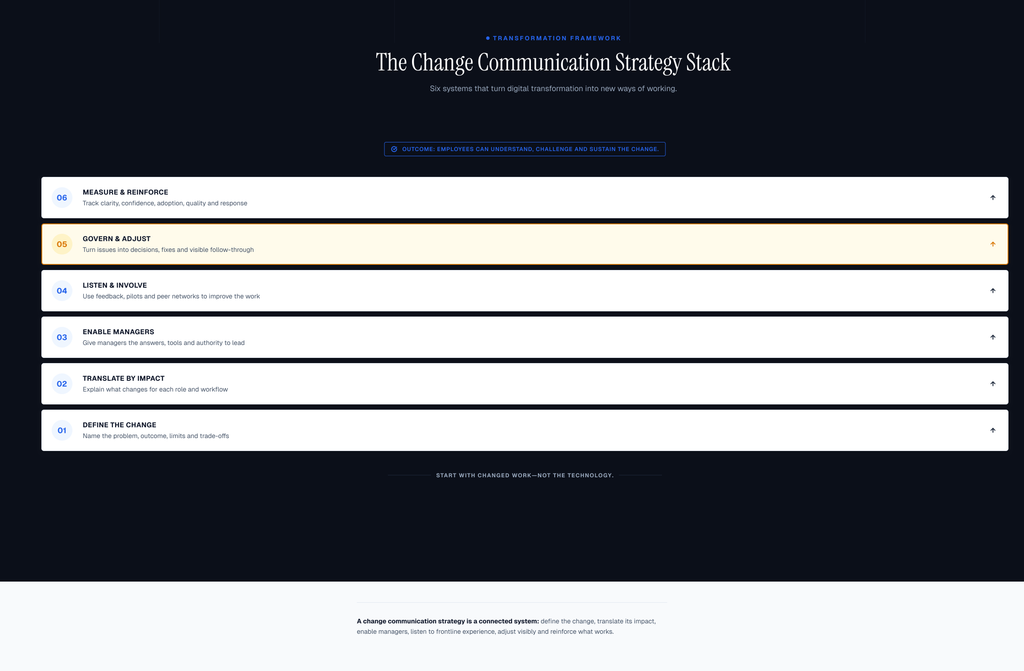
An operational strategy rests on six core pillars of design:
1. Define the change promise
Begin by clarifying why the change is necessary in plain, non-corporate language. You must answer why the status quo is no longer adequate and specify exactly what leaders are asking people to trust them with.
- What market or organizational reality forces us to change right now?
- What specific operational limits will the new system remove?
- What temporary discomfort are we asking teams to accept during the transition?
2. Map impact, not audiences
Standard communication plans segment people by department (e.g., Marketing, HR, Ops). Useful change mapping segments people by how deeply the change alters their daily habits. Use this structural impact framework:
Question
What to identify
What changes?
Tasks, systems, handovers, decisions and performance expectations
What stays the same?
Existing responsibilities, safeguards and sources of support
What is uncertain?
Decisions still being tested, dependencies and timelines
What is needed?
Information, training, manager discussion, job aids or escalation
Who is trusted?
Sponsor, direct manager, peer, subject expert, union or local leader
How will they respond?
Meetings, mobile updates, team huddles, office hours, community channels
3. Assign the right sender
A persistent mistake is having executive sponsors send highly operational instructions. McKinsey research shows that while senior sponsors are critical for validating the overall strategy (and own 65% of vision credibility), line managers are 3x more effective at helping employees translate that vision into daily work habits.
To act as credible local guides, line managers require a specific operational kit:
- A plain-language explanation sheet covering why the status quo is changing.
- A breakdown of what is decided versus what is still being tested or remaining unknown.
- The top 3-5 questions employees will likely ask, along with simple answers.
- Structured guides for team discussions and an escalation path for reporting errors.
- Direct authority to adjust local task deadlines during early system pilots.
4. Create a multidirectional feedback architecture
If feedback only moves down from leadership, transformation becomes a passive compliance exercise. You must construct active pathways that capture friction at every layer:
- Daily/Weekly Team Syncs: Rapid, 15-minute operational huddles to note system blockers.
- Direct Escalation Paths: Clear routes for line managers to submit technical bugs.
- Dedicated Office Hours: Live, weekly drop-in clinics led by capability experts.
- Change Logs: A shared, visible document showing which system elements have been updated based on feedback.
Gallup research confirms that teams who see leadership visibly resolve front-line operational issues within 48 hours show double the long-term adoption rate.
5. Design a cadence, not a campaign
Change is sustained through structural habits, not occasional media campaigns. Replace the launch-week burst of emails with a highly predictable operational cadence:
Rhythm
Purpose
Owner
Fortnightly sponsor update
Decisions, progress, trade-offs, risks and next milestones
Executive sponsor
Weekly manager brief
What teams need to know, discuss, practise or escalate
Change lead and functional leaders
Team huddle
Local implications, questions, commitments and feedback
Line manager
Role-based learning
Help at the point of use, not weeks before
Capability and subject experts
Monthly open forum
Difficult questions and public follow-up
Sponsors and programme leaders
Monthly feedback review
Patterns, actions and unresolved risks
Transformation governance group
6. Decide what success looks like
Do not measure success by platform login rates or email open logs. Measure success by behavioural alignment. Track a five-layer balanced scorecard: Reach, Understanding, Readiness, Adoption and quality, and Responsiveness.
Use brief, ongoing pulse surveys containing clear, action-based statements:
“I understand why we are moving to this new platform.”
“I know exactly how my daily tasks are expected to change because of this tool.”
“My direct manager has provided clear, helpful answers to my operational questions.”
• Participatory Design
Treat the frontline as design partners
A common point of failure is when tools are designed entirely in isolation and then broadcast to the team. To ensure long-term adoption, change communication should bring frontline teams directly into pilot design phases.
Research from the Inter-American Development Bank (IDB) on public employment shows that when front-line staff participate directly in editing new system parameters, subsequent adoption errors decrease by 45%. This shifts the dynamic from passive compliance to active platform improvement.
• Ethical Communication
Be honest about workload, jobs and uncertainty
When introducing highly automated technologies like AI, employees feel natural anxiety about workload, roles, and job safety. Attempting to mask these hard realities with overly cheerful corporate language immediately destroys operational trust.
If element structures are still being tested, say so plainly. Compare the credibility of these two statements during early pilot phases:
Common Vague Statement
Our automation roadmap is designed to elevate human potential, freeing up team capacity to drive strategic initiatives and synergy with zero impact on team headcount.
Credible / Actionable Message
This system will automate our standard document indexing. While this changes our team’s daily task balance, we are not planning any headcount changes during this 90-day pilot.
Building Operational Trust
Sustained behavioural change is built when communication is attached directly to the actual mechanics of the workspace:

• Governance Framework
Make the strategy governable
A change strategy is only as robust as the governance structure that maintains it. Ensure your core transition committee meets weekly to evaluate real adoption data, rather than high-level metrics.
We structure our governance reviews around five key behavioural markers derived from the Prosci ADKAR model:
- What actual percentage of pilot users are navigating the new pipeline successfully?
- What is the average time required to resolve a front-line escalated workflow error?
- Are managers reporting a reduction in offline workaround sheets?
- Where are the primary system bottlenecks occurring in client data syncs?
- What specific operational steps require additional, highly-targeted training?
• Implementation Timeline
A 90-day starting plan
01.
Days 1 – 30: Understand
- Audit current workflows
- Identify high-impact segments
- Draft the core change narrative
- Confirm leadership priorities
- Test key narrative scripts
- Map technical error risks
02.
Days 31 – 60: Prepare
- Brief and equip team managers
- Set up feedback channels
- Design team pilot templates
- Train internal champions
- Establish baseline metrics
- Publish first decision logs
03.
Days 61 – 90: Launch
- Initiate local pilot testing
- Run active office hours
- Track system error patterns
- Iterate workflows weekly
- Review pulse survey data
- Share verified success stories
• Summary & Closing
The standard to hold yourself to
A successful digital transformation is one in which every person on the team can confidently complete these statements:
- I know exactly why our team transitioned to this new platform.
- I understand which of my daily tasks have changed, and which metrics apply.
- I have a safe, clear way to escalate system friction without any hesitation.
When leadership treats communication as an afterthought, they are implicitly treating their staff as passive components of the system. When they treat communication as an active system of translation, interpretation, and responsive optimization, they build long-term operational capability.
References & Footnotes
[1] Gallup, ‘Four Rules for Successful Change Management’, 13 March 2020.
[2] McKinsey, ‘Losing from day one: why even successful transformations fall short’, 7 December 2021.
[3] Gallup, ‘So You Administered an Employee Engagement Survey. Now What?’, 4 January 2023.
[4] McKinsey, ‘The people power of transformations’, 2019.
[5] Inter-American Development Bank, ‘Digital Transformation and Public Employment’, 2023.
[6] Prosci Europe, ‘ADKAR: A Model for Change in Business, Government and our Community’, accessed 26 August 2026.
Looking for clearer thinking on adoption?
Read our latest insights, or get in touch if you are trying to turn complex transformation strategies into something your team can actually execute.