11,000 messages and an incomplete picture: what Microsoft and Nvidia reveal about crisis communication
Two very different crises show why organisations need more than a statement. They need a way to share what is known, listen to those affected and explain how decisions are made.
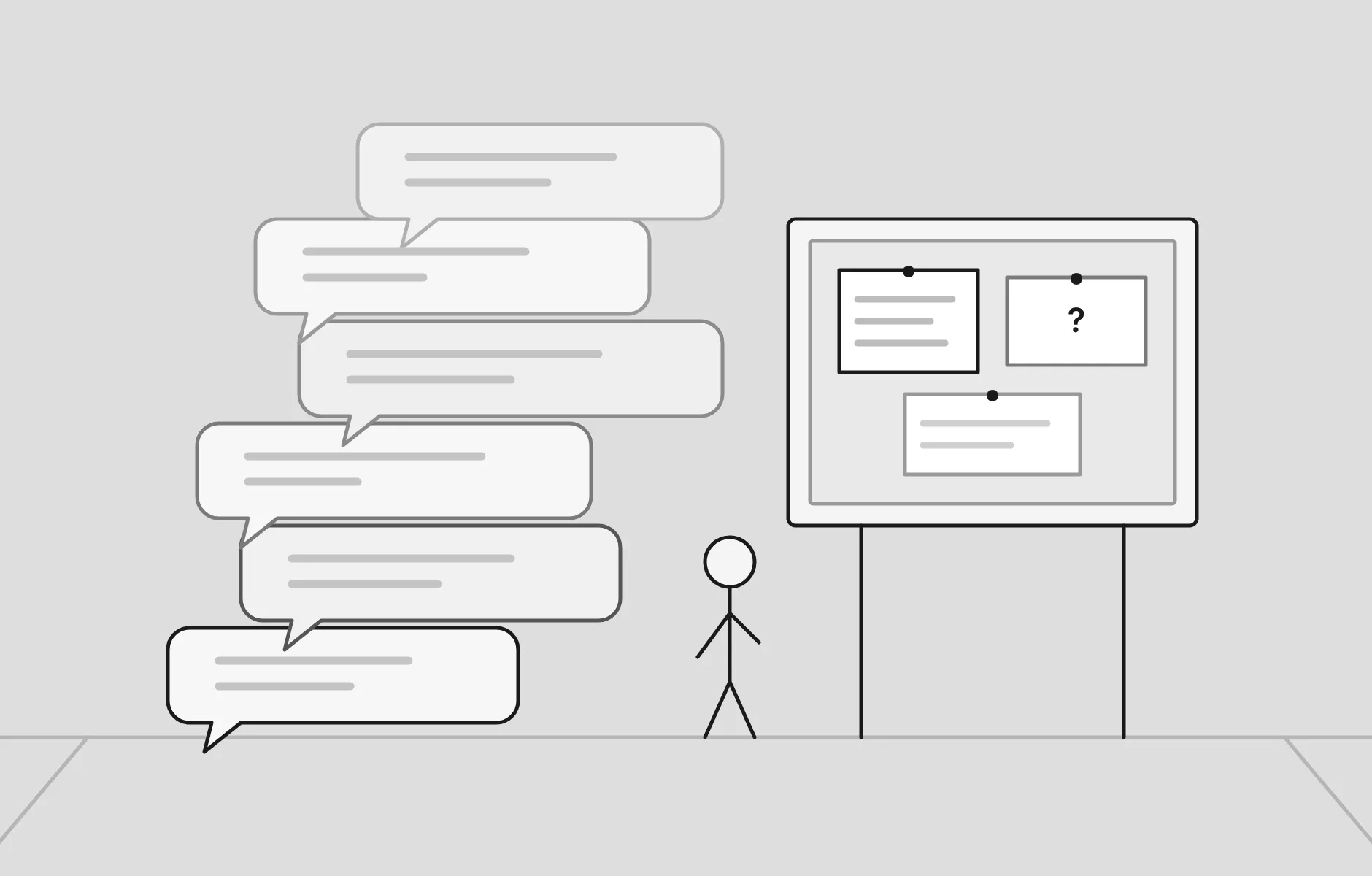
Eleven thousand messages is a great many sentences. Stacked up, they would furnish a small library, and nobody wandering the shelves would conclude that the authors had failed to express themselves.
Yet that is roughly what happened during Microsoft’s November outage. According to a memo reviewed by Reuters, responders exchanged more than 11,000 messages across 11 Teams chats and still struggled to maintain a cohesive picture of their hypotheses and decisions, because the diagnostic data lived in fragmented internal tracking systems (Reuters).1 The memo’s author, a Microsoft vice-president, described engineers working through a ‘fog of war’.
It is a handsome phrase. Clausewitz would nod, and so would anyone who has ever had to tell a board why the email is down. But notice what the metaphor does. Fog is weather, and weather happens to you; nobody is asked to account for it. Microsoft’s own explanation, meanwhile, points to an undetected defect introduced back in July, which is less like fog than like a clause in a contract that everyone signed and nobody read.
Jorge Luis Borges imagined a library containing every possible book, whose inhabitants spend their lives searching for the catalogue. The 11 chats had the books. What the responders lacked was the catalogue, and a catalogue, it turns out, is a communication tool. I came to something like this conclusion in The most-clicked button in your company, where seven agents on one task looked like a committee with a whisk. It seems that humans, given enough chat windows, can form one too.
Around the same time, Nvidia was in a different sort of trouble. Its chief executive, Jensen Huang, resigned and was reinstated 11 days later, while an independent investigation stayed open throughout (Reuters). At Microsoft the puzzle was how to restore a service. At Nvidia it was how a board explains a decision that its own staff, customers and investors are still trying to read.
The two incidents are unrelated. Together they ask something that sits underneath all crisis communication and is more unsettling than it first looks. When an organisation does not yet understand what is happening to it, what exactly is it communicating?
A noticeboard in the same storm
Microsoft was not silent, and it is worth saying so before anyone gets too pleased with themselves. The incident began at 16.20 UTC on 12 November. The company’s own report says an alert triggered a post to its service health dashboard immediately, and that the first customer notification followed about 20 minutes after broad impact began. It commits to improving detection and automated notification by the end of the year (Microsoft post-incident report).2 By the early hours of 13 November the company was saying there was no indication of malicious activity, and its final status called the incident ‘a technical issue not related to cyber or AI / agents’ (IncidentHub).3
That last phrase is a small masterpiece of defensive classification. It tells you what the outage was not, in the two categories the public was most inclined to fear. It is reassuring, and it is also a sentence about the audience’s imagination more than about the outage.
The harder question is whether anyone could find what was said. Several administrators wrote on Microsoft’s own support forum that they could not load the admin centre or the public status page. A later update pointed them to a separate status site for that very case (Microsoft Q&A). These are a handful of comments, not a measured finding, and I would not build a case on them. They do suggest an old problem in new clothes: a noticeboard is only useful if the corridor leading to it stays open. It is territory I have covered in The interface owes you an explanation, with the awkward difference that here the interface was supposed to explain the outage and was itself caught up in it.
There is a second reason to be wary of the status page. A status page is a dashboard, and dashboards have a talent for being green at the wrong moment. As I argued in The AI adoption dashboard is green. Is the work any better?, the work has not necessarily disappeared; it may have changed desks. A customer who is reading ‘investigating’ while their trading desk waits for a mailbox is sitting at one of those desks.
The stakes were not small, even if the product was email. Reuters reported that the outage reached governments from Australia and Japan to the United States, delayed trading firms and disrupted airline communications (Reuters). Email is the least glamorous infrastructure we have and, like grammar, it is noticed mainly when it stops.
Inside the building, Microsoft declared a ‘Code Red’, set a target of worldwide resolution within an hour in future incidents, and plans to use AI agents to help engineers read system-health data faster (Reuters). Ars Technica observed, with some restraint, that the company has not said how it will avoid another 11-chat sprawl (Ars Technica). The proposed cure for too much talk is, in part, a new participant who never tires of reading it.
I am not against the reader. But an agent that summarises diagnostics inherits the old problem: somebody must decide what counts as the picture, and somebody must notice when the summary is wrong. In Human in the loop is not an approval policy I wrote that an approval button records a decision without promising that anyone understood it. A crisis summary has the same weakness. It records a view of events without promising the view is complete.
The verb that did the heavy lifting
Nvidia’s story rewards a closer reading of its verbs.
On 8 November the board announced an independent investigation, said it had no reason to believe national security or company secrets had been compromised, and said it had confidence in Huang (Nvidia). On 12 November his resignation was announced. The interim chief executive, Colette Kress, wrote to staff promptly and told them there would be a meeting on 18 November. Several PR consultants told Fortune that this was a long time to wait. One of them put the grievance exactly: ‘“Coming days” to me does not mean six days away’ (Fortune).
Phrases such as ‘the coming days’ are elastic by design. Their purpose is to promise attention without promising a date, and employees, who are expert readers of such phrases, tend to hear the date anyway. What they are measuring is the interval, and I have a name for the cost of intervals. In The coordination tax the argument was that most of an organisation’s delay sits between the steps, not inside them. The same holds for organisational feeling. Most of the anxiety lives in the gap between a message and the meeting that is supposed to explain it.
In fairness, an all-hands the morning after an earnings release is standard practice at Nvidia, so the date was not invented for the crisis. The meeting did take place. According to CNBC, it lasted about an hour, was held in person and streamed, and executives answered questions staff had submitted in advance. The same reporting describes a divided workforce, with a petition for Huang’s return that had gathered nearly 200,000 signatures, about 10,000 of them, by one count, from people who said they were current or former employees (CNBC, CNBC).4 Nvidia has roughly 42,000 employees, and the signers’ claims are unverified. Even so, consider what it is like to work somewhere and discover that a large and unknown fraction of your colleagues are signing things about the identity of the company while you sit at your desk.
This is where I think the usual advice on timing falls short. In Before the next AI announcement, answer the question I argued that communication can clarify a decision but cannot make one. Some employees need better information. Others are simply waiting for a decision that hasn’t been taken. A town hall is generous to the first group and almost useless to the second, and the awkward part is that from the stage the two groups look identical.
The day before that meeting, the board chair, Harvey Jones, said on the earnings call: ‘The Nvidia board unanimously accepted his resignation and does not intend to reinstate Jensen as CEO’ (quoted by CNBC).
Mark the verb. ‘Does not intend’ is a statement about the speaker’s state of mind and not about the world. It is the most modest form of a flat refusal, and it has a short shelf life, because intentions are cheap to revise. CNBC reported that an employee said some executives had asked why such a definite statement was made while the investigation was still playing out. Six days after Jones spoke, the board voted unanimously to reinstate Huang, saying it was satisfied with his candour and ability to lead, and that input from senior US government figures had left it confident that he posed no national security risk. The investigation, it said, would continue to its conclusion (Nvidia).
Read that release the way you would read a poem you suspected of hiding something. ‘Input’ is a word borrowed from machines. ‘Senior levels’ is the language of altitude. ‘Satisfied with respect to candour’ arrives while the inquiry into what Huang had told the company remained open, which prompted Nada Kakabadse of Henley Business School to call it a strange phrase. New York City’s comptroller, Mark Levine, said the board had made ‘a total 180 without any explanation’ (Reuters via Euronext).5
Here a little care is owed. An open investigation is not evidence of wrongdoing. The board’s decision has defenders as well as critics, and the reasons for it are contested. Reuters reported that it came under pressure from Donald Trump, who said his intervention was important, while noting that it was unclear exactly what had been communicated to the board (Reuters). Huang told staff at his own all-hands that this was untrue, according to a person familiar with the meeting (Reuters). Neither account has been settled in public, and a writer should resist settling it for them.
What can be said is narrower and, I think, more interesting. A categorical sentence was spoken before the facts had finished arriving. It then had to be walked back, at a company whose employees were trying to decide what sort of place they worked for. And the board’s justification, however sincere, leaned in part on input from outside the room, whose exact content Reuters said was unclear. I have written elsewhere about the way important decisions become ownerless, and about committees as places where accountability goes to disappear. A reversal explained by ‘input’ is at least a reminder of how easily that happens.
What the studies can and cannot say
Four recent papers offer ways of thinking about this. None examined Microsoft or Nvidia, so they are lenses, and lenses distort in useful ways.
The first concerns silence. In a US sample of 127 managers and 93 non-managers, most managers said they stayed silent to keep the workplace stable, while most non-managers took the same silence to mean that leaders were avoiding responsibility or protecting themselves (Moon and Bodie).6 Silence, in other words, is a text with two readers who disagree about the author’s intentions, and the more anxious reader tends to win. The study cannot tell us what Nvidia staff thought during their six days of waiting.
The second concerns visibility. Survey data from 609 US employees, collected during the pandemic, associated higher perceived visibility of organisational information with lower uncertainty and greater job satisfaction (Bighash and Farzinpour).7 It measures perception and shows association, not cause. Applying it to Microsoft’s scattered diagnostics is my inference and not the authors’ finding, but it is an inference with a good deal of company. Information that exists is not information that can be seen.
The third is the most mischievous. Interviews with 18 employees led Sanna Ala-Kortesmaa to describe ‘unlistening’: a pattern in which an organisation performs attentiveness through rituals and procedures while the concerns it collects go without a meaningful response (Ala-Kortesmaa).8 It is a small qualitative study and says nothing about either company. What it does is give crisis planners an awkward question to put to their own Q&A forms. Who is responsible for answering what comes in?
The fourth is a review of 36 studies, which found that listening, openness and follow-through support employee voice. Most of the evidence rests on self-reported, one-off surveys, so it supports a principle without proving a mechanism (Sacavém and colleagues).9 Its recommendation is to acknowledge input and close the loop, which is advice that sounds modest until you try to follow it on a Thursday afternoon in the middle of a crisis.
Four questions for the first hour
What follows is a proposal informed by the research and these cases. It has not been tested on either incident, and it is offered the way one offers a hypothesis, with the door left open.
What do we know? A dated account of what is confirmed, what is not, who owns the update and when people will hear more. The test of a sentence in a crisis is whether it could survive being wrong. ‘Does not intend’ did not, and a dated account might have.
Where can people find it? Somewhere reachable by employees, customers and partners, with an alternative for the day the first place fails. A noticeboard is not a plan until someone has asked what happens if the corridor is shut.
Can people respond? There needs to be a way to ask or object, and a named person responsible for answering. Questions submitted in advance are a start. They are also exactly the format a ritual of listening would favour, which is why the next question matters.
How will we know what changed? Decisions, corrective actions and the way of judging whether they worked, explained in terms that someone outside the room could follow. Microsoft has attached dates to its commitments, and they will be checked by the same customers who sat through the outage. Nvidia’s board has promised that its investigation will conclude, and Huang has agreed to answer questions from three House committees and to appear before the Senate Banking Committee, which had asked for a public hearing on 3 December (Reuters). Whether the reversal gets a fuller explanation than ‘input’ remains to be seen.
None of this is possible without someone who has the authority to say it, and that is a governance question before it is a writing one. Elsewhere I have made the case that an incident needs named decision-makers and a rehearsed response. The same applies to the words. The person who may say ‘we do not yet know’ should be identified before the day on which saying so is hardest.
The unsettling part
Here is the thought I keep returning to. A statement has two audiences, and only one of them is outside the building.
The outside audience reads it for facts. The inside audience, which includes the people who wrote it, reads it for permission to feel that something has been done. A message sent is a box ticked, and a box ticked produces a small, warm feeling of competence. That may be why organisations in trouble produce so much of it. Eleven thousand messages is also a way of not yet admitting that nobody has the whole picture.
This is not cynicism, and it is not especially corporate. It is human. Tolstoy made a version of the point in War and Peace, where commanders issue orders and messengers arrive with news the battle has already left behind. Much of what we call communication in a crisis is a way for frightened people to feel less alone with a problem.
But the people on the receiving end are not trying to feel less alone with it. They are trying to find out whether they can still trust the place that employs them, or supplies their email, or holds a stake in what they do for a living. They want to know what is known, where to look, whom to ask and what changed. Those are the questions that turn a stream of messages into something one can stand on.
There is one more uncomfortable consequence. If a message can console its sender without informing its audience, then volume tells us nothing about quality. The right unit of measurement is not how much was said, but what the listener could do afterwards that they could not do before. A company can send 11,000 messages and leave itself no further forward, and a board can issue one carefully worded release and leave its employees uncertain which version of the company they belong to.
For internal communicators there is a modest way to check. After an incident, ask a sample of affected people whether they could reach an update, understood what they needed to do and knew where to take a question. Those answers will not prove the business value of a response. They will show whether the arrangements work when the primary channel is under strain, and when everyone in the room is, understandably, doing their best to look as though they know.
Notes and sources
- Reuters, ‘Microsoft declares code red after historic outage, internal memos show’, 24 November 2026. The 11,000 messages, 11 Teams chats, ‘fog of war’ and Code Red details come from memos reviewed by Reuters; Microsoft’s spokesperson said its work does not end when service is restored. Read the report. Ars Technica’s follow-up is here.
- Microsoft 365 post-incident report (EX1550543/MO1550821), dated 20 November 2026, as hosted by Next.ink. It sets the incident start at 16.20 UTC on 12 November, the first customer notification at about 20 minutes after broad impact, and the ‘improve detection and automated notification’ action for the fourth quarter of 2026. It does not give a total number of affected customers. Read the report.
- IncidentHub’s timeline of Microsoft’s public status-page updates is a third-party record and secondary to Microsoft’s own report. It records the first public status-page update at 18.10 UTC on 12 November and the ‘not related to cyber or AI / agents’ wording at 17.57 UTC on 13 November. Read the timeline. The administrator comments are on Microsoft Q&A and are anecdotal.
- CNBC, ‘Nvidia interim CEO Kress tells employees “let’s move forward” at first all-hands meeting since Jensen Huang exit’, 18 November 2026 (article), and CNBC, ‘Nvidia’s Kress faces a divided workforce as some employees push for Huang’s return’ (article). Accounts of employee sentiment rely on anonymous attendees and differ; the petition’s employee signers are unverified. Chair Harvey Jones’s remarks on the 17 November earnings call are also reported by Reuters.
- Reuters, ‘Nvidia board’s Huang reversal raises doubts about independence, critics say’, 24 November 2026, via Euronext. Nvidia’s reinstatement announcement, 23 November 2026, is here. The Harvard Business Review analysis of whether Huang can rebuild trust, published on 10 November before the resignation, is here.
- Bitt Moon and Graham D. Bodie, ‘Exploring Leadership Silence in a Sample of Managers and Non-managers Within US-Based Organizations’, Management Communication Quarterly, 2026. Abstract. US sample of 127 managers and 93 non-managers.
- Leila Bighash and Michael Farzinpour, ‘Information Visibility as a Stabilizing Organizational Communication Practice: Uncertainty and Job Satisfaction During Long-Term Disruptive Events’, Management Communication Quarterly, 2026. Abstract. Nationally representative US sample (N = 609) collected during the Covid-19 pandemic; an association, not a causal finding.
- Sanna Ala-Kortesmaa, ‘Communication Structures That Hold Us Hostage: Conceptualizing Unlistening as an Organizational Practice’, International Journal of Business Communication, published online 7 March 2026 (open access). Article. Thematic analysis of 18 semi-structured interviews.
- António Sacavém, Andreia de Bem Machado, João Rodrigues dos Santos and Ana Casinhas Sacavém, ‘When leaders listen, employees speak up: a systematic review of communicative leadership, voice and technology in hybrid internal communication’, Corporate Communications: An International Journal, 2026. Abstract. A PRISMA-reported review of 36 studies, most of them cross-sectional self-report designs.