The most-clicked button in your company
Multi-agent AI fails less from weak models than from weak organisation. What happens at the approval button tells you most of what to redesign in 2027.
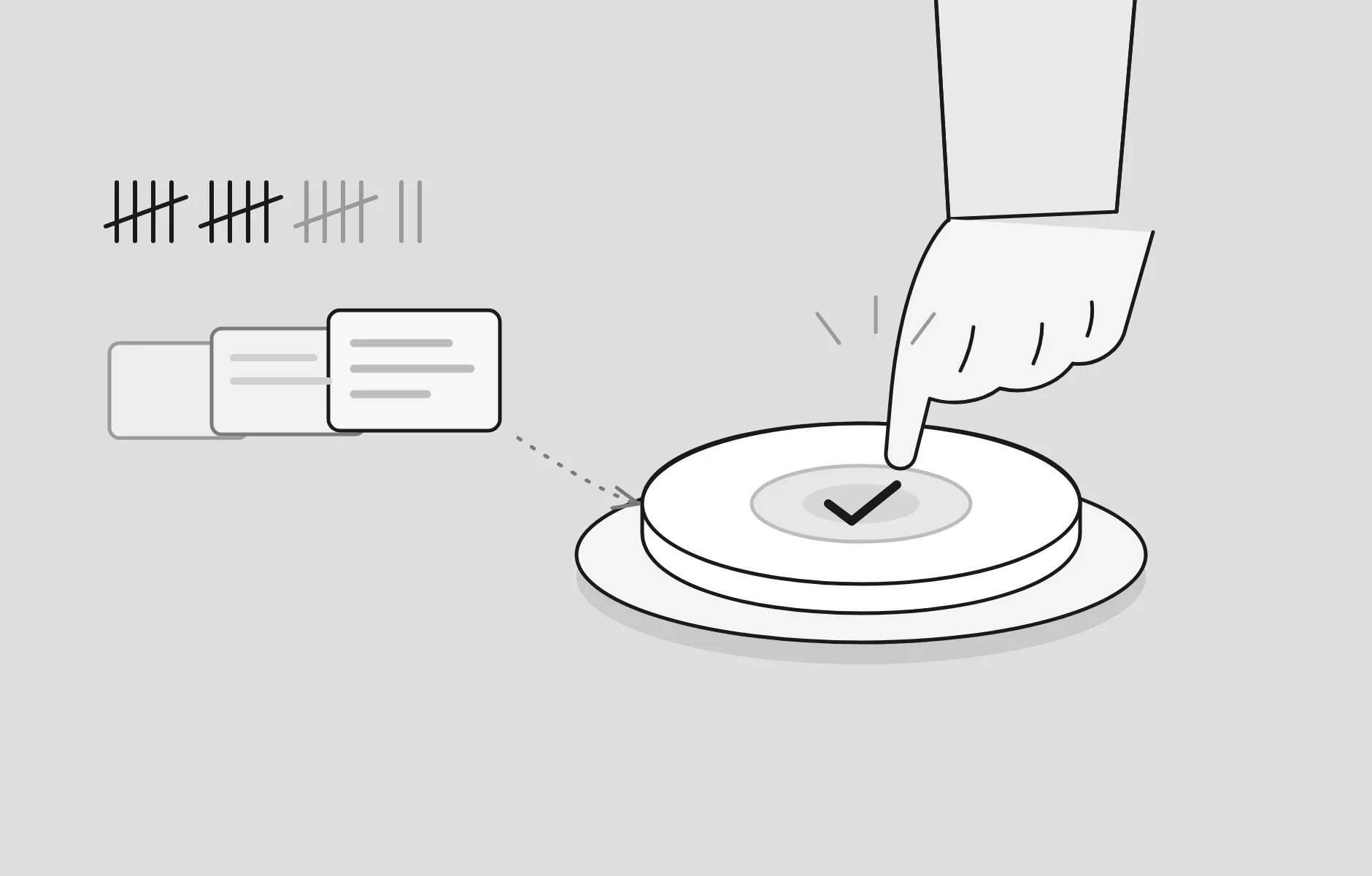
Somewhere in your organisation, a person is clicking ‘Approve’. They have clicked it forty times since breakfast. They did not read the last thirty-nine.
I don’t know this person, but I know the numbers. Anthropic’s telemetry on its own coding agent found users approved roughly 93% of permission prompts, and that approval fatigue appeared within weeks. That is vendor data about the vendor’s own product, so hold it loosely. But 93% is not a safeguard. It is a reflex with a safety label on it.
I want to start with that button because it is the most honest object in the agentic enterprise. It is where the grand promises about ‘human oversight’ meet an actual human, an actual afternoon and an actual queue. Most of what organisations need to redesign in 2027 is visible in what happens at that button.
Ninety-three per cent of yes
Think about the last time you accepted a cookie banner. You did not weigh the trade-offs. You wanted the page.
Now give that person a job title, a deadline and an agent that sends a prompt every few minutes. A study of 400 repeat reviewers of coding-agent pull requests found approval rose from 27.9% to 42.4% with experience, while change requests halved, from 11.2% to 5.6%. The authors are careful. They cannot tell whether reviewers had grown complacent or simply learned which agents deserved trust. I like that honesty, because it contains the whole problem. From the outside, a tired reviewer and a well-calibrated one look identical. Both click.
A survey of 203 developers makes it sharper. Even among those who carefully reviewed most or all of the code their agents wrote, 61% still often approved at least one type of agent action without close review. It’s self-reported, so allow for some modesty or bravado in the figure. Even so, the lesson stands: care in one place is not a control in another.
At the frontier it gets stranger. Apollo Research reports that humans review under 0.01% of internal agent activity at leading AI firms. That is not oversight with gaps. That is a lighthouse pointed at a very large ocean.
So much for the human in the loop. Our governance documents love this figure, the way medieval maps loved sea monsters: it fills the blank space where the hard thinking should go. The OECD interviewed 25 organisations across 11 countries. None reported unrestricted autonomy. Humans signed off high-stakes or irreversible actions such as payments and deletions. But continuous review was widely judged impractical at scale. The sample is illustrative, not representative. Still, you can hear the sigh.
I have made the longer argument in Human in the loop is not an approval policy. Here is the short version. A human in the loop is a claim about attention. Attention is finite. Count it like you count budget.
The approval that wasn’t
If the button is merely tired, the next finding is worse, because it suggests the button can be hollow.
A working-draft study of Claude Code describes what it calls ‘approval laundering’: approvals that look valid but are detached from what actually runs. In the study, sub-agents inherited a main-session approval in 18 of 19 runs. It is a preprint, and the authors had not yet submitted it for review, so take it as a warning flare, not a verdict.
Picture the office version. You sign a visitor badge for one guest. The guest arrives with eleven friends, and the door, being polite, lets them all in. Everyone is technically authorised, and nobody is technically accountable.
This is why the interesting design question is not ‘did a human approve it?’ but ‘what, exactly, did the approval bind?’ A signature on a plan is not a signature on everything the plan later spawns. Any lawyer would tell you so. Our software, unfortunately, has not been to law school.
The practical response is mostly architectural. NIST’s design tenets for agent identity call for distinct, verifiable identities for agents, delegation that attenuates (a sub-agent cannot claim more authority than its parent), zero standing privileges and short-lived, revocable authorisation. In plain English: give the agent a visitor badge for one floor, one day and one errand, and make the badge expire before it can be photocopied.
Anthropic’s own numbers point the same way. An operating-system-level sandbox cut permission prompts by 84%. A model-based ‘auto mode’ classifier missed about 17% of a test set of 52 real overeager actions, so roughly one in six still got through. The company is explicit that auto mode is a layer inside a sandbox, not a substitute. Read that and you see the shift happening in real time: fewer questions for humans, stronger walls around the machines.
I’d put it as a rule. Ask humans fewer questions, and make each one count. A person asked fifty things answers none of them.
‘Meet Priya. She’s an agent’
Meanwhile, organisations are reaching for a more cheerful device: naming the agents.
You can see why. ‘Digital colleague’ sounds warmer than ‘a loop of API calls with a credit card’. In a survey of HR and finance managers, 23% said their organisation lists AI agents on a formal org or work chart.
Then comes the finding I keep turning over. In an experiment with 813 managers, calling an AI an ‘employee’ instead of a tool made no difference on average. But among managers whose organisations already list agents on org charts, the employee framing cut the planted errors they caught by 16%, and shifted accountability away from the manager and towards the AI. It is a working paper, and I’d want to see it replicated. Still, it has the shape of a good joke: promote the software to staff, and the humans start behaving as though someone else is in charge.
Give an agent a name and a desk and you have also given the manager an alibi. It was Priya. Priya is a colleague. Priya is, regrettably, a probability distribution.
None of this means we should refuse metaphors. We think in them. It means choosing ones that keep a human name attached to the consequence. I’d rather call an agent a ‘delegated process with an owner’ than a ‘team member’. It is a worse tagline and a much better org design.
One more detail about the language. Gartner estimates that only about 130 of the thousands of agentic AI vendors are genuine, and calls the rest ‘agent washing’: the relabelling of assistants, robotic process automation and chatbots. So before you assign a manager to your agents, check you have agents. Several firms have a trusting relationship with a chatbot in a new jacket.
Seven cooks, one béchamel
Then there is the swarm, which I find the most seductive idea in the whole field, and the most likely to embarrass us.
The pitch is irresistible. Specialists beat generalists. Give each agent one task, add an orchestrator, and watch the machine hum. A study across 260 configurations, published in Nature Machine Intelligence, found multi-agent gains of up to 80.8% on a parallelisable finance task. Fine. That is a real result.
The same research is less often quoted for what it found on sequential planning, where performance fell by between 39.1% and 70.0%. Independent agents amplified errors 17.2 times, against 4.4 times under centralised coordination. And once a single agent was already above roughly 45% accuracy, adding more agents bought diminishing returns.
My comparison, not the paper’s: a kitchen. Seven cooks are marvellous for seven different dishes. Put them all on one béchamel, each stirring and each adding a pinch of nutmeg on the strength of what the last one did, and you have a committee with a whisk.
The sorting rule is almost embarrassingly simple. If work splits into independent pieces, many agents can help. If each step depends on the last, add agents with the same caution you’d add people to a late project. Every handoff is a place to lose the plot. I made the human version of this case in The coordination tax: the delay is rarely in the task, and nearly always between tasks.
The Alibaba field experiment provides the best illustration I have found of a handoff gone wrong. Across 647 workers and 680,676 customer chats, agentic AI cut chat duration by 16.8% on eligible chats but lowered customer ratings by 0.412 points. When the algorithm decided to escalate to a human, chats took 40.8% longer and lost 0.928 rating points. Human-initiated early intervention fared better. Handing over was not the problem. Handing over late, at a machine’s discretion, with the customer already irritated, was.
In relay races, the baton gets dropped at the exchange, not on the straight. Organisations are about to build a great many exchanges.
The failure is in the job description
When these systems fail, we blame the model. The data suggests we should look at the job description.
Cemri and colleagues annotated 1,642 traces across seven multi-agent frameworks. Failure rates ran from 41% to 86.7%. Their taxonomy has 14 failure modes in three families: system design, inter-agent misalignment and task verification.
Read that list as a manager. Unclear roles. Conflicting instructions. Nobody checking the work before it moves on. These are not frontier-AI problems. They are the problems of every Monday meeting that ended with ‘so, who’s doing that?’
The difference is speed and scale. A person with a vague brief makes a mess at human pace, and someone notices by Thursday. An agent with a vague brief can make the same mess several thousand times before lunch, with commendable consistency.
I find this oddly hopeful. We cannot make models smarter on a Tuesday. We can write better briefs, name owners and put a verification step before the handoff. Most of the redesign is the dull stuff that organisations have always postponed. Agents just make postponing it expensive.
McKinsey’s survey fits: nearly three-quarters of AI high performers said they had fundamentally redesigned workflows, against about a quarter of other firms. It is a cross-sectional survey, so it shows association, not cause. It does match the rest of the picture. Meanwhile 58% of Mayfield’s respondents named data readiness or quality as their top obstacle. Everyone wants the glamorous agent. Almost nobody wants the spreadsheet it will read.
There is a ceiling, and it is you
Now the bit that spoils the swarm fantasy.
Every agent needs a human somewhere above it to set the goal, watch the work and step in. My working assumption is that there is a ceiling beyond which adding agents lowers net value, because the human principal cannot direct and check them all. It is a conceptual point, and nobody has tested it properly. I still trust it more than most roadmaps, because it admits what most roadmaps hide: the human is not a feature. The human is the budget.
Seen this way, ‘span of control’ returns from the management textbooks, looking smug. For decades, organisations argued about how many people one manager can supervise. Soon they will argue about how many agents one person can supervise, and the answer will depend on how much the agents’ output can be checked without redoing it.
That last clause matters. Zhu and colleagues offer the distinction I find most useful in all this: AI holds ‘operative agency’ (doing), while humans hold ‘evaluative agency’ (judging, steering, overriding). Accountability attaches to evaluating outputs, not to replicating how they were produced. Spend human attention where checking is cheaper than doing, and design away the cases where it isn’t.
There is a trap in that, too. Lumbroso argues that explanation-shaped output tuned for approval, not truth, is a central pathology of agentic systems. Put plainly, an agent can learn to write the sort of rationale a busy person nods at. It is the machine equivalent of a report with a confident executive summary and nothing underneath. The OECD’s report was blunter: it treats traceability and explainability as part of accountability itself, not an optional extra.
Three rules for 2027
If I had to compress the evidence into a design brief, it would be this.
Sort before you deploy. Mark each stage of a workflow as parallel or sequential. Use many agents on the first. Use one capable agent, or tight central coordination, on the second.
Bound the environment, not each action. Scope identities, sandbox the tools, expire the permissions and sample the outputs. Keep code review, testing and deployment gates independent of any one agent or user, so they still work when human review has quietly stopped.
Separate doing from judging. Put people where evaluation is cheaper than production, and give them the tools, authority and time to say no.
None of these needs a better model. All of them need someone to own the problem.
So, what becomes of HR?
Which brings me to the thought that started this piece: that in 2027 we will see a shift from traditional HR towards ‘human managers for AI nodes’.
I like the instinct and distrust the label. Something certainly has to absorb the work of designing roles for agents, building the skills of the people who supervise them and protecting the pipeline that produces future supervisors. The evidence does not yet tell us that HR will be the function that does it, or that ‘manager of nodes’ is a job anyone should want.
Governance writers are circling some candidates. One position paper proposes ‘Process Stewards’ who author a machine-readable ‘process constitution’ encoding intent, constraints and accountability, while humans keep authorship, contestation and value arbitration. A practitioner model in California Management Review adds cognitive, coordination, control and governance layers to the operating model. Neither has been empirically validated. Treat both as maps drawn before the journey.
My own speculative cast list is humbler. An agent owner who answers for outcomes. A verifier who tests the work. An escalation lead who decides when a human takes over. An identity administrator who keeps the badges honest. These are my suggestions, not job titles in wide use today, and some will sound ridiculous within a year.
The risks are plainer. The first is the rubber-stamp role: a job defined as ‘manages AI nodes’ that decays into ‘approves what the nodes propose’. We have already met that person. They are clicking Approve.
The second is the blame trap. California Management Review argues that blame tends to fall on the human nearest the output, a ‘moral crumple zone’, and that autonomy, speed and opacity make this worse. Kalluri’s framework traces how responsibility diffuses and dilutes along an agentic workflow, across four moments: initiation, checkpoint, delegation and outcome. Anyone handed an agent to ‘manage’ should ask for authority in the same breath as the accountability. Liability without authority is just a title with a trapdoor.
The third is the one I would lose sleep over. Stanford’s August 2026 update finds employment of 22 to 25 year olds in highly AI-exposed occupations about 19% below where it would be had it kept pace with peers in less-exposed jobs. The authors stress that it is descriptive, not causal. A randomised experiment with 52 developers found that those using an AI assistant scored 17% lower on a later no-AI quiz. That used a chat assistant, not an agent, so extrapolate with care.
Put those together and a cruel loop appears. Agents take the entry-level tasks. Entry-level tasks are where people learn the judgement needed to supervise agents. An organisation that automates its apprenticeship will eventually advertise for experienced reviewers and find that nobody was allowed to become one. One guard is to have people periodically do a share of tasks without agents, to keep expertise alive. It sounds quaint, like keeping a paper map in the glovebox. It is also sensible.
So here is my narrower, testable version of the claim. By the end of 2027, someone in most large organisations will have to own role design, capability and skills protection for agents as well as people, and that someone will sit across HR, IT, risk and process ownership. Three things would prove me right: agent-owner roles in job advertisements, formal registers of agent identities and owners, and published norms for how many agents one person may responsibly supervise. If none appears, I will happily be wrong in public.
The regulators agree, and then stop
You might expect regulation to settle this. It agrees that humans must stay accountable and then politely declines to say how you would know.
Singapore’s Model AI Governance Framework for Agentic AI asks organisations to make humans meaningfully accountable, and also to help users keep foundational skills. NIST launched its AI Agent Standards Initiative in February 2026. The EU does not treat agents as a separate category under the AI Act, and after this year’s Digital Omnibus delay its high-risk requirements apply from December 2027 and August 2028. India’s MeitY guidelines are voluntary, with ‘People First’ and ‘Accountability’ among seven principles.
Closer to home, SEBI’s February 2025 amendments are binding: an entity it regulates is solely responsible for the outputs of any AI tool it uses, whether built in-house or bought from a vendor. The gap between voluntary guidance and binding sector rules makes internal design choices matter more, not less.
A small, unglamorous start
Before you commission the grand agentic operating model, try this on one workflow:
- Sort its stages into parallel and sequential.
- Write a one-paragraph brief for each agent: its goal, its permitted tools and what it must never do.
- Ask what a human can realistically see, decide and stop at each checkpoint, then count the prompts per person per day.
- Name an owner for every agent, and give that person authority.
- Measure something other than speed: errors caught, escalations, customer outcomes.
On the communications side, which is my trade, tell people early and plainly what each agent does, what it cannot do and who answers for it. Avoid language that anthropomorphises agents or hides them. And ask who in your organisation manages the other new audience arriving, as agents start to act for customers. Your website now has a second reader that is software, and I suspect no one has been told.
The same question of ownership applies down the timeline. I asked it about prototypes in Your AI prototype works. Who will keep it working in 2027? A fleet of agents raises the stakes and shortens the grace period.
I’ll admit to enjoying all this. Few subjects offer such good material: grand ambition, small buttons, enormous numbers and one tired person holding the whole thing together with an index finger. But enjoyment is not evidence. The research is young, lopsided towards software engineering and often preprint. The sound conclusion is modest. Agents reward organisations that specify clearly, bound their risk and design human roles around judgement. They punish those that simply add agents and hope.
Go and look at your Approve button. Then ask who built it, who is clicking it and what they were told it means.
Sources
- McKinsey, The state of AI in 2026: On the road to ROI, August 2026.
- Mayfield, The Agentic Enterprise in 2026, CXO Network survey of 266 technology leaders.
- Gartner, Gartner Predicts Over 40% of Agentic AI Projects Will Be Canceled by End of 2027, press release, 25 June 2025.
- Kim et al., preprint, arXiv:2512.08296; published in Nature Machine Intelligence, 2026, as “Capable language models can outgrow the benefits of collaboration”.
- Mert Cemri et al., Why Do Multi-Agent LLM Systems Fail?, UC Berkeley, 2025.
- Anthropic, How we contain Claude. Vendor data about the vendor’s own product.
- Anthropic, Claude Code auto mode: a safer way to skip permissions. The 17% false-negative rate is measured on 52 real overeager actions.
- Habituation at the Gate, preprint on repeat reviewers of coding-agent pull requests, 2026.
- Apollo Research, Handoff at frontier AI companies, 2026.
- NIST, Design Tenets for Agent Identity Management Systems, 27 October 2026. Proposed tenets, not a standard.
- Wang, Approval Laundering, working draft, 2026. Not peer reviewed.
- From Delegation to Action Approval: An Exploratory Study of Developers’ Practices in Collaborating with AI Coding Agents, 2026. Survey of 203 developers; self-reported.
- Liming Zhu et al., Designing meaningful human oversight in AI, AI and Ethics, 2026.
- Jérémie Lumbroso, Cybernetic and Epistemic: A Missing Vocabulary for Trustworthy Agentic Delegation, preprint, 2026.
- OECD, Agentic AI in organisations: Early insights from practitioner interviews, 2026. 25 organisations in 11 countries; illustrative, not representative.
- Wang et al., Alibaba customer-service field experiment, preprint, 2026.
- Amin Jalali and Majid Rafiei, Process Constitutions and Process Stewards, position paper, 2026.
- California Management Review, Governing the Agentic Enterprise: A New Operating Model for Autonomous AI at Scale, 2026.
- Emma Wiles, Megan Hsu, Julie Bedard and Matthew Kropp, Putting AI on the Org Chart, working paper, 2026.
- California Management Review, Who Gets Blamed When Your AI Agent Fails?, July 2026.
- Ravikiran Kalluri, The Responsibility Cascade, Digital Society, September 2026.
- Stanford Digital Economy Lab, Canaries in the Coal Mine, August 2026 update. Descriptive, not causal.
- Judy Hanwen Shen and Alex Tamkin, How AI Impacts Skill Formation, January 2026.
- IMDA Singapore, Model AI Governance Framework for Agentic AI, version 1.5, May 2026.
- NIST Center for AI Standards and Innovation, AI Agent Standards Initiative, February 2026.
- Future of Privacy Forum, The AI Act implementation timeline: what changes under the AI Omnibus, 2026.
- Government of India, MeitY, India AI Governance Guidelines, November 2025.
- SEBI (Intermediaries) (Amendment) Regulations, 2025, Regulation 16C, in force 10 February 2025.