The coordination tax: why faster tasks do not always make faster organisations
A Victorian novelist, an eighteenth-century pin factory and a 2026 dataset agree on where the delay lives. AI has made it easier to see and harder to excuse.
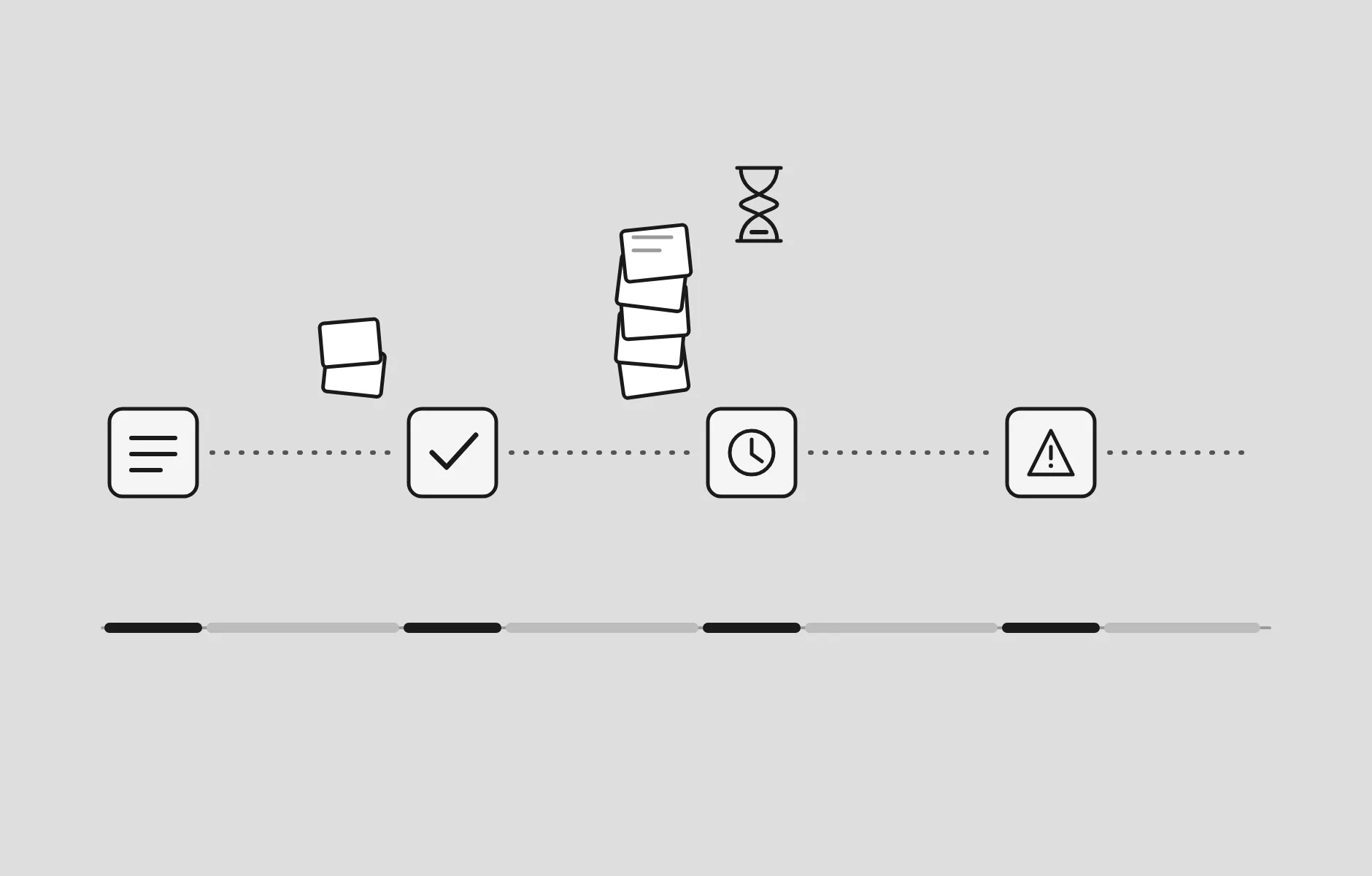
At a Fortune 500 manufacturer, more than fifty planners spent ten nights or more of every planning cycle adjusting production allocations by hand. They worked across more than 75 planning tools, most of them spreadsheets and legacy systems. We know this from a McKinsey article published in September, which says the client has been disguised. The company has no name, so the figures must be taken on trust. The lesson does not depend on the name.1
Nobody in the story was slow. The seven steps of the workflow, taken together, needed between 12 and 24 hours of hands-on work. Between the steps, work sat for between 9 and 18 days. McKinsey puts the waiting at nine to 36 times the working. The planners were not the delay. They were the people paid to stay up while the delay did its work, and the delay was contained in no single step, only in the gaps between them.1
McKinsey calls this the "coordination interface tax": the total cost an organisation pays for human-mediated handoffs between steps.1 I will shorten it to the coordination tax. The phrasing is new. The thing it describes was identified, with some venom, in the 1850s.
A department devoted to delay
In Chapter 10 of Little Dorrit, which Dickens titles "Containing the Whole Science of Government", the reader meets the Circumlocution Office, the department without whose acquiescence no public business could be done. Whatever was required, Dickens writes, it was "beforehand with all the public departments in the art of perceiving – How Not To Do It".2
Dickens knew that an institution can run on delay for decades, provided the delay is dignified. Several solemn lords, he writes, had "attained the reputation of being quite unearthly prodigies of business, solely from having practised, How not to do it, as the head of the Circumlocution Office".2 The queue was not a failure of the system. It was where the system kept its authority. A petitioner who waited was a petitioner who had been shown who decided.
Few modern firms set out to build a Circumlocution Office. They arrive at one by an entirely respectable route, one sensible division at a time.
The saving and the interface
The most famous paragraph in the history of productivity is about pins. Adam Smith, in the first chapter of The Wealth of Nations (1776), describes a small manufactory where ten men, each performing one or two of the operations that make a pin, produced upwards of 48,000 pins a day. Working separately, he judged, each could scarcely have made twenty.3 Smith also counted, among the benefits of dividing work, the saving of time otherwise lost in passing from one kind of work to another.3
What he did not need to count was the time pins spent waiting between men, because in a small manufactory there was nowhere for them to wait. Every division of labour since has been a bet that the gain from specialisation will exceed the cost of passing the work along. Two and a half centuries of organisational growth have made the stakes larger and the interfaces less visible. Thomas Malone and Kevin Crowston defined coordination in 1994 as the management of dependencies between activities.4 A dependency, in plain terms, is a place where one person waits for another.
McKinsey says coordination consumes 35 to 60 per cent of work time in knowledge-intensive organisations. The authors concede the range is "a convergent estimate drawn from studies using different methods and definitions, not a single measured figure", blending Mintzberg's observation of managers, activity measured inside Microsoft 365 and Asana's self-reported survey.1 Treat it as a reason to look, not a number to quote. The same article reports that the visible coordination cost in its manufacturing example was under 7 per cent of the total. The remaining 93 per cent "appeared as latency and opportunity costs, which showed up nowhere on the income statement".1 The consultancy sells the cure, so the diagnosis deserves a second opinion. Lean practitioners have been offering one for decades. The Lean Enterprise Institute says waiting is the main cause of long lead times in office work, as work "sits in someone's inbasket".5 Its guidance on AI is blunter: a step that took an hour can now take five minutes while the work still sits in a queue for a week.6
The dynamo did not help at first
The best historical warning is not about government. It concerns electricity.
By 1881, Edison's central generating stations were open in New York and London. Yet, as the economic historian Paul David observed in 1990, factory electrification did not show up in manufacturing productivity until the early 1920s, roughly four decades later.7 The reason was not that engineers failed to see the potential. Early factories bought the new power and kept the old arrangement. Steam-driven plants had been built on several floors around a single engine, with shafts and belts carrying power to the machines. The location of every machine was dictated by its distance from that engine, not by the order in which work moved. Swap the engine for a dynamo and the layout, the belts and the habits stayed where they were.7 8
Productivity rose when factories were rebuilt on a single floor, with a motor at each machine and the line arranged to carry materials from one stage to the next. That took new buildings, new skills and, as David's account has it, different arrangements for the people running the machines.7 8
The parallel is not subtle, so it should be stated with care. Generative AI is not electricity, and the comparison proves nothing about its eventual returns. It does explain a pattern. A faster engine placed at one station in an unchanged factory produces a faster station. It does not, by itself, produce a faster factory. The task got faster. The calendar did not notice.
Software has already run the experiment
Engineering is where the experiment is easiest to read, because every pull request and review leaves a timestamp. Three sources, taken together and with their limits, tell a consistent story.
Faros AI, which sells engineering analytics, reported in 2025 on more than 10,000 developers in 1,255 teams. High-adoption teams completed 21 per cent more tasks and merged 98 per cent more pull requests, but review time rose 91 per cent and organisational delivery metrics were flat.9 Its 2026 report covers about 22,000 developers over roughly two years. As teams moved from low to high adoption, tasks per developer rose 33.7 per cent. The median wait before anyone began reviewing a pull request rose 156.6 per cent, median time in review rose 441.5 per cent, and 31.3 per cent more pull requests were merged with no review at all.10 These are associations between periods of adoption, not proof of cause, and the report says as much. It also describes organisational delivery as improving, at a cost.10
Google's DORA programme, drawing on surveys, found in 2025 that AI adoption was linked to higher delivery throughput and lower stability, a reversal on throughput from the previous year. Its reading deserves to be remembered: AI speeds up software development, and that speed can expose weaknesses further down the line.11
And in 2025 METR ran a randomised trial of 16 experienced open-source developers across 246 tasks. With the early-2025 tools, tasks took 19 per cent longer when AI was allowed. The developers believed they had been 20 per cent faster.12 That result is dated. METR's later update points towards speed-ups with newer tools and warns that selection effects make their size hard to judge.13 The durable part is the gap between the feeling and the stopwatch. People who have just been handed a draft are poor witnesses to how long the whole job took.
None of this shows that AI slows organisations. It shows that when the first station gets faster, the waiting moves to whoever has to check the work. A recent theoretical paper by Silvia Bartolucci and Pierpaolo Vivo puts the mechanism in queueing terms: AI can cut the average human time per task while increasing waiting time across the workflow, if its occasional errors return as rework. Review time plus expected rework must come in below the manual time. A quick first draft does not, on its own, meet that condition.14 It is a model and not an empirical study. It names, though, the quantity most dashboards omit.
Where the hour goes
In 1865 William Stanley Jevons, in The Coal Question, made an observation that economists still cite and managers still forget. Improvements in the efficiency of steam engines, he argued, did not reduce the consumption of coal. They increased it.15 The analogy to attention is imperfect and tempting. Spare an hour, and the organisation tends to find something to fill it.
Keynes, in 1930, was more hopeful. He predicted that within a century, growth and technology would shrink the working week to about fifteen hours.16 The century is nearly up, and the week has not shrunk. Output per hour rose, much as he expected. The hours did not follow, and the evidence below suggests that, once again, they are being reclaimed as volume.
The current evidence does not suggest the saved hour is being given back. In a Danish study linking surveys of roughly 25,000 workers to administrative records, users reported time savings of about 3 per cent of work hours, the saving did not show up as fewer hours worked, and the authors found no measurable effect on earnings or recorded hours two years on.17 In an eight-month study of a 200-person technology company, the Berkeley researchers Aruna Ranganathan and Xingqi Maggie Ye found that AI intensified work: people moved faster, took on a broader scope and worked into more hours of the day.18 The study is in-progress research at one firm. It describes a pattern, not a rate.
Then there is the problem of whose hour it is. BetterUp Labs and the Stanford Social Media Lab surveyed 1,150 US workers about "workslop", polished AI output that lacks substance. They reported that 40 per cent had received some in the previous month, that each instance took nearly two hours to sort out, and that the cost was about $186 per affected employee per month.19 The figures are self-reported, and the time estimates deserve scepticism. The structure does not. The sender saves the minutes and the receiver spends them.
What redesign has and has not been shown to do
The standard advice is to redesign the workflow rather than bolt AI on to it. I think the instinct is right, and I have argued for it in I stopped asking AI to write my marketing. I started redesigning the work, where my own adoption "looked suspiciously like more work". The causal evidence is thinner than its reputation.
The experiment most quoted is by Hyunjin Kim, Dahyeon Kim and Rembrand Koning of INSEAD and Harvard Business School, who studied 515 startups. McKinsey describes it as a contrast between firms that redesigned workflows across handoffs and firms that used AI inside existing steps.1 The working paper describes something narrower. Both groups received the same tools, credits and training. Treated firms were also shown case studies of how AI-native companies had reorganised their workflows, teams and financing. They found 44 per cent more use cases, completed 12 per cent more tasks, were 18 per cent more likely to acquire paying customers and reported 1.9 times the revenue, the last at the 10 per cent significance level.20
So the evidence says that prompting young firms to look across their functions paid off over a three-month accelerator. It does not isolate handoff redesign, and it says nothing about a bank or a ministry. McKinsey's rule of thumb that 70 per cent of the effort belongs to people and process is the opinion of experienced practitioners, which has its value, but is not a finding.1
Who pays
This is where the numbers stop being the point.
A coordination tax is a transfer. When a drafting tool saves a writer an afternoon and an approver loses a morning, the organisation records the afternoon. When review capacity is fixed and volume rises, something gives, and Bartolucci and Vivo's model predicts what: as congestion grows, more drafts pass with less scrutiny.14 Faros's 31.3 per cent increase in pull requests merged without review looks like that prediction made flesh.10 The same report finds incidents per pull request more than tripled across the same comparison, though it does not claim to prove the link.10 Somebody is always the final reviewer. Where the company has stopped reviewing, it is usually the customer.
The people who bear the tax are rarely the people who announce the saving. They are the reviewers, the junior staff given the corrections and the colleagues who sit in the part of the workflow nobody put on the slide. Their cost is hidden by the same accounting that makes the Circumlocution Office look busy. A dashboard counts drafts produced and licences activated. It does not count the afternoon someone spent finding out what the draft left out. I have made the case for measuring work rather than usage before, and the argument gains force each time another vendor reports a record number of generated words.
Then there is the question of who gets to make others wait. A queue is a record of authority. Every approval that sits for six days says that somebody has the standing to keep work waiting and that nobody has been asked to justify it. Some approvals deserve their delay. Many were designed for a slower age and are enforced by habit. AI will not tell you which are which. It will deliver more drafts to the same gate, and expose how few of the gates have an owner. I made the same point about the work that keeps getting stuck: the opportunity lies in the exceptions, and an exception needs an owner. It is also why a handoff can be a communications problem in disguise. Employees waiting on an answer are not helped by more information, as I argued in Before the next AI announcement, answer the question. They are waiting on someone to decide.
The ethical stake is sharper when the measure of success becomes personal. When AI use enters performance reviews, the person who produces more drafts looks better, even if the person who corrects them is doing the real work. I examined that bargain in Your AI strategy is quietly rewriting the rules of work. The faster draft becomes the visible virtue. The checking becomes a cost, and the unpaid sort of cost, which means it will be done by whoever is least able to refuse.
How to look
You do not need a consultancy to find your own waits. You need one workflow, a few timestamps and the people who actually do the work.
Four numbers do most of the work. Flow efficiency: active working time divided by elapsed time. Wait before each handoff: the interval between "ready" and "started". First-pass acceptance: the share of work the next person can use without correcting it. Review load against capacity: items arriving per week against items a reviewer can properly check. Where arrivals exceed capacity, the queue is already deciding what gets read.
Illustrative example, not a reported case. In the worksheet's invented policy update, six steps take 59.8 hours from request to publication. The AI-assisted drafting step takes twelve minutes. Waiting takes 56 hours, or 93.6 per cent of the elapsed time. Halving the drafting time again would change almost nothing.
The accompanying handoff and delay-mapping worksheet below takes about 90 minutes with the people who do the steps. It asks who checks the work, what the receiver usually has to ask and where the wait is about information and where it is about a decision. It is not a validated instrument. It is a way of asking an uncomfortable question in a form that can be answered.
Then do the thing that no dashboard does. When someone reports that AI saved an hour, ask who received the work afterwards. If the answer is "nobody yet", you may be in a department Dickens would recognise. The Circumlocution Office, to be fair to it, never had a drafting problem.
Footnotes and research
- McKinsey & Company, Ali Sankur, Bernhard Mühlreiter and Steffen Fuchs, Cutting the "coordination tax": How agentic AI can reshape workflows, 18 September 2026. The manufacturing case is disguised; the 35 to 60 per cent range is described by the authors as a convergent estimate, not a single measured figure. Their description of the INSEAD and Harvard experiment is looser than the working paper (note 20).
- Charles Dickens, Little Dorrit, Book 1, Chapter 10, "Containing the Whole Science of Government": Standard Ebooks text. Quotations are taken from this edition.
- Adam Smith, An Inquiry into the Nature and Causes of the Wealth of Nations (1776), Book I, Chapter I, Of the Division of Labour, Adam Smith Works.
- Thomas W. Malone and Kevin Crowston, The interdisciplinary study of coordination, ACM Computing Surveys, vol. 26, no. 1, March 1994, pp. 87–119; open author copy.
- John Shook, Lean Enterprise Institute, Helpful Hints about Mapping off the Plant Floor in Support of Administrative Operations. A practitioner source, not a study.
- Lean Enterprise Institute, Lean AI for Value Streams. A training organisation's guidance, not a study.
- Paul A. David, The Dynamo and the Computer: An Historical Perspective on the Modern Productivity Paradox, American Economic Review (Papers and Proceedings), 1990.
- Paul David's argument as summarised in It took decades for the economic impact of electricity to be felt, History News Network, covering the move from multi-storey, shaft-and-belt factories to single-floor plants with individual motors.
- Faros AI, The AI Productivity Paradox Research Report, 2025. Vendor telemetry from more than 10,000 developers in 1,255 teams.
- Faros AI, AI Engineering Report 2026: The Acceleration Whiplash. About 22,000 developers and more than 4,000 teams, analysis as of March 2026. Changes compare each team's low- and high-adoption periods; the report does not claim to establish causation, and treats the 2025 and 2026 reports as independent cross-sections. The "improving but at a cost" description is from Faros's own summary.
- Google Cloud, Announcing the 2025 DORA Report. Survey-based associations. The previous year's throughput finding is reported in TechTarget's coverage.
- METR, Measuring the Impact of Early-2025 AI on Experienced Open-Source Developer Productivity, 10 July 2025.
- METR, We are Changing our Developer Productivity Experiment Design, 24 February 2026, and its February 2026 progress report.
- Silvia Bartolucci and Pierpaolo Vivo, Queue & AI: When Faster Tasks Slow Down the Workflow, arXiv 2605.27202. A theoretical queueing model with illustrative calibrations, not an empirical study.
- W. Stanley Jevons, The Coal Question (1865), Econlib; see also Yale's Energy History summary. The extension from coal to attention is my analogy, not Jevons's claim.
- John Maynard Keynes, Economic Possibilities for our Grandchildren (1930); the fifteen-hour week is discussed in Nicholas Crafts, The 15-Hour Week: Keynes's Prediction Revisited, Economica.
- Anders Humlum and Emilie Vestergaard, Still Waters, Rapid Currents: Early Labor Market Transformation under Generative AI, NBER working paper 33777, revised March 2026 (first circulated as “Large Language Models, Small Labor Market Effects”). Time savings are self-reported; the findings concern Denmark and early chatbot use.
- Aruna Ranganathan and Xingqi Maggie Ye, AI Doesn't Reduce Work—It Intensifies It, Harvard Business Review, 9 February 2026; see also the Berkeley Haas summary. In-progress research at one company.
- Harvard Business Review, AI-Generated "Workslop" Is Destroying Productivity, September 2025, by BetterUp Labs and the Stanford Social Media Lab; see also BetterUp's summary. Cost figures are derived from self-reported salaries and time estimates.
- Hyunjin Kim, Dahyeon Kim and Rembrand Koning, Mapping AI into Production: A Field Experiment on Firm Performance, INSEAD working paper, 2026; see also the HBS AI Institute summary. Not peer reviewed; startups in a three-month accelerator.
Related reading on this site: The AI adoption dashboard is green. Is the work any better? · Your next AI agent should fix a broken workflow, not invent a new job · Before the next AI announcement, answer the question · Your AI strategy is quietly rewriting the rules of work