I stopped asking AI to write my marketing. I started redesigning the work.
For a while, my AI adoption looked suspiciously like more work.
I could research faster, generate more headlines and turn an article into several social posts before finishing my coffee. Yet the inconvenient parts remained. I still had to decide whether the argument mattered. I still had to check the evidence, correct the tone, remove the suspiciously confident sentence and explain the same context to another tool.
The output accelerated. The work around it accumulated.
This was the gap between using AI for digital marketing and building an AI-first marketing practice. I had improved individual tasks without sufficiently changing how those tasks connected.
My work spans communication, editorial strategy, digital publishing and AI enablement. I was not short of things to produce. I needed a more reliable way to move from a useful question to credible research, a distinctive argument, publication and learning.
The breakthrough was not finding a model that wrote more convincingly.
It was recognising that I had been treating AI as an exceptionally fast freelancer: capable, occasionally brilliant and apparently suffering from permanent first-day-on-the-job confusion.
What I needed was a better working system.
Digital marketing did not become irrelevant. Its operating assumptions did.
My earlier digital marketing practice followed a recognisable sequence. Understand the audience. Research the topic. Develop the content. Optimise the page. Publish. Distribute. Review the results.
Those fundamentals still matter. People have not stopped needing useful information because software can generate it.
What changed was the cost and speed of producing plausible material. A first draft, once a substantial piece of work, became something I could summon almost immediately. But plausibility is not the same as accuracy, and fluency is not the same as an argument.
The temptation was to use that speed to publish more.
For someone with an editorial background, this was an uncomfortable proposition. I know how much work a polished paragraph can conceal: an untested assumption, a weak source, a comparison that collapses under scrutiny.
AI made it easier to produce the appearance of completion.
I began to think that the useful question was not “How much content can I create?” but “Which parts of this process should become faster, and which parts deserve more attention?”
Research collection could accelerate. So could formatting, preliminary comparisons and adapting approved material.
Positioning, interpretation and accountability needed something else: room to think.
That became my working definition of AI-first marketing. Not AI making every decision, but a process deliberately redesigned around what it can do well—and around the consequences when it gets something wrong.
The people who helped me ask better questions
I did not arrive at this approach through tool experiments alone. Learning from people who had moved from marketing into applied AI gave those experiments a more useful structure.
Christopher S. Penn helped me look beyond writing assistance. His career runs through inbound marketing, marketing technology and analytics into Trust Insights, where his work connects AI with substantive marketing problems. The appeal was the continuity: AI was not replacing marketing knowledge; it was extending what an experienced practitioner could do with it.
What I took from that was a change in ambition. Instead of asking for a better paragraph, I could ask for a more rigorous research process, an examination of competing explanations or a structured way to interrogate information.
Paul Roetzer provided a different perspective. His transition from founding PR 20/20 to building Marketing AI Institute demonstrated that the shift was organisational as well as technical. The institute’s education moves from understanding AI to piloting and scaling its use.
That helped me separate experimentation from adoption. Trying a tool is an event. Making it useful, repeatable and accountable is a practice.
Mike Kaput made the connection to everyday marketing particularly clear. His role combines content marketing, strategy, technology and AI with responsibility for traffic, leads and revenue. He is not merely explaining developments from outside the function.
Katie Robbert’s work supplied a discipline I kept returning to: define the purpose, identify the people, document the process, choose the platform and measure performance. Trust Insights’ 5P Framework deliberately puts the tool after the problem and the work.
I did not need to copy any one person’s system. I needed to combine these lessons with my own editorial instincts.
Keep the marketing fundamentals. Understand the technology. Design the handoffs. Retain responsibility.
Then test whether the whole arrangement actually helps.
Better prompts were useful. They were not enough.
My early improvements came from giving AI better instructions.
I supplied audience details, writing samples, preferred language, publication requirements and clearer objectives. The results improved. But I still found myself rebuilding the working environment each time.
One conversation contained the research. Another held the strongest draft. A third had the revised positioning. Somewhere else was the instruction not to use that particular opening again.
The knowledge existed, but it travelled badly.
This is where my focus shifted from prompting to context: the information a system needs to do useful work, and how that information remains available as the work develops.
Anthropic describes context engineering as curating and maintaining the information a model receives, including instructions, tools, external data and message history. It is broader than writing a clever prompt.
For my practice, the implication was straightforward. I needed a maintained working brief rather than a succession of improvised explanations.
That brief should contain:
- The audience and the problem the content addresses.
- My service positioning and the claims I can substantiate.
- Relevant experience, examples and approved evidence.
- Editorial rules, including UK English and source expectations.
- The purpose of the asset and the action it should support.
- Boundaries around confidential information and publication.
The important change was not making the brief longer. It was making it dependable.
A system cannot preserve a distinction it has never been given. It cannot know that a striking statistic belongs to a different project unless the context says so.
I became more precise about agents
“Agent” has become one of those technology words that seems to expand whenever a sales presentation needs it.
I wanted a more useful distinction.
A workflow follows a defined sequence. An agent has some discretion over how to pursue a goal: which tool to use, what to investigate next and whether the available information is sufficient. Anthropic distinguishes predefined workflows from agents that dynamically direct their processes and tool use.
This matters because a sequence of prompts is not automatically an autonomous agent.
If I specify research, outline, draft and review in advance, I have designed a workflow. If a research agent can identify a missing source, choose how to find it, inspect the result and decide whether another search is necessary, it has bounded decision-making authority.
“Agentic AI” is useful to me as a description of that capacity to act towards a goal—not as a synonym for better software.
Nor is autonomy automatically desirable.
Anthropic recommends starting with the simplest approach that works, adding complexity only when it improves the outcome. Workflows offer predictability; agents are useful where flexibility is genuinely needed.
That became an important corrective to my enthusiasm.
I did not need an autonomous marketing department. I needed selected parts of the work to proceed with less supervision, without allowing the system to mistake permission to investigate for permission to publish.
The workflow I built towards
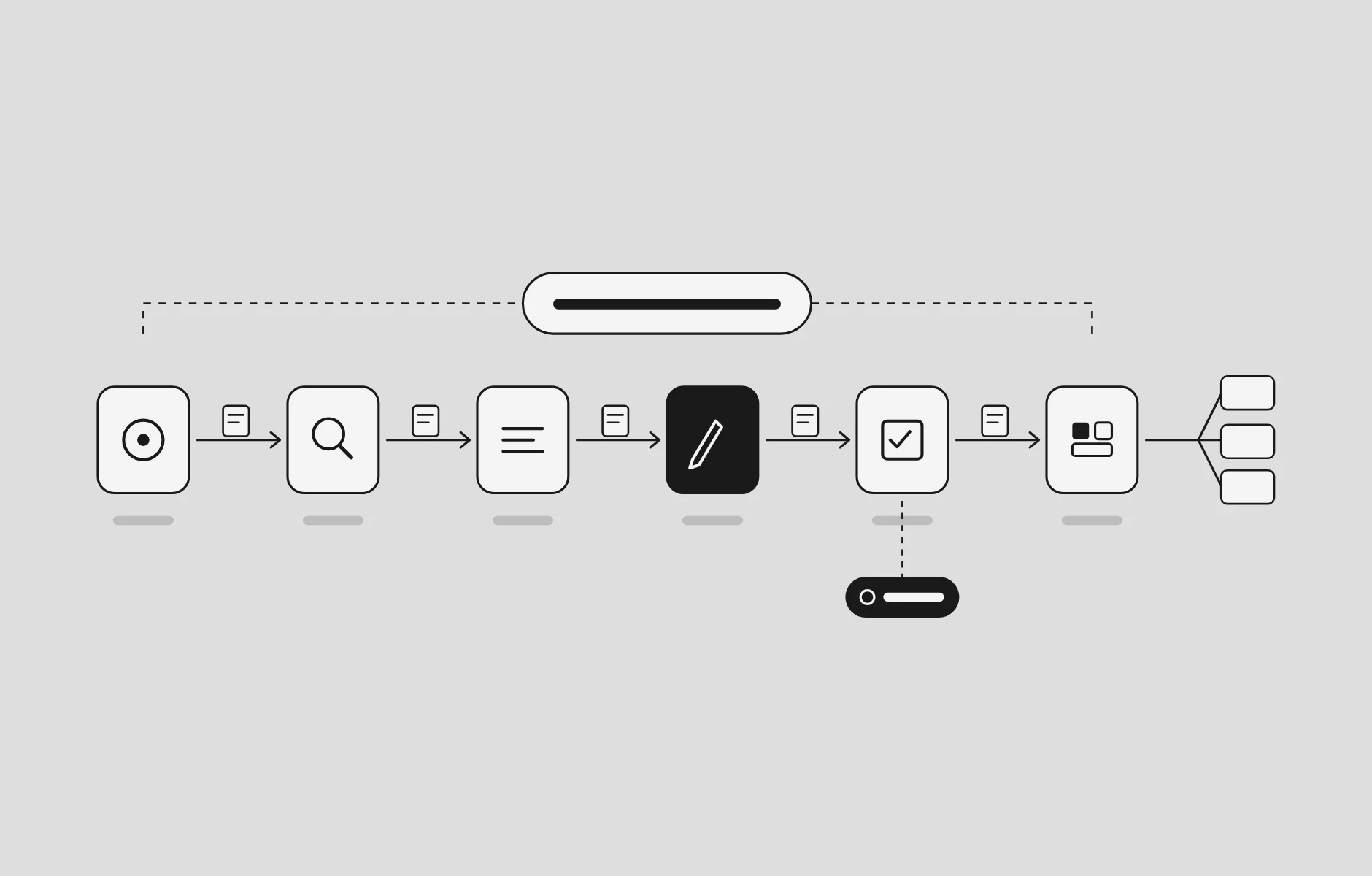
The central change was moving from a conversation-led process to an evidence-led one.
Previously, progress depended on what I remembered to ask next. The revised approach gives each stage a defined purpose, an expected output and a condition for moving forward.
The point is not to make every stage autonomous. It is to stop each stage from starting again.
1. Begin with a real audience problem
A topic is not yet a reason to publish.
“AI in marketing” is a category. “Why a small consultancy produces more content but receives no better enquiries” is a problem.
The brief needs to establish who is experiencing that problem, what they misunderstand and what the article should help them decide.
This is where I retain control. AI can suggest questions and expose gaps, but choosing what deserves my name is part of the work I am offering.
A useful brief also defines success before production begins. Is this piece intended to answer a recurring client question, clarify a service or demonstrate a particular kind of judgement?
Without that decision, optimisation becomes an elaborate way of avoiding purpose.
2. Give research a boundary and an output
A research agent needs more than “find information”.
It needs a defined question, source preferences, a time boundary where relevant and instructions for handling disagreement.
Its output should separate:
- What the source establishes.
- What remains uncertain.
- What is interpretation.
- What needs further verification.
That separation is essential. Otherwise, a plausible inference can quietly acquire the status of a fact as it moves into the draft.
For an article about AI adoption, I want the original research behind a productivity claim—not five websites quoting the same press release.
The handoff should be an evidence record that another stage can inspect, not simply a polished summary that asks to be trusted.
3. Test the argument before writing the article
Research creates possibilities. It does not choose the argument.
This is where my editorial experience matters most. What does the evidence change? Which assumption deserves challenging? What am I adding beyond a competent summary?
AI is useful here as an adversarial reader.
I can ask it to identify unsupported leaps, competing explanations or places where a recommendation assumes a budget, skill or organisational freedom the reader may not have.
That is a more valuable intervention than asking it to “make the article insightful”.
Insight is not an adjective a model can sprinkle over a draft. It emerges from a defensible connection.
4. Draft from approved evidence and a clear position
Only then does drafting begin.
The drafting stage works from the argument, selected evidence and editorial brief. It should not introduce new statistics or client outcomes because they would make a paragraph more persuasive.
Any new factual claim returns to research.
This creates a small but consequential rule: writing cannot manufacture its own authority.
It also changes how I edit. Instead of spending all my time removing generic phrasing, I can assess whether the piece makes its case, respects the reader’s knowledge and says something worth remembering.
5. Review in separate passes
One instruction to “check everything” is too vague.
I separate factual review from editorial review and publication checks.
A factual pass asks whether sources support the claims. An editorial pass examines reasoning, repetition, tone and structure. A publication pass checks headings, metadata, links, accessibility and the relationship between the page and its intended action.
These can be separate stages without pretending each is an independent expert.
That distinction matters. Several model-generated reviews do not become independent corroboration merely because they have different role names.
I remain responsible for inspecting the evidence and accepting the final text.
6. Adapt the idea, not just the word count
Distribution used to arrive at the end, often when my attention was already depleted.
A connected workflow makes adaptation easier because the central argument, evidence and boundaries travel with the article.
But a LinkedIn post should not be a compressed blog. A newsletter needs a reason to enter someone’s inbox. A service-page section must help someone understand what I can do for them.
The formats have different jobs.
AI can propose those adaptations. My task is to decide whether each version offers independent value rather than functioning as another small advertisement for the original.
The improvement came from the handoffs
The most useful part of this system is also the least glamorous.
What happens when one stage gives its work to the next?
Does the draft receive the sources or only a summary? Does the distribution stage know which claims were removed? Does a revised positioning statement reach the next piece of content?
These are not merely administrative questions. They determine whether errors travel and whether learning survives.
Anthropic’s account of its multi-agent research system describes a lead agent coordinating specialist research and synthesising the findings. It also notes the additional complexity involved in coordination, evaluation and reliability. More agents create more work to manage as well as more capacity.
That is why I prefer clear outputs to elaborate role-play.
Each stage should leave something inspectable: an evidence record, an approved argument, a reviewed draft or a publication checklist.
If the next stage cannot tell what is approved, what is provisional and what must not change, the workflow is not ready.
It is simply moving uncertainty faster.
Better results require more honest measurement
In my AI-enabled communication work, I have previously recorded a 40% reduction in content-production time.
That is a meaningful improvement. It is not evidence that agents alone caused it, nor that every marketing outcome improved by the same proportion.
The result reflects a wider change in research, drafting and editorial workflows. I would need separate measurement to isolate the contribution of an agent-based process.
This distinction is worth protecting because AI case studies often move too quickly from “we saved time” to “we transformed performance”.
For me, better measurement now needs three layers.
First, operational performance: time to a publishable asset, revision rounds, correction time and the number of manual handoffs.
Second, editorial quality: factual reliability, usefulness, originality and consistency with the position I want to establish.
Third, commercial contribution: relevant enquiries, evidence that prospects understand the offer and conversations that move towards suitable work.
These measures are connected, but they are not interchangeable.
A faster article may be better. It may also be a faster way to publish something nobody needed.
The question is whether the system releases time for judgement and improves the usefulness of the final work—not whether it makes an activity dashboard look industrious.
I do not give every agent the same permissions
Connecting a system to tools changes the consequences of a mistake.
An incorrect research note can be corrected before publication. An incorrect email sent to a prospective client cannot be unsent in the same practical sense.
My governing principle is therefore simple: autonomy should depend on the cost of being wrong.
Research and draft preparation can have more room to operate. Publishing, sending messages, changing live pages and using sensitive information require explicit boundaries and approval.
For any delegated task, I want to know:
- Which information it may access.
- Which tools it may use.
- What it may change.
- When it must stop or ask.
- What record it leaves behind.
A spending limit, a retry limit and a stopping condition are not signs that an agent has failed to become intelligent. They are signs that somebody has thought about operating it.
Evaluation matters just as much. Anthropic’s guidance on agent tools emphasises testing and iterative improvement against real tasks, rather than assuming a promising demonstration will translate into dependable performance.
That is the standard I want for my own work: not impressive once, but useful repeatedly.
What I would change first, starting again
I would not begin by selecting an agent platform.
I would choose one recurring piece of work that causes friction and has a result I can assess.
For my kind of practice, that might be turning a well-defined client question into a sourced article and a small set of useful supporting assets.
I would map how it happens now, including the awkward parts: searching again for a source, restoring context, correcting an adaptation and checking whether an example is safe to use.
Then I would establish a baseline.
Only after that would I decide which steps need a model, which require tool access, which benefit from limited discretion and which should remain mine.
I would test the workflow on representative work, record its failures and keep a manual fallback.
This is slower than announcing an autonomous content engine.
It is also more likely to produce something I can trust.
AI-first has made editorial judgement more important
The surprising part of this transition is how little it has diminished the value of my original skills.
Editorial experience helps me recognise unsupported authority. Communication experience helps me identify the audience and the decision at stake. UX thinking helps me notice friction between stages. Change communication reminds me that a process nobody understands is unlikely to be adopted consistently.
The technology expands what I can do. Those skills determine whether it is worth doing.
Learning from Penn, Roetzer, Kaput and Robbert helped me take AI seriously as a change in working practice. Bringing agents, bounded autonomy and connected workflows into that practice helped me move beyond the endless exchange of prompts.
But I do not regard the resulting system as finished. It needs maintenance, evaluation and occasional simplification.
My aim is no longer to make AI produce more of my marketing.
It is to make the process more reliable, preserve what I learn and spend less attention reconstructing yesterday’s context.
That leaves more room for the part I cannot sensibly outsource: deciding what deserves to be said, and standing behind it when it is published.