The AI adoption dashboard is green. Is the work any better?
As organisations plan their next round of AI investment, usage figures leave a harder question unanswered: which workflows deliver better results once checking, correction and human effort are counted?
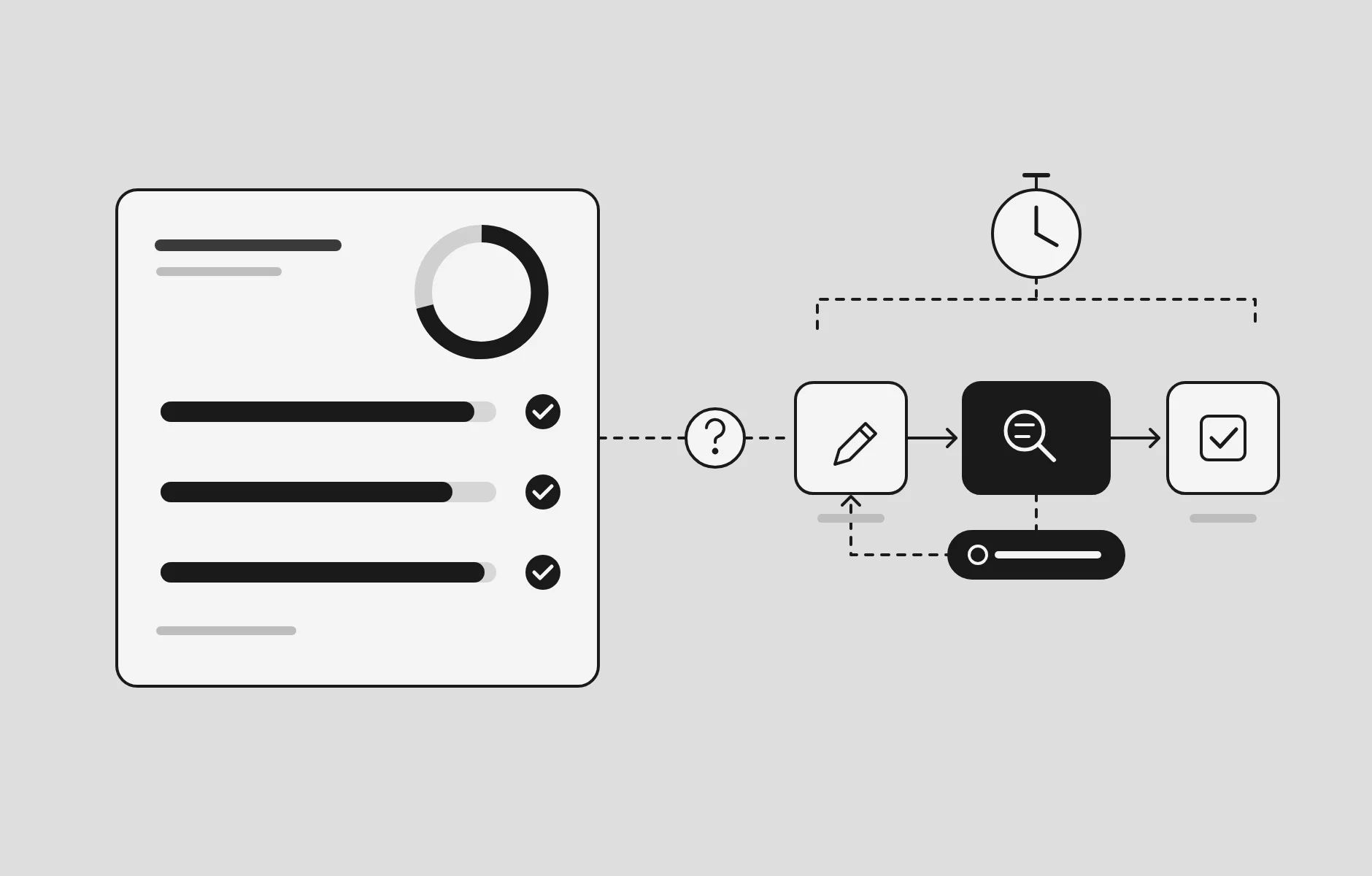
The dashboard has good news. Employees are using AI. Training completion is up. The licences are active.
Then someone asks whether the work has improved.
A brief silence. Someone offers to circulate the dashboard.
As organisations prepare their 2027 plans, this is the distinction worth keeping in view. Evidence that people use a tool is not, by itself, evidence that buying more of it is a good decision. Nor does a faster first draft establish a faster process. The draft may simply have arrived earlier at the desk of someone who now has more to check.
Lenovo’s November 2026 research gives this problem a timely number. Among 1,200 IT leaders at large enterprises, 70% reported having an AI adoption programme. Only 12% reported measuring adoption and effectiveness at individual or team level and using that evidence to refine training, employee personas and technology decisions.1
That is not proof that the other organisations receive no value from AI. It is evidence of a reported gap between running a programme and maintaining a feedback loop capable of improving it.
Before approving the next phase, leaders should ask a less comfortable question than “Are people using it?”
What, precisely, has become better—and what have we counted to reach that conclusion?
A recent survey, not a universal verdict
First, the necessary small print. It matters, even when it interrupts a perfectly serviceable headline.
Lenovo published The AI-ready workplace on 10 November 2026, drawing on an August survey of IT leaders in organisations with at least 1,000 employees across 12 countries, including India. It is vendor-sponsored research based on leaders’ accounts, not independent observation of employees completing tasks.1
The 12% finding also describes a specific combination: measuring adoption and effectiveness, then using the findings to refine decisions. It does not mean that only 12% measure anything. Nor should we subtract it from 70% and announce that the remainder have programmes with no measurement. Those headline figures do not provide that cross-tabulation.
The release separately reports that only around one in ten organisations continuously connects AI use to workflow outcomes to guide investment. That is a different measure, not another way of expressing the 12% result.1
The useful conclusion is narrower than “enterprise AI is failing”, and more actionable: programme activity and decision-quality evidence are not the same thing.
For the next investment cycle, the practical task is to connect them.
The licence is not the unit of value
A licence dashboard answers legitimate questions.
Who has access? Who has completed training? Are paid accounts sitting unused? Which teams need support?
Keep those measures. Nobody needs a philosophical argument to discover that half the subscriptions have never been opened.
But a licence is an access arrangement. It is not a unit of improved work.
Imagine a communications team introducing AI-assisted drafting. This is an illustrative scenario, not a reported case study.
The writer produces an announcement more quickly. The editor then spends longer checking facts, removing invented certainty and restoring the awkward qualification that made the original information accurate.
The approver sends it back because it answers the question management wanted employees to ask, rather than the one employees actually have.
The first draft was faster. The completed announcement may not be.
This is the handoff problem in measurable form: a tool can perform one part of a task well while the surrounding process remains unprepared to receive its output.
An evaluation should follow the work across that boundary. Otherwise, the writer records a saving while the editor quietly becomes the organisation’s unbudgeted verification service.
The work has not necessarily disappeared. It may have changed desks.
Feeling faster is a useful clue. It is not a stopwatch.
There is another reason to look beyond adoption surveys and employee enthusiasm: perceived improvement and observed performance can diverge.
In a randomised study published in July 2025, METR examined 16 experienced open-source developers completing 246 real tasks in repositories they knew well. With the early-2025 AI tools studied, tasks took 19% longer when AI was allowed. Yet, after participating, developers estimated that AI had made them 20% faster.2
That finding has an expiry warning attached, and it should travel with the statistic.
METR’s February 2026 update reported evidence pointing towards improved productivity with later tools, but said selection effects made the size of the improvement difficult to estimate. The researchers changed their experimental approach; their original article now explicitly warns against treating the historical result as a current estimate.3
The lesson is not that AI makes developers slower. That would turn a bounded, dated experiment into a slogan.
The lesson is that an organisation needs a way to distinguish a convincing experience from a demonstrated result—and to update its conclusions when tools and working practices change.
Employees’ accounts remain valuable. They can explain where a process feels easier, why a tool is avoided or which checks create friction. They cannot, on their own, establish how much total effort the organisation saved.
A satisfaction survey is not a stopwatch, however tastefully designed.
Stop timing the impressive bit
The easiest thing to time is often the most flattering.
How quickly did the tool generate a response? How long did the employee spend producing a draft? How many documents appeared?
The better question is how long it took to reach an acceptable result.
For a recurring task, define:
- The starting point: when the team has what it needs to begin.
- The finishing point: when the output meets agreed acceptance criteria.
- The required checks: what must be verified before use.
- The follow-up period: when subsequent corrections will be counted.
Then distinguish active working time from elapsed time.
Active time captures effort: preparation, production, verification, correction and approval. Elapsed time captures the journey, including queues and handovers.
Both matter. An AI-assisted document might require less hands-on work but sit in an approval queue for three days. Alternatively, it might move through the system faster because it is more complete, even if production time barely changes.
Neither result is visible in a prompt count.
This is also why redesigning the work matters more than repeatedly asking a tool to produce another version. The useful improvement may come from better source material, a clearer brief or removing a redundant handover—not from generating faster.
Build a scorecard that can disappoint you
A measurement system should be capable of producing an inconvenient answer. Otherwise, it is a launch campaign with columns.
The following is a proposed adoption-to-outcomes scorecard, not a validated instrument. Adapt it to the task, the risk and the decision being made.
| Measure | Definition | What to collect |
|---|---|---|
| Eligible-task adoption | AI-assisted eligible tasks divided by all eligible tasks sampled | Whether AI was used, at which stage and for what purpose |
| Output quality | Performance against a predefined task-specific rubric | Independent assessment of comparable outputs |
| Active completion time | Hands-on effort from preparation to acceptance | Time spent producing, checking, correcting and approving |
| End-to-end cycle time | Elapsed time from the agreed start to acceptance | Workflow timestamps, including waiting |
| Review burden | Effort needed to verify and correct the output | Reviewer time and substantive changes |
| First-pass acceptance | Share accepted without substantive correction | Approval decisions using a consistent threshold |
| Appropriate use | Compliance with agreed information and oversight rules | Sampled checks of authorised use and required verification |
| Downstream rework | Corrections after initial acceptance | Linked issues within a defined follow-up period |
Do not rush to combine these into a single maturity score. A tidy average can hide the exact trade-off leadership needs to see.
Faster work with more serious errors is not the same result as faster work at equivalent quality. Better quality at higher cost may still be worthwhile, but it is a different investment proposition.
Agree the quality rubric before reviewing the outputs. For an internal announcement, it might cover accuracy, completeness, audience relevance, clarity and compliance with the brief.
Also define “substantive correction”. Fixing punctuation is not the same as discovering that the announcement contains the wrong eligibility rules.
Where practical, reviewers should assess outputs without knowing how they were produced. Record when that concealment is imperfect.
Finally, compare like with like. A routine update and a sensitive restructuring announcement are both “communications”. So are a postcard and a diplomatic incident.
Count costs honestly—and do not turn minutes into money by magic
If the decision concerns further investment, a task scorecard is necessary but insufficient.
Alongside it, record the costs attributable to the pilot: licences, setup, integration, training, evaluation and support. Include the effort of the people conducting the checks.
Then separate three possible benefits:
- Capacity: employees have time available for other work.
- Financial savings: expenditure actually falls or an identified future cost is avoided.
- Service improvement: the organisation delivers something better, faster or more reliably.
These can overlap. They are not interchangeable.
For the business case, record saved time as capacity unless there is a credible route to redeploying it or reducing expenditure. Do not convert every recovered minute into a cash saving and then behave as though the budget has already become smaller.
A proposed calculation is straightforward:
Net active time recovered = baseline total effort minus AI-assisted total effort, including review and correction.
That gives a starting point, not a completed return-on-investment claim. Quality, risk, implementation cost and the use of recovered capacity still need examination.
If a team recovers time, decide what it will stop doing, what it will improve or what additional demand it will absorb.
This is the strategic question behind what the business is for now: changing the tools should prompt a decision about the work the organisation still needs—not just how much more it can produce.
Appropriate non-use belongs on the dashboard
A programme designed to maximise usage will struggle to recognise a good decision not to use AI.
The scorecard should make room for that decision.
Before a pilot, identify where AI assistance is permitted, where it requires additional checks and where it is excluded. Judge use against those rules, rather than treating frequency as a proxy for competence.
An employee who avoids putting restricted information into an unauthorised tool has not failed to adopt AI. They have followed the brief.
Likewise, someone who completes a simple task directly rather than constructing an elaborate prompt may have made a sensible choice. Not every sentence requires a technological support act.
For delegated or agent-assisted work, add a few specific questions: where did a person intervene, which exceptions required escalation and what happened when an action was wrong?
An error caught in a draft and an error acted on downstream should not receive identical treatment merely because both involved a human eventually noticing.
Define who may approve the work, who may stop the process and who owns the outcome. “Human oversight” is not an operating instruction until someone knows what they must inspect and what authority they have.
Ask the reviewer. Then ask what happened next.
The numbers need explanation. Short interviews can expose what the scorecard has missed.
Ask users:
- Which step became easier, and which step disappeared?
- What extra preparation or checking did AI introduce?
- Describe a task where you chose not to use it.
- Did the result become better, or merely easier to produce?
Ask reviewers:
- What required the most attention?
- Which weaknesses were hardest to detect?
- Did the output reduce your work or change its nature?
- What would have happened if you had accepted it without correction?
Ask managers:
- What happened to any time recovered?
- Did another team inherit additional work?
- What evidence would justify expansion?
- What result would make you stop?
That last question belongs before the pilot, not after an executive has declared it a success.
Use interviews to investigate specific tasks and outputs. “How do you feel about AI?” may produce an interesting conversation. “Show me the last output you had to substantially repair” is more useful for improving a workflow.
A six-week pilot that can survive an awkward result
Here is a proposed case-study route: follow one team, one recurring task and one investment decision for six weeks.
It is a bounded evaluation, not a promise to settle the organisation’s entire AI strategy before the next quarterly review.
Week 1: Establish what happens now
Choose a task with enough comparable instances to examine.
Document the current process. Collect baseline outputs, active time, elapsed time and review effort. Agree the quality rubric and record task complexity.
If employees already use AI, say so. The existing workflow is the baseline; it is not automatically a non-AI condition.
Agree the decision criteria now: what improvement would matter, which quality standards cannot deteriorate and what would trigger a pause.
Week 2: Define and test the assisted workflow
Provide task-specific guidance covering approved sources, information restrictions, verification and approval.
Test the logging process too. If completing the measurement form takes longer than completing the task, the evaluation has developed ambitions of its own.
Explain the data being collected, who can see it and how it will be used. Assess the workflow rather than constructing an employee leaderboard. Collect only the work material needed and authorised for the evaluation.
Weeks 3–5: Compare and investigate
Where feasible, assign comparable tasks to the assisted and existing-method conditions. Let participants experience both, while recognising that learning can carry between them.
If random assignment is impractical, use matched comparisons and describe their limitations. Record differences in complexity, staffing, workload and source quality.
Have outputs independently assessed. Sample the logs against actual revision records rather than relying entirely on recollection.
Record material changes to the tool or workflow during the pilot. If the process changes halfway through, do not pretend every observation tests the same arrangement.
Interview users and reviewers about specific examples. Look for the mechanism behind any apparent gain.
Was it the AI assistance? Better source material? A clearer brief introduced during training? Removing an unnecessary approval?
That distinction determines what should be repeated.
Week 6: Make a decision, including “not yet”
Compare the findings with the criteria agreed at the start.
There are several legitimate outcomes:
- Expand the tested workflow.
- Revise the instructions, inputs or review process.
- Restrict use to the task category where it helped.
- Stop because the benefit does not justify the cost or risk.
- Continue testing because the evidence is inconclusive.
Report the number and type of tasks assessed, not just the average improvement. Show the spread of results and the important exceptions. A small pilot cannot establish that rare failures will not occur.
Do not manufacture certainty to meet a steering committee deadline.
A useful case study explains what was tested, what changed, what remained uncertain and what decision followed. It does not need a triumphant ending. It needs an honest one.
Make the next dashboard answer a decision
Keep the activation counts. Keep training completion. Keep the information needed to run the programme.
Place them beside evidence about the work.
Instead of reporting only that active use increased, aim to make a bounded claim: comparable tasks met the agreed quality standard with less total effort, under specified conditions. Or report that drafting improved but review burden erased the gain. Or that the workflow helped routine tasks and remained unsuitable for sensitive ones.
Those are different results. They deserve different decisions.
The useful question for 2027 is not whether every employee can be persuaded to use AI more often. It is whether the organisation can identify where the technology earns its place, where the process needs redesign and where a perfectly competent person should simply get on with the task.
Before renewing or expanding a programme, ask its owner to bring one piece of evidence:
A completed workflow, assessed against a credible baseline, with the checking included.
If that evidence is missing, the next investment should be in finding out—not in making the dashboard greener.
Footnotes and research
- Lenovo, The AI-ready workplace, sixth report in the Work Reborn series, published 10 November 2026. The accompanying release describes the sample, survey timing and distinction between adoption measures and continuous workflow-level evaluation. Vendor-sponsored, self-reported research; not an independent performance assessment.
- METR, Measuring the Impact of Early-2025 AI on Experienced Open-Source Developer Productivity, published 10 July 2025. The randomised study concerns a specific group of developers, tasks and early-2025 tools. Its historical result should not be presented as a current general estimate.
- METR, We are Changing our Developer Productivity Experiment Design, published 24 February 2026. The update discusses later results, selection effects and why changing adoption patterns complicate measurement.