AI strategy: what is your business for now?
Lessons from Adobe, DBS and Arizona State University on changing what an organisation offers, how it works and what it must protect.
Imagine a consultancy that uses AI to write a report in an hour instead of a day.
The partners are pleased. The presentation looks better. Someone calculates the time saved and puts it in a slide about transformation.
But clients still receive the same report. The fees still depend on hours. Nobody has decided whether the saved time should mean a lower price, a better investigation, more clients or fewer employees.
This is an illustrative business, but the strategic question is real: what has changed beyond the speed of production?
An AI strategy should answer that question before its authors buy another licence.
Efficiency matters. It is simply not the whole of strategy. A business also needs to decide whom it serves, what those people value, what it will charge for and which responsibilities it cannot hand over to software.
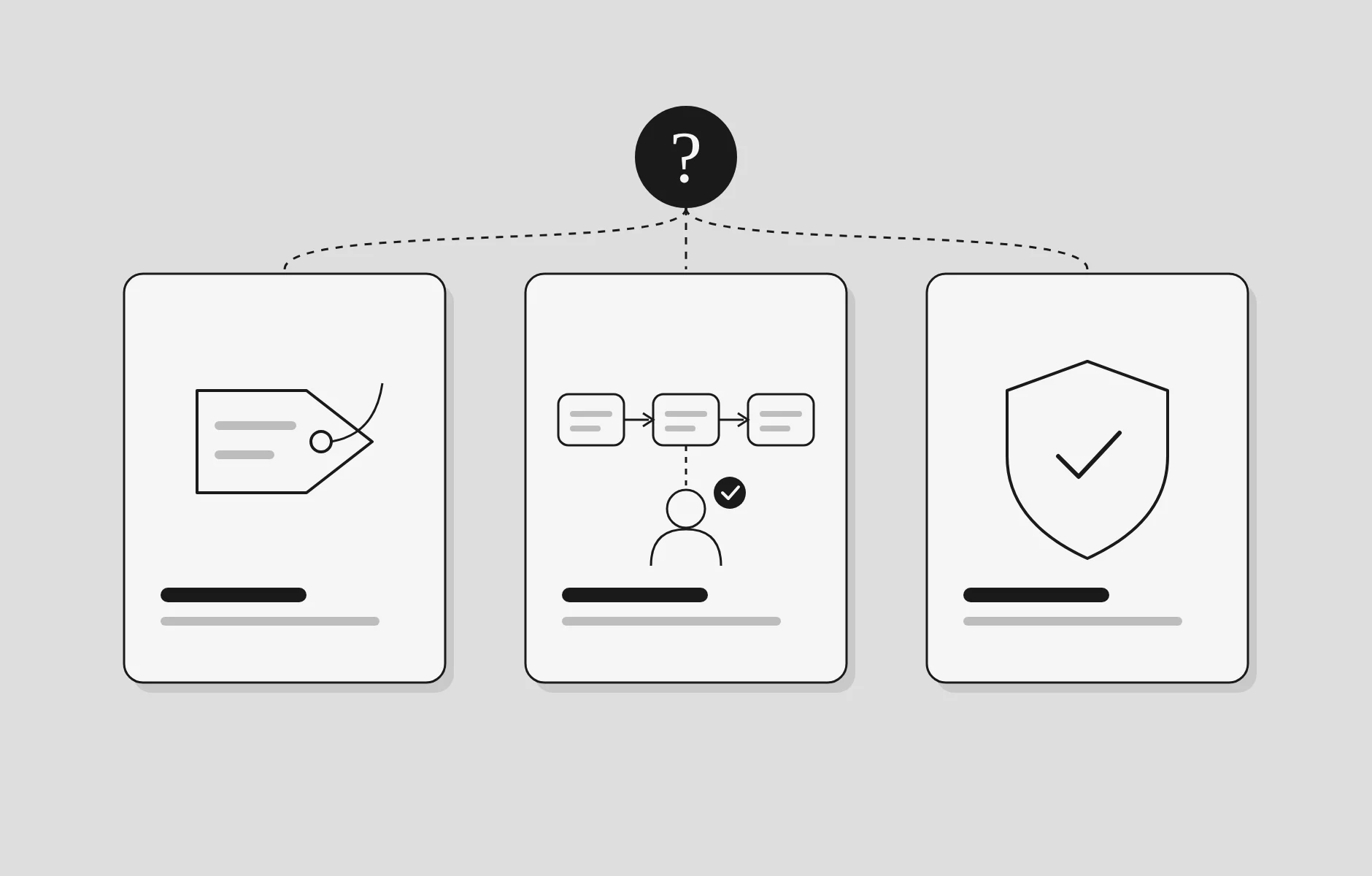
That is why Adobe, Singapore’s DBS and Arizona State University are worth examining together. Their public accounts describe changes to creative products, banking workflows and the ability to build educational tools.1,2,3 They offer three different ways to think beyond the familiar promise of doing existing work faster.
They are not three certified success stories. Company disclosures explain what management wants readers to notice. University announcements establish what has been introduced, not necessarily what students have learned. The useful approach is to borrow the questions these organisations expose, without borrowing their publicity.
Adobe: sell a different promise
Start with a problem that anyone selling expertise should recognise: what happens when something customers used to find difficult becomes easier to produce?
Adobe’s Firefly offering includes generation inside familiar creative applications, tools for adapting approved assets and custom models trained on an organisation’s own material.1,4 The strategic interpretation is more interesting than the list of features. Adobe is not only selling an easier way to make an image. It is trying to occupy more of the process through which an organisation produces and uses creative work.
Consider an illustrative marketing team preparing a campaign for several countries. Generating an image is one task. Obtaining approvals, preserving the brand’s identity, adapting formats and knowing whether the material can be used commercially are others.
If the first task becomes cheap, the remaining difficulties do not disappear. They may become the more valuable part of the offer.
Adobe’s own business material makes commercial safety, integration and brand controls central to its pitch.4 Those are vendor claims, not independent guarantees. Its intellectual property indemnification applies to qualifying arrangements and selected outputs, subject to contractual terms and exclusions.4 “Safe” is not a reason to stop reading the contract.
Still, there is a lesson here for businesses whose value has rested on producing things that were once slow to make.
A communications consultancy, for example, should ask whether the first draft was ever what the client most needed. Perhaps the valuable work is identifying the decision, interrogating the evidence or helping several departments agree on what can honestly be said.
That is a proposed direction, not an automatic escape route. Customers still have to value it enough to pay.
The distinction between using AI to produce marketing and redesigning the marketing work belongs here. Producing more material is one ambition. Making a better commercial promise is another.
There is evidence that Adobe is monetising its changing offer. In its September 2026 earnings call, it reported 40% quarter-on-quarter growth in ending annual recurring revenue across Firefly apps and Firefly credit packs.1 That is a specific vendor revenue measure. It is not 40% growth in Adobe’s total revenue, nor proof of an equivalent return for customers.
Nor has the strategic contest ended. Reuters’ coverage of those results also noted competitive pressure and a fourth-quarter revenue outlook whose midpoint fell slightly below analysts’ expectations.5
The lesson is not “become Adobe”. It is to identify which customer problem remains valuable when production gets easier.
Then decide whether the business is equipped to solve it. A new description on the services page will not make that capability appear.
One useful exercise is to separate the deliverable from the consequence the customer wants. A report may help secure an investment decision. A campaign may help people understand a new service. A course may prepare someone to handle a difficult conversation. These are illustrative examples, but the distinction changes the brief: the organisation must decide how far beyond production it is willing and qualified to take responsibility.
DBS: redesign the responsibility
A bank presents a less forgiving version of the problem. A plausible-looking answer is not enough when the work concerns lending, customer information or financial risk.
DBS’s 2025 annual report describes changes that reach beyond tool deployment: rebuilding processes for people and AI to work together, reskilling employees and simplifying organisational structures.2 Its account of the business model also describes business and technology teams working towards shared performance measures.6
Read those details before the headline number.
DBS attributed approximately S$1bn in economic value in 2025 to data analytics and AI/machine learning initiatives.2 That figure covers a broader programme than generative AI. It should not be retold as a billion-dollar return from chatbots, or as independently established proof that AI alone caused the gain.
The more transferable lesson sits inside a particular task: preparing a corporate credit memo.
In July 2026, Computer Weekly reported that DBS was using multiple agents to assemble material for these memos. A relationship manager still had to interrogate the output and its supporting evidence; the bank described it as not ready for approval.7
That distinction is the design decision. Preparing a recommendation and authorising lending are different responsibilities.
By 5 November, DBS said the credit-memo solution had gone live across 12 markets in April, was being used by about 1,500 relationship managers and had produced more than 1,800 memos during the year to date.8 These are management-reported deployment figures. They establish use at scale, not the quality of every lending decision.
For another organisation, the equivalent might be preparing an insurance claim, assembling a procurement recommendation or investigating a disputed invoice. The point is not that these tasks are interchangeable. It is that each requires a clear boundary between gathering material, recommending action and taking responsibility.
That boundary changes the practical questions.
- Who maintains the source information?
- Who checks a recommendation?
- What can the system do without permission?
- What happens when the reviewer disagrees?
- Who owns the unfinished work?
These questions should determine how the process works, rather than appear later in a policy document.
There is also a useful refusal in the DBS story. In the July interview, its transformation chief said agent supervision was less mature than agent capability, explaining why human checking remained necessary.7 The same account described controls over identity, traceability, permissions and stopping systems.7
Restraint here is not the absence of strategy. It is a decision about the conditions under which the organisation is prepared to act.
The small-business version need not involve a bank-sized technology programme. Start with a broken workflow and its exception queue. Give the AI a bounded contribution and give a person authority over the result.
Borrow the discipline, not the scale. A faster recommendation is useful only when the organisation knows what must happen before it becomes a decision.
ASU: share the design work
Education introduces an uncomfortable complication: sometimes the effort is the point.
A student who finishes an assignment faster has not necessarily learned more. Removing difficulty from a task can improve the experience or remove the practice that gives the task its purpose.
Arizona State University’s CreateAI programme offers a different strategic lens from either Adobe or DBS. Its toolkit allows people across the university to build customised AI experiences rather than rely solely on a centrally selected application.3,9
The distinction is between giving people a tool and giving them some ability to design the tool around their work.
ASU’s reported examples include conversational language practice, simulated patient encounters and course assistants built around syllabuses.3 These are different educational uses, not simply different subjects placed inside the same chatbot.
A language learner may need a patient conversational partner. A medical student may need to practise an encounter. Someone looking for an assignment deadline needs a reliable answer, not a philosophical conversation about learning.
The closer the design gets to the actual need, the harder it becomes to talk meaningfully about “AI in education” as one thing.
In October 2026, ASU reported that CreateAI tools were being used in 715 classrooms serving more than 42,000 enrolled students.9 It had also opened access to all 200,000 students that autumn.9 Access, classroom deployment and individual use are different measures; none establishes improved learning by itself.
That limitation is essential, not a small qualification to tuck beneath the enthusiasm.
A separate study published in PNAS in 2025 makes the measurement problem concrete. In a field experiment involving nearly 1,000 high-school mathematics students, a basic GPT-4 interface improved performance during supported practice but was followed by grades 17% lower than the control group when AI was removed.10 A tutor designed around teacher-provided hints largely mitigated the negative effect.10
This was not a study of ASU. It examined a particular subject, school setting and short-term assessment. It does not prove that AI harms education generally. It does show why successful task completion and successful learning must be measured separately.10
For a university, the product is not merely a completed answer. For a workplace, the parallel question is whether people are becoming more capable of judging the answers they receive.
ASU also describes a governed environment for its tools, while its guidance assigns builders responsibilities for the material they upload.3,11 Shared infrastructure does not make local judgement unnecessary.
The lesson is to distribute the ability to solve problems without distributing responsibility into a fog.
Let people closest to the work shape appropriate uses. Give them boundaries, support and a way to evaluate what they build. And remember that the interface owes its user an explanation: what the system knows, what it can do and where its authority ends.
Three lessons, different stakes
These cases are useful together precisely because they are not versions of the same story. The comparison below is an interpretation of their reported choices, not a ranking of AI maturity.
| Organisation | Strategic question exposed | What should not be mistaken for success |
|---|---|---|
| Adobe | What will customers pay for when generating content becomes easier? | Growth in the vendor’s AI revenue is not evidence of every customer’s return.1 |
| DBS | How should preparation, judgement and authority be divided? | More AI-produced memos do not establish better credit decisions.7,8 |
| ASU | Who should be able to design useful educational tools? | Wider access and classroom use do not establish better learning.9,10 |
For a smaller organisation, the useful move is not to copy the visible product. It is to identify the unresolved decision beneath it.
A professional-services firm might discover that its pricing rewards the time AI is supposed to remove. A membership organisation might find that answering more enquiries is less valuable than reducing the confusion that causes them. A training provider might need to distinguish making a course easier to complete from making a skill easier to acquire.
Those are hypotheses to investigate, not universal prescriptions.
The exercise is to look at the business from the customer’s side. Which difficulties are they paying to overcome? Which are merely consequences of how the organisation has arranged itself?
AI gives no useful reason to preserve the second category.
The bargain needs explaining
There is another question underneath these cases: who receives the benefit when work becomes faster?
The answer might be the customer, through price or service. It might be employees, through a more manageable workload. It might be owners, through lower costs. It might be the business, through capacity to grow. These choices can coexist, but they should not be blurred into a promise that everyone automatically wins.
DBS’s November analyst call made the employment implications unusually explicit. Management described increased capacity and opportunities to move into more specialised work, while also saying some lower-level roles were no longer needed in the same numbers.8
An opportunity to retrain is not the same as a guaranteed destination. Neither is a forecast of time saved a funded plan for redeployment.
This is where AI strategy starts rewriting the rules of work. People need to understand which responsibilities are changing, how performance will be assessed and what support is actually available.
Treat that explanation as part of the design. If a manager cannot explain what happens after a task disappears, the organisation has more work to do before announcing liberation from routine.
A better brief for 2027
Before commissioning another AI roadmap, write a one-page account of the business you intend to run.
Start with the customer’s problem. Describe the situation in ordinary language. “Our customers spend too long finding a defensible answer” is more useful than “We need an AI-powered knowledge experience”. The first can be investigated. The second has already selected the technology.
Then identify what AI changes about the offer. Does it make an existing service affordable to people previously excluded? Allow a problem to be resolved earlier? Make support available at a moment when nobody was there to provide it?
Not every organisation will discover a new market. Improving the existing service may be the right choice. What matters is making that choice deliberately rather than calling every time saving a strategic reinvention.
Next, follow one piece of work from the initial request to the accepted result. Include waiting, checking, corrections and the handover to the next person. A business case that stops when a draft appears stops before the business knows whether it has received anything useful.
Mark the decisions that require authority. A system might retrieve information, prepare a recommendation or execute an action. Do not let a single label such as “assistant” conceal those differences.
Write down the economics too. What new costs appear? Who pays for review, integration and maintenance? If production gets cheaper, does the pricing model still make sense? If capacity grows, is there demand to use it?
Finally, choose evidence that could make you change your mind. For an illustrative advisory service, that might mean tracking whether clients can act sooner, how much revision they need and whether they would buy the service again. For a training programme, it should include whether participants can demonstrate the skill, not simply finish the module.
Test the new arrangement with the people who will inherit its output. Ask a reviewer to work through a real case, including an incomplete request or an ambiguous source. Can they identify what needs checking? Can they reject a recommendation without losing the useful preparation? Do they have enough time to exercise the authority the process supposedly gives them?
This is also a skills question. If less experienced employees stop doing preparatory work, decide how they will acquire the knowledge required to review it later. Do not assume that supervising software is an entry-level skill merely because the interface looks approachable.
A useful brief should also name the people responsible for updating guidance, reviewing failures and deciding whether to continue. “The business owns it” is not enough when the work crosses several teams and nobody has time allocated to the new responsibility.
Set a review date. Decide in advance what would justify expanding the service, narrowing it or stopping it. That turns an AI initiative from a declaration of intent into a decision the organisation can revisit.
None of this requires predicting the best model of 2027. It requires being specific about the business now.
Decide what to stop
The final test is subtraction.
If the organisation is serious about changing how it works, what will it stop asking people to do? Which duplicate record, unnecessary handover or obsolete deliverable can disappear? Which customer frustration should no longer be accepted as normal?
Removing a step requires more confidence than adding a tool. Someone must decide that the old arrangement no longer deserves its place.
That is the useful lesson to take from these organisations: not that AI removes the need for strategy, but that it makes inherited choices harder to leave unexamined.
Before asking what else the software can produce, ask what the business should no longer require—and what, instead, it is prepared to promise.
Source notes
- Adobe, Q3 2026 earnings call, 10 September 2026. Product strategy and management-reported Firefly recurring-revenue growth; not a customer impact evaluation.
- DBS, CEO reflections, Annual Report 2025. Operating-model changes and the bank’s economic-value attribution across analytics and AI/machine learning.
- Annie Davis, ASU News, From medical training to fashion branding, CreateAI offers ASU community ways to make AI work for them, 18 March 2026. Institutional account of teaching examples and the governed environment.
- Adobe, Firefly approach for business. Product positioning, integration, custom models and conditional IP indemnification. Commercial claims are Adobe’s own.
- Reuters, Adobe beats third-quarter revenue estimates on AI product demand, 10 September 2026. Independent reporting on results, competition and the outlook.
- DBS, How we create value: our business model, Annual Report 2025. Shared measures, cross-functional working and governance arrangements.
- Aaron Tan, Computer Weekly, DBS holds off on letting AI agents run on their own as controls lag capability, 28 July 2026. Executive interview about credit-memo preparation and supervision, not an independent audit.
- DBS, Third-quarter 2026 analyst call, 5 November 2026. Management’s latest deployment figures and account of capacity, workforce changes and risk.
- Stephanie King, ASU Enterprise Technology, One year later: CreateAI Builder expands access across ASU, 20 October 2026. Institutional deployment and access figures, not a controlled learning-outcomes evaluation.
- Hamsa Bastani and colleagues, PNAS, Generative AI without guardrails can harm learning: evidence from high school mathematics, 25 June 2025. Field experiment examining supported practice and subsequent unaided performance; separate from ASU’s programme.
- ASU, CreateAI Builder: file upload handling and privacy for project owners, 28 August 2025. Builder responsibilities and file-handling guidance.