
• AI Governance · Institutional Communication
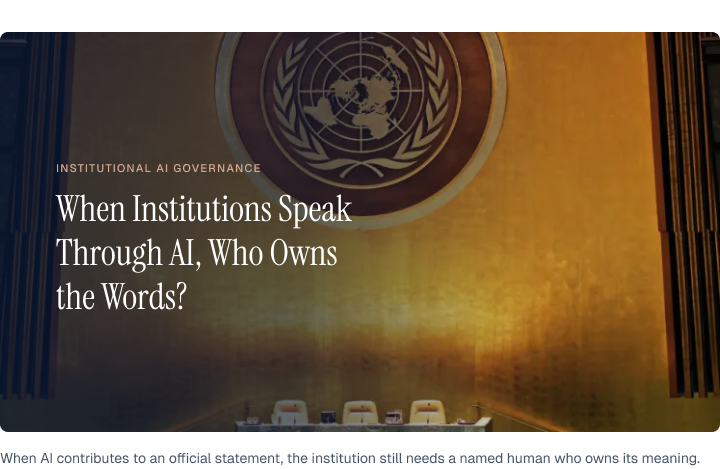
When Institutions Speak Through AI, Who Owns the Words?
AI may already be helping governments and executives write their most consequential statements. The governance problem is not whether a machine drafted the words. It is whether a human still owns their meaning.
By Suchetana Bauri · Published 29 September 2026 · 22-minute read
Key Takeaway
The scandal is not that presidents may use AI. It is that institutions can use AI to shape public meaning without keeping a credible record of the process.
- The wrong trial
- Ghostwriting
- The sameness tax
- Disclosure
- Voice protocol
- 30-day plan
• 01 / The Wrong Trial
The podium is crowded, yet the author is missing
A president walks to th“It has no loyalty to the institution’s valuese lectern at the United Nations. The flags are in place. The cameras are live. The statement arrives in the first person plural: we believe, we reject, we call upon. The grammar performs an old political trick. One person speaks, but an institution claims the words. Now there may be another presence at the podium. It has no flag, no constituency and no responsibility for what happens next.
An analysis published by the AI-detection company GPTZero examined 768 speeches, comprising 348,853 words, from 12 meetings of the 81st session of the UN General Assembly between 8 and 25 September 2026. It classified It classified 107 speeches, containing 57,729 words, as AI-generated under its detection methodology.¹ In the General Debate, it flagged 18 of 106 national statements, compared with four of 112 the previous year.²
Speeches Examined
768
across 12 General Assembly meetings
Words in AI-Classified Speeches
16.5%
of all words in the analysed sample
General Debate
18 / 106
statements flagged, vs 4 the previous year
Source: GPTZero, September 2026. Classification is document-level, not word-level.
That is the arresting version: one word in six at the UN may have come from a machine. It is also not quite what the evidence proves.
GPTZero did not establish the origin of each word. It classified entire speeches. Once a speech crossed its AI-probability threshold, every word in that speech entered the AI-generated total. The figure is therefore a document-level classification, not proof that a machine produced precisely one in every six words. The danger is that a mechanical threshold distracts us from the political and ethical choices of the humans who accepted the draft.
“A detector score is a lead to investigate, not a verdict to enforce.”
— Suchetana Bauri
Independent academic studies, including a landmark Stanford evaluation, have shown that AI detectors suffer from significant false-positive rates, particularly when processing texts written by non-native English speakers.³ ⁴ In international settings like the UN, where speeches are often drafted by multilingual diplomats using standard, structured diplomatic templates, the risk of misclassification is extraordinarily high. Slogans and generic boilerplate are the native language of both the diplomat and the LLM.
The UN is an especially awkward place to forget this. It is a multilingual institution full of translated statements, formal diplomatic conventions and speakers using English as an additional language. Predictable syntax may indicate a model. It may also indicate translation, protocol, a shared theme, a careful non-native speaker or simply the house style of multilateral diplomacy.
• 02 / Ghostwriting Is Not New
The automated speechwriter is different
Political speech has always been collaborative. Leaders rely on speechwriters, diplomats, policy specialists, translators, legal advisers and exhausted staff making final corrections in hotel rooms. Corporate leaders do the same with communications teams, investor relations, lawyers and subject experts. The public accepts this arrangement because authorship in institutional life has never meant typing every sentence. It means assuming responsibility for the statement.
Generative AI introduces a different kind of invisibility. A speechwriter may be invisible to the audience, but not to the organisation. An editor can ask who supplied a claim. Legal counsel can challenge a promise. A minister can reject a phrase. A version history can show when the meaning changed. The process is imperfect, political and occasionally chaotic, but its participants can be named. An LLM synthesises patterns from massive, unstructured training data. It can produce fluent language without disclosing which source shaped a sentence, whether a fact was retrieved or invented, or why one formulation prevailed over another. Most dangerously, it can turn a weakly supervised drafting process into polished prose.
These questions apply well beyond diplomacy. They belong in earnings statements, regulatory submissions, public-health notices, crisis responses, policy consultations, executive announcements and internal messages about jobs. In each case, language does something. It commits money, signals policy, moves markets, calms employees or distributes blame.
Polish is useful camouflage. Readers tend to notice broken language; they do not always notice broken provenance.
The questions that matter more than “Was AI used?”
1. What task did the system perform in this workflow?
2. What material or confidential data entered it?
3. Which specific claims came from verified human sources?
4. Who altered the substance or arguments of the draft?
5. Who reviewed the final meaning and verified its truth?
6. Who held the explicit human authority to publish?
7. What permanent record remains if this statement is challenged?
• 03 / The Convergence Problem
The convergence of institutional voice
Because LLMs are trained to predict statistically probable next words, their default outputs often drift towards a smooth, consensus-driven average. When multiple global institutions use the same commercial models to draft their policies, statements and reports, their voices begin to blur into a single, homogenised dialect.
This is the convergence tax on organisational communication. It replaces distinct, situated human perspectives with polished, predictable clauses that sound authoritative but communicate nothing. The real hazard is that this aesthetic polish creates a false sense of security, allowing leaders to issue complex, highly consequential statements without going through the messy, necessary human process of actually thinking through them.
These questions apply well beyond diplomacy. They belong in earnings statements, regulatory submissions, public-health notices, crisis responses, policy consultations, executive announcements and internal messages about jobs. In each case, language does something. It commits money, signals policy, moves markets, calms employees or distributes blame.
The first organisation saves drafting time. The hundredth inherits everyone else’s voice.
• 04 / Disclosure Is Not Enough
Moving past the “AI-Assisted” checkbox
Adding a generic “this text was generated with the assistance of AI” label is an evasion, not a solution. It tells the reader nothing useful about which ideas belong to the author and which were suggested by an autocomplete algorithm. To build real public trust, we need to focus on editorial control and explicit, verifiable human ownership of content.
Regulatory Insight: EU AI Act Article 50
Article 50 requires deployers to disclose certain AI-generated or manipulated text published on matters of public interest. The obligation does not apply where meaningful human review or editorial control has taken place and a person or organisation holds editorial responsibility.⁵ ⁶ The important phrase is not AI-generated. It is editorial responsibility.
India AI Governance Principles
IndiaAI’s principles call for organisational structures that identify who is accountable for AI outcomes, clear roles across the lifecycle, documentation and human supervisory control.⁷ India’s AI Governance Guidelines also emphasise understandable disclosures, accountability and grievance mechanisms.⁸
Level
What AI Does
Minimum Control
Assistive
Corrects grammar, formats text or transcribes approved material without changing meaning.
Author checks the output; public disclosure is usually unnecessary.
Substantive
Rewrites arguments, summarises evidence or translates politically, legally or culturally sensitive material.
Named editor verifies sources, reviews meaning, records AI contribution.
Delegated
Produces most of the position, narrative or final public statement from a structured brief.
Senior approval, retained evidence trail and contextual disclosure.
• 05 / Build an Evidence Trail
Implement an Institutional Voice Protocol
Rather than relying on vague policy statements, organisations can build a structured evidence trail for high-stakes AI-assisted communication. It should show how a document was produced, what data entered the workflow and who accepted final responsibility for its meaning.
Classify by consequence
Separate output into Routine, Sensitive, or Authoritative tiers to map appropriate verification protocols.
Otherwise, a crisis statement receives the same control as a routine email.
Record AI’s role, not every keystroke
For sensitive and authoritative material, retain the approved source pack, a proportionate record of the material AI contribution, the accountable editor and the final version.
Otherwise, there is no evidence when a statement is challenged.
Assign one accountable editor
A human lead must explicitly confirm that the approved position is maintained, facts are verified and no data was leaked.
Otherwise, approval becomes collective and responsibility becomes invisible.
Verify claims against source material
Open the original source to confirm passages, dates, jurisdictions and precise context before signing off.
Otherwise, fluent language substitutes for evidence.
Match disclosure to audience expectation
Disclose substantive AI use whenever hiding the tool’s contribution would materially change the reader’s understanding.
Otherwise, the audience cannot calibrate trust.
This creates an evidence trail without turning communicators into archivists. Public bodies may already have records-management duties. In the US, National Archives guidance says AI material used in official business or relied on in decision-making may qualify as a federal record.⁹ ¹⁰
Need to apply this to your communications workflow? Explore AI enablement and governance services.
Disclosure Template A
Generative AI helped organise and edit an initial draft. The named authors developed the argument, verified the sources and approved the final wording.
Disclosure Template B
AI produced the initial translation. A qualified language specialist reviewed the meaning, terminology and final wording before publication.
• 06 / Put It Live in 30 Days
A practical roadmap to operational readiness
Do not embark on a six-month policy writing programme that will be obsolete before the ink dries. Implement a simple, structured workflow change immediately and iterate based on real feedback.
Implementation Roadmap
4-Week Operational Timeline
Week 1
Map high-consequence outputs
Identify 10-15 recurring high-consequence communications.
Week 2
Assign controls and ownership
Classify each output and name its accountable editor.
Week 3
Add the workflow controls
Add AI-use, verification and approval fields.
Week 4
Test a controlled failure
Run a 45-minute exercise using three planted errors.
Connect the exercise to the organisation’s AI incident-reporting process. If an AI-assisted communication causes harm, the team needs more than a correction: it must preserve evidence, assess affected audiences, notify the right functions and decide whether external disclosure is required.
• 07 / The Human Signature
Ownership cannot be automated
As AI text tools become more ubiquitous and conversational, the human signature becomes a more important safeguard. It is not proof that every word was written unaided. It is the assurance that a situated, accountable person has examined the evidence, tested the context and stands behind the communication.
We must stop treating AI adoption as a technical deployment problem. It is a communication and governance challenge. When an institution publishes words, it publishes its integrity. If we fail to preserve the chain of human accountability, we lose more than accuracy—we lose the foundation of public trust itself.
The response should not be a hunt for suspicious adjectives or a detector score attached to every speech. Detection is too uncertain, and the obsession with catching AI mistakes the symptom for the system. The answer is a visible chain of responsibility: classify the communication by consequence, record AI’s role, verify claims against source material, name an accountable editor and retain enough evidence to explain the decision later.
AI may help write the sentence. It must not become the place where responsibility disappears.
— Suchetana Bauri
References:
[1] GPTZero, ‘Is AI Ghostwriting the United Nations General Assembly’ — gptzero.me
[2] POLITICO, ‘Is AI writing UN speeches?’ — politico.com
[3] Stanford HAI, ‘AI-Detectors Biased Against Non-Native English Writers’ — hai.stanford.edu
[4] NIST, ‘GenAI Pilot: Text Detection’ — nist.gov
[5] European Commission AI Act Service Desk, ‘Article 50: Transparency obligations’ — ec.europa.eu
[6] European Commission, ‘Finalised Transparency Rules for AI-Generated Content’ — ec.europa.eu
[7] IndiaAI, ‘Principles and Points of Focus’ — indiaai.gov.in
[7] IndiaAI, ‘Principles and Points of Focus’ — indiaai.gov.in
[9] NIST, ‘AI Risk Management Framework (AI RMF 1.0)’ — nist.gov
[10] US National Archives, ‘Guidance on Applying the Federal Records Act to AI’ — archives.gov
AI GOVERNANCE · STRATEGY CONSULTING
Can your organisation explain how an AI-assisted
I help communications, policy and leadership teams classify high-stakes content, assign accountable editors and build a review process they can actually use.