
• INSIGHTS · AI STRATEGY
Readiness Is not a Steering Committee
Before launching AI, organisations need more than a vendor, a policy and an executive sponsor. They need the conditions in which people can change how work gets done.
Access
Enablement
Everyday work
By Suchetana Bauri • AI readiness · 12 min read · 18 August 2026
At 9.07am on launch day, an executive tells the organisation that artificial intelligence will change everything. The announcement is suitably confident. There is a sleek demonstration, a video showcasing instant productivity gains, and a congratulatory sign-off.
By 9.12am, the questions begin. Can I use this with client information? What happens if it gets something wrong? Is it approved for this task?
These are not awkward implementation details. They are the real AI launch.
01 –
Activity is not readiness
WHAT ORGANISATIONS CALL READINESS
A vendor has been selected
Licences have been purchased
An AI policy has been published
A pilot has delivered success stories
Leaders have attended a workshop
Leaders have attended a workshop
WHAT IT ACTUALLY PROVES
Procurement is complete
Access exists
Legal and risk teams have considered some scenarios
A protected group received more support than most employees will
Senior people attended a workshop
Someone can count logins
None of this tells you whether a manager can help a worried employee change their work on a Wednesday afternoon.
02 –
AI does not improve culture. It reveals it.
Without a structured approach, systemic anxiety silently paralyses teams. When technology arrives from above as a mandate, individuals resort to performative usage-inflating logs to demonstrate compliance while their essential work patterns remain unchanged. Managers find themselves caught in the middle: tasked with enforcing adoption of tools they may not fully understand.
GALLUP FINDING
99%
of CHROs said AI was important to strategy. Yet half were not confident managers could guide employees in using AI at work.
MICROSOFT RESEARCH
67%
of reported AI impact is accounted for by organisational factors, compared with only 32% for individual mindset.
Real enablement starts at the workflow boundary. To build true capability, organisations must shift from theoretical tutorials to daily operational practices. Capability is not born in a lecture hall; it is forged through iterative trials on live, context-specific responsibilities.
03 –
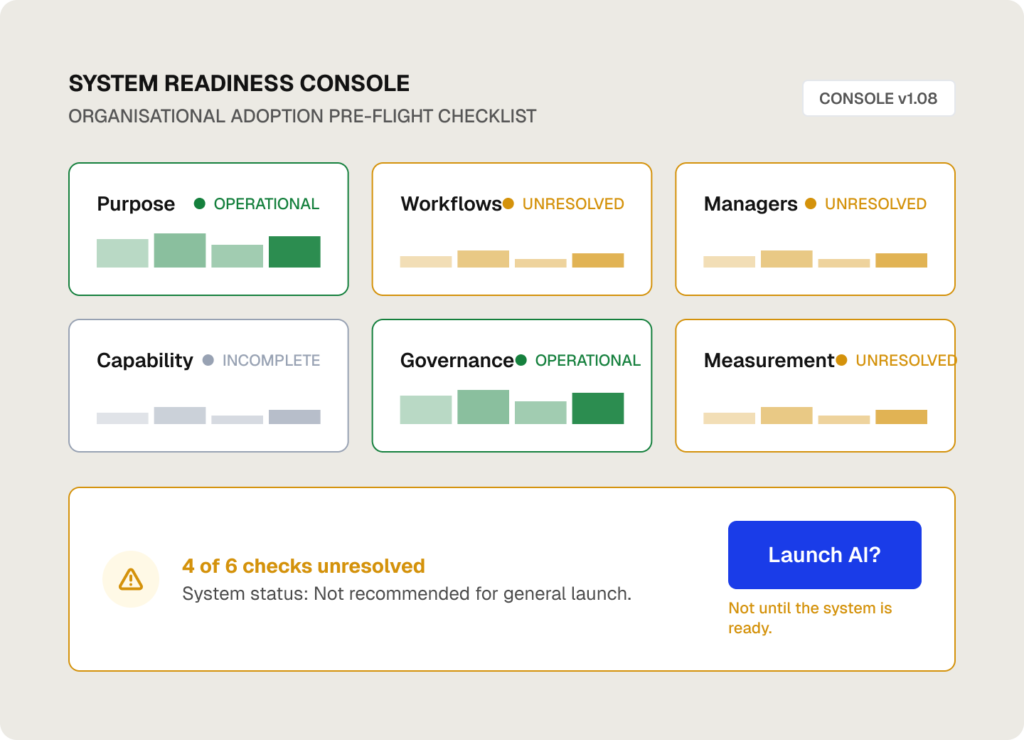
The Six Proofs of Readiness
Proof 01
Purpose
What problem are we solving? Clear boundaries on what AI is expected to address first.
Proof 02
Workflow
What will stop or change? Redesigning workflow paths rather than simply stacking technology.
Proof 03
Managers
Can teams get help in daily work? Equipping line managers with concrete situational answers.
Proof 04
Capability
Can people practise on real work? Safe sandboxes to test processes on complex real work.
Proof 05
Governance
Are the rules usable today? Pragmatic guidance over verbose policy documents.
Proof 06
Learning
Are we measuring better work, not logins? Quantifying business outcomes rather than usage metrics.
04 –
The pre-launch test
GO-NO-GO ASSESSMENT
Do not launch at scale if you cannot answer:
01.
02.
03.
04.
05.
06.
07.
08.
09.
10.
What important work problem will this solve first?
Which employee groups will experience the greatest change?
What tasks, reports, approvals or routines will stop, simplify or move?
How will managers explain the change in the context of their own teams?
Which tools and data uses are approved, restricted or prohibited?
What human review is required for high-consequence work?
Where can employees get a clear answer within a working day?
How will people practise with real, role-specific work?
What will show that the change has improved quality or outcomes-not merely increased usage?
What will leaders change if employees’ lived experience contradicts the dashboard?
AI READINESS IS ORGANISATIONAL DESIGN
Let’s talk.
If AI is creating more tools, more uncertainty and more work, the problem is not employee enthusiasm. It is the system around the tool.