
Students in ads are always walking somewhere. Across lawns. Up library steps. Into bright futures. They carry spotless bags, wear soft knits, and somehow look emotionally regulated before a deadline. Apple’s student Mac film cuts against that polished tradition and finally shows what Mac for college students looks like when life is messy, not curated.apple+1
That is what makes the video effective. It understands that the modern university experience is not mainly about aspiration. It is about pressure. Pressure to keep up, pressure to look composed, pressure to turn every setback into a lesson and every delay into a personal branding opportunity. The recurring line — “I’ve got this all under control” — lands because everyone knows that, at some point in college, that sentence is less a fact than a prayer.apple
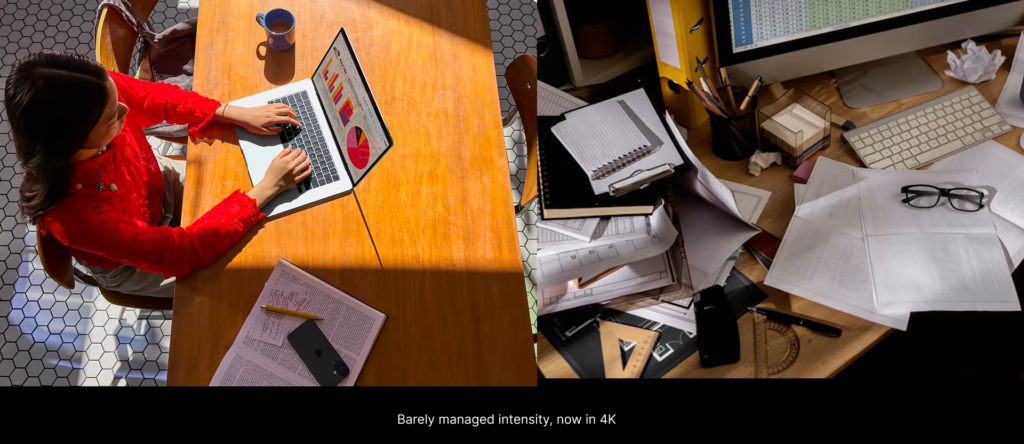
“Every frame says: ‘I’ve got this all under control.’ Every student face quietly says: ‘Obviously I don’t.’”
Apple is smart enough to know that a student campaign in 2026 cannot be all sunshine and stationery. So the film reaches for something closer to truth: the tremor before an exam, the panic of things not working, the private humiliation of not being as on top of your life as you think you should be. Then, because it is still an Apple ad, it offers a familiar answer. Here is a Mac. Here is a machine with enough battery, speed and polish to help you hold the week together.apple+1
That is not a terrible answer. In fact, for many students, Mac genuinely is a very good tool. Apple’s college pages make a clear practical case for it: up to 18 hours of battery life on MacBook Air, up to 24 hours on some MacBook Pro models, long-term durability, strong performance from Apple silicon, easy syncing across devices, writing tools, transcription, summaries, and enough ecosystem glue to make a chaotic semester feel a little less chaotic. But the film also does what ads do best: it compresses the problem. It turns a messy mix of stress, class, money, institutional failure and ambition into a cinematic arc with a product at the centre.apple
This is where the interesting conversation begins. Not “is Mac good?” but “what exactly is Apple selling when it sells Mac to students through stress?” This piece argues that the film works because it captures something real about student life, but also that it quietly mistakes resilience for infrastructure. A laptop can support you. It cannot be your only system.
Apple’s smartest move: showing wobble
The first thing the film gets right is emotional texture. It shows students across disciplines — business, engineering, design, the arts — not as mini adults with perfect workflows, but as people in the middle of things going sideways. That is a significant shift from older student-tech advertising, which often treated education as a string of neatly branded milestones. Apple’s film is more interested in the feeling of almost dropping the ball.apple
There is a reason this lands. Student life has become harder to narrate honestly without talking about strain. Apple’s own newsroom language stays upbeat, describing students around the world trusting Mac and iPad for “longevity, portability, and reliability” as they tackle everything from screen writing to visual arts and engineering. That framing is polished, but it reflects a genuine reality: students are juggling more than lectures. They are managing side hustles, social media identities, competitive internships, financial pressure and an ambient sense that every semester must prove something.apple
The mantra “I’ve got this all under control” is therefore doing two jobs at once. On one level, it is a resilience slogan. Keep going. You will figure it out. On another, it captures a more fragile truth: that students are often performing calm for professors, parents, classmates and themselves. The phrase works because it is both affirmation and cover story.
“Resilience is useful. Pretending not to be overwhelmed is something else.”
That ambiguity gives the film its edge. Apple is not mocking students for being stressed, and it is not flattening stress into a single melodramatic collapse. Instead, it turns pressure into atmosphere. The problem is that once the ad has created that atmosphere, it still needs an answer. The answer, inevitably, is product.
What Apple is really selling
On the surface, Apple is selling laptops. At a deeper level, it is selling a particular fantasy of competence. Not the fantasy that everything will be easy, but the fantasy that, with the right machine, difficulty will remain manageable. That distinction matters.
Apple’s college students page is unusually explicit about the practical case for Mac. It promises all-day battery life, durable aluminium hardware, software updates that keep the device usable over years, iPhone Mirroring, Universal Clipboard, AirDrop, Apple Intelligence writing tools, and features that help students record, transcribe and summarise study sessions. This is a much more grounded sales case than the average lifestyle campaign. It is less “be your best self” and more “forget your charger, finish your work, survive the semester”.apple
That practicality comes through in Apple’s own student stories too. In a 2024 Newsroom feature, Brayden Gogis, a mechanical engineering and biochemistry student, says his MacBook Air runs AutoCAD, supports note-taking for organic chemistry, and helps him build apps in Xcode. Medical student Yoora Jung highlights iPad note-taking and the promise of Apple Intelligence features such as rewriting, proofreading and summarising text. Anuj Pachhel, studying medicine in Nagpur, points to battery life, speed, and video editing with DaVinci Resolve Studio on MacBook Pro.apple
These are not fake use cases. They are persuasive precisely because they sound like work. Not vibes, not aesthetics, not desk-tour theatre. Work. Apple knows that students do not just want to look studious. They want to make it through a very long Tuesday.
Still, this is where the story gets slippery. When Apple says Mac is “reliable from bachelor’s degrees to PhDs” and designed to keep you running smoothly “through college and into your professional life”, it is not only selling durability. It is selling calm as a purchasable state. Buy this machine, and maybe the edges of your week soften.apple
“The dream is not really about owning a Mac. It is about owning a semester that does not constantly threaten to come apart.”
That is a powerful pitch. It is also, to be blunt, only partly true.
Where Mac genuinely helps
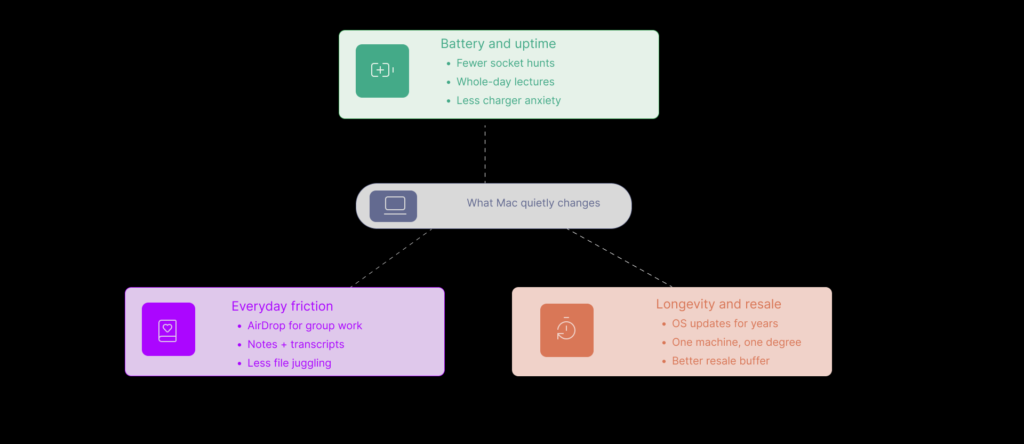
Before getting sceptical, it is worth being fair. One reason Apple’s student marketing works is that Mac does solve several problems that matter a great deal in actual student life.
Battery is not sexy, but it is freedom
Apple says MacBook Air offers up to 18 hours of battery life, while some MacBook Pro models go up to 24 hours. Those are laboratory numbers, not a perfect prediction of lecture-hall reality, but the broader point holds. Good battery life changes the shape of a day.apple
For students, that means not circling libraries for the last free socket. It means not carrying a charger the size of a brick “just in case”. It means not watching your machine die as a group project hits the worst possible point. Battery is not glamour. It is a quiet reduction in daily friction.
Independent commentary on student laptops often stresses exactly this: a good student device needs to last across lectures, travel, writing, reading and casual work without forcing users to think about power constantly. Apple’s advantage here is not just spec-sheet endurance. It is how little attention the machine demands once it is charged.which.co+2
Ecosystem calm is real
The second advantage is ecosystem coherence. Apple’s student pages keep returning to features such as Universal Clipboard, iPhone Mirroring, AirDrop, and cross-device syncing for notes, reminders and files. Read cynically, that is ecosystem lock-in. Read from the point of view of a student with five deadlines and eight browser tabs open, it is also convenience.apple
Gogis tells Apple that his notes, texts, calendar events and reminders sync across devices and help keep him on track when he is being “pulled in a million different directions”. That is one of the rare lines in student tech marketing that feels fully believable. Students are not looking for transcendence. They are looking for fewer annoying breaks in concentration.apple
There is a larger design lesson here. The best student technology is not the flashiest. It is the technology that disappears into routine and leaves a little more mental bandwidth for the work itself. When Apple shows students moving between iPhone, iPad and Mac with minimal friction, it is not just selling premium devices. It is selling continuity.apple+1
The long game matters
Apple also makes a strong longevity argument. The college page emphasises durable aluminium builds and software updates that keep devices viable “through college and into your professional life”. For students who need one machine to last across an entire degree and possibly into early work, that claim matters more than flashy launch-day features.apple
Some external guides on student laptops note that upfront price is only part of the story; lifespan, resale value, reliability and how often a device needs replacement all affect total cost. On those terms, Mac can make rational sense, especially for students in writing-heavy, research-heavy, design or coding-adjacent courses who want one dependable laptop for years.tomfanderson+1
So yes: Apple is simplifying. But it is simplifying around a product that, in many cases, does offer real practical value.
The part the ad cannot afford to show
This is where the ad becomes more interesting as a cultural object than as a buying guide. Its emotional insight is strong. Its social analysis is thin.
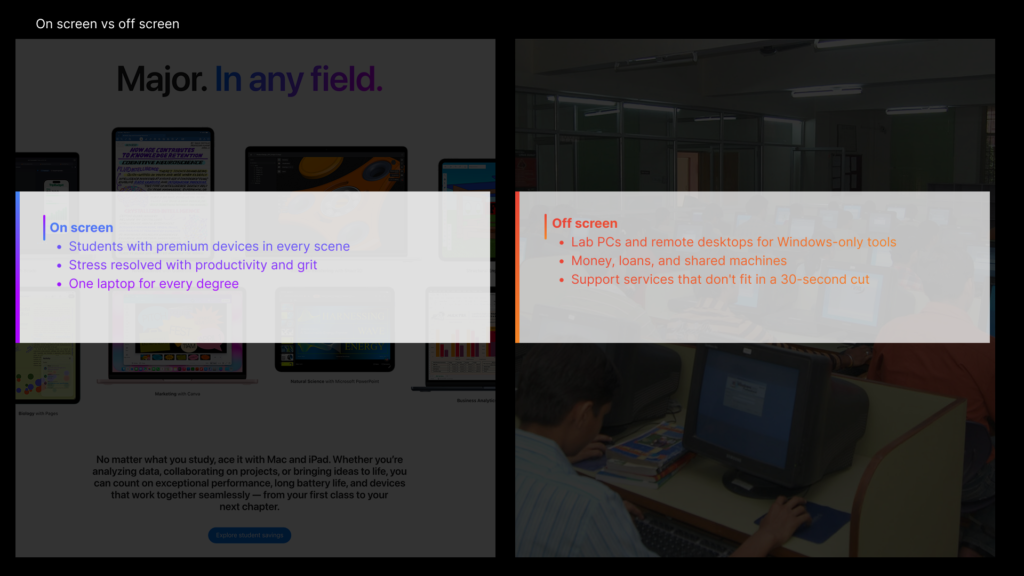
The film tells the truth about strain, but only up to the point where strain can still be aesthetically contained. It can show stress, wobble, and near-failure. What it cannot really show is structure: class differences, course-specific hardware needs, weak university support systems, and the basic fact that a very good laptop is still out of reach for many students.
A Mac is not the right answer to every degree
Apple’s education page is broad by design, showing Mac and iPad across computer science, illustration, business, anatomy, design, mathematics and engineering. The message is clear: whatever you study, this can work for you. That is persuasive marketing. It is not always complete guidance.apple
Course requirements still matter. External guides for students routinely advise checking whether your degree depends on software that runs best — or only — on Windows, especially in some engineering, architecture or specialist technical contexts. Universities often provide lab access or remote desktop options, but that creates a different kind of dependency: your beautiful personal machine becomes secondary at precisely the moment you most need it.telegraph.co+1
This is where a calmer buying conversation would help. Ask not “is Mac good for students?” but “is Mac good for my course, my tools, my campus, my actual week?” Apple understandably does not want to lead with that question. Students should.
The ad universalises access
The second blind spot is money. Apple’s college pages talk about education savings, trade-in credits, special AppleCare pricing and payment over time. Those are real ways to reduce cost. They do not change the fact that, in many countries and families, buying a Mac is still a major financial decision rather than a casual upgrade.apple
This matters because student advertising often smuggles class assumptions in through visual normality. If every student in the campaign has a premium device, the device starts to look like the baseline for being serious, modern, prepared. It is not. Plenty of excellent students work on older Windows laptops, shared desktops, borrowed devices, campus labs, and whatever they can keep functioning long enough to finish the term.
“Owning a Mac does not make you disciplined, ambitious or future-ready. It means you have access to one kind of advantage.”
That is not an argument against buying one. It is an argument against mistaking hardware for moral worth.
Resilience cannot replace support
The biggest thing the ad softens is institutional responsibility. The line “I’ve got this all under control” is emotionally potent because students are often expected to behave as if they do. The expectation is simple and brutal: be capable, stay adaptable, keep bouncing back. Learn the material, find internships, answer emails professionally, make your portfolio, maintain your friendships, and do it all with the correct amount of cheerful grit.
A Mac can absolutely help with parts of this. Apple highlights features such as Writing Tools to rewrite and summarise text, note recording and transcription, AirDrop for group projects, and multitasking tools like Stage Manager and window tiling. Those features can reduce friction. They can help a student manage information better. They can make a packed week less chaotic.apple
What they cannot do is substitute for proper support. The gaps it cannot fill are obvious: proper mental health support, reasonable deadlines, clear teaching, financial steadiness, and a culture where asking for help is easier than pretending you are fine.
If a university system is running on student overextension, then better devices may make that overextension smoother. They do not cure it.
What students should actually ask before buying a Mac
The useful response to Apple’s film is not cynicism. It is better questions.
Five questions before you buy a Mac for uni
A quick interactive checklist to help you think beyond the ad and buy around your degree, budget and actual week.
- 1Ask seniors which software they actually use in second year, not just what the brochure says. Check for any Windows-only tools, lab dependencies or remote desktop workarounds.
- 2Think about lecture blocks, library days, long commutes and shared study spaces. Battery life matters more if your week regularly happens far from sockets.
- 3A more expensive laptop can make sense if it stays fast, supported and useful across an entire degree and into early work. Buy for lifespan, not just for this semester.
- 4Maybe it is charger anxiety, slow file transfers, unreliable video calls, or a machine that stutters under design tools. Name the real pain before you buy the fix.
- 5Look beyond day one. Check authorised service access, likely repair turnaround times, warranty coverage and what happens if something fails in the middle of term.
1. What does your course require in practice?
Ignore the fantasy version of your degree for a moment. Ask what tools second‑year students genuinely rely on, which programs routinely crash in labs, and which laptops or setups seniors recommend once the marketing slides are out of the way. Which assignments depend on tools with awkward compatibility? General student laptop guides keep returning to this point because it is the point that saves people money and grief.which.co+1
2. How important is battery and portability to your real week?
If you commute, move between buildings all day, sit through long lectures, work in libraries and prefer not to carry heavy accessories, battery life matters a lot. If you mostly work at a desk with constant power, it matters less. Buy around your routine, not around the ad.which.co+1
3. Are you buying for one semester, one degree, or your next five years?
Longevity changes the calculation. A higher upfront cost can make sense if the device is likely to remain fast, supported and useful through undergrad and beyond. If money is tight, though, it is worth comparing total cost of ownership against very good mid-range alternatives, not only against the worst cheap laptop on the shelf.tomfanderson+2
4. Which friction do you most want to remove?
Do you need stronger battery life? A lighter machine? Better typing comfort? Easier file movement between phone and laptop? Better support for coding or design tools? The right answer is not the most powerful device. It is the device that removes the friction you meet most often.
5. What support exists around the device?
Repairs, service, warranty coverage, accidental damage protection, and the availability of authorised support all matter once the machine stops being new. A laptop choice is not only about day one. It is about how ugly day 473 might get.apple
“Control is not a mood. It is a set of boring systems that keep a hard week from becoming a disaster.”
A better reading of Apple’s student film
So what is the fairest way to read this campaign? Not as a lie. Not as gospel. As a beautifully made compression of a complicated truth.
University often feels like barely managed intensity, and tools genuinely matter. Strong battery, fast performance, reliable syncing and low‑friction software can make an outsized difference over a degree. Even at their best, though, devices cannot solve what the campaign is borrowing emotionally: precarity, pressure, exhaustion and the need to appear fine when you are not.apple+1
Apple’s brilliance here is that it does not pretend stress is absent. It makes stress legible. Its limitation is that it still needs to resolve that stress through consumption. Buy the machine, and you are one step closer to handling everything.
There is a kinder, more useful way to put it. If your course fits, your budget stretches, and the ecosystem works for how you live, a Mac can be an excellent partner for college. It is a partner, nothing more – not a saviour, not a personality, and not evidence that you are somehow doing university the ‘right’ way. Just a good tool.
That may sound less glamorous than the ad. It is also more liberating. Students do not need another story about having everything under control. They need reliable devices, honest expectations, and enough support around them that losing control for a week does not feel like failure.
Footnotes
- Apple, “Education – College Students”, accessed May 2026.apple
- Apple Newsroom, “College students head to campus with Mac and iPad”, 19 August 2024.apple
- Which?, “Best budget laptops for students”, 2 September 2024.which.co
- Tom F. Anderson, “The Best Mac for College Students (And Most of Us, Really)”, 10 July 2024.tomfanderson
- The Telegraph, “The best laptops for students, tested by a tech expert and former teacher”, accessed May 2026.telegraph.co