
Most AI product messaging is trying to do two contradictory things at once. It wants to sound magical and safe, sweeping and precise, disruptive and dependable. The headline promises transformation; the small print quietly admits the system can be wrong, partial, stale or overconfident.forbes+1
That split is no longer a minor brand problem. It is one of the main problems in AI marketing, because buyers are now less impressed by scale alone and more interested in trust, control and proof. In a market crowded with agents, copilots and breathless promises about autonomous work, the strongest product stories are not the loudest. They are the clearest.revsure+3
“In AI, clarity is no longer a nice tone-of-voice choice. It is part of the product.”
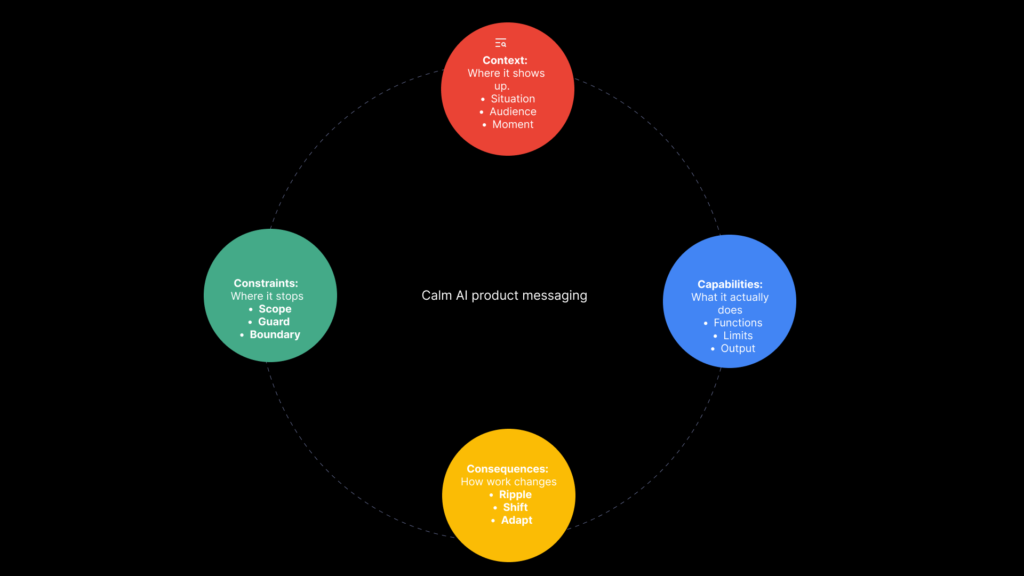
This is the framework that helps untangle messy AI narratives for teams: Context, Constraints, Capabilities and Consequences. It borrows from classic messaging frameworks, which stress audience focus, clear value propositions, message pillars and proof points. But it adapts that discipline for a category where the product is probabilistic, the market is overheated and the emotional stakes are higher than many teams admit.gradybritton+2
The sameness problem
If you line up the major AI assistants, the family resemblance is striking. OpenAI’s ChatGPT page opens with broad, low-friction utility language: “Get answers. Find inspiration. Be more productive.” It then stacks example after example around writing, learning, coding, planning and image analysis.
Anthropic’s Claude page takes a different tonal route, calling Claude a “thinking partner” and “the AI for problem solvers”. It then shows examples built around collaborative reasoning, local file work, code fixes, study guides and approval-based delegation through Cowork.
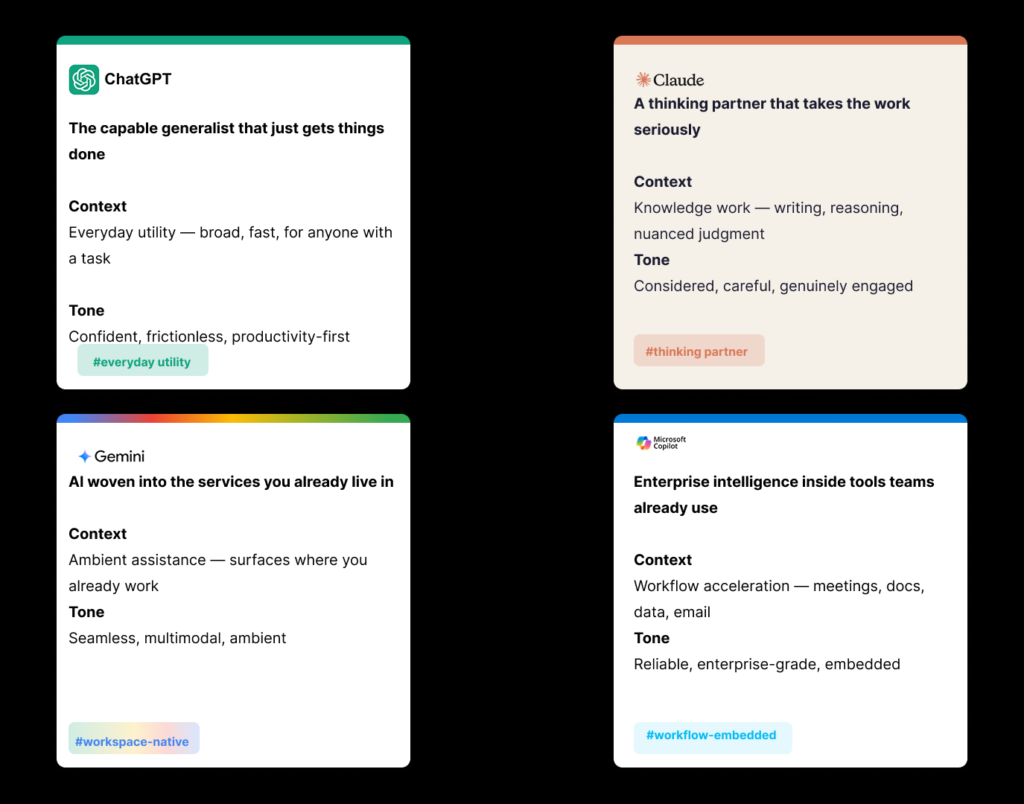
Google Gemini and Microsoft Copilot are different again, but not entirely. Both lean on assistant metaphors, ecosystem familiarity and productivity gain, even though the surrounding systems give them very different advantages in practice. The result is a market where many products sound broadly similar long before a buyer reaches the point of evaluating fit.fortune+1
Why this weakens the story
A strong messaging framework gives a reader three things quickly: a reason to care, a reason to believe and a sense of fit. Much AI marketing gets the first part mostly right and the other two only halfway. The category is full of large promises and fuzzy edges.courses.lumenlearning+1
Calm technology principles offer a better direction. They argue that technology should respect attention, simplify complexity and work gracefully in the background when possible. Most AI messaging still behaves like it wants to be the loudest thing in the room.calmtech+1
“The problem with most AI messaging is not that it is ambitious. It is that it is vague where it should be specific, and loud where it should be calm.”
Context: start with the job, not the glow
Most messy AI narratives begin with the model, the feature list or the glow of possibility. That is how teams end up writing lines such as “AI for everything your team needs” or “your intelligent copilot for work”. Those lines are not necessarily false. They are just too far away from the moment where a person decides whether the tool is worth using.gradybritton+1
Classic messaging frameworks begin with audience and value because people do not buy architecture. They buy relief, speed or progress inside a recognisable situation. AI teams often forget this because the technology itself feels like the headline. For users, though, the real headline is usually smaller and much more practical.incurvo+1
What ChatGPT gets right about context
ChatGPT is a useful example of context handled at scale. Its overview page does not lead with models or benchmarks. It starts with verbs ordinary people understand: get answers, find inspiration and be more productive. It then reinforces that frame with concrete prompts, from writing a text to neighbours and improving an essay to creating a Python script or planning a trip.
That matters because breadth is hard to message without sounding empty. ChatGPT avoids some of that emptiness by grounding breadth in recognisable tasks. The page gives users a quick answer to the most important early question: where does this fit into my life?
What Claude gets right about context
Claude takes a more deliberate route. Anthropic positions it as a “thinking partner” and “the AI for problem solvers”, then uses examples around organising files, building study guides, fixing a login flow, analysing data and preparing reports. The tone is more measured than ChatGPT’s, but the underlying move is similar: it creates scenes of use rather than abstract category language.
That contrast is instructive. ChatGPT’s context is everyday utility at massive scale. Claude’s context is thoughtful collaboration on harder work. Neither is just saying “AI assistant” and walking away.
What Gemini and Copilot reveal
Google Gemini and Microsoft Copilot add another lesson: context often lives in the surrounding ecosystem as much as the headline. Buyers often understand Copilot through Microsoft 365 habits such as email, documents, meetings and enterprise search. Google’s AI products are often understood through Search, Workspace and Android behaviour instead.linkedin+1
That means AI messaging has to account for the work environment the tool enters, not just the model it uses. In this category, the surrounding system is often part of the product story.fortune+1
Constraints: say what the system will not do
This is the step most teams avoid because they think it makes the product feel smaller. In practice, it often makes the product feel safer, smarter and more adult. In a market where trust is being actively renegotiated, visible constraints are no longer a weakness. They are evidence of maturity.linkedin+1
A calm technology, by definition, should reduce cognitive burden and behave well at the edges, including when things go wrong. AI product messaging should do the same. A system that can act on files, code, summaries or customer data needs to tell people where the hand-offs and boundaries are.adsabs.harvard+1
Claude’s approval logic is part of the message
Claude offers one of the clearest examples of this. Its Cowork messaging says users stay in control, grant access only to the files they want and approve every step. That is not a footnote buried in legal text. It is front-stage messaging.
In one move, Anthropic names the capability, the limit and the human role. The product does not sound smaller because of that. It sounds more usable.
Why Copilot and Gemini make boundary-setting essential
Copilot’s value is tied closely to familiar work surfaces such as email, chats, documents and meetings. That makes boundary questions central to the sale. What information can it access, what should employees review before sending, and how much control remains with the user? The closer the AI sits to operational work, the more important those questions become.linkedin
Google’s AI ecosystem faces a similar challenge from another angle. Integration is a strength, but it also raises questions about recency, provenance and trust. If an assistant draws on live information or connected services, the messaging needs to clarify what is current, what is inferred and what still needs human judgement.fortune
“Helpful everywhere can quickly become responsible nowhere.”
A practical test for teams
One exercise improves almost every AI landing page: write a short “This is not for” block.” “This is not for final legal sign‑off; keep a lawyer in the loop.” “In high‑stakes customer situations, it should not send unsupervised responses.” “When the work depends on data sources the system cannot see, this tool is not the right fit.”
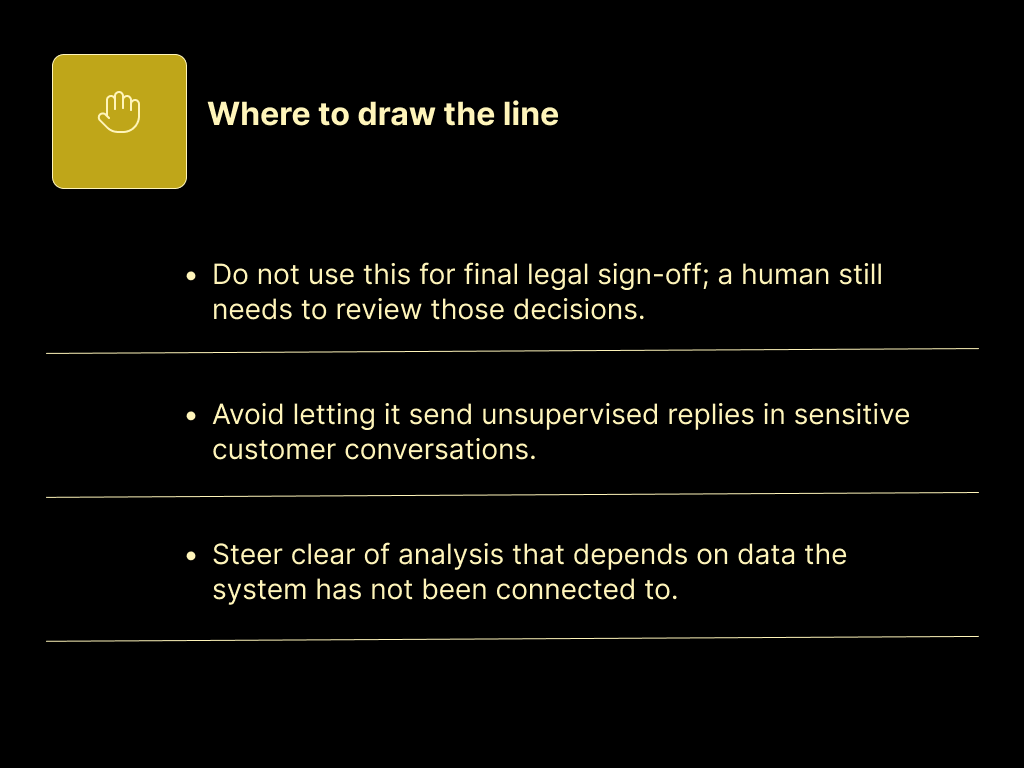
Avoid letting it send unsupervised replies in sensitive customer conversations.
Steer clear of analysis that depends on data the system has not been connected to.
Those lines do not kill momentum. They stop the story from turning into theatre.
Capabilities: show what happens in plain English
Once context and constraints are clear, capability becomes easier to write and much harder to fake. This is where many teams try to begin, and it is why they end up with sentences full of “powered by” and “intelligent orchestration”. Without context, capabilities sound vague. Without constraints, they sound inflated.
A strong messaging framework links value to proof and gives readers a compact reason to believe. For AI products, that means describing the capability in a way that a non-technical buyer can picture immediately.courses.lumenlearning+1
ChatGPT’s task language is a useful discipline
ChatGPT’s page is packed with ordinary task language: write a text, improve an essay, automate reports, analyse data, create a chart, plan a day, build a webpage. These are not polished brand abstractions. They are clear descriptions of work.
That directness is worth studying. The user can picture the input and guess the output. In AI messaging, that is half the battle.
Claude frames capability through collaboration
Claude does something similar with a different texture. Its page describes breaking down problems, expanding logic, simplifying complexity, building spreadsheets, preparing reports, debugging code and creating study guides from uploaded materials. The important thing is not the elegance of the phrase. It is the legibility of the task.
This is where many AI companies should be tougher on themselves. “Helps your team move faster” is not a capability. “Clusters support tickets into repeat issues and drafts a two-minute summary for your ops lead” is a capability. “Transforms enterprise knowledge into action” is not a capability. “Searches approved internal docs and drafts a first-pass answer with linked sources” is a capability.incurvo+2
The sentence pattern that keeps copy honest
A useful line pattern is simple: when you do X, the AI does Y, so you can do Z. It keeps capability grounded and stops the message from drifting into omniscient language. That matters because AI systems are not deterministic tools in the old sense. They are probabilistic systems with strong and weak zones.forbes+1
Verb choice matters here too. Drafts, flags, surfaces, summarises, routes and recommends are often better than solves, guarantees, replaces or eliminates. The calmer verbs are not weaker. They are usually more accurate, and accuracy is now one of the few real competitive advantages in a category drowning in inflated language.linkedin+1
Consequences: tell the truth about what changes
This is the part most AI messaging skips. It tells you what the feature does but not what life looks like after adoption. That is a miss, because buyers are not only buying functions. They are buying changes in workflow, pace, confidence, responsibility and office politics.
Standard messaging advice often describes the after-state in broad terms such as efficiency, relief, scale or growth. For AI, that is not enough. When a product changes how decisions are made or how knowledge is handled, the consequences are not abstract. Meetings disappear. Review rituals appear. Some people feel relieved. Some feel watched.incurvo
Different assistants imply different futures of work
ChatGPT’s broad productivity frame implies a world where more people use AI as an everyday thought partner for writing, learning, planning and coding. Claude’s collaboration frame implies a world where harder work is broken down with a more deliberate, approval-aware partner. Copilot implies a world where AI becomes part of the grain of office work, folded into documents, meetings and communication flows. Google’s AI products imply a world where assistance becomes more ambient, tied to search, devices and workspace habits.linkedin+1
These are not just product differences. They are different stories about how work and attention should be organised.fortune+1
Why the consequences belong in the copy
Good messaging should make those consequences visible. Which tasks quietly drop out of their week? What new checkpoint or review ritual takes their place?Where does the human stay firmly in charge? And which fear does the product calm while introducing a new note of caution?
This is especially important now because trust in AI buying is increasingly tied to governance, explainability and internal defensibility. A buyer often needs to justify not just why the product is useful, but why it is safe to place inside a team’s workflow.martechedge+1
“If the copy cannot tell a believable story about how work changes, the buyer has to invent one alone.”
A better way to draft AI messaging
This framework is not a grand rebrand ritual. It is a practical way to make an AI story sound like a product rather than a prediction. A 90-minute workshop is often enough to produce a serious first pass.
Start with Context: describe one real user in one real situation under one real pressure. Move to Constraints: list what the system cannot do, should not do or should never do alone. Then write Capabilities using concrete inputs, outputs and outcomes. Finish with Consequences: describe what changes in the user’s workflow, where human review stays essential and what new habits or safeguards appear after rollout.
The outputs can then map neatly into more familiar messaging structures. Context sharpens audience definition. Constraints help build trust language and proof. Capabilities become the value proposition and supporting pillars. Consequences feed the website, onboarding, demos, internal comms and sales story.gradybritton+2
There is room for AI inside this process, but not at the beginning. AI tools can help generate variants, compress drafts or tailor wording once the human thinking is done. Ask AI to produce the message before you have named the job, the limit and the consequence, and it will usually give you what the category already has: smooth prose, inflated confidence and no real point of view.pedowitzgroup+2
That is the deeper argument here. Calm systems need clear stories because ambiguity is now expensive. The next generation of strong AI brands will probably not be the ones making the biggest claims about autonomous everything. They will be the ones whose messaging matches what their product can do on a bad day as well as a good one.calmtech+2
Footnotes
- Anthropic, “Meet Claude”, accessed May 2026.
- OpenAI, “ChatGPT”, accessed May 2026.
- Grady Britton, “The Power of a Messaging Framework”, 2025.gradybritton
- Incurvo, “Value Proposition & Messaging Strategy Framework”, accessed May 2026.incurvo
- Lumen Learning, “Defining the Message”, accessed May 2026.courses.lumenlearning
- Calm Technology, “Calm Technology”, accessed May 2026.calmtech
- ADS abstract, “Principles and Patterns of Interaction Design under Concept of Calm”, 2021.adsabs.harvard
- Forbes/Forrester, “How GenAI and Trust Are Reshaping B2B Buying in 2026”, 2026.forbes
- Revsure, “2026 GTM Strategy Insights | Trust, Governance & AI-Powered Decisions”, 2025.revsure
- Fortune, “How to decide between AI tools best for business needs”, 2025.fortune
- Comparative commentary on Microsoft Copilot, ChatGPT, Claude and Google AI tools, 2026.linkedin
- Commentary on AI buyers and demand for guardrails in 2026, 2025.linkedin
- Martech Edge, “How AI Is Rewriting Trust and Buying Behavior in 2026”, accessed May 2026.martechedge
- Calm Tech Institute, “Designing Tech That (Finally) Respects Our Time & Humanity”, 2024.calmtech
- Pedowitz Group, “Crafting Messaging Frameworks with AI”, 2026.pedowitzgroup
- Conveyor, “Creating a Brand Messaging Framework with AI”, 2025.conveyormg
- Pedowitz Group, “AI-Crafted Product Messaging Frameworks”, 2025.pedowitzgroup