
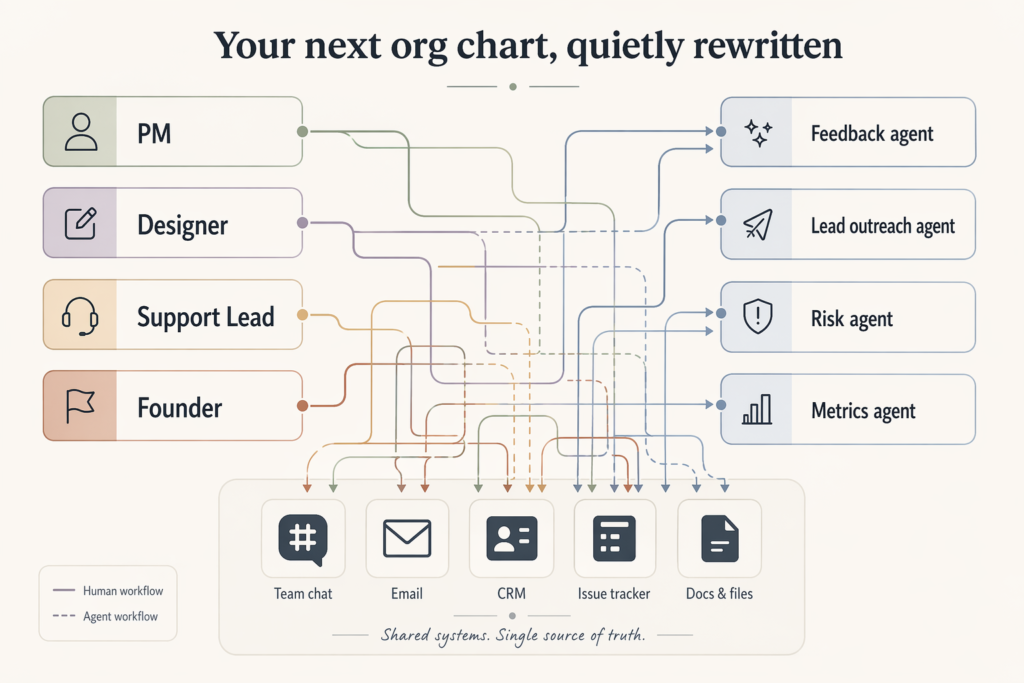
Somewhere between a Jira ticket and a Friday metrics deck, a quiet re‑org is underway. ChatGPT’s new workspace agents aren’t assistants; they’re proto‑team members with API keys and a job description.
They don’t sit in your org chart, but if you’re not careful, they’ll start behaving like your most reliable product analyst, SDR, risk officer and rev‑ops associate rolled into one. That’s the opportunity and the risk. As an AI advocate, I’m not asking whether we should use them. I’m asking whether we’re ready to live with the organisation they will quietly create.
Thesis: your next shadow org chart is made of agents
Workspace agents in ChatGPT are being pitched as “shared agents that can handle complex tasks and long‑running workflows across tools and teams”.¹ In plain English:
Describe the job, connect your tools, and ChatGPT will create a worker that never sleeps, never forgets context, and runs in the background until you tell it to stop.¹siliconangle
OpenAI’s own examples are telling:
- A product feedback routing agent that scans Slack, forums and support tickets, clusters issues, and opens Linear tickets.²youtube
- A lead outreach agent that grades leads, writes emails, and runs a follow‑up cadence.¹help.openai
- A third‑party risk agent that screens vendors, compiles evidence and outputs due‑diligence summaries.¹help.openai
- A software review agent that evaluates internal tool requests and opens tickets for IT.²youtube
- A weekly metrics reporting agent that pulls data from Drive, calculates KPIs, builds charts and drafts the narrative.³youtube
Individually, each looks like benign automation. Taken together, however, they amount to something else: a parallel org made of scripted judgement calls, embedded directly into your operational stack.
The claim of this piece is simple:
For small product teams, especially in India, the question is no longer “should we use agents?” but “how do we design this shadow org so it reflects our judgement, not just OpenAI’s defaults?”
If you don’t answer that, the answers will be made for you – in your Slack, your CRM, your Jira and your weekly reviews.
From “assistant in a tab” to “back‑office on autopilot”
The official documentation is very clear about what these agents are for: work “that takes time, context, and follow‑through: coordinating across tools like Slack and Linear, tracking progress, and moving tasks forward without needing constant supervision”.¹timesofindia.indiatimes+1
This marks a subtle but important shift from the original “ask ChatGPT a question in a browser” mental model. The new paradigm is:
- Long‑running: agents live across days or weeks, not just a single chat session.¹help.openai
- Tool‑connected: they plug into Slack, email, CRMs, project trackers, Google Drive and more.¹venturebeat+1
- Shared: you “build once, share across teams”.¹x+1
In other words, these are not personal helpers. They are team processes encoded as code and language instructions. The interface is friendly; the implications are not.
Every time you turn a recurring workflow into an agent, you’re doing three things:
- First, baking your current process into a set of instructions and assumptions.¹help.openai
- Second, giving those instructions the power to act across systems without human initiation.¹siliconangle
- Third, making that behaviour reusable and scalable inside your organisation.¹help.openai
You’re not just automating tasks. You’re institutionalising a particular way of doing them – including all your blind spots.
The five agents that quietly change how you work
Now let’s look briefly at what each demo agent actually does, because this is the substrate based on which we’ll build the Indian playbook.
1. Product feedback routing agent
- Reads product feedback from Slack, public forums and support channels via app connections and web search.²youtube+1
- Groups and synthesises that feedback into a daily summary for the product leadership channel.²youtube
- Creates and updates Linear issues with rich context for each recurring problem.²youtube
Importantly, the agent’s permissions are explicit and limited – it can only access the tools and data you give it.¹timesofindia.indiatimes+1
In practice, you’re centralising product signal inside one agent. That makes your feedback process more systematic – and concentrates agenda‑setting power inside a black box that now decides which complaints are “themes” worth action.
2. Lead outreach agent
In the lead outreach demo, an agent:
- Takes a plain‑language description of your SDR workflow.³youtube
- Generates a multi‑step plan: qualifying leads, drafting emails, scheduling follow‑up.³youtube
- Connects to Gmail and other tools, then runs on a schedule to work new leads.¹siliconangle+1
The pitch is that you get a tireless SDR that follows your script exactly.
As a result, you’ve effectively turned your lead‑qualification policy into an executable object. If the policy is shallow or biased, the agent will happily scale that shallowness or bias into every inbox it can reach.
3. Third‑party risk management agent
Another demo shows a risk agent that:
- Uses a reusable skill encoding the finance team’s risk assessment methodology.¹help.openai
- Pulls data from web and internal systems about a vendor.¹help.openai
- Runs the assessment, gathers evidence, and outputs a structured report for an analyst.¹help.openai
You can inspect its decisions and tool calls step by step.¹help.openai
In effect, you are partially automating judgement in an area – vendor sanctions, reputational risk – where mistakes are expensive. The promise is consistency and speed; the danger is that “whatever the agent flagged” quietly becomes a proxy for truth.
4. Software review agent
The software review agent:
- Takes internal software requests (“I want to use X for recording demos”).²youtube
- Checks against the approved tools list and IT policies.²youtube
- Does web research to compare requested tools with existing ones.²youtube
- Replies with a recommendation and opens a Jira ticket if provisioning is approved.²youtube
Consequently, this is shadow IT triage transforming into semi‑formal governance. Decisions that used to be negotiated over hallway chats are now filtered through a system that sounds authoritative and behaves consistently.
5. Weekly metrics reporting agent
Finally, the metrics agent:
- Connects to Google Drive and other data sources via agent‑owned connections.³youtube
- Calculates defined weekly metrics, builds charts, and writes a narrative summary.³youtube
- Runs on a schedule and logs an activity history for auditing.³youtube
A dedicated metrics calculation skill encodes what to compute and how to interpret it.³youtube
In other words, you’ve just converted your “Friday data ritual” into an automated narrative. Whoever defines the metrics and their interpretation now wields disproportionate influence over what leadership believes is happening.
Why this matters now for small teams in India
In India, the gap between ambition and headcount is often comical. You have a five‑person product team expected to operate with the maturity of a 50‑person Silicon Valley org.
Workspace agents are arriving at the precise moment when:
- The SaaS stack is already bloated and underused in many start‑ups.⁴9to5mac+1
- Founders are under pressure to show “AI leverage” to investors.⁴venturebeat
- Talent markets reward breadth – PMs also moonlight as quasi‑ops, quasi‑data, quasi‑growth.
The leverage – and the trap – for Indian product orgs
Against that backdrop, agents are a seductive answer:
- One agent to triage feedback instead of a full‑time PM doing rote synthesis.
- One agent to handle top‑of‑funnel outreach instead of a junior SDR.
- One agent to assemble weekly metrics instead of a data analyst.³youtube
Used well, that’s leverage. Used lazily, it’s a slow replacement of hard thinking with plausible automation.
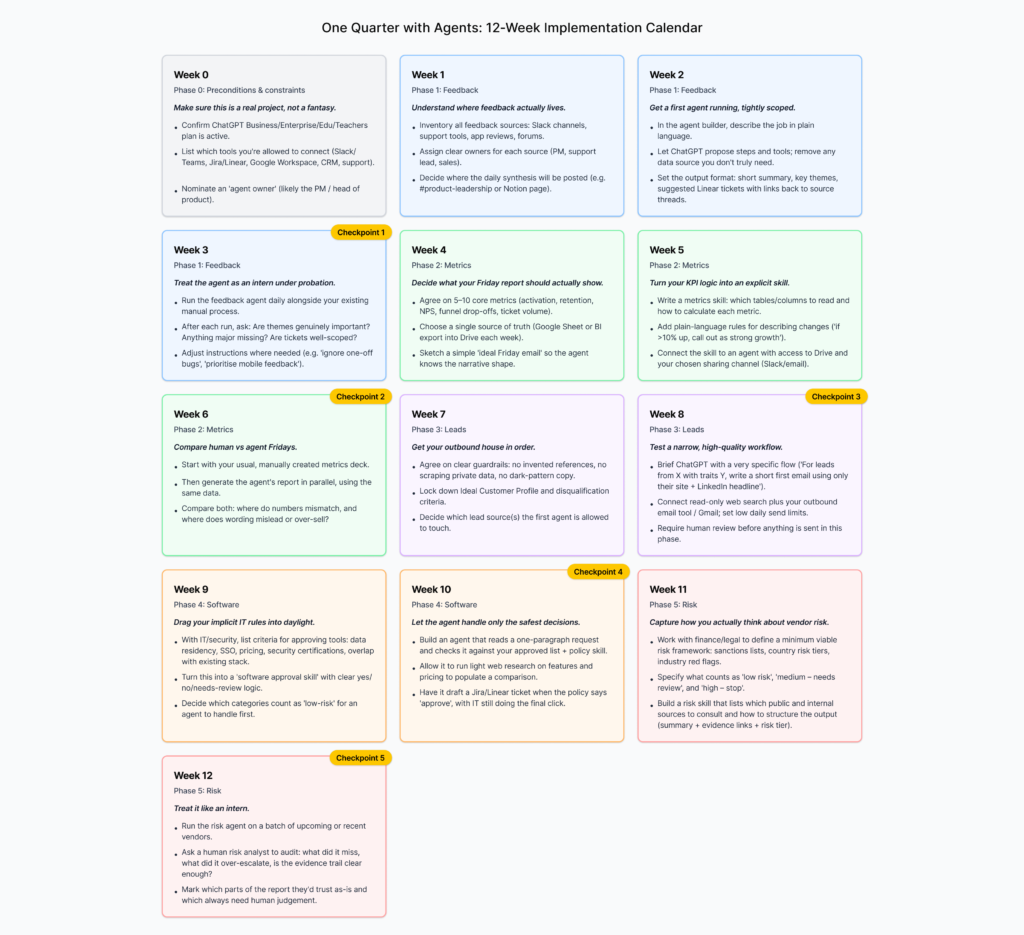
So the practical question becomes: if you’re a 10–30 person product org in Bengaluru, Hyderabad or Gurgaon, how do you adopt exactly these workflows over a quarter in a way that sharpens, rather than dulls, your judgement?
Risks you cannot delegate to an agent
As you implement these workflows, a few structural risks will keep recurring. Treat them as design constraints, not afterthoughts.
1. Process ossification
Once you encode a workflow into an agent and a skill, it becomes harder to change. The path of least resistance is to let “how the agent does it” become “how we do it”.
Countermeasure: schedule quarterly reviews of agent skills and instructions. Put them on the same cadence as your product roadmap reviews.
2. Hidden bias at scale
If your feedback agent mostly reads English‑language Slack channels, it may underweight Hindi or regional language complaints. If your lead agent only grades leads that “look like” your current customer base, it bakes in narrow targeting.
Countermeasure: deliberately feed diverse sources and periodically audit outputs for skew (geography, language, segment).
3. Over‑trust in narrative
The more polished your weekly metrics report looks, the easier it is to forget that it’s built on definitions someone chose. A well‑worded “summary” from an agent can quickly turn into dogma.
Countermeasure: treat the report as a conversation starter. Encourage leaders to challenge it: “Which data did this come from? What did it leave out?”
4. Compliance theatre
Running a risk agent can create the illusion that “we’ve done our diligence” when you’ve actually just run a scripted checklist.
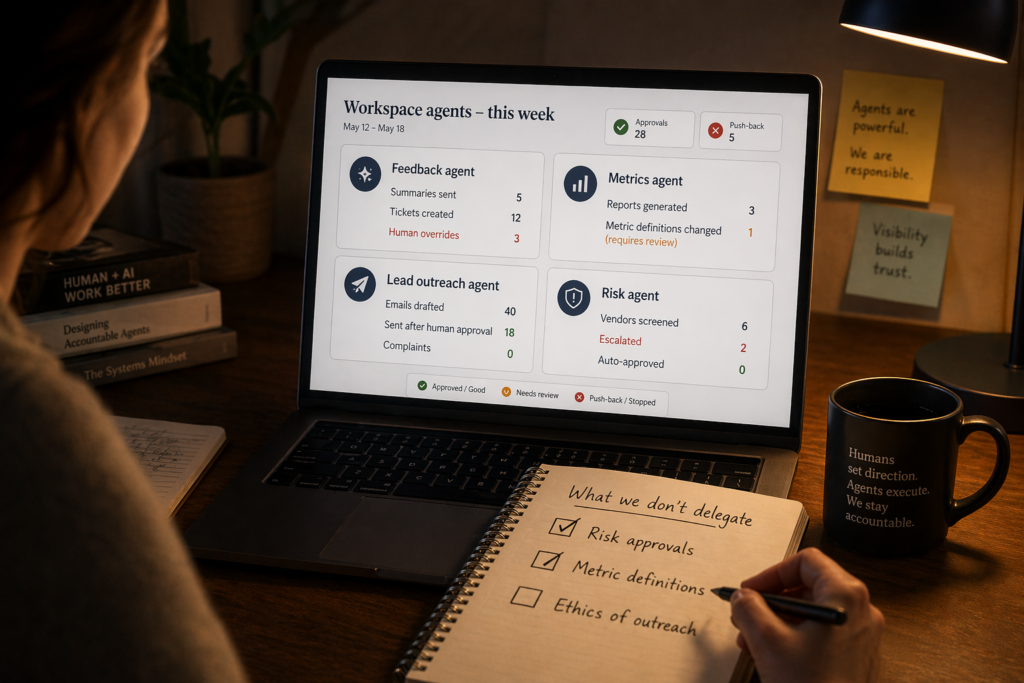
Countermeasure: make it explicit in documentation which parts of the process remain human‑owned. A human signature on risk decisions should not be optional.
What professionals should actually change
If you adopt workspace agents thoughtfully, your job doesn’t disappear. It just shifts.
- PMs should focus less on compiling feedback and more on framing the questions the feedback agent is allowed to answer – and pushing for cases it systematically misses.
- Designers should treat agent‑generated reports and dashboards as narrative surfaces that can mislead as easily as enlighten; design for legibility, not just aesthetics.
- Marketers and growth leads must encode ethics into agent skills up front – what you won’t let an AI say on your behalf, even if it converts.
- Founders and heads of product need to see agents not as cheap headcount, but as encoded strategy: anything you turn into an agent is something you are, effectively, writing in ink.
The temptation will be to brag about “AI‑powered ops” and “24/7 agents keeping work moving”.¹ The more honest stance is quieter:streetinsider+1
“We’ve automated the boring parts, and we’re now spending our human time on the bits that can’t be safely delegated.”
Done right, your Friday deck will write itself, your feedback queue won’t drown you, and your SDRs will spend less time copy‑pasting. Done lazily, you’ll wake up with a parallel organisation whose decisions you didn’t really design – you just clicked ‘Create agent’ and hoped for the best.
The tools are here. The shadow org is coming. The only real question is whether it will end up reflecting your judgement, or replacing it.
¹ OpenAI, ‘ChatGPT Workspace Agents for Enterprise and Business’, help centre, April 2026.timesofindia.indiatimes+1
² OpenAI, ‘Product feedback routing agent’ and ‘Software review agent’, demo videos, April 2026.youtube+1
³ OpenAI, ‘Weekly metrics reporting agent’, demo video, April 2026.youtube
⁴ 9to5Mac and VentureBeat coverage of workspace agents launch, April 2026.9to5mac+1