

Somewhere between your last pull request and your latest Codex diff, something odd happened: you realised you hadn’t actually written much code that week.
The feature shipped, the tests passed—but your keyboard felt suspiciously unused.
What Just Happened: The Day Manual Coding Quietly Left the Building
Picture a Monday morning in any mid‑size product team in Bengaluru or Hyderabad.
You open the Codex app. Yesterday’s agents are still there: one thread called ‘Payment flow cleanup’, another ‘Refactor notification service’, a third ‘Add audit logs to admin actions’. Each shows a neat status: done. Each has a diff waiting for your review.¹ ²
You skim. The payment thread has split a 900‑line controller into three smaller modules. The notification service has shed duplicated logic you’d been meaning to touch for months. The audit logs agent has threaded instrumentation through twenty‑odd functions without breaking a single test.³ ⁴
You accept most of it. A line gets tweaked here, a chunk of code rejected there. By the end of it, you haven’t opened a blank file once.
This is not a sci‑fi storyboard; it’s Codex’s advertised workflow. You give it a task in plain language, it spins up a cloud environment with your repo, plans changes, edits multiple files, runs tests and linters, and hands you a diff.⁵ ⁶ In the desktop app, you can orchestrate multiple such agents in parallel, each working in its own git worktree, so they never step on each other.⁷ ⁸ ⁹
By April 2026, Codex had more than 2 million weekly active users.¹⁰ The majority are not using it for line‑by‑line autocomplete. They are delegating whole refactors, feature branches, and vulnerability scans to an agent that behaves less like a helpful IDE plugin and more like a very fast, very sober junior engineer.¹⁰ ⁶
So when I say ‘Codex killed manual coding’, I’m not being dramatic. I’m just talking about what the workflow already feels like.
Lens 1 — What Codex Actually Unlocks
Let’s start generously, because the capability is real.
From Typing to Tasking
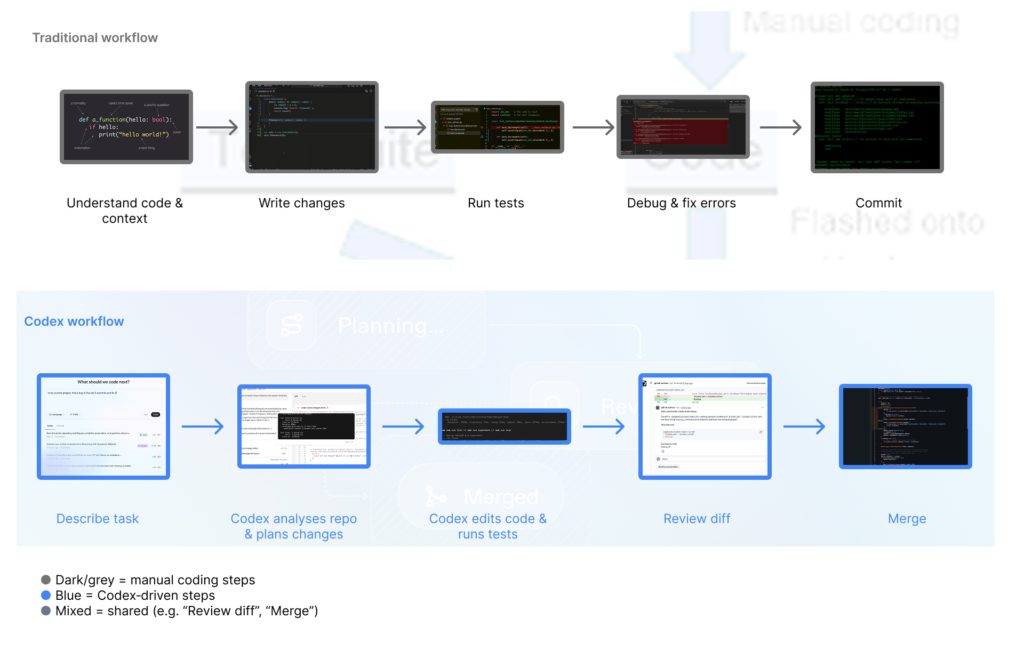
OpenAI is explicit about what this Codex is for. It is not the old GPT‑3‑era code completion model; it’s a cloud‑based autonomous coding agent built on o‑series and GPT‑5‑series models.⁶ ¹¹ You describe a task—‘remove dead code from this module’, ‘split this 2k‑line file into smaller pieces’, ‘update our auth library without breaking APIs’—and Codex does the following, largely on its own:³ ¹²
- Reads the relevant parts of your repository.³
- Constructs a plan, often visible as a checklisted set of steps.³ ¹³
- Edits multiple files across the codebase.³
- Runs tests and other tools (linters, type‑checkers, security scanners).⁵ ¹³
- Iterates until tests pass, then presents a diff and command log for you to review.⁵ ⁶
Most tasks complete in minutes rather than hours, and you see the shell commands and test results it ran along the way.⁵ ⁶
For gnarly refactors, OpenAI’s own guidance in its use‑case guide on refactoring your codebase is to break work into small, reviewable passes: delete dead code, untangle oversized modules, collapse duplicated logic, modernise patterns while keeping APIs stable.³ Codex is very good at this kind of grind. It doesn’t get bored halfway through a tedious namespace clean‑up.
A Command Centre for Parallel Agents
The Codex desktop app extends this from ‘one agent at a time’ to ‘a small software house on your machine’.
- Each project maps to a repository. Within it, multiple threads can each host one or more agent instances.¹ ⁷
- Threads use git worktrees: isolated working directories sharing the same history but living on separate branches.⁷ ⁸
- You can have Agent A refactor the database layer, Agent B rewrite the notifications module, and Agent C add tests—all against the same repo—without merge conflicts.⁷ ⁸ ⁹
When an agent finishes, it commits to its worktree and presents you with a diff to accept, modify, or discard.⁹ One guide describes running four concurrent agents in a TypeScript monorepo for a week without a single merge conflict, purely because worktrees kept everyone in their lane.⁸ ⁹
From the developer’s perspective, this is a psychological shift.
Your day is no longer defined by ‘what code did you write’, but by ‘what tasks did you assign and what diffs did you accept’.
Coding sessions start to look like triage boards.
Beyond Refactors: Security and House‑Keeping
Codex is also branching into specialised agents. In March 2026, OpenAI introduced Codex Security, an application‑security agent that builds a threat model of your repo, looks for vulnerabilities, and proposes fixes.¹⁰ In research, code agents like Codex are already being benchmarked on their ability to autonomously refactor collections of solutions into reusable libraries—planning, implementing, and fixing tests without humans in the loop.¹³
Put bluntly: if your repo has tests, Codex can do a surprising amount of the mechanical labour of software engineering, faster and more patiently than most humans.
It can keep a neglected legacy module on life support long after any developer has volunteered to open it.³ ¹⁰
If you’re a working engineer, this is a gift. The nights you used to lose to tedious migrations, copy‑pasted boilerplate, and ‘just one more small refactor’ can be handed to a system that doesn’t care how boring the task is.
If manual coding is dying, these are the knives: speed, parallelism, and an inhuman tolerance for drudgery.
Lens 2 — What Codex Obscures When It Kills Manual Coding
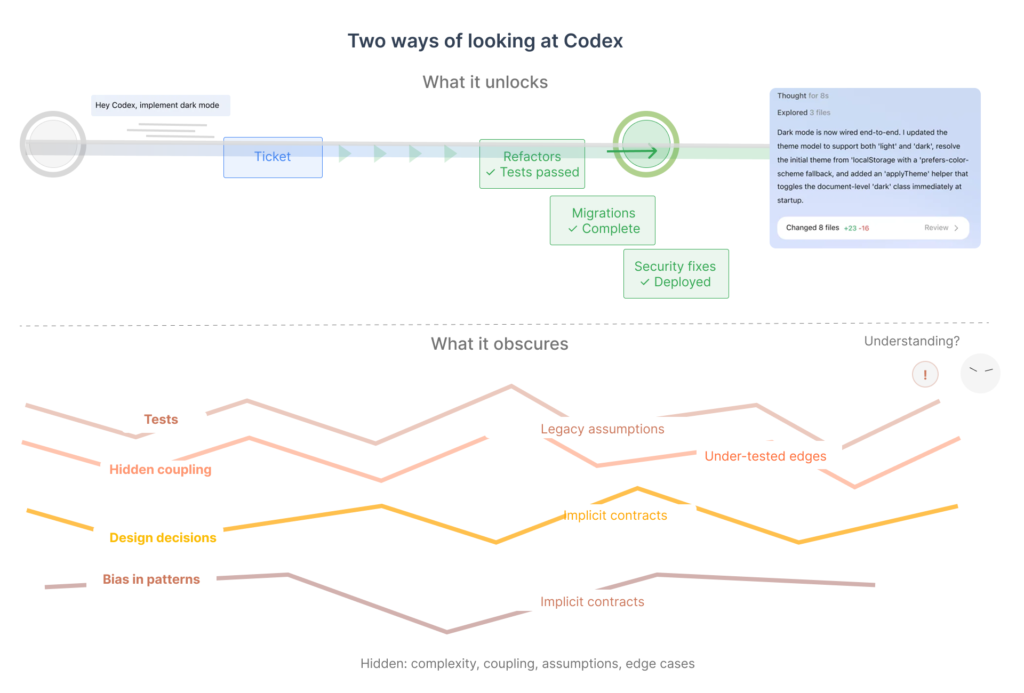
Now the uncomfortable part. Because while Codex is busy freeing you from the keyboard, it is also rearranging where understanding and authorship live in your team.
From Understanding‑Then‑Coding to Coding‑Then‑Understanding
Traditional craft mythology says: you read the code, you understand the system, then you change it. Codex quietly reverses that order.
Most documented Codex workflows look like this:⁶ ¹ ³
- You describe the desired change in natural language.
- Codex analyses the codebase and constructs a plan.³
- It edits files, runs tests, perhaps a security scanner.⁵ ¹³
- It presents diffs and logs for your approval.⁵ ⁶
Your first exposure to the changed code is as an output, not as a mental model.
You are invited to review what Codex has done, not to reason your way towards the change yourself.
Developers writing honestly about these tools admit as much: many are comfortable delegating 80–95% of the actual coding in a session to Codex or similar agents, as long as the tests pass and the diffs ‘look reasonable’.¹⁴ ¹⁵ On Hacker News and Reddit, people describe running agents in loops—‘try again until green’—rather than stepping through the logic manually.¹⁶ ¹⁷
This has at least three under‑discussed consequences:
Retrospective understanding
You only build a model of the change by reading the diff after it exists. If you’re tired or rushed, you will skim. You will miss things. Your understanding becomes a luxury, not a prerequisite.¹⁵ ¹⁶
Test‑shaped vision
Because Codex runs whatever tests you have and stops when they’re green, your view of ‘working’ code shrinks to whatever your suite currently asserts. If the tests don’t capture a class of behaviour, neither you nor Codex is likely to notice it broke.³ ¹³ ¹²
Shrinking apprenticeship
For juniors, the first years of debugging ugly code and writing careful fixes are how they learn to think like engineers. If Codex is always the first responder, juniors move straight into being supervisors of work they never had to do by hand.¹⁵ ⁶
Manual coding doesn’t just produce code; it trains intuition. When you remove the former, you need a deliberate plan to preserve the latter. Most teams do not have that plan.
The Invisible Shift in Authorship
Codex also blurs who is actually ‘writing’ your software.
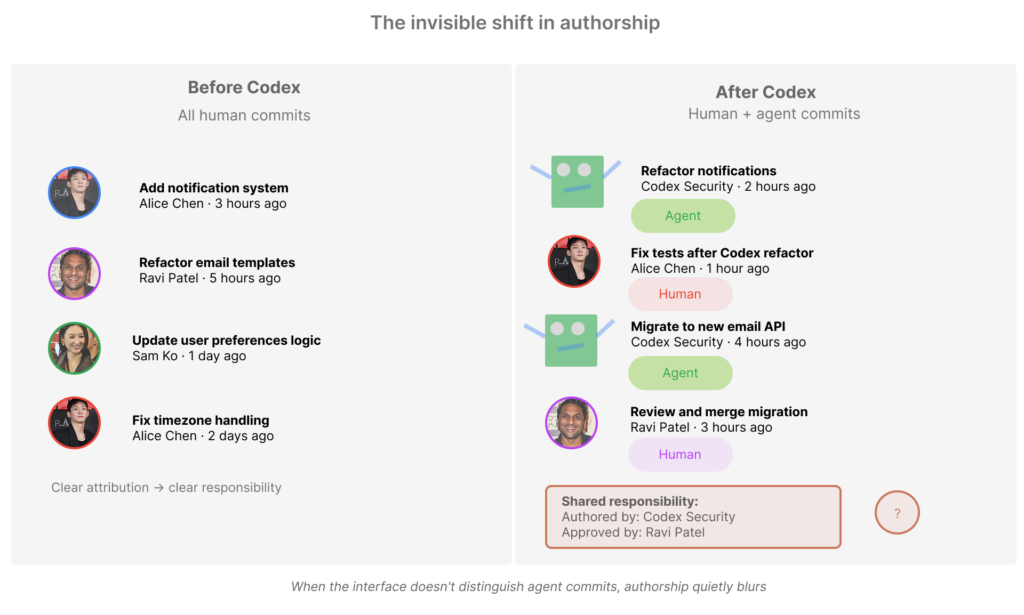
By default, Codex commits appear like any other: the git history shows changes, sometimes with a machine‑generated message, but nothing in the raw tooling forces you to mark them as agent‑authored.¹⁰ ⁹ A few third‑party guides recommend conventions like using specific prefixes or bot accounts, but these are optional.⁹ ¹⁸
Meanwhile, the Codex app UX encourages a sense of seamless delegation: multi‑agent threads, neat statuses, diffs attached to conversational histories.¹ ⁷ It feels like an extension of you, not a separate author.
The result is a quiet transfer of authorship and accountability:
- In code history: someone reading git blame later may see your name on a merge that essentially accepted an agent’s design decision. There is no visible line where human intent ended and agent improvisation began.¹⁰ ⁹
- In culture: teams start to talk in the passive voice—‘the refactor broke staging’, ‘tests started failing after the migration’—because no one feels like the primary author of the change. Codex did it, but Codex isn’t in the post‑mortem.
- In incentives: engineers who are excellent at designing prompts, tasks, and workflows may be undervalued relative to those who still look ‘productive’ in conventional metrics like commits and tickets closed. The actual intellectual work shifts, but recognition doesn’t.¹⁹ ¹
This is not an argument for going back to a text editor and a prayer.
It’s a reminder that when manual coding dies, manual ownership is often buried with it.
New Failure Modes at Scale
Finally, there are failure modes that only appear because you have an efficient autonomous agent.
Research on code agents like Codex shows they can successfully refactor collections of solutions into reusable libraries, but also that they fail when tests are incomplete or specifications are underspecified.¹³ OpenAI’s own best‑practice docs stress breaking work into small, reviewable passes and keeping public APIs stable for exactly this reason: large, sweeping agent changes are brittle.³
In the wild, though, teams are tempted to do the opposite. If Codex can pull off an auth migration in one go, why not let it try? If it can fix dozens of ‘trivial’ bugs overnight, why not schedule it over the weekend?
The risk is systemic:
- Fast propagation of subtle design flaws
If your existing patterns are flawed—leaky abstractions, over‑complicated APIs—Codex will faithfully replicate and sometimes amplify them as it refactors.³ ¹² You get ‘modernised’ code that still embodies yesterday’s mistakes. - Hidden coupling
Agents are excellent at making local changes that pass local tests. They are less good at spotting cross‑cutting business rules that aren’t fully encoded in tests. You may not notice a broken invariance until production data behaves strangely.¹³ ¹⁶ - Security assumptions
Codex Security can help find vulnerabilities, but the mere presence of a ‘security agent’ can lull teams into complacency—assuming that anything it didn’t flag must be fine.¹⁰ ¹³
Manual coding dies. Manual paranoia should not.
Where This Breaks in Real Teams
You can already see the cracks forming in how people talk about Codex online.
On one side, there are glowing posts about ‘95% of my work now delegated to Codex’ or ‘my poor man’s AI setup where a single agent keeps my side projects maintained’.¹⁴ ¹⁵ People celebrate the ability to point Codex at a ticket and come back to a tested diff.¹ ²⁰
On the other, you have early complaints:
- Developers confused when Codex’s threads and worktrees fall out of sync with their local branches.¹⁸
- First‑time users asking how to get Codex to explain its plan or break work into milestones and handoff docs.¹⁷
- Teams discovering that their lack of tests or chaotic branching makes Codex nearly unusable without major process changes.²¹ ³
The pattern is clear: Codex works beautifully on tidy, well‑tested systems with disciplined teams. It magnifies chaos elsewhere.
This is the part most ‘end of manual coding’ think‑pieces skip: the distributional impact.
Manual coding is dying first in well‑instrumented, test‑rich, process‑heavy organisations—the kind that were already relatively safe.
In under‑resourced teams with tangled legacy code and minimal tests, manual coding is still very much alive, and now has to compete with the myth that ‘everyone else has automated this already’.
If you’re a CTO in an Indian SaaS company shipping features across several time zones, this matters. The pressure to ‘keep up with Codex‑powered competitors’ will be intense. But unless you’ve invested in your test suite and refactored your own messes, Codex will mostly reveal your lack of infrastructure, not solve it.
Manual coding didn’t die of AI. It died of decades of accumulated discipline in the few places that had earned the right to kill it.
What Better Looks Like: Designing for Good AI, Not Shallow AI
If you stop at critique, you’re just another commentator. So what would it mean to defend good AI here—to insist on Codex workflows that are powerful and honest?
1. Make Authorship Visible
- Tag agent‑generated changes explicitly in git: separate bot identities, clear commit prefixes, and metadata linking back to the Codex thread that produced them.¹⁰ ⁹ ¹⁸
- In the Codex UI, show ‘authorship bars’ for each diff: how many lines added by the agent, how many edited by humans before merge.
- In post‑mortems, treat Codex as an entity: ‘This incident involved a change proposed by Codex Security that was insufficiently reviewed.’¹⁰
You’re not trying to shame the tool. You’re mapping responsibility.
2. Expose Uncertainty and Coverage
- Alongside ‘tests passed’, show which suites were run, their coverage of the changed files, and any skipped or flaky tests.³ ¹²
- Provide a simple risk indicator—based on number of files touched, depth of stack affected, and novelty of patterns—that nudges reviewers to slow down when it matters.
- Let Codex annotate its own diffs: ‘high confidence here; low confidence in this edge case’. Even approximate self‑assessment is better than the current illusion of uniform certainty.¹³ ¹²
The interface should teach developers when to trust the automation and when to lean in harder.
3. Design for Interruption, Not Blind Delegation
- Allow users to pause an ongoing Codex run, inspect intermediate changes, and redirect—like stepping through a debugger rather than waiting for a crash.¹ ⁷
- Default to small, incremental passes for refactors, with explicit prompts when a request is too broad: ‘This sounds like three tasks. Shall I split it?’³
- Provide human‑friendly ‘plans’ for non‑trivial changes that can be reviewed before code is written, not just after.¹³ ¹²
Good AI doesn’t demand trust; it invites oversight.
4. Rebuild Team Rituals Around Specification and Review
If manual coding is no longer the bottleneck, your team’s scarce resources become good specifications and serious reviews.
Practically:
- Introduce a ‘spec review’ step for any task you intend to give Codex: is the description clear, are acceptance criteria testable, does it encode the relevant business rules?²⁰ ⁶
- Treat code review as education. For each significant agent diff, ask the author to explain the change back to the team: not because they wrote it, but because they own it now.
- Track incidents where Codex was involved and update your ‘what we give to agents’ policy accordingly. Some tasks should be permanently labelled ‘manual only’—not for sentimental reasons, but because the risk or ambiguity is too high.
This is what it means to be pro‑capability and anti‑sloppiness: you refuse to let powerful tools operate inside weak processes.
Zooming Out: What This Means for the Craft of Engineering
Codex did not kill manual coding by accident. It did it by finally aligning three forces that have been building for years: transformer models that can read and write large codebases, robust tooling around tests and version control, and developer cultures that already prized speed over ceremony.¹⁰ ³ ⁷
The larger shift is not ‘fewer keystrokes’. It is the relocation of judgement:
- from individuals labouring over functions
- to agents negotiating with tests, plans, and prompts,
- supervised by humans whose primary acts are specification and acceptance.
If you build or lead software teams, that redistribution is your real design problem. Not ‘should we use Codex’, but:
- Where in our workflow should judgement sit now?
- How visible are the new authorship lines?
- What skills will atrophy if we don’t protect them?
- What new skills—prompting, system design, critical review—must we actively cultivate?
Manual coding may well become a niche practice, like hand‑lettering in a world of fonts. But manual thinking does not have to disappear with it. The risk is not that agents will start writing all our code. The risk is that we will quietly let them take over our sense‑making too—and only notice when something breaks far from the keyboard.
Codex has made it incredibly cheap to change code.¹⁰ ⁹ The real question is whether we are willing to pay the cost of redesigning our workflows around that fact.
Because what just disappeared from the day‑to‑day was not the ability to type, but the assumption that understanding always begins with our hands on the keys.
Footnotes
- OpenAI, Codex App Overview, OpenAI Developers (2026).intuitionlabs+1
- GrowwStacks, ‘OpenAI Codex App: Parallel AI Agents, Automations, and Git in One Place’ (2026).growwstacks
- OpenAI, ‘Refactor your codebase | Codex use cases’, OpenAI Developers (2026). developers.openai
- Verdent AI, ‘Codex App: Conflict‑Free Worktrees’ (2026).verdent
- OpenAI, ‘How OpenAI uses Codex’ (2026).openai
- OfLight, ‘OpenAI Codex Beginner’s Guide — Getting Started with Cloud Codex’ (2026).oflight
- OpenAI, ‘Worktrees – Codex App’, OpenAI Developers (2026).developers.openai
- Verdent AI, ibid.verdent
- ThePlanetTools, ‘OpenAI Codex – tool overview and workflow examples’ (2026).theplanettools
- OpenAI Codex (AI agent), Wikipedia (updated March 2026).wikipedia
- OpenAI Codex, Wikipedia (updated March 2026).wikipedia
- Flowith, ‘OpenAI Codex FAQ: Multi‑File Editing, Context Window, Security’ (2026).flowith
- Chen et al., ‘Refactoring Codebases through Library Design’, arXiv preprint (2025).arxiv
- Reddit, r/ClaudeCode, ‘As a Claude Code devotee I am currently using Codex to do 95% of my coding’ (2026).reddit
- Infoxicator, ‘The Reality of AI Coding in Production (and My Poor Man’s Setup)’ (2026).dev
- Hacker News thread, ‘The Codex app illustrates the shift left of IDEs and coding GUIs’ (2026).news.ycombinator
- Reddit, r/codex, ‘First time Codex user. Need help with refactoring’ (2026).reddit
- GitHub Discussions, ‘[Codex App] Agent‑created worktrees should sync with the main repo’ (2026).github
- LinkedIn, ‘A single Claude Code / Codex session is no longer enough. AI workflows across teams’ (2026).linkedin
- OpenAI, ‘Workflows – Codex’, OpenAI Developers (2026).developers.openai
- OpenAI Community, ‘Tips and tricks for using Codex’ (2026).openai