
At I/O 2026, the company announced everything it’s building on top of your data. The question isn’t whether it’s useful. It’s whether you own any of it.
There is a particular flavour of corporate event that has become its own cultural genre. You know the format: the warmly lit stage, the carefully chosen human-interest story — ideally someone who immigrated, struggled, built something — and then the slow reveal that the real point was always the product. Google I/O 2026, held yesterday at Shoreline Amphitheatre in Mountain View, was the genre in its mature form.[1][2]
The opening film introduced Matteo, whose brother built him an AI assistant. Next came Holly, a South Korean immigrant who opened a restaurant and used Gemini to build WorkOnward, a platform now serving over 13,000 people in New York City. Then the tagline: “Let’s not just make. Let’s make something that matters.”
All of it was real. None of it was the point.
The point was that Gemini is being woven into your digital life. Your email, your calendar, your search history, your YouTube watch habits, your shopping behaviour, and now, potentially, your face — via smart glasses launching this autumn with Warby Parker and Gentle Monster.[3][4]
Sundar Pichai called it the “agentic Gemini era.” Plain English: AI that acts, not just answers. Google is serious about being the company that builds it first — and it is spending $180 to $190 billion in capital expenditure this year, up from $31 billion in 2022. Inflation explains a fraction of that rise. The rest is a deliberate decision to become an AI utility company: hardware, models, products, distribution — all under one roof, all under one set of terms.[2]
This article follows the keynote’s seven acts — Omni, Antigravity, Spark, Search, Gemini, Generative Media, Intelligent Eyewear — and asks the same question at each stop: what does this actually cost?
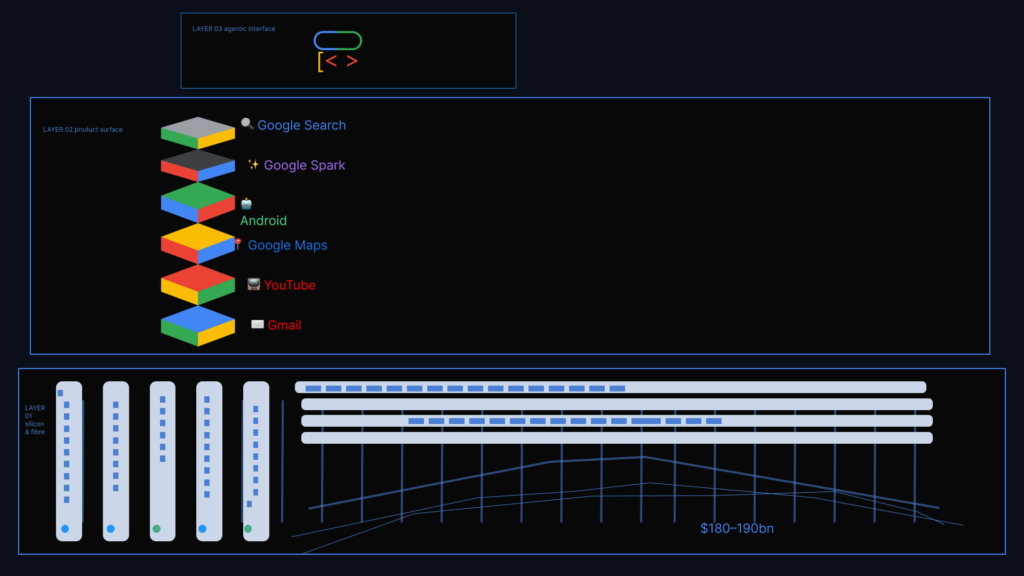
Act I: Gemini Omni — The World Model Pitch
The AGI Claim
Demis Hassabis used the I/O stage to declare that AGI is “just a few years away.” Earlier that same week, in a Bloomberg interview, he put it at roughly 50% probability by 2030 and added: “We’re still quite far from that.” The Verge noted the discrepancy directly. When the CEO of Google DeepMind says something different depending on whether a camera is rolling, that is worth keeping.[5]
The conceptual centrepiece is “world models” — AI that moves from predicting text to simulating reality. The pitch is compelling. In practice, Gemini Omni Flash is a conversational video-editing tool. You type; it edits. Useful, certainly. However, whether it constitutes a “world model” in the research sense is a question the keynote declines to press.[6]
What the Benchmarks Actually Say
Gemini 3.5 Flash is claimed to be “four times faster than other frontier models.” Speed, measured in output tokens per second, is a real advantage. But it is too narrow a metric to serve as a capability verdict. On SWE-bench — the standard test for real-world coding tasks — Claude Opus 4.5 scores 80.9% against Gemini 3 Pro’s 76.8%. Moreover, on hallucination rates — which matter when you are drafting contracts or researching anything you will put your name on — Gemini sits at “moderate” while Claude records the lowest error frequency in the field.[7][8]
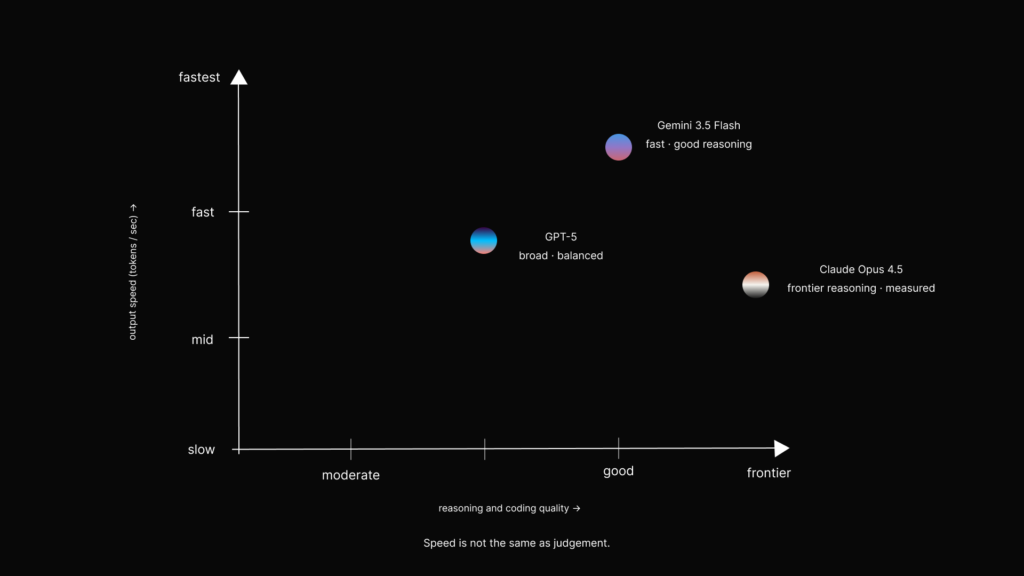
The honest mid-2026 ranking: Claude leads on complex reasoning and coding quality; GPT-5 on versatility; Gemini on speed and context windows. Google is competitive. It is not dominant. Distribution, not raw capability, is its actual moat: thirteen products with over a billion users each, five with more than three billion.[8][9][2]
Act II: Google Antigravity — The Agent Farm
The Demo and Its Limits
The Antigravity segment produced the keynote’s most theatrical moment: 93 subagents, working in parallel over 12 hours, making over 15,000 model requests and processing 2.6 billion tokens to build a functioning operating system — for under $1,000 in API credits.[2]
It is impressive. However, it is also carefully chosen. Building a toy OS in a sandboxed environment is a valid stress test of multi-agent orchestration. It is not, though, a substitute for the constraints of production engineering: existing codebases, compliance requirements, team review processes, licensing obligations. The demo answered “can the system do something complex?” It did not answer “will it behave predictably inside your organisation?”
How the Alternatives Compare
Cursor remains the preferred agentic IDE for teams that prioritise codebase awareness. GitHub Copilot — backed by Microsoft and OpenAI, with SOC 2 and ISO compliance credentials — integrates directly into VS Code without trapping your planning documents in a proprietary folder. Claude Code remains the quality benchmark most senior engineers reach for when accuracy matters. On independent evaluations, OpenAI’s Codex scores 96/100 against Antigravity’s 92.[10][11][12][13][14][15]
The Structural Tell
Here is the architectural admission no one highlighted on stage: Antigravity 2.0 ships with support for Claude Sonnet and OpenAI’s open-source models alongside Gemini. In other words, Google’s own developer platform is hedging against its own model. When a company ships competitor models inside its flagship product, that is not modular design philosophy. It is a quiet acknowledgement about quality.[10]
The Data-Governance Gap
Furthermore, Google’s internal developers were processing 3 trillion tokens per day with Antigravity and Gemini 3.5 Flash at the time of the keynote, and the system is designed to learn from that usage. For enterprises considering Antigravity for production: what is retained? How are proprietary codebases isolated? And what audit trails exist when 15,000 autonomous model requests run on your codebase? Google Cloud’s enterprise documentation is thinner on these points than the stage demo suggests.[16][17][2]
Act III: Gemini Spark — The 24/7 Agent in Your Inbox
What Spark Does
Spark is Google’s most consequential consumer announcement — and, consequently, the one most in need of careful reading.[18][2]
The demo is coherent. Spark compiles a week of launches from Docs, Gmail, and chat, drafts an update email in the user’s voice, manages block-party RSVPs, maintains a live Google Sheet updated directly from incoming emails, sends follow-up reminders, and generates a Slides deck — all in the background, across tools, while the presenter moves on. An agent that carries out multi-step administrative tasks without babysitting is, in principle, a real productivity gain.[2]
“It’s your personal AI agent that helps you navigate your digital life, taking action on your behalf and under your direction. It runs on dedicated virtual machines on Google Cloud, and it is 24/7.” — Sundar Pichai, I/O 2026
What the Beta Code Actually Says
No stage time went to the disclosure buried in the app’s own pre-release code, surfaced by Forbes ahead of the announcement. Verbatim:[19][20]
“While it is designed to ask for your permission before taking sensitive actions, it may do things like share your info or make purchases without asking. Make sure to supervise Gemini Spark, and don’t rely on it for medical advice, legal, financial, or other professional help.”
The agent can also “share necessary info with third parties” — including “your name, contact information, files, preferences, and info you might find sensitive.” This is not a leak. It is the literal text of the product’s own disclosure. Freelancers whose financial correspondence lives in Google Workspace, professionals handling client information through Gmail — this clause applies to you.[19]
The 30-Day Accountability Gap
In addition, agent logs delete after 30 days. A purchase made without asking, a mailing list unsubscribed, a document shared with a third-party service to complete a forgotten task — all gone within a month. Enterprise users face genuine compliance exposure. Everyone else loses the ability to reconstruct what an AI did in their name.[21][22]
What the Alternatives Offer Instead
By contrast, Notion’s Custom Agents — now powering over one million user-built agents — operate within an explicitly bounded workspace with clearer data isolation. Similarly, Microsoft Copilot, built on GPT-5 and embedded in Microsoft 365, offers enterprise data governance frameworks that Spark’s current terms do not match. Both sit inside ecosystems with years of enterprise trust credentials. Spark, by contrast, is launching into that market with a beta disclaimer about unsupervised purchases.[23][24][25]
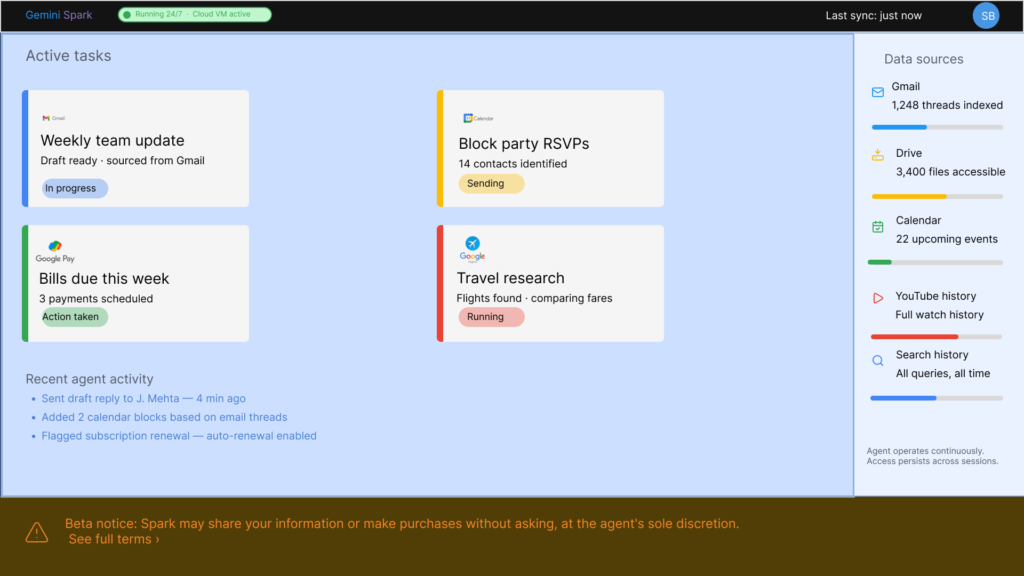
Spark rolls out first to Google AI Ultra subscribers at $200 per month. The keynote’s “AI for everyone” language carries a heavy load when the most powerful — and most risky — features sit behind a subscription that costs more annually than most comprehensive software suites.[2]
Act IV: Search — The Upgrade That Eats the Web
The Ask Maps Question
Google called its Maps update “the biggest upgrade in a decade.” The Ask Maps demo — a parent whose child fell in a duck pond 30 minutes before a wedding, needing to walk to buy a dress — is warmly received. The underlying capability is real: natural-language, multi-constraint queries represent a genuine step forward from “type ‘dress shops near me’ and tap twelve filters.”[2]
That said, whether a UX layer over existing routing, POI data, and commerce backends constitutes a decade-defining leap — or a decade of excellent infrastructure finally made legible to people who never learned the filters — is a question worth pressing.
Every Story Ends in a Purchase
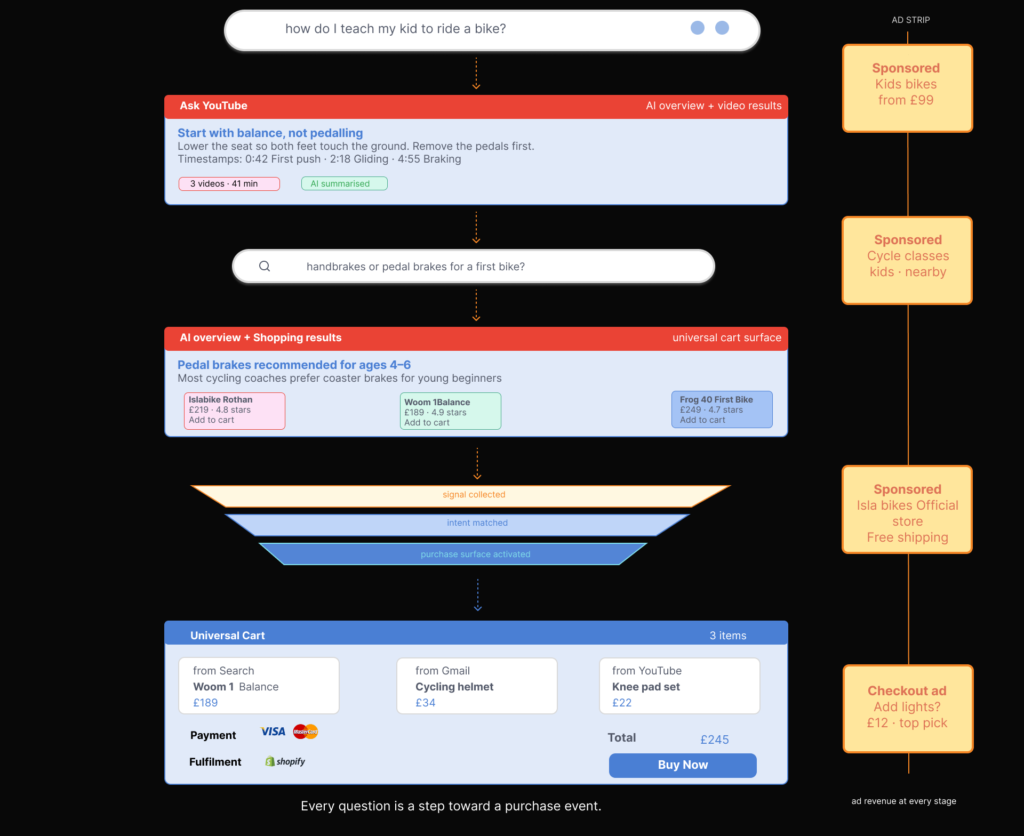
Tellingly, the pattern runs across every demo. Ask Maps: duck pond → where to buy a dress. Ask YouTube: how to teach a child to ride a pedal bike → “should I buy handbrakes or pedal brakes?” Universal Cart: collect items from Search, Gemini, YouTube, and Gmail into a single cross-merchant checkout. The agent maintains context across your session precisely to convert curiosity into a purchase event. That is the business model showing through the UX.[26][2]
The Zero-Click Economy
Google AI Mode now produces a zero-click rate of 93%. Nine out of ten searches in AI Mode end without anyone visiting an external website. Meanwhile, Universal Cart accelerates the logic: shopping decisions that once required a retailer visit now complete inside Search, with ads served and purchase data captured throughout.[27][26]
Who Universal Cart Actually Serves
The Universal Commerce Protocol was co-developed with Walmart, Target, Shopify, Etsy, Wayfair, Adyen, Visa, and Mastercard. Large retailers get access to 900 million Gemini users; in exchange, they cede the checkout relationship to Google. As a result, independent retailers outside that ecosystem face progressive invisibility on Google’s highest-intent shopping surfaces.[26]
The Perplexity Contrast
Perplexity remains the benchmark for citation transparency and answer quality. In independent testing across 40 queries, Perplexity logged a hallucination rate of ~5% against Google AI Mode’s ~7%. Crucially, every Perplexity claim cites a clickable source. Google AI Mode, by contrast, embeds ads inside conversational answers. These are not equivalent models of information delivery.[28][29][30]
Act V: Gemini — The Subscription Architecture
The Pricing Contradiction
By the time Sundar returns to the redesigned Gemini app — with Daily Brief, Gmail Live, and a new AI Inbox — the pricing structure has become visible enough to examine directly.[31][6]
The full stack runs on tiers. The most capable, most autonomous features — Spark, full Antigravity orchestration, AI Ultra search — sit at $200 per month. AI Pro at around $20 per month gets a subset. The free tier gets the rest. That is rational commercial architecture. It is not, however, compatible with the egalitarian language of “AI for everyone.”[32][2]
“We’ve heard that many companies are already blowing through their annual token budgets, and it’s only May.” — Sundar Pichai, I/O 2026
The Competitive Pressure
When Sundar says the top Google Cloud companies could save “over $1 billion annually” by shifting 80% of workloads to Gemini 3.5 Flash, he is making a sales pitch to enterprise CIOs and a competitive threat to Anthropic and OpenAI simultaneously. Flash at “less than half the price of comparable frontier models” forces rivals to either compress their margins or defend a quality premium more loudly than before.[2]
Why Microsoft Is Harder to Displace
Microsoft Copilot, at $30 per month and embedded in Microsoft 365, is Gemini’s most direct enterprise competitor. Crucially, Copilot benefits from something Gemini cannot easily replicate: years of trust inside IT departments, enterprise data governance frameworks, and the Microsoft Graph — which gives Copilot organisational context across Teams, Outlook, and SharePoint without requiring workflow migration. Gemini is fighting for that territory. It is not there yet.[24][23]
Act VI: Generative Media — Who Owns ‘Real’?
What SynthID Does Right
SynthID has now watermarked 100 billion images and videos, and 60,000 “years” of audio assets. OpenAI, Nvidia, Kakao, and Eleven Labs are adopting it. Content Credentials Verification is expanding into Search and Chrome: right-click and ask “was this generated with AI?”[33][2]
This is a genuine public good. Humans correctly identify high-quality deepfake video only about a quarter of the time. Consequently, embedded provenance metadata, accessible via the browser, is better than nothing.[2]
But Better Than Nothing Is Not Enough
SynthID answers how something was made, not whether what it depicts is true. A watermarked image can still spread misinformation. Moreover, text — the medium through which most political manipulation operates — is not yet addressed at scale. There is still no tool that answers the more important question: not “was this made by AI?” but “is this claim accurate?”[33]
The Power Geometry
More structurally, Google is building the largest generative media infrastructure in the world — Omni, Nano Banana Pro, Veo, audio models — while simultaneously positioning itself as the default authenticity oracle for that media. In other words, the same company is the biggest producer of synthetic media and the arbiter of what counts as real on the web. That is not a reason to dismiss SynthID. It is, however, a reason to want independent verification standards, managed outside any single company, alongside it.[34][35][2]
Act VII: Intelligent Eyewear — Glass, But This Time With Agents
What Was Announced
Gentle Monster and Warby Parker frames, running Android XR and Gemini, launching this autumn. Features include voice-activated navigation, real-time translation, photo capture, and notification summaries — all hands-free, heads-up.[36][37][3]
The design is attractive. Moreover, Google is directly responding to Meta’s Ray-Ban Smart Glasses, which have sold over two million units precisely because people will wear something that looks like eyewear rather than hardware. The difference is that Google’s glasses will carry Gemini: an agent that understands what it sees in real time and acts on it.[38][39]
“It is very clear that Google is taking a page from Meta’s playbook — really positioning these glasses as a vehicle for Gemini and AI.” — Victoria Song, The Verge
The Questions Nobody Answered
Nevertheless, there was no on-stage disclosure about ambient recording, bystander consent, or data-collection policies for the camera’s continuous feed. Pricing, battery life, and precise carrier plans were also absent. For a product shipping this autumn, that is a pointed set of omissions.[40][37][31]
The social history here is not subtle. Google Glass failed in 2013 not because the technology was wrong but because a camera on someone else’s face, connected to the internet, changes what it means to be in a public space. The question now is whether adding Gemini resolves the consent question or deepens it. An agent that understands what it sees and acts on it has more power than one that simply records. The answer to “what happens to what these glasses see?” was not given on stage. It needs to be given before autumn.[41][36]
The India Angle: 900 Million Reasons to Push Hard
The Strategic Play
It is not incidental that Sundar Pichai opened I/O 2026 by describing Google’s “full-stack approach to AI innovation” just months after attending the India AI Impact Summit in New Delhi and committing to a $15 billion data centre campus in India.[42][43]
India became the world’s largest market for generative AI app downloads in 2025, with installs jumping 207% year-over-year. As of early 2026, Gemini has 118 million monthly active users in India — trailing ChatGPT’s 180 million, but growing fast. Perplexity has 19 million. India now accounts for 19% of the global user base of leading AI assistant apps, ahead of the US at 10%.[44]
What Free Actually Means
The strategy is not charitable. Those free premium offers and subsidised tiers are user-acquisition at scale. Their purpose is to convert India’s billion internet users into a paying subscriber base before the window closes. Gemini Live now supports Hindi and eight Indian regional languages. Furthermore, Google has partnered with Reliance Jio for a cloud region in India, backed a 150 MW renewable energy project in Rajasthan, and launched the Google Market Access Program to help Indian AI startups reach global markets — with Gemini as the model stack underneath all of it.[45][46][42][44]
“If you solve for India, you build for the world.” — Google, India AI Startups Conclave, 2026
The infrastructure deal, the language support, the startup programme, the data centre — these are coordinated moves in a market where Android already runs on hundreds of millions of phones and Google Search is the default gateway to the web. Gemini is the next layer. The question for Indian professionals and developers is the same as everywhere else: you can use these tools without knowing the terms, or you can read the small print.
The Antitrust Context Nobody Wants to Talk About
The Legal Frame
In December 2025, Judge Mehta’s final antitrust remedies order set a six-year legal framework designed to stop Google replicating its search monopoly tactics in AI. Courts barred Google from conditioning access to one product on use of another. Separately, the EU’s Digital Markets Act proceedings probe whether third-party AI providers get equal access to Google’s infrastructure. The Apple–Gemini deal faces scrutiny as an “exclusive in effect.”[47][48][49]
Why It Matters for Every Announcement
A US federal court found Google guilty of operating an illegal search monopoly. Under active court supervision designed to prevent exactly this, the company is building the next layer of its market position: AI agents, AI shopping, AI search, AI eyewear. This is not a footnote. It is the structural context inside which every I/O 2026 announcement should be read.
What Professionals Should Actually Do
Developers: use the model that fits the task, not the one tied to the subscription you already pay. Antigravity 2.0 is solid orchestration infrastructure; the best model to run inside it is often not Gemini. Cursor and GitHub Copilot offer more refined daily-coding experiences with stronger enterprise compliance. Reach for Claude on reasoning-heavy or accuracy-critical tasks. Multi-model flexibility is the asset — exploit it.[11][12][15][10]
Marketers and SEO professionals: a 93% zero-click rate is not a trend to optimise around. It is a structural shift to plan for. Organic search traffic has a contracting runway. Therefore, the question is not how to rank in AI Overviews — it is which distribution channels you are building that do not depend on Google’s goodwill.[27]
Small business owners: Universal Cart favours businesses already connected to Shopify, Walmart’s platform, or UCP-linked processors. Outside that ecosystem, your products face progressive invisibility on Google’s highest-intent shopping surfaces. That is not a problem to defer.[26]
Privacy-conscious professionals: Spark’s own terms allow information sharing without explicit confirmation. As a result, legal, financial, medical, or journalistic work carrying a confidentiality obligation should not run through Spark — not yet. The $200/month price point buys time. The $20/month tier is coming, and the decision about what you hand an agent needs making before it arrives.[20][19]
Anyone considering the glasses: ask the questions the keynote declined to answer. What is recorded, retained, shared, and with whom. Ask before autumn.[3][41]
The Thing Worth Remembering
Aspiration and architecture are both real here, and genuinely in tension.
Google is building tools that help people. Holly’s story was not fabricated. Gemini Omni’s video capabilities are remarkable. Antigravity 2.0 is serious infrastructure. Daily Brief will save some people real time. SynthID is better than nothing. These products work.[6][2]
At the same time, they run on your data, under terms that expand Google’s access with each upgrade, inside an infrastructure built by a company under court order for monopolistic behaviour, with monetisation layered into every surface that presents as neutral.[49][19][26]
Distilled, the I/O 2026 message is: “We’re making AI helpful for everyone.” What that means in practice is: “We’re making AI indispensable to everyone — on our infrastructure, at our pricing, under our terms, in ways that consolidate our position at every layer of the digital economy.”
Both are simultaneously true. The first does not cancel the second. Holding both in the same frame is the task for anyone using these tools — professionally, personally, at scale.
Harder than it looks when the keynote film is that good.
Footnotes
¹ Maxim AI’s frontier model comparison, April 2026 — SWE-bench scores and hallucination rates for Gemini, Claude, and GPT-5.[7]
² AI for Code: OpenAI Codex vs Google Antigravity, May 2026 — independent evaluation scores and Antigravity’s multi-model support.[10]
³ The Verge: Demis Hassabis on the AI singularity, 19 May 2026 — keynote remarks vs Bloomberg interview discrepancy.[5]
⁴ Forbes: Inside Gemini Spark’s beta code, 16 May 2026 — disclosure language on unsupervised purchases and third-party sharing.[19]
⁵ Logicity: Gemini Spark and 24/7 access to your digital life, May 2026 — 30-day log deletion policy.[21]
⁶ Google Blog: Universal Commerce Protocol, January 2026 — partnership details with Walmart, Shopify, Adyen, Visa, Mastercard.[26]
⁷ Pasquale Pillitteri: Google AI Mode zero-click SEO 2026, May 2026 — 93% zero-click rate in AI Mode.[27]
⁸ Lumichats: Perplexity vs ChatGPT Search vs Google AI Mode, April 2026 — 40-query accuracy test with hallucination rates.[29]
⁹ Alex Ewerlöf: GitHub Copilot vs Google Antigravity, March 2026 — developer comparison on rate limits, planning modes, and enterprise readiness.[15]
¹⁰ Winston & Strawn: Antitrust remedies in United States v Google; Reuters: EU DMA proceedings, January 2026; Mogin Law: Apple–Gemini scrutiny.[48][47][49]
¹¹ TechCrunch: India’s AI boom, February 2026 — India’s 207% growth in generative AI downloads, user figures for Gemini, ChatGPT, and Perplexity.[44]
¹² Google Blog: Intelligent eyewear with Gemini coming this fall; Warby Parker intelligent eyewear; Samsung/Google Android XR first look.[4][36][3]
¹³ Google DeepMind SynthID; Nano Banana Pro launch, November 2025.[35][33]
¹⁴ Economic Times: Google Market Access Program for Indian AI startups, January 2026; ET Now: Google’s $15 billion India data centre investment.[46][43]