
Seven videos in five days is not a content burst. It is a labour signal. Between 14 and 18 May 2026, Anthropic published four tutorials on Claude Code and three role-based demos for Claude Cowork. Taken together, they form the clearest statement yet of which professionals the company thinks are ready for AI-assisted workflow redesign: developers, sales teams, marketing ops and legal staff.anthropic+1
Anthropic is careful with its language. It talks about augmentation, productivity and better workflows. Yet the underlying message is harder than the branding. If your work consists of gathering information, structuring it, drafting outputs and passing them upwards, large parts of your role are now legible to software.axios+1
That does not mean every job disappears. It does mean the composition of many jobs is changing fast. The professionals who thrive will not be the ones who merely use these tools. They will be the ones who redesign their work around them before management does it for them.bcghendersoninstitute+1
The developer’s double bind
The Claude Code videos are not glossy marketing. They are practical onboarding for people who already know their way around a terminal. Installing Claude Code, Your first Claude Code prompt, The Explore → Plan → Code → Commit workflow and Context Management in Claude Code all assume technical fluency rather than beginner curiosity.anthropic
That matters because Anthropic’s own research on software development found that Claude Code interactions were automation-heavy. The company reported automation in 79% of Claude Code usage, versus 49% on the standard Claude.ai interface. That figure is not a forecast. It is a description of how people are already using the product.anthropic
From coder to director
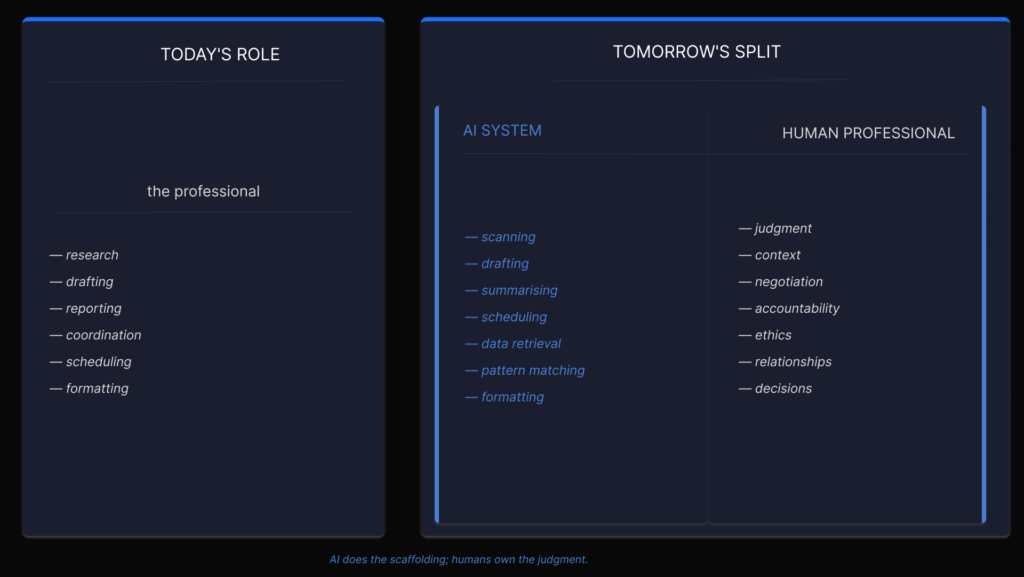
The central lesson in these tutorials is not how to install a tool. It is how to think like a supervisor of machine output. The Explore → Plan → Code → Commit workflow treats the developer less as a hands-on builder and more as a director who scopes, checks and approves work.anthropic
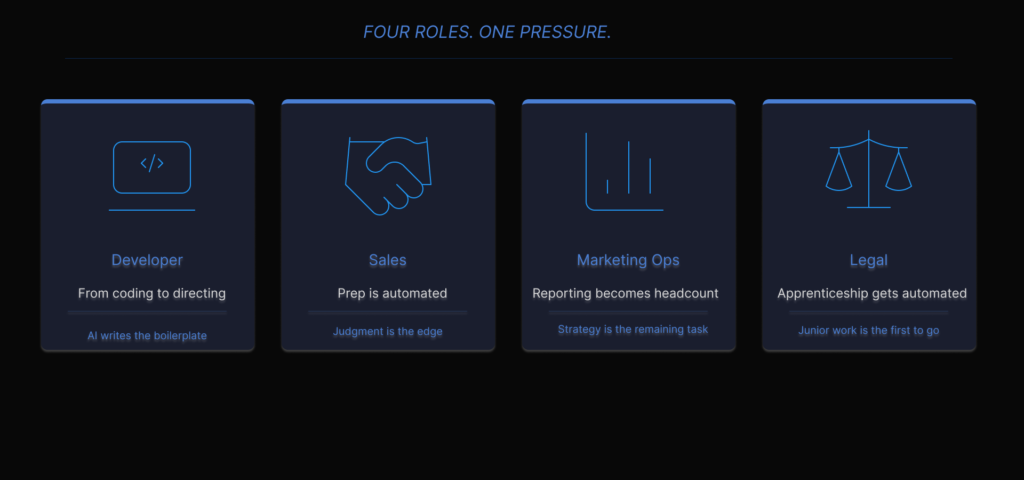
That shift sounds flattering, but it carries a sting. It quietly moves prestige upward and routine work downward. Senior engineers become editors, architects and reviewers. Junior engineers lose some of the repetitive tasks that once helped them learn the craft.
Anthropic chief executive Dario Amodei has said publicly that some engineers inside Anthropic already let the model write the code while they edit and handle the surrounding decisions. That remark matters because it strips away the usual corporate euphemism. The task itself is moving. Human value is being pushed into judgment, not production.linkedin+1
The quiet collapse of entry-level work
This is where the optimism gets selective. If AI handles more of the first draft, the people with the least experience have fewer safe places to practise. Jose de Cabo noted in March 2026 that engineering demand remained strongest for people with five to seven years of experience and above, while the lower end of the ladder was under growing pressure.linkedin
Anthropic’s January 2026 Economic Index pointed in the same direction. It found a fall in entry-level hiring in AI-exposed roles and a growing pattern of AI taking on more complete task flows rather than just assisting humans at the edges. BCG’s 2026 work on job redesign reaches a similar conclusion at a broader scale: AI is more likely to reshape jobs than erase them outright, but junior-heavy ladders are especially vulnerable when routine work is easy to automate.markets.financialcontent+2
The tutorials are therefore honest in one way and evasive in another. They teach a useful workflow. They do not really confront who gets squeezed when that workflow becomes standard.
The sales professional’s attention problem
The sales demo centres on Brittany, a growth account executive who uses Claude Cowork to assemble account context before a call. The proposition is obvious and attractive. Modern sales teams are buried under CRM updates, meeting notes, product changes and internal chatter. An AI system that gathers the relevant material and turns it into a usable brief solves a genuine problem.cnbc
But this is also where the demo becomes more interesting than it means to be. It ends at the point of preparation. Claude gathers the context. Brittany arrives informed. Then the curtain falls.
When everyone has the same brief
That missing second act is the entire story. Once information gathering becomes automated, information advantage shrinks. The differentiator is no longer who found the data. It is who can interpret it well, adapt to the mood of the conversation and build trust in real time.
This matters because many sales organisations still reward mechanical busyness as if it were strategic work. Research and prep have long been treated as proof of professionalism. Yet if every account executive now arrives with a polished AI-generated brief, preparation stops being a moat. It becomes table stakes.
The likely outcome is not the death of sales. It is the death of mediocre sales work that looked sophisticated only because it was time-consuming. The best sellers will still win on reading the room, handling resistance and turning context into momentum. The weaker ones will discover that having the same summary as everyone else is not the same as having an edge.
What AI does to the SDR ladder
The most exposed part of sales is not the seasoned closer. It is the entry-level sales development role. Structured outreach, list building, qualification and repetitive follow-ups map neatly onto agentic systems. As AI takes over more of that scaffolding, the ladder into sales becomes narrower and stranger.linkedin
That is already visible in pay signals across adjacent functions. The January 2026 jobs analysis cited a 43% wage premium for marketers with AI skills and a 36% premium for automation expertise. Sales is moving in the same direction. The market is rewarding people who can work with automated systems, while quietly devaluing those whose contribution sits inside repetitive prep work.thepromptinsider+1
For sales professionals, the practical lesson is blunt. Treat AI-generated research as the floor, not the craft. What matters now is live judgment: objection handling, credibility, timing and the ability to connect a buyer’s stated need with their unstated fear.
Marketing operations: the most exposed role in the building
If the sales demo is suggestive, the marketing ops demo is almost brutally explicit. Ian, the marketing ops lead, uses Claude Cowork to pull reporting data and produce a draft narrative in minutes. He adds an important caveat: Claude is good at pulling the numbers, but he still has to steer the story. That caveat is true. It is also the part every executive will mentally edit out first.
Marketing operations has always sat in dangerous territory. It is essential, but much of its work is structured, repeatable and judged on speed. The more a role depends on stitching together systems, cleaning records, producing reports and routing insights, the easier it is for management to imagine software doing more of it.displacement+1
When reporting becomes headcount
This is why the hard data matters. Displacement.ai rated the marketing operations manager role at a 70% AI displacement risk and put campaign performance analysis at an 80% automation risk within one to three years. The Prompt Insider’s review of the January 2026 jobs report noted that professional and business services shed 57,000 jobs in a single month while AI adoption in marketing surged.thepromptinsider+1
The pressure is also top-down. Forbes, citing Spencer Stuart research, reported that more than a third of CMOs expected to reduce marketing headcount within two years. Among companies making more than $20bn annually, nearly half expected cuts. That is not an abstract future. It is a budgeting conversation.forbes
The Cowork demo therefore works as an accidental case for downsizing. If a weekly reporting cycle can be reduced from days to minutes, senior leaders will ask the obvious question. They will not ask it with malice. They will ask it because the software just gave them permission.
From weekly reports to always-on agents
There is another reason the demo feels more radical than it first appears. It still shows a human triggering the workflow. That may not last. RevenuePulse’s analysis of marketing ops in 2026 describes multi-agent systems that monitor CRM data, enrich records, refresh scoring models and recommend actions in the background with minimal human input.revenuepulse
That is the real horizon line. The risk is not only that one report gets drafted faster. The risk is that the reporting cadence itself disappears because the system is always on. Once that happens, the role changes from producing insight packages to auditing machine-generated decisions and intervening only when context shifts.
What still resists automation
That sounds bleak, but it is not evenly bleak. Some parts of marketing ops are much harder to replace. Strategic planning, stakeholder management and cross-functional coordination remain more stubborn because they depend on organisational context, negotiation and trade-offs.displacement
The professionals who survive this transition will be the ones who move up the stack. They will spend less time pulling numbers and more time deciding which numbers matter, which actions are politically viable and which trade-offs the business should accept. Tool fluency helps. Strategic fluency matters more.
The lawyer’s uncomfortable reckoning
The legal demo is the most careful of the set, which is another way of saying it is the most nervous. Mark, the in-house lawyer, uses Claude Cowork to work through long memos and surface the points that matter. “Trust but verify” gets invoked twice. A human must remain in the loop. Every output, he assures us, is reviewed.
All of that is sensible. None of it changes the underlying problem. The work being demonstrated is dangerously close to the work that junior lawyers have historically done in order to become useful senior ones.
Automating the apprenticeship
That is the profession’s real dilemma. AI can already do a fair amount of the document review, extraction and summarising that once filled the first years of legal practice. Law360 reported in March 2026 that 71% of law firm leaders expected junior roles to change significantly because of AI. The International Bar Association made the same point more plainly: many tasks once handled by trainees and young lawyers can now be carried out with relative ease by AI.law360+1
The economics are awkward. Thomson Reuters research, cited in legal industry coverage, suggests AI could return up to 240 billable hours per professional each year. Firms may present that as efficiency. Yet efficiency inside a billable-hours model quickly becomes a staffing question.alexatranslations
If junior lawyers lose the work that taught them pattern recognition, what replaces it? Watching an AI summary and checking it for errors is useful, but it is not the same as grinding through the source material yourself. The profession may save time only to discover it has damaged its own training pipeline.
Seniority is not a moat
There is another twist. Senior people are not necessarily the best prepared. Law360 found that 55% of firm leaders viewed partners as the least prepared group to use AI effectively. Among UK respondents, that figure rose to 81%.law360
That inversion is revealing. Junior associates are often more willing to experiment because they have less status to defend. Senior lawyers are more likely to possess judgment, but less likely to understand the tools that now mediate routine legal work. The result is a profession caught between two shortages at once: not enough senior technical fluency and fewer junior tasks through which judgment used to develop.innsofcourt+1
The legal teams that cope best will not be the ones that chant “human in the loop” most loudly. They will be the ones that redesign training, supervision and quality control around the fact that first drafts now arrive from software.ibanet+1
What these seven videos really reveal
Taken separately, the videos are product tutorials and role demos. Taken together, they make a sharper claim. Anthropic believes the gap between what AI can automate and what organisations are willing to operationalise is narrowing fast.cnbc+1
The company’s own data supports that reading. Anthropic’s January 2026 Economic Index found that the share of occupations in which AI handled at least a quarter of tasks rose from 36% to 49% in a year. In software development, the company’s research showed Claude Code skewing heavily towards automation rather than light-touch assistance.axios+1
Delegation flips and premature layoffs
This shift matters because companies often act on expectations before they act on evidence. Harvard Business Review reported in early 2026 that many AI-related layoffs were being driven by belief in future AI capability, not by proven current performance. Organisations were restructuring in anticipation.hbr
That makes these videos more than marketing.These videos function as management content. Executives see, in a few minutes, what a compressed workflow looks like. The same clips hand them a plausible script for cutting friction, cost and, eventually, headcount.
The danger is not only that the tools improve. It is that leadership teams decide they have improved enough.bcghendersoninstitute+1
BCG’s framework helps here. Its research suggests AI will reshape more jobs than it fully replaces, but the reshaping is uneven. Roles with a strong mix of structured work and senior oversight are especially exposed to what BCG calls divergent outcomes: more leverage at the top, less room at the bottom.bcghendersoninstitute
The skill that connects all three
Across all seven videos, one skill keeps appearing without ever being properly named. It is the ability to design, document, audit and improve the workflow that AI follows.
In Claude Code, that appears as context management and disciplined prompting. In Claude Cowork, it shows up as the skill file: the plain-text structure that tells the system how work gets done in a given domain. Anthropic presents this as a transparency feature. It is that, but it is also a power move.cnbc
Skill files as power, not paperwork
The professional who can write a good skill file is doing something more valuable than drafting instructions. They are encoding judgment into a repeatable system. They are turning tacit know-how into infrastructure.
That has two effects. First, it makes AI output better because the workflow becomes clearer. Second, it makes the person who built that workflow harder to ignore. The expertise is no longer trapped in meetings, habits or intuition. It is visible. It can be audited, improved and scaled.
The opposite is also true. Professionals who cannot externalise their judgment into systems risk being reduced to reviewers of someone else’s logic. That is a weaker place to stand.
The rise of the workflow engineer
This is why the most important emerging role across these professions may not be coder, seller, marketer or lawyer in the old sense. It may be workflow engineer: someone with enough domain understanding to translate messy human practice into reliable machine-readable process.law360
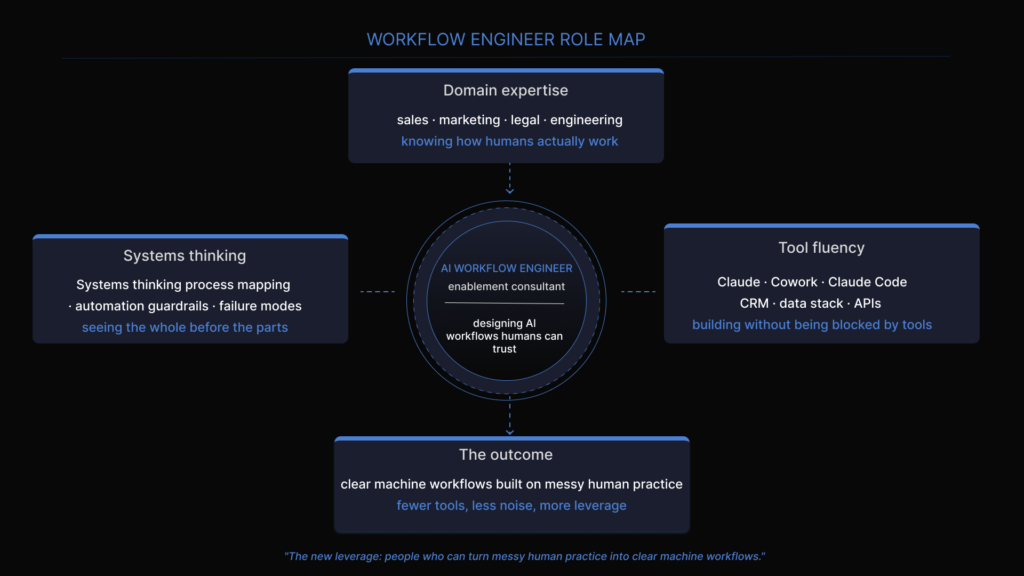
That role is not glamorous yet. It sits somewhere between operations, product thinking and editorial precision. But it is where leverage is accumulating. The videos hint at it constantly. They just never quite say it aloud.
Why now
The timing is not incidental. Anthropic is expanding Claude Cowork with more enterprise connectors and pushing harder into practical business workflows. This is the phase when AI stops being a lab fascination and starts becoming procurement, policy and staffing.cnbc
At the same time, senior managers are under pressure to show return on investment. CMOs are already moving from pilots to budget scrutiny. Law firms are making new AI hires while keeping overall headcount tight. Software teams are rethinking what junior engineers are for.linkedin+3
The two-year window
This creates a narrow but real window for professionals who are paying attention. BCG estimates that 50% to 55% of US jobs could be significantly reshaped by AI within two to three years. That does not mean a clean apocalypse. It means role redesign, wage pressure and a scramble over which skills still command a premium.thepromptinsider+1
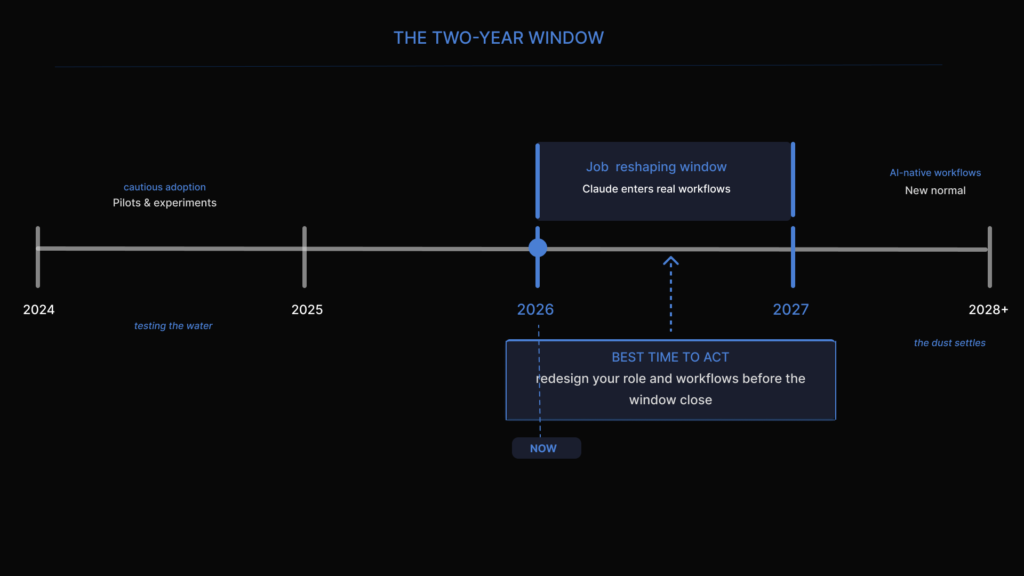
The point of these seven videos is not that Anthropic has solved work. It has not. The point is that the company has published a rough script for how parts of work are about to be reorganised. Developers, sales teams, marketing ops professionals and lawyers are all being told the same thing in slightly different accents: routine competence is getting cheaper. Judgment, system design and trust are getting dearer.bcghendersoninstitute+2
Footnotes (sources)
- Anthropic, “Anthropic Economic Index: AI’s impact on software development” (2025).
- Anthropic, “Claude Code tutorials and documentation” (official product pages and YouTube series).
- CNBC, “Anthropic updates Claude Cowork tool built to give the average office worker a productivity boost” (24 Feb 2026).
- TechBuddies, “Anthropic’s Claude Cowork aims to turn enterprise AI pilots into production workhorses” (25 Feb 2026).
- BCG Henderson Institute, “AI Will Reshape More Jobs Than It Replaces” (April 2026).
- Morocco World News, “AI Set to Reshape Up to 55% of Jobs in the US, BCG Report Finds” (30 April 2026).
- Harvard Business Review, “Companies Are Laying Off Workers Because of AI’s Potential — Not Its Performance” (2 Feb 2026).
- The Prompt Insider, “How Is AI Affecting Marketing Jobs? The January 2026 Jobs Report Reveals the Truth” (16 April 2026).
- Forbes, Roger Dooley, “Is 2026 the Year AI Finally Comes For Marketing Jobs?” (5 Jan 2026).
- RevenuePulse, “AI in Marketing Ops: What’s Actually Happening in 2026” (6 May 2026).
- Displacement.ai, “Will AI replace Marketing Operations Manager jobs in 2026?” (9 Feb 2026).
- Law360, “AI Set To Transform Junior Lawyer Roles, Survey Finds” (23 March 2026).
- American Inns of Court, “AI and the Future of Junior Lawyers” (31 Dec 2025).
- International Bar Association, “AI technology presents both opportunity and threat to young lawyers” (15 March 2026).
- Litera, “AI in Legal Tech: 5 Predictions for 2026” (17 Dec 2025).
- Alexa Translations / Thomson Reuters commentary, “Beyond the Hype: How A.I. Is Really Changing Law Firms in 2026” (10 Dec 2025).
- LinkedIn, Gökhan Kocamaz, “The Future of Sales in 2026: How AI Is Rewriting the Commercial Playbook” (22 Dec 2025).
- Prospeo, “Will AI Replace Sales Jobs? What the Data Says (2026)” (2026).
- Salesforce / IDC, “The Tipping Point: How Agentic AI Is Redefining the Future of Work” (white paper).
- MIT Sloan, “Agentic AI, explained” (17 Feb 2026).
- Axios, “Anthropic study says job impact is more evolution than apocalypse” (15 Jan 2026).
- Token Ring, “The End of the Entry-Level? Anthropic’s New Economic Index” (14 Jan 2026).
- LinkedIn / Indian Startup News, “Anthropic CEO Warns of AI Impact on Software Engineering Jobs” (20 Jan 2026).
- LinkedIn / Jose de Cabo, “People say AI will reduce demand for developers. Yes, layoffs are…” (18 March 2026).