
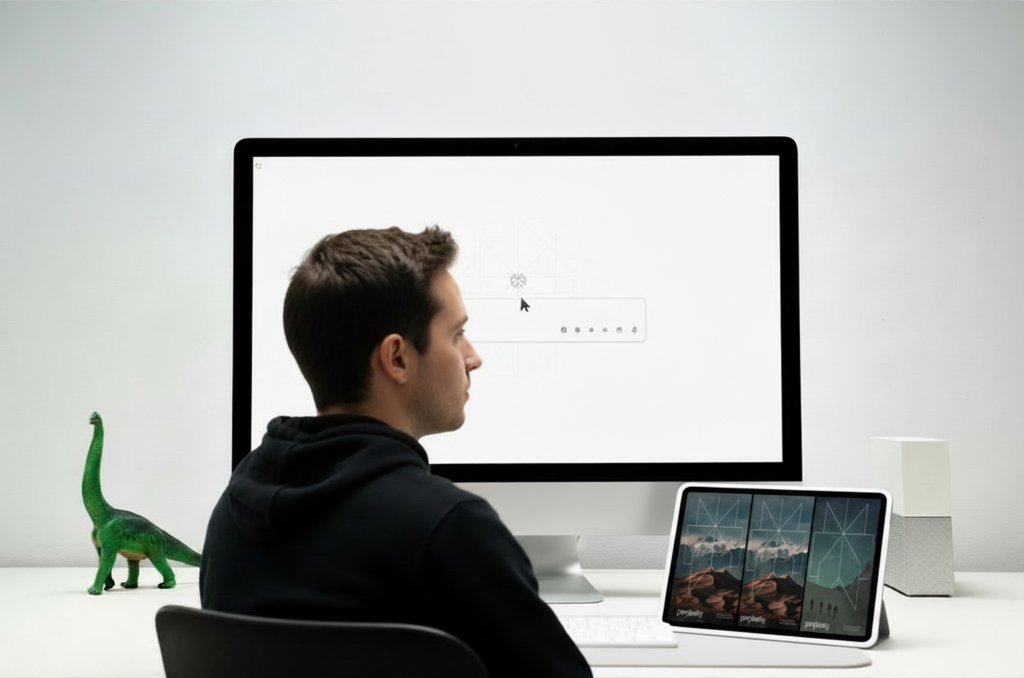
Somewhere between ‘ask a question’ and ‘ship a product / deliverable’, the modern knowledge worker began to thin out. Perplexity Computer arrives with a simple, unnerving promise: you no longer talk to an AI; you hand your work to it.perplexity, ai-corner.
“Computer is not selling intelligence. It is selling absence.”
Observation: A computer that works while you sleep
How Computer is framed
In the Perplexity Academy explainer, Computer is introduced with the confidence of a product that thinks it has renamed the category. This is not ‘Pro search’ or ‘Labs’ with nicer packaging. It is framed as “a new kind of digital coworker” that “turns a single request into finished, shippable work”, running for hours or days while you do something else. timesofindia.indiatimes+1youtubeperplexity
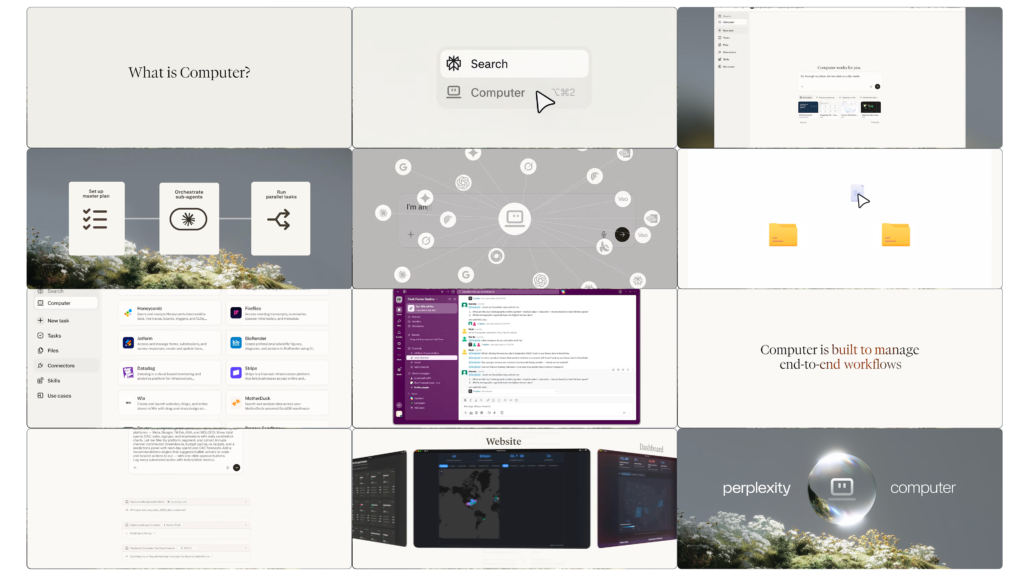
The official launch blog and LinkedIn announcement go further. Computer “unifies every current AI capability into one system” and can “research, design, code, deploy, and manage any project end‑to‑end”. Under the hood, it orchestrates around nineteen frontier models in parallel, routing each step of your project to the model best suited to it.linkedin+4
Agents browse the web, work with your files, write and run code, and plug into tools like Slack, Notion, Google Drive, Snowflake, Salesforce, and HubSpot. Instead of a single chat, you get a small digital production team in the cloud.youtubeperplexity+2
Outcomes, not process
“You increasingly risk seeing only the outputs and skipping over the work.”
This is the crucial observation: Computer is not selling intelligence. It is selling absence. The user’s absence from the process.
Hand it “a presentation, a dashboard, a recurring workflow, or a new website”, and it will quietly build, refine, and deliver while you attend meetings or sleep. You can still inspect logs and traces in many agent systems, but the default UX tilts toward outcomes, not process.gendyoutubeeesel+3youtube
For people who build digital products – marketers, engineers, UX designers, product managers – that is both seductive and unsettling. If an AI system is now the one that “works through the night”, what exactly is your job?
Anecdote: The disappearing maker (in prototype)
A PM, a marketer, and an engineer walk into Computer
Imagine a typical Tuesday in a mid‑size SaaS company that is slightly ahead of the curve.
A PM, tired of being permanently behind on ‘competitive visibility’, opens Computer and types: “Track our top five competitors, monitor new feature launches, summarise changes weekly, and publish a one-page brief into our strategy Notion.” Computer obliges, wiring itself into Notion, scraping product blogs, scanning release notes, and assembling a digest while the PM moves on. This is exactly the kind of “research → slide deck → email it to the team” workflow highlighted in early coverage.the-ai-corner+4
In the marketing pod, someone has a different problem. The team needs a campaign micro‑site by Friday. They feed Computer a brand guidelines file, a product one‑pager, and a Slack thread of half‑formed ideas. Then they ask it to “design and build a single-page launch site in our style, export the assets, and push the code to GitHub.” Independent testers describe building branded callout‑box apps and small web tools in a single night using Computer’s multi‑model agents.karozieminski.substack+2
Meanwhile, a data‑leaning engineer wants less inbox babysitting and more signal. Their brief: “Watch our subscription metrics and key customer accounts. If churn risk crosses a threshold, generate a short analysis and email me and the CSM with possible causes.” Here too, Computer’s intended use case is clear: long‑running, scheduled workflows that watch data sources, run analysis, and deliver proactive briefings into your existing tools.builder+3youtubegend
“In these vignettes, the human role tilts from doing to specifying.”
Pilots, not a settled reality
Right now, many of these setups exist only in ambitious pilots. Reviews note that agents still break on brittle integrations, outputs need heavy editing, and governance teams are only just deciding what they’re comfortable delegating. The vision is ahead of the reality.guvi+3
But the direction of travel is clear. In these vignettes, the human role tilts from doing to prompting and constraining – from “I will build this” to “I will describe what needs to exist, and something else will build it”. This is more than automation. It is a quiet, proposed transfer of authorship.
Pattern: From copilot to contractor
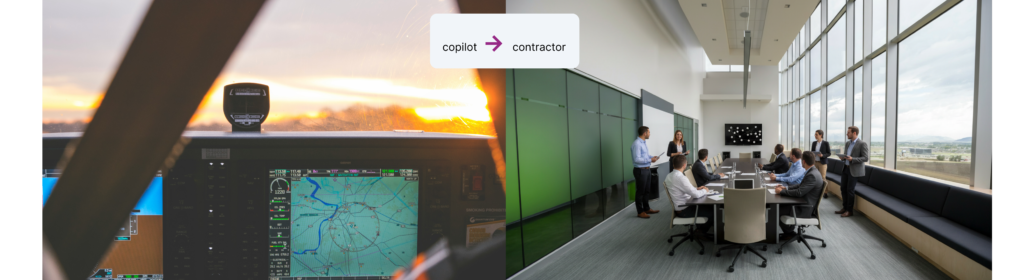
The end of the ‘copilot only’ era
For the last three years, AI marketing has been dominated by the ‘copilot’ metaphor. Perplexity itself positioned as an “AI‑powered answer engine” that helps you research and explore with citations and live web search. ChatGPT, Claude, Microsoft Copilot, GitHub Copilot and Gemini all framed themselves as assistants that sat beside you, generating drafts and suggestions while you remained firmly in charge. microsoft+9
This ‘assistant’ framing runs through most tutorials and explainers, from Perplexity Academy to independent guides on YouTube. youtube+1
Perplexity Computer points toward a different relationship. It is closer to hiring a contractor than onboarding an assistant.
Three design moves that matter
Structurally, three patterns stand out:
End‑to‑end, not in‑the‑loop
Computer is explicitly designed to “create and execute entire workflows” that can run “for hours or even months” with only high‑level prompts at the start. Instead of co‑writing a deck, the canonical example is “research our top five competitors, compare their pricing, build a slide deck, and email it to the team” – a single request that covers research, synthesis, formatting, and distribution.perplexity+3youtubethe-ai-corner+1
Massively multi‑model orchestration as product surface
Perplexity and independent reviewers emphasise that Computer “runs 19+ AI models at once” and uses a core reasoning model to route each subtask to the right model. Images, long‑context recall, quick Q&A, deep research and coding are all delegated to different systems, coordinated by Perplexity’s agent layer.eesel+4
Persistent, tool‑connected memory
Computer is positioned as “what a personal computer in 2026 should be”: personal to you, remembering your work, and connected to hundreds of tools – email, chat, docs, CRMs, analytics, and more. It is not just ‘aware’ of your files. The product vision is that it monitors calendars, metrics and repositories, then acts on them autonomously via scheduled and conditional workflows.perplexity+6“Computer is not an AI feature. It is a proposal about where digital work should live.”
Taken together, these patterns reveal what Computer is trying to be: not an AI feature, but a proposal about where digital work should live. Not only on your laptop, not only in your head, but in a cloud‑based agentic system that outlives individual sessions and, in theory, individual employees.linkedin+4
Today, most deployments still look like high‑powered assistants. They hallucinate, misread edge cases, and trip over permissions and security controls. But the product narrative is already optimised for a world where the contractor model becomes normal.bridgers+2
Cultural interpretation: The possible outsourcing of digital authorship
A shifting moral economy of ‘the work’
The obvious story here is productivity. The more interesting story is cultural: what happens to identity in organisations if systems like Computer succeed in becoming primary makers of digital work?
Historically, there has been a moral economy around ‘the work’ in tech organisations. Engineers earned status by solving hard problems and shipping reliable features and systems. Designers earned it by making interfaces legible, beautiful, and empathetic. Marketers earned it by understanding the market well enough to change behaviour. PMs earned it, at least in theory, by making sound product decisions.
Computer foreshadows a future in which that economy could blur. When an AI system assembles research packets, drafts specs, writes code, configures dashboards, and even deploys micro‑apps, the visible artefacts of expertise start to look suspiciously generic. A deck built by an agent will be clean, structured, citation‑rich. A prototype it ships will be plausible, responsive, safely generic. A weekly briefing will arrive on time, formatted, sourced.fonearena+5
“An AI that produces ‘finished deliverables’ on command doesn’t just automate work; it standardises taste.”
What this means for specific roles
For marketing and comms, this raises a sharp question: if ‘finished deliverables’ are now a default output of a digital coworker, what makes a human strategist valuable? The answer can’t simply be ‘taste’. It has to be the ability to define the questions Computer is allowed to answer, the constraints it must observe, and the blind spots it may reproduce.digitaltrainee+3
For engineers, the system challenges the identity of the builder. If agents can “write, test, and deploy code”, call APIs, and spin up micro‑apps with sensible defaults – even if imperfectly today – the badge of honour shifts from “I wrote this” to “I decided what was worth building, and I constrained how it interacts with the rest of our stack”. Coding becomes less like carpentry and more like urban planning.capstonec+4
For UX and product design, the danger is subtler. An AI that can research, design, and generate assets from brand guidelines will happily produce sites and flows that are perfectly on‑grid and perfectly forgettable. If organisations treat those outputs as ‘good enough UX’, the discipline risks being reduced to post‑rationalising what an orchestration engine decided to do.standout+3
For product managers, Computer tempts a regression into specification theatre. It is suddenly very easy to feel productive by typing detailed outcome prompts into a system that will obligingly produce roadmaps, PRDs, dashboards and monitoring workflows. Whether any of those should exist becomes a secondary question.eesel+2
Delegation, trust, and forgetting how work is done
Computer does not yet make organisations outsource authorship. But it points toward a future in which that outsourcing becomes easy, tempting, and hard to notice. Human–AI delegation research already shows that trust, not just capability, shapes what work gets handed to AI. The narrative of how work was done risks moving from “here is the trail of decisions and trade‑offs” to “here is the prompt, here is what came back”.aisel.aisnet+5
“The risk is not that no one works. It is that no one remembers how.”
Practical layer: What practitioners should actually do differently
Because this is not a neutral design choice, professionals who build the digital world will need to adjust their practice if they want to stay upstream of the agents.
For AI product marketers
For AI product marketers, the temptation is to sell Computer as magic: a system that “does your work for you”. That’s a powerful hook – and Perplexity’s own launch materials lean into the “digital coworker” that turns a single request into shippable work. But the more durable narrative is more uncomfortable and more honest: Computer is incredibly capable but fundamentally un‑opinionated. It will gladly scale your organisational confusion.
So the job of AI product marketing here is to:
- Emphasise scope and limits, not just power. Be explicit about what Computer is good at (multi‑step workflows, research plus execution) and where humans must remain in the loop for judgement, risk and values.
- Acknowledge current friction. Talk honestly about hallucinations, brittle integrations, access‑control headaches and compliance reviews, which early reviewers and enterprise buyers are already flagging.
- Show real failure modes. Share examples of projects that went sideways until a human stepped in, and what guardrails were added afterward.
- Frame Computer as an amplifier of well‑posed problems, not a saviour of messy organisations. AI does not fix broken systems; it multiplies them.
For engineers who code
Treat Computer less like a junior developer and more like a highly capable, slightly reckless automation layer.
That means:
- Moving your craft up a level. Shift from writing individual functions to designing constraints, observability, and failure handling around whatever code an agent generates or deploys.linkedin+3
- Owning the interfaces. Insist that any Computer‑driven code or tooling conforms to your team’s standards for security, performance, and maintainability, rather than accepting whatever the orchestration layer produces.fonearena+3
- Designing for partial autonomy. Build kill switches, sandboxing, and guardrails for what agents are allowed to touch in production.mckinsey+2
- Measuring not just output volume (number of scripts, dashboards, automations), but downstream impact and incident rate.worklytics+1
If systems like Computer are going to operate inside your stack, you should be the one defining their blast radius.
For UX and product designers
Computer is very good at ‘design‑like’ outputs: slide layouts, landing pages, flow scaffolds. That should be treated as raw material, not as design.dribbble+3
Practically:
- Use Computer to explode the space of options, then use human judgement to decide which options are ethically and experientially acceptable.kyndryl+1
- Focus more of your attention on system behaviours than on static screens. Ask how an autonomous agent explains what it is doing, asks for consent, shows progress, and admits uncertainty. The UX of delegation and accountability will matter more than the precise curvature of buttons.kyndryl+1
- Design the “agent transparency” layer. Provide simple views where users can see what a workflow is doing, what data it touched, and why it made certain decisions.acm+2
- Build rituals for interrogating Computer’s outputs. Run regular reviews where teams ask “why does this flow exist? who benefits? who is inconvenienced?”, not just “does this look on‑brand”.“The real UX challenge is not how Computer looks, but how it behaves when no one is watching.”
For product managers
If Computer can, even imperfectly, handle a large chunk of research, synthesis, specification and basic experimentation, PMs have fewer excuses for hiding behind the busyness of artefacts.
The work shifts towards:
- Deciding which problems are worth feeding the machine in the first place, and which should not be automated at all.jenova+3
- Establishing decision frameworks that agents cannot provide. That includes value vs risk trade‑offs, sequencing, and explicit “we won’t do this even if the metric moves” rules.journals.sagepub+3
- Creating clarity around ownership. When Computer maintains a dashboard, triggers alerts, or launches a micro‑experiment, someone still needs to be accountable for the consequences.sidetool+2
- Working closely with legal, security and compliance to define “automation‑safe” problem classes where agents can be allowed to roam.reports.weforum+2
If everyone owns the digital coworker, no one owns its mistakes. PMs will either step into that vacuum, or live with decisions made by default.
Quietly resonant ending: Who is the computer now?
Perplexity’s own line – that Computer is “what a personal computer in 2026 should be” – is more revealing than it intends to be. For forty years, the personal computer was the device that gave individuals more agency over information and tools. You were the one in front of the screen, deciding what to do next.the-ai-corner+2
Computer inverts that relationship, or at least gestures toward a world where it might. The work happens in a system you do not directly see, across models you did not personally choose, inside workflows you may have only loosely specified. You become, in a sense, the interface: the thing that occasionally types a goal and receives outcomes. karozieminski.substack+5
“The interface has become human. The computer is elsewhere.”
That does not mean the professions of marketing, engineering, UX, or product management are about to vanish. It does mean their centre of gravity is drifting away from making artefacts and towards deciding which kinds of work the organisation is willing to hand over to an invisible production layer – and which it refuses to delegate, no matter how capable the machine becomes.papers.ssrn+3
The question Perplexity Computer leaves us with is not “what can AI build for you?” but something more uncomfortable: if these tools succeed on their own terms, are you still prepared to stand, publicly, behind the things they quietly build in your name?scholarspace.manoa.hawaii+2
Footnotes
- Perplexity AI, ‘Introducing Perplexity Computer’, April 2026.perplexity
- Perplexity AI, ‘Everything is Computer’, April 2026.perplexity
- Perplexity AI, LinkedIn, ‘Introducing Perplexity Computer: Unified AI System’, February 2026.linkedin
- Perplexity AI, YouTube, ‘What Is Perplexity Computer? | Perplexity Academy’, April 2026.youtube
- Times of India, ‘Explained: What is Perplexity Computer and how does it work’, February 2026.timesofindia.indiatimes
- Karo Zieminski, ‘Perplexity Computer: What I Built in One Night’, February 2026.karozieminski.substack
- Eesel, ‘Perplexity Computer: A complete guide to the AI agent system in 2026’, 2025.eesel
- Builder.io, ‘Perplexity Computer Review: What It Gets Right (and Wrong)’, March 2026.builder
- Digital Applied, ‘Perplexity Computer: Multi-Model AI Agent Guide’, February 2026.digitalapplied
- Bridgers Agency, ‘Perplexity Computer: Can an AI Agent Actually Replace Your Team?’, March 2026.bridgers
- GUVI, ‘Perplexity Computer Review: Is This the Future of AI or Hype’, April 2026.guvi
- SAP, ‘What are AI agents: Benefits and business applications’, 2024.sap
- BCG, ‘AI Agents: What They Are and Their Business Impact’, 2026.bcg
- Sidetool, ‘The Impact of AI on Knowledge Work’, 2025.sidetool
- Jared Chung, ‘What skills do knowledge workers need in the Agentic Era?’, June 2025.linkedin
- McKinsey, ‘AI in the workplace: A report for 2025’, 2025.mckinsey
- World Economic Forum, ‘Future of Jobs Report 2025’, 2025.reports.weforum
- Akhil S.G. & Kalle Lyytinen, ‘Distributed Cognition and Human-AI Delegation in Knowledge Work’, ICIS 2025.aisel.aisnet
- Marc Pinski et al., ‘AI Knowledge: Improving AI Delegation through Human Enablement’, 2023.acm
- Jenova, ‘AI for Knowledge Workers: How Intelligent Agents Are Transforming Work’, 2026.jenova
- Vegard Kolbjørnsrud, ‘Designing the Intelligent Organization: Six Principles for Human-AI Collaboration’, 2024.journals.sagepub