A town hall shouldn’t leave people guessing.
Company-wide communication has a big audience and a small window of attention.
- Organisation
- Microsoft (via partner)
- What I made
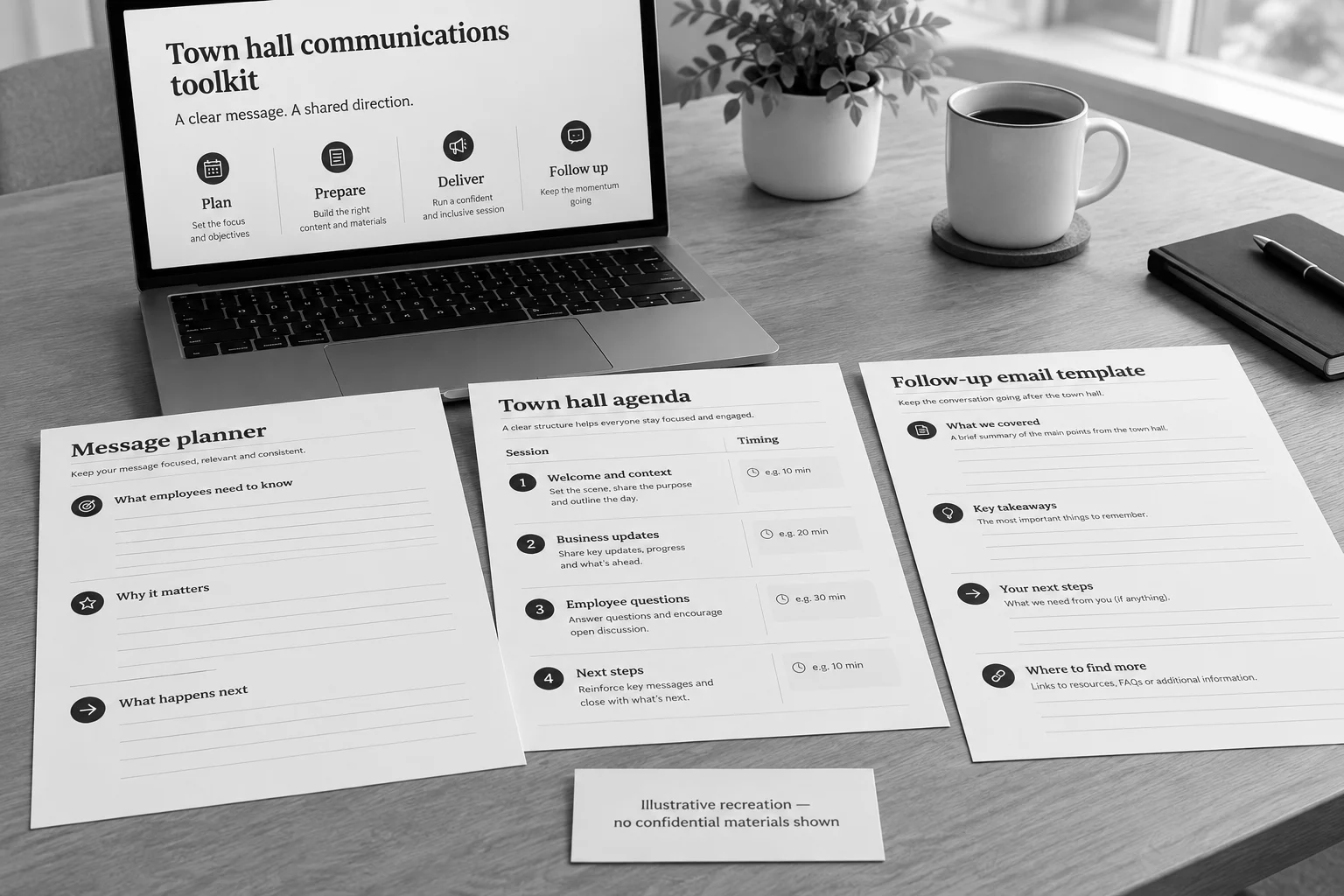
- Town hall toolkits and templates
- Focus
- Purpose, structure and employee relevance
- Format
- Reusable framework for contributors
- Materials
- Illustrative recreation; originals confidential
Working with Microsoft through a partner, I created town hall toolkits and templates to support clearer company-wide communications. The focus was straightforward: help the people preparing the communication organise what mattered—and help employees understand it.
Because bringing everyone together is only useful if the message comes together, too.
The challenge: one event, plenty to explain
A town hall needs to do more than fit updates into an agenda.
It needs a clear thread: what matters, why it matters and what employees should take away. Without that structure, even useful information can become a succession of announcements competing for attention.
The communication task was to create a framework for those messages without making every contribution sound like it had come out of the same corporate biscuit cutter.
Consistency, yes. Identical sentences, no.
What I made
Town hall toolkits · Templates for company-wide communications
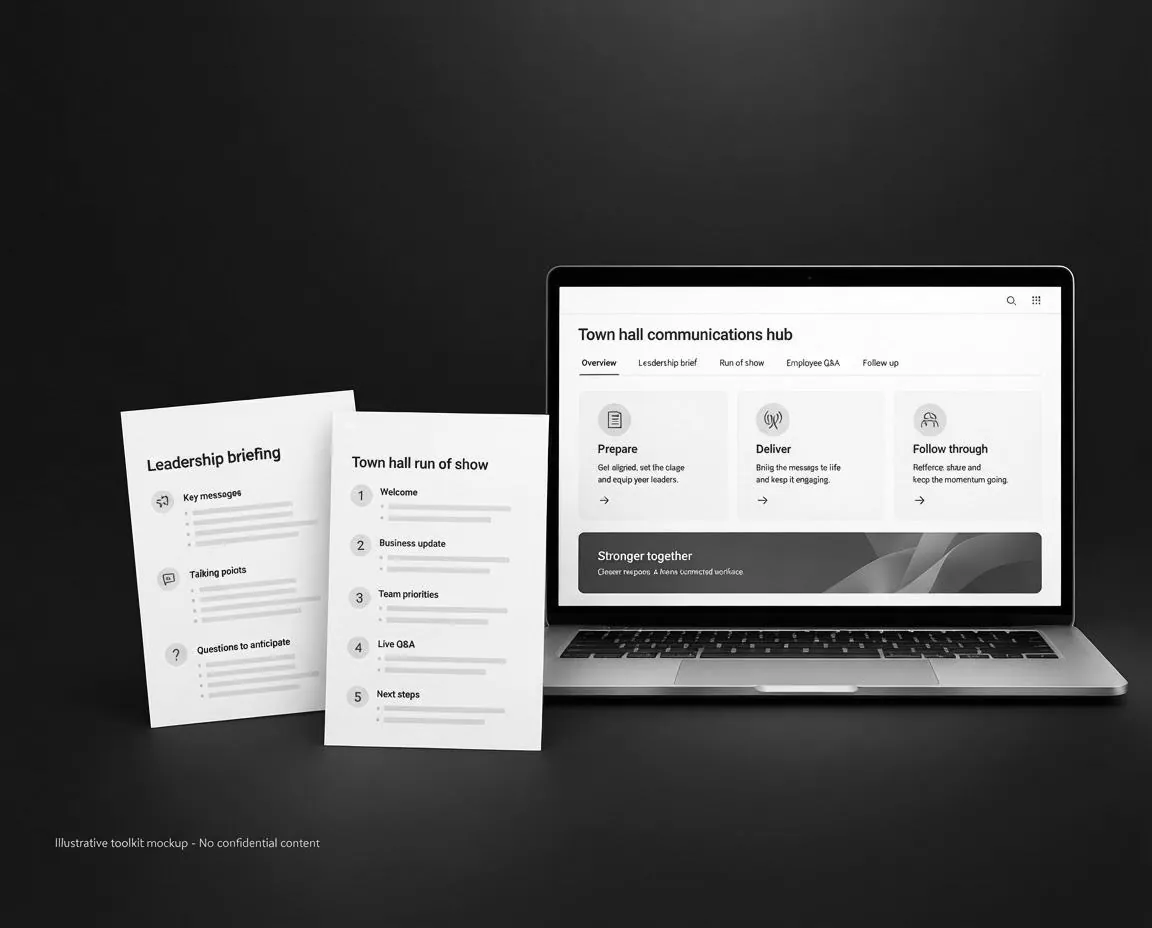
The materials provided a reusable foundation for preparing internal communications, with an emphasis on clarity, structure and employee relevance.
The portfolio examples are illustrative recreations. Original materials are confidential.
My approach: give the message a backbone
Put the point before the preamble
I focused on helping the communication establish its purpose early.
What did employees need to know? Why was it worth their attention? Those questions gave the content a centre of gravity.
The opening shouldn’t need its own executive summary.
Create structure without scripting every word
The templates gave contributors a framework for organising information while leaving room for the subject and speaker.
The aim was a recognisable communication structure—not a recognisable case of template fatigue.
Keep the employee’s question in view
Company-wide updates can explain what the organisation is doing and still leave employees wondering what it means for them.
I brought that reader’s perspective into the work: make the context useful, the main message visible and any next step clear.
Make the framework reusable
The toolkit format supported a repeatable approach rather than treating every communication as a blank-page exercise.
The point wasn’t to remove judgement. It was to give that judgement a useful starting place.
My contribution
Working through a partner, I:
- Created town hall toolkits and company-wide communication templates.
- Helped structure messages around their purpose and employee relevance.
- Connected editorial clarity with the practical needs of communication preparation.
What this case demonstrates
This case focuses on the toolkit work—not a claim that templates alone transformed employee engagement.
It shows how I translate communication needs into practical editorial resources: enough structure to guide preparation, enough flexibility to accommodate different messages and a consistent focus on the audience.
The broader internal communication programme has its own reported results. Those should remain separate unless the toolkit’s specific contribution can be established.
The takeaway
A good toolkit doesn’t do the thinking for people.
It helps them spend less time finding a structure and more time deciding what is worth saying.
The goal: company-wide communication with a clear point—not just a large invitation list.
Portfolio note: Illustrative recreation only; original materials are confidential.