From digital marketing to AI-first: beyond faster content
What I learned from AI marketing pioneers—and why the real improvement came from redesigning the work, not collecting more tools.
The first thing AI gave me was more drafts.
This was useful, up to the point at which I had to read them.
There were headlines, summaries, social posts and articles with the reassuring surface of something finished. The sentences arrived promptly. The judgement remained my responsibility.
I could generate an article faster. I still had to decide whether its argument deserved an article. I could produce five LinkedIn posts from it. I still had to establish whether any of them offered a reason to interrupt someone’s afternoon.
That distinction became the starting point for my move from digital marketing to AI-first marketing.
I did not need a more industrious content machine. I needed a better relationship between research, writing, distribution and learning.
My background is in communication, publishing, digital systems and applied AI. Much of that work involves taking something complex and making it useful to someone who has other things to do. AI has expanded what I can attempt. It has not abolished the reader’s right to be unimpressed.
The meaningful change came when I stopped treating each AI interaction as an isolated request and began examining the work around it: what information went in, what travelled to the next stage, what needed checking and what should remain a human decision.
The draft was only one part of the process.
For a while, it had received rather too much publicity.
Digital marketing was not the problem
I am not declaring digital marketing dead. It has endured enough declarations of death to qualify for a loyalty programme.
Understanding an audience still matters. So do positioning, useful content, discoverability, distribution and measurement.
A badly defined offer does not improve because an agent can describe it in several formats. A weak argument remains weak when accompanied by a carousel.
What I wanted to change was how those fundamentals were put to work.
My earlier approach to AI focused on individual tasks: summarise this material, explore this topic, propose an outline, sharpen this paragraph. Those applications remain useful. But they can leave the surrounding process largely untouched.
The research may sit in one conversation. The approved position may live in another document. The next task begins with another explanation of the audience, the purpose and the sentence we have already agreed never to use again.
Each interaction can look efficient while the overall arrangement depends on a person carrying the context.
Usually, that person is also expected to have a strategy.
For me, AI-first marketing means designing a more connected process around the objective. AI can help investigate, produce and analyse. People establish the purpose, set boundaries and remain accountable for what reaches the audience.
“First” describes when I consider AI in the design of the work. It does not mean the technology gets priority over the customer.
The customer has not applied to participate in my software experiment.
What the practitioner-teachers helped me see
Learning from Christopher S. Penn, Paul Roetzer, Mike Kaput and Katie Robbert helped me move beyond the question of which tool to try next.
Not because they supplied a universal recipe. Their value was in making different parts of the problem visible.
Roetzer and Kaput’s work at Marketing AI Institute emphasises identifying useful applications, prioritising them and developing practical pilots. Their teaching connects AI adoption with a business problem rather than treating experimentation as an end in itself.
The lesson I took was simple: enthusiasm is not a selection criterion.
A tool can be impressive and still be the wrong answer to the task in front of me. The demonstration may be excellent. Unfortunately, my work is not a demonstration.
Penn and Robbert helped sharpen another distinction: a capable system still needs direction, context and a clear definition of completion.
In their discussion of agentic prompting, they connect instructions with purpose, people, process, platform and performance—the Trust Insights 5P Framework. They also stress the importance of specifying available tools, boundaries and what “done” means.
That last question deserves more attention.
“Improve our marketing” is not a definition of done. It is a permanent employment contract for a system with access to your budget.
I began to pay more attention to the conditions around the request. Who will use the output? What information is approved? What may the system change? When should it ask rather than continue?
My refinement was to connect these lessons with an editorial approach: make the evidence inspectable, preserve the argument between stages and distinguish proposing something from authorising it.
Better prompts cannot carry the entire organisation
A good prompt helps. I still care about clear instructions.
But a beautifully written request cannot compensate indefinitely for scattered information, outdated guidance or an absent decision-maker.
If the audience definition changes, someone has to update it. If a claim is no longer supportable, it needs to stop appearing in future drafts. If a positioning statement has been approved, the next stage should not quietly resurrect the previous version.
This is less exciting than finding the perfect prompt. It is also more useful.
The underlying problem is familiar from communication work: information exists, but it does not reliably reach the point where someone needs it.
I explore the wider organisational version in AI workplace transformation starts with workflows. The same principle applies to marketing. Buying capability is not the same as arranging work so that capability can be used.
For an AI-supported process, the working context needs to be maintained, not merely mentioned once.
That can include:
- The audience and the decision the content should help them make.
- The offer, positioning and claims that can be substantiated.
- Approved evidence and examples.
- Editorial standards and channel requirements.
- Restrictions on data, actions and publication.
The aim is not to produce a vast document that nobody reads, including the machine.
It is to give each stage the information it actually needs—and a reliable way to find the current version.
The useful idea behind the “brand harness”
Daniel Verten’s article on brand engineering gave me a helpful way to think about this surrounding system.
Defyner calls it a “brand harness”: the scaffolding that connects brand knowledge, processes, assets, tools and governance around AI models and agents. Its proposed architecture has four layers: Brand Code, Act, Persist and Govern.
Translated into everyday working questions:
- What must the system know?
- What may it do?
- What must it retain?
- How will we assess it?
Those questions are more valuable to me than the promise of an autonomous marketing department.
They also expose what can disappear in a tool-led conversation. Retention, for example, is not glamorous. Neither is version control. Yet neither becomes less necessary because the interface is conversational.
If a correction is made and then lost, the system has not learned. A person has performed maintenance in a place where nobody thought to keep the receipt.
I find Defyner’s architecture useful without accepting every expansive claim attached to it. It is a consultancy’s proposed approach, not independent proof that every organisation will gain a durable advantage.
Nor would I assume that integration removes the need for technical expertise. Connecting tools, controlling access and handling failures are real responsibilities. A friendly interface does not make them disappear. It merely makes them look less like work until something breaks.
Agents need a job, not a personality
The word “agent” can now describe almost anything that happens after a prompt.
I find that unhelpful.
Anthropic draws a useful architectural distinction. Workflows follow predefined paths. Agents can direct their own processes and tool use in pursuit of a task. Its guidance also recommends starting with the simplest workable approach and adding complexity only when it improves the result.
This distinction changed how I thought about delegation.
A sequence that researches, drafts and reviews according to specified steps is a workflow. A research agent that identifies an evidence gap, chooses how to investigate it and assesses whether further work is needed has some discretion.
Both can be useful. Neither needs a fictional job title.
Calling a model “chief strategy officer” does not give it commercial judgement. It gives the prompt a business card.
What matters is the task, the information available, the tools permitted and the standard against which the work will be assessed.
For predictable steps, I favour predictability. For open-ended investigation, bounded discretion can help.
The goal is not maximum autonomy. It is appropriate autonomy.
That may mean allowing a system to search further while preventing it from publishing anything. It may mean generating alternatives while reserving the choice. It may mean asking for analysis only, with no changes to live material.
Permission to think is not permission to send.
A connected workflow, without the theatre
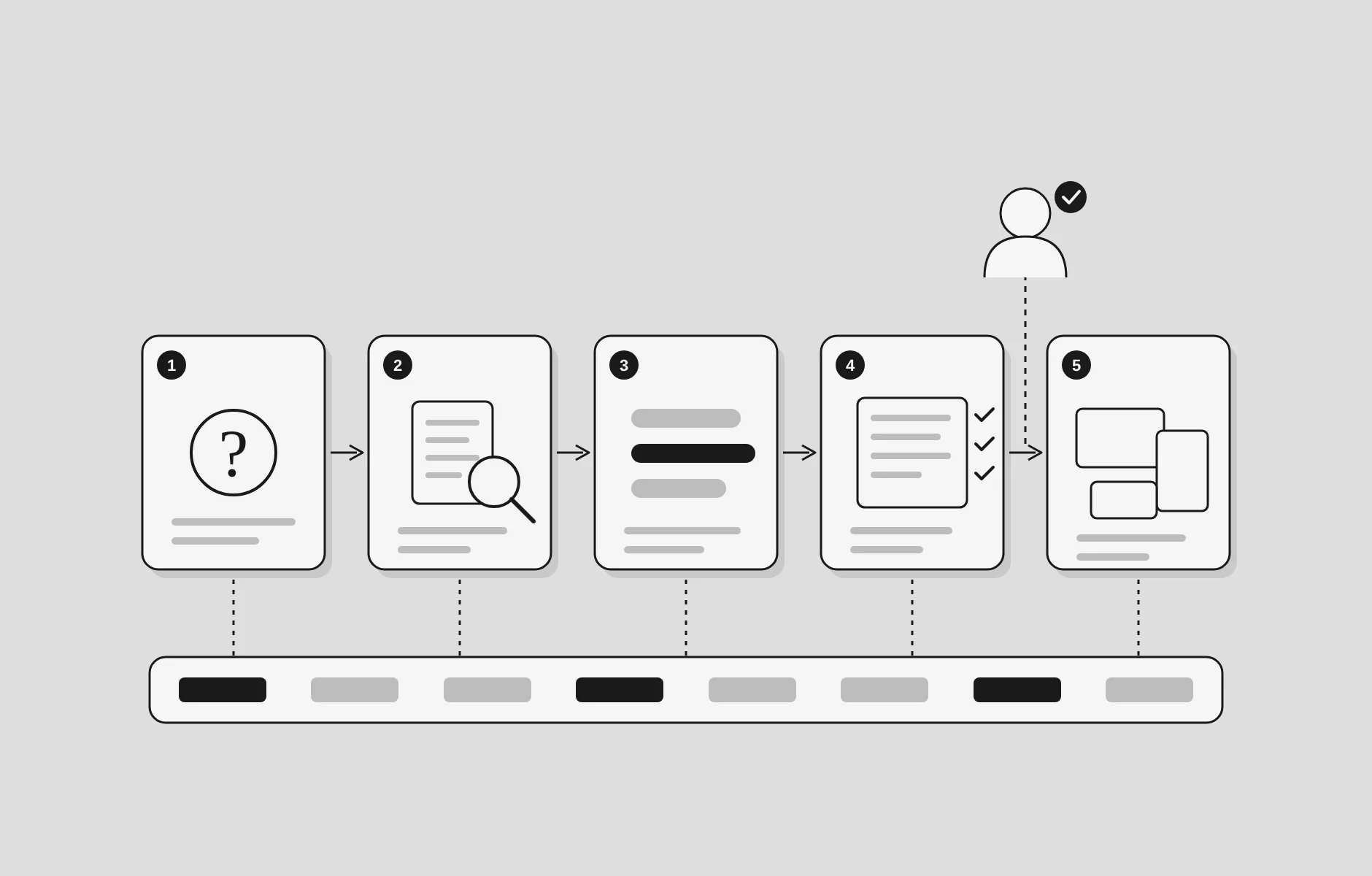
The most practical way to explain this approach is through one deliverable.
Consider a substantive article intended to help a prospective client understand a problem. The following is an illustrative design, not a claim that every part of my practice runs through one fully autonomous system.
Start with a question worth answering
“AI in marketing” is a topic.
“Why are we producing more content without receiving better enquiries?” is a problem.
The brief should establish who is asking, what they need to understand and why my experience gives me something useful to contribute.
AI can help explore that question. Choosing it remains a strategic decision.
Otherwise, the workflow becomes an efficient way of publishing whatever happened to be easiest to generate.
Research with the evidence attached
The research stage should return more than a persuasive summary.
I want the source, the claim it supports, the limitations and any unresolved disagreement.
A research agent can be useful when it has a clearly bounded question and permission to investigate gaps. It should also have a stopping condition. “Continue until comprehensive” is an invitation to confuse diligence with endurance.
Most importantly, the evidence should travel with the findings.
A summary without its sources creates a trust exercise for the next stage. Marketing already contains enough of those.
Choose the argument before commissioning the prose
Research does not decide what the article should say.
This is where editorial judgement earns its place: identifying the consequential connection, rejecting the fashionable but unsupported claim and deciding what the reader should understand differently.
AI can challenge the reasoning. Where does the argument overreach? What alternative explanation have I ignored? Does the recommendation assume resources the reader does not have?
Those are useful questions.
“Make this more insightful” is less useful. Insight is not a finishing treatment.
Draft from approved material
The drafting stage should work from the agreed position and evidence.
It should not introduce an attractive statistic merely because the paragraph appears to need one. New factual claims return to verification.
This prevents the writing from quietly manufacturing its own authority.
It also lets me edit for something more substantial than the removal of generic openings. Does the piece explain? Does it distinguish fact from interpretation? Does it respect what the reader already knows?
Review different risks separately
Factual review, editorial review and publication checks have different jobs.
A factual pass checks support. An editorial pass tests reasoning and expression. A publication pass checks links, headings, metadata and the action the page invites.
AI can assist with each. Several AI reviews, however, are not automatically independent corroboration. A small committee of models can still agree on the same error.
The final approval remains mine.
Adapt the argument to the channel
A newsletter is not a blog with fewer paragraphs. A LinkedIn post is not an introduction followed by a request to go elsewhere.
Each format needs its own reason to exist.
A connected workflow helps carry the approved argument and evidence into those adaptations. Human judgement decides whether each version offers value—or merely contributes another reminder that I have published something.
The quiet importance of remembering
The most useful improvement is not always visible in the final asset.
It may be the source I do not have to find again. The boundary I do not have to restate. The rejected claim that stays rejected.
This is why retained knowledge matters.
But I do not confuse storage with learning. A folder full of outputs is a folder full of outputs. An agent that remembers everything may preserve mistakes as enthusiastically as useful decisions.
What deserves retention needs curation: approved examples, verified claims, recurring corrections, relevant performance observations and the reasons behind important choices.
It needs ownership, too.
Who updates the audience brief? Who removes an outdated example? Who decides that a new instruction is better than the old one?
Without those responsibilities, “persistent memory” risks becoming institutional clutter with a search function.
The process should become more reliable as it develops, not merely heavier.
Better results need smaller claims
I have found value in moving towards connected AI-enabled work. But I want to be careful about what counts as a result.
Time saved is useful. It is not automatically evidence of stronger marketing.
An article can reach publication sooner and still fail to help the intended audience. A campaign can generate more material while making the offer less clear.
I separate three questions.
First, operational performance: how long does the complete task take, including checking and correction? How much repeated explanation is required? Where does work stall?
Second, editorial quality: is the material accurate, distinctive and genuinely useful? Are corrections decreasing? Does the writing express a position I am willing to defend?
Third, commercial contribution: does the work attract relevant interest, clarify the offer or support better conversations?
These measures are related. They are not interchangeable.
My AI business case article approaches the broader question of demonstrating value. Marketing deserves the same discipline.
If a drafting improvement shifts work into review, count the review.
If a result depends on a person quietly repairing the process, count that too.
The spreadsheet should not receive the edited version of events.
Why it can get harder before it gets easier
There is a point in this transition when the promised simplicity produces an unexpected amount of documentation.
That is not necessarily failure.
Michelle Taite and Will Fernandez’s October 2026 HBR article warns that AI marketing transformation can initially increase costs and complexity before gains emerge. Its opening describes a system combining machine-readable brand knowledge, execution agents and orchestration that escalates decisions requiring human judgement.
That framing is useful because it makes the work around execution visible.
Someone has to articulate the rules that experienced practitioners apply almost without noticing. Someone must decide when a reasonable exception becomes an unacceptable risk.
Some of the complexity I associate with marketing was never eliminated. People absorbed it: remembering context, interpreting an ambiguous brief, noticing a claim that should not survive publication.
Making those decisions explicit takes effort.
It can also reveal disagreements that a shared document had politely concealed.
“Professional but approachable” may have sustained an organisation’s tone-of-voice guidelines for years. It becomes less helpful when a system needs to choose between two sentences and nobody agrees why one is better.
Documentation forces specificity.
Occasionally, that is what makes it unpopular.
Governance belongs in the workflow
An agent connected to tools is not simply generating text. Depending on its permissions, it may be able to change records, contact people or alter published material.
My position is straightforward: the cost of being wrong should shape the degree of autonomy.
Research and draft preparation can have room to operate. Publishing, spending, customer communication and sensitive information require explicit controls.
Instructions matter. So do actual access restrictions and approval mechanisms.
“Please be careful” is an inadequate security architecture, however politely expressed.
For every delegated task, I want clear answers about access, permitted actions, stopping conditions, escalation and the record left behind.
This is also why shadow AI governance matters. The practical question is not merely whether people are using AI. It is whether the organisation understands how work is already changing around it.
Good boundaries should make legitimate work easier to carry out safely.
They should not exist solely to make an approval diagram look responsible.
Start smaller than the software demonstration
If I were beginning again, I would choose one recurring deliverable before choosing another platform.
I would map its current path, including the inconvenient parts: searching for the approved source, restoring context, chasing an answer and repairing a draft that took a confident wrong turn.
Then I would establish a baseline and redesign that single process.
The first version needs a clear purpose, maintained context, inspectable evidence, defined permissions and a human approval point. It also needs a manual fallback.
Only then would I ask where an agent’s discretion improves the work.
That is the approach behind my workflow and operating-model design: start with how work actually happens, rather than how neatly it can be represented in a product presentation.
Test representative tasks. Record failures. Include the maintenance cost. Expand when the evidence justifies it.
A workflow that works reliably is more valuable than an autonomous department that exists mainly in a diagram.
The judgement is still mine
The most reassuring discovery in this transition is that my earlier skills have not become irrelevant.
Editorial experience helps me question an unsupported claim. Communication work helps me identify who needs what, and why. UX thinking helps me notice where a process makes people work unnecessarily hard.
AI extends those capabilities. It does not decide what they are for.
Learning from practitioner-teachers gave me stronger ways to experiment. Incorporating agents and connected workflows changed what I could delegate and what I needed to define.
But the aim is not a marketing system that never needs me.
It is one that needs less repeated explanation and leaves more attention for the decisions that matter.
What should we say? What can we substantiate? What would help this particular reader? What should we choose not to publish?
I still want better results.
I have simply become less interested in mistaking a full content calendar for one.
Linked source notes
- Marketing AI Institute, Marketing AI workshops. Describes Roetzer and Kaput’s approach to identifying applications, prioritising opportunities and designing pilots.
- Trust Insights, The 5P Framework and agentic prompting. Referenced for purpose, process, boundaries and a measurable definition of completion; its machine-generated transcript should not be treated as independently verified evidence for incidental examples.
- Daniel Verten, Brand engineering, Defyner, 19 May 2026. Source for the proposed brand-harness architecture, not independent validation of its commercial claims.
- Anthropic, Building effective agents. Referenced for the workflow–agent distinction, testing, stopping conditions and the recommendation to add complexity only when useful.
- Michelle Taite and Will Fernandez, Your AI marketing transformation will get harder before it gets easier, Harvard Business Review, 19 October 2026. References here are limited to the accessible summary and opening. Fernandez is also a Defyner co-founder; these are related perspectives, not independent corroboration.