
It is time to retire the sad piano music. Apple’s latest accessibility campaign proves that the most radical move a brand can make in late 2025 is to let its customers be ordinary, messy, and entirely unimpressive.
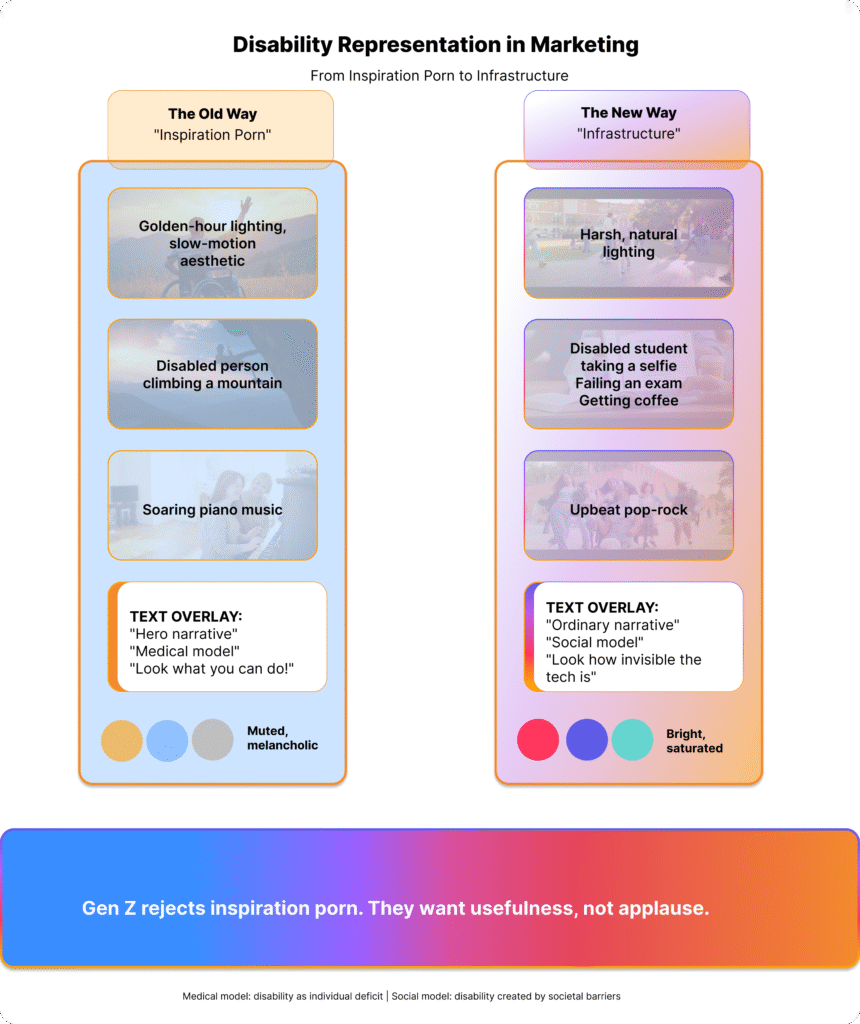
The most important moment in Apple’s new film—released a day before yesterday to mark the International Day of Persons with Disabilities—is not a triumph. There is no summiting of a mountain with a prosthetic leg. No tearful embrace after hearing a loved one’s voice for the first time.
Instead, we see a student sitting in a lecture hall, failing a maths equation.
He doesn’t overcome it. He simply gets it wrong, looks annoyed, and the song kicks in:
“Speak Screen: Dear student, congratulations!
You have been accepted into — [GASP]
I got into college.
♪ One! Two! ♪
♪ One! Two! Three! Four! ♪
0:16♪ I’m not remarkable I’m just finding my way ♪
♪ It’s not a walk in the park But baby I got the grades ♪
♪ Don’t wanna be admired ♪
♪ I’m not your inspiration ♪
♪ If you wanna be inspired ♪
♪ There’s a library down the hall ♪
♪ Have you noticed admiration ♪
♪ Sometimes smells a bit like pity ♪
♪ I can be strong I get stuff wrong ♪
♪ And I don’t always talk so pretty ♪
♪ I’m not remarkable Not heroic or brave ♪
♪ I’ve got no superpowers ♪
♪ I can’t even do this stupid equation! ♪
♪ I’m not remarkable ♪
♪ And neither are you (And neither are you!) ♪
♪ We all have toes (How weird are toes!) ♪
♪ We all look funny in the nude ♪
♪ I’ve got a life I’ve got a name ♪
♪ And I need stuff And you need stuff ♪
♪ And all our stuff is not the same ♪
♪ And some days I get so tired ♪
♪ She gets grumpy He gets bossy ♪
♪ Yeah Well I have a special need ♪
♪ I call it… “coffee” ♪
♪ Do I have to be remarkable? I’m just having a try ♪
♪ I’m not fragile or indestructible ♪
♪ And like everyone I sometimes cry ♪
♪ And I’m not like the rest ♪
♪ But then the rest of you aren’t like the rest either ♪
♪ I’m not a saint I’m not a sinner ♪
♪ I’m not a loser I’m not a winner ♪
♪ I’m not more and I’m not less ♪
♪ I’m just your average human mess ♪
♪ I’m not remarkable ♪
♪ And neither are you ♪
♪ I’m not remarkable ♪
♪ And neither are you! (Neither am I!) ♪
♪ We’ve all got toes ♪
Hold on, I don’t…
♪ We all look gorgeous in the nude ♪
♪ I’ve got a face I’ve got a place ♪
♪ I’ve got a life I’ve got a name ♪
♪ And I need stuff And you need stuff ♪
♪ And all our stuff is not the same ♪
♪ And we will strive And we will fail ♪
♪ And we’ll get hurt But we’ll prevail ♪
♪ And it’ll be joyous And it’ll suck ♪
♪ And I’ll be lonely And I’ll be loved ♪
♪ And on the way We will discover ♪
2:28♪ We’re not the same But we’re not the other ♪
♪ There’s a life out there that I refuse to miss ♪
♪ I’m only remarkable because everybody is ♪
SCATTERED CHEERING]
CLATTERING] [SCATTERED CHEERING]“
For the past decade, the advertising industry has been trapped in a feedback loop of “inspiration porn”—a term coined by the late disability activist Stella Young. We have sold disability as a tragedy requiring a hero, or a superhuman feat demanding applause. We have treated disabled people not as consumers, but as props to make non-disabled audiences feel warm about buying yoghurt or banking software.
With “I’m Not Remarkable,” Apple has effectively declared the “Brand Purpose” era of pity-marketing dead. For marketers, strategists, and creative directors, this represents a wake-up call. If your 2026 strategy involves putting a halo on a customer simply because they use your product to navigate a wheelchair ramp, you are arguably already obsolete.
The Monetisation of Mundanity
The real brilliance of this campaign lies not in its compassion, but in its pragmatism. For years, accessibility marketing has operated through the medical model: the user is “broken,” and the technology is the “cure.” Apple has shifted to the social model: the user is a bored student, and the technology is simply plumbing.
Watch the film carefully. When the blind student uses VoiceOver to find the lecture hall, the phone isn’t framed as a miracle device. Rather, it functions as a tool—as mundane as a hammer or a kettle. Similarly, when the fire alarm sounds, the student using Sound Recognition isn’t “saved” by their iPhone; they are simply alerted to stand outside in the cold, like everyone else.
This strategic pivot matters to marketers. We are moving from Empowerment (Look what you can do!) to Infrastructure (Look how little you have to think about this).
In 2025, “magic” rings hollow. We are drowning in AI slop and algorithmic hallucinations. Consumers no longer trust technology that claims to be miraculous. Instead, they trust what works.
By showing accessibility features facilitating the boring, messy, average parts of life—getting coffee, taking vain selfies, failing exams—Apple makes a bolder claim than any “Supercrip” narrative: Our tech is so good, it becomes invisible.
The Stella Young Effect
We cannot discuss this film without acknowledging its spiritual architect. In 2014, Australian comedian and activist Stella Young delivered a TED talk that dismantled the entire industry of “inspiration.”
“I am not your inspiration, thank you very much,” she said. Young argued that non-disabled people use disabled lives as a yardstick to measure their own gratitude, thinking: ‘My life is difficult, but at least I’m not them.’
Apple’s lyrics echo her thesis directly: “Have you noticed admiration / Sometimes smells a bit like pity?”
By licensing this sentiment, Apple takes a considerable risk. They bite the hand of the viewer. They tell the non-disabled audience: Stop staring. Stop clapping. It’s uncomfortable.
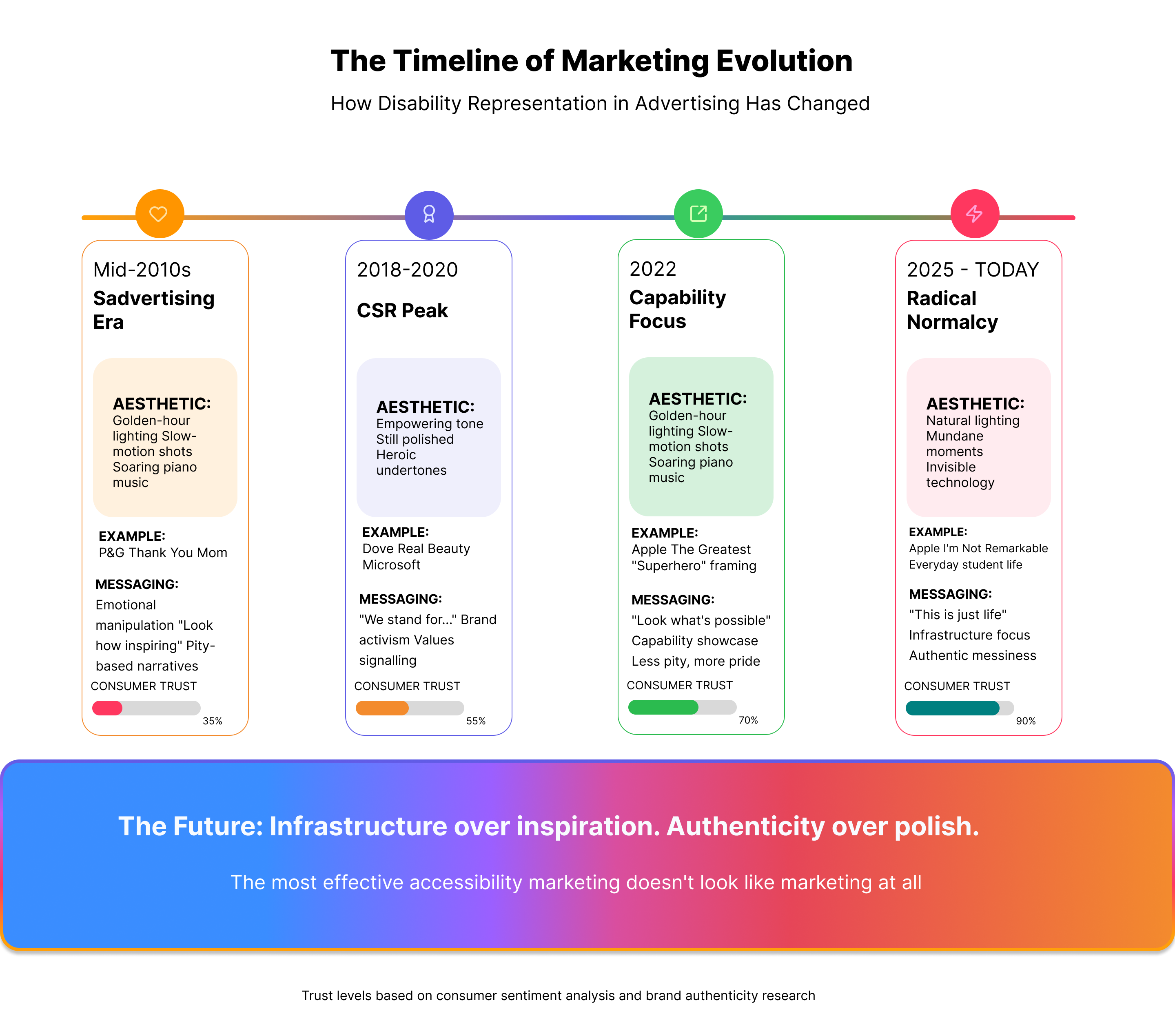
For a corporation worth trillions, this is genuinely high-wire work. Yet it lands because it aligns with the cultural temperature of Gen Z. This generation detects condescension like a shark detects blood. They reject sanitised, corporate CSR aesthetics in favour of the “human mess.”
The Aesthetic of Failure
Look at the art direction. Dorm rooms are cluttered. Hair is unkempt. Lighting is harsh and unforgiving.
This stands in stark contrast to the “Sadvertising” of the mid-2010s, where every frame was a cinematic masterpiece of golden-hour lighting and slow-motion resilience. That aesthetic feels hollow now. As I’ve explored regarding the nuances of disability representation in Indian advertising, moving away from these ingrained, melodramatic tropes is difficult for brands, but necessary.
The “I’m Not Remarkable” campaign embraces what we might call Radical Normalcy. It suggests that the ultimate luxury is not perfection, but the privilege of being average. As the tagline states: “I’m only remarkable because everybody is.”
When everybody becomes remarkable, nobody is. Consequently, we can stop “saving” people and start serving them.
The Trap for Marketers
Before you rush to adopt this approach, understand the trap. Do not mistake this ad for permission to stop trying.
The danger lies in thinking: “Oh, cool, we can abandon serious accessibility work and just be edgy instead.”
That would be a mistake. Apple earns the right to run this campaign because they have the receipts. They have spent a decade building the features shown in the film—VoiceOver, AssistiveTouch, Live Captions. The advertisement works because the underlying product (mostly) works. As I’ve written about previously regarding Meta’s accessibility failures, performative allyship without product substance is easily spotted by the community.
If you attempt to run a campaign celebrating how “normal” your disabled customers are, but your website fails WCAG 2.1 compliance and your retail stores have a step at the entrance, you will face justified backlash. You cannot claim the cultural high ground of “normality” if your product actively excludes people from ordinary life.
Moreover, we should remain critical of Apple itself. This remains capitalism. They are selling the idea of “messy humanity” to shift units of expensive hardware. They commodify the “anti-inspiration” movement just as effectively as Dove once commodified “Real Beauty.” In reality, the friction of using accessibility technology is rarely as seamless as a ninety-second musical number suggests. Real users encounter bugs, operating system updates that break features, and hardware costs that are prohibitive for the very students depicted in this film.
As a piece of brand communication, however, it remains exemplary in reading the cultural moment.
How to Apply This (Without Being Apple)
You lack Apple’s budget, and you probably lack their cultural cachet. Yet you can borrow their strategy. Here is how to rethink your marketing in 2026:
Audit for Pity
Review your creative assets carefully. Are you using minor keys on the piano? Does the camera look up at the subject in hero-worship, or down at them in sympathy?
Shoot at eye level. Literally and metaphorically. This simple shift changes everything.
Highlight Mundane Friction
Stop showing your product solving world peace. Instead, show it solving a Tuesday morning.
If you sell banking apps, don’t depict a blind user climbing Everest. Show them splitting a pizza bill fairly without getting ripped off. Usefulness, it turns out, is the new inspiration. This aligns with the broader trend of authenticity in video marketing—audiences want reality, not polish.
Cast for Personality, Not Just Capability
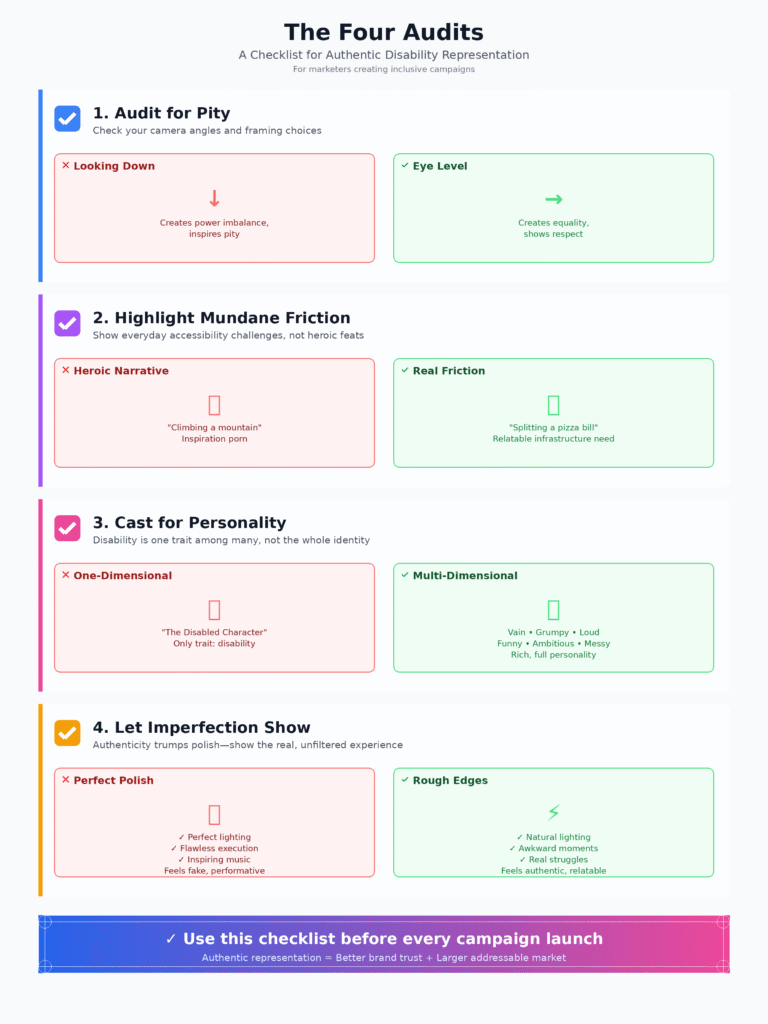
The characters in the Apple spot are distinctive. One is vain. Another is grumpy. A third is loud. None of them flatten into “The Disabled Character.” When casting, ask: “What is this person’s actual personality?” If your answer is simply “disabled,” begin again.
Let Imperfection Show
Perfection has become suspect. Polished, sanitised campaigns now feel untrustworthy to audiences—they read as corporate and inauthentic. Allow your campaigns to have rough edges. Let your subjects fail. When success eventually arrives, it feels earned rather than choreographed.
The Bottom Line
“Inspiration” is a cheap drug. It gives brands an unearned high of virtue and leaves customers hungover with objectification.
Apple has recognised something crucial: the most respectful thing you can do for any community is treat them as a market segment, not a charity case. The students in this film aren’t heroes. They are customers. Customers don’t need your applause. They need your product to work so they can get on with failing their maths exams, like everyone else.
References & Citations
- Young, S. (2014). “I’m not your inspiration, thank you very much”. TEDxSydney. https://www.ted.com/talks/stella_young_i_m_not_your_inspiration_thank_you_very_much
- Disability Visibility Project. “Stella Young, Inspiration Porn, and the Objectification of Disabled People” (2014). https://disabilityvisibilityproject.com/2014/10/16/stella-young-inspiration-porn-and-the-objectification-of-disabled-people/
- Bauri, S. (2025). “Disability Representation in Advertising in India”. Suchetanabauri.com. https://suchetanabauri.com/disability-representation-advertising-india/
- Bauri, S. (2025). “Meta’s accessibility marketing is a betrayal of disabled users”. Suchetanabauri.com. https://suchetanabauri.com/metas-accessibility-marketing-is-a-betrayal-of-disabled-users
- Bauri, S. (2025). “AI Video Authenticity: Bridging the Heart Gap”. Suchetanabauri.com. https://suchetanabauri.com/ai-video-authenticity
- Apple. “VoiceOver”. Apple Accessibility. https://www.apple.com/accessibility/voiceover/
- Apple Support. “Use Sound Recognition on your iPhone, iPad, or iPod touch”. https://support.apple.com/en-us/HT212180
- Apple Support. “Use AssistiveTouch on your iPhone, iPad, or iPod touch”. https://support.apple.com/en-us/HT202658
- Apple Support. “Use Live Captions on your iPhone, iPad, or Mac”. https://support.apple.com/en-us/HT210986
- W3C Web Accessibility Initiative. “WCAG 2.1 Quick Reference”. https://www.w3.org/WAI/WCAG21/quickref/