
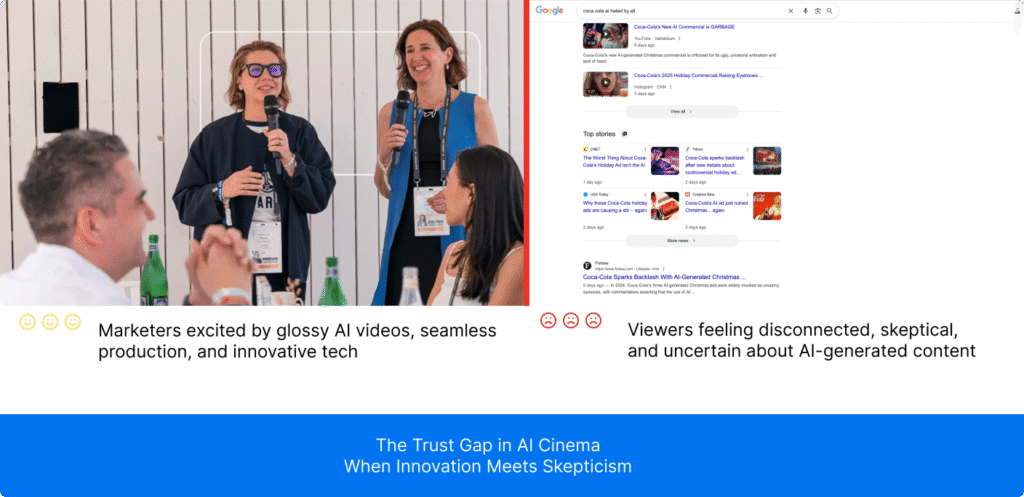
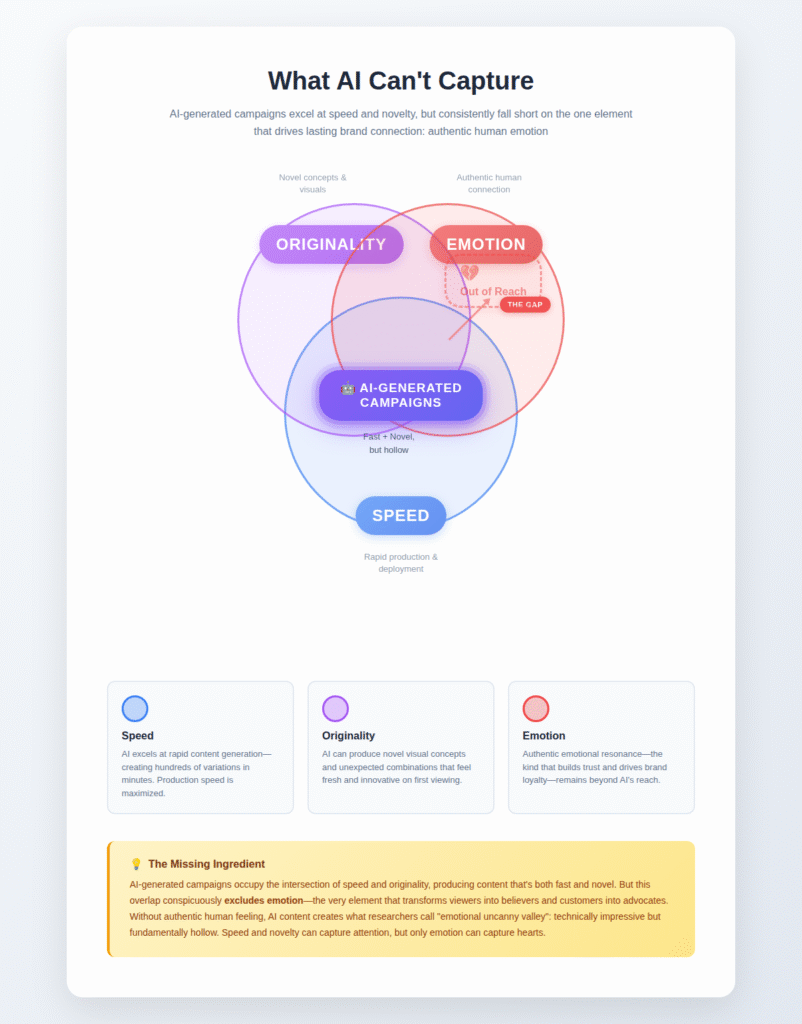
Your team slashed video production costs by 70 per cent. Campaign turnaround fell from two weeks to 48 hours. Marketers can now generate 50 different ads from a single brief. Every ad is tested right away, and budgets shift instantly using AI predictions. The return on investment looks excellent.
Still, something doesn’t feel right.
The footage is polished. Motion is smooth. The lighting looks professional. But when the campaign is shared for review, feedback is muted. Someone says “impressive,” but doesn’t sound convinced. Another wonders aloud if it feels “a bit… generic?” You move on, hoping the data will prove them wrong.
But recent data provides a warning:
“Research from the Netherlands Institute for Marketing finds that labelling a video as AI-generated lowers consumer trust and purchase intent—even if the content looks identical to human-made work. That ‘trust penalty’ is real.”
Read the full study
The Kling AI NextGen Creative Contest, with over 4,600 global submissions and screenings at MIPCOM Cannes, offers a clear view. Today’s AI tools are impressive, but gaps in believability and engagement remain.
For marketers relying on AI-generated video, these films show the limits of generative cinema right now. They also hint at a truth many miss: tools meant to democratise creative work could end up making mediocrity the norm.
Kling’s Winning Edge
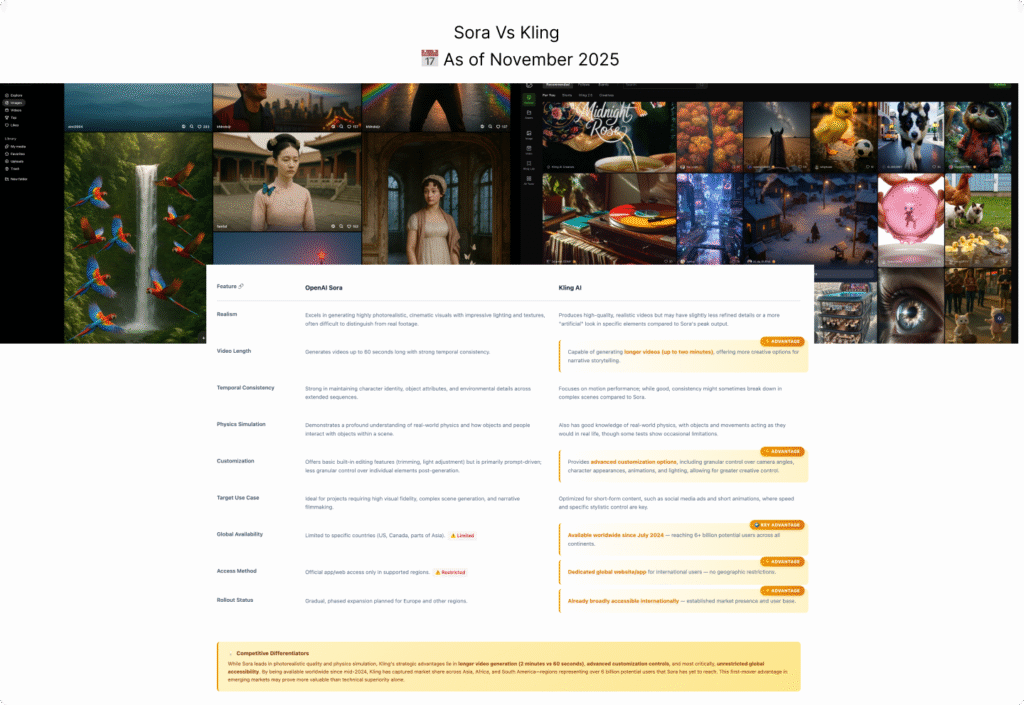
A quick look at strengths. According to industry analysis, Kling AI leads the pack, outperforming OpenAI’s Sora, Google’s Veo 3, and Runway Gen-4 on several fronts.
Physical Realism
Sora’s videos often struggle to capture convincing movement. Kling uses “space-time attention” methods that make water, cloth, and bodies behave more like they do in the real world. This matters for brand demos featuring people or products in motion.
Consistency Over Time:
Kling’s latest updates mean fewer glitches—faces and objects change less frequently during a scene. Runway’s Gen-3 and Gen-4 improve narrative flow, but Kling’s results are more physically accurate. Pika still has more visible character drift.
Access and Workflow
Sora is only available in the US and Canada right now. Kling’s workflow, via its app, is easy to use globally.
For deep dives on narrative and brand authenticity in Indian markets, see suchetanabauri.com’s AI in brand storytelling archive.
Despite these technical strengths, the big challenges remain. Kling, Runway, and Sora all hit the same wall when it comes to storytelling, authenticity, and audience trust.
Authenticity and Trust
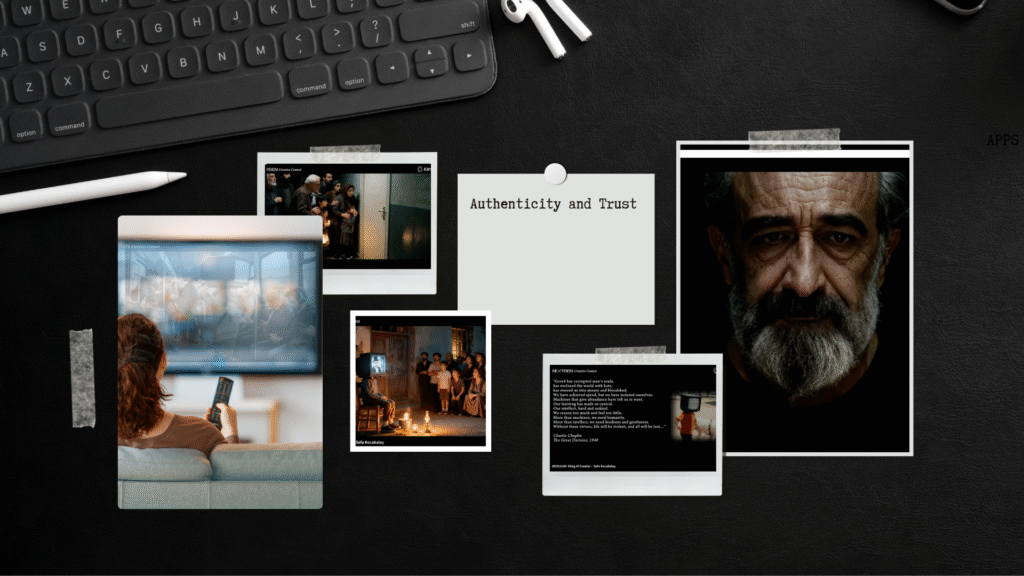
Bozulma (The Distortion), a prize-winner by Turkish creator Sefa Kocakalay, explores screen addiction. In its world, a solar flare destroys all digital screens, so a boy with a TV on his head becomes everyone’s source of entertainment. He is hailed as a hero, then becomes a prisoner of people’s expectations.
The film ends with Charlie Chaplin’s words from The Great Dictator:
“More than machinery we need humanity. More than cleverness we need kindness and gentleness.”
If you use this clip, remember:
“AI-generated content may feel clever, but lacks the rough edges and unpredictability that inspire emotion. Chaplin’s speech, meant for a turbulent century, feels different when delivered by a machine-driven image.”
Why does this matter? Studies show audiences find AI content less “natural” and less “useful”—even if the message and visuals match human work.
Looking for campaign analysis comparing output and brand value? See September Smartphone Marketing 2025 and Creative Reality Check: Kajaria’s Gresbond Campaign for examples questioning the idea that more output equals more impact.
“When viewers know a campaign is made by AI, engagement drops. Trust erodes, even before any real problems appear.”
Speed Can Hurt
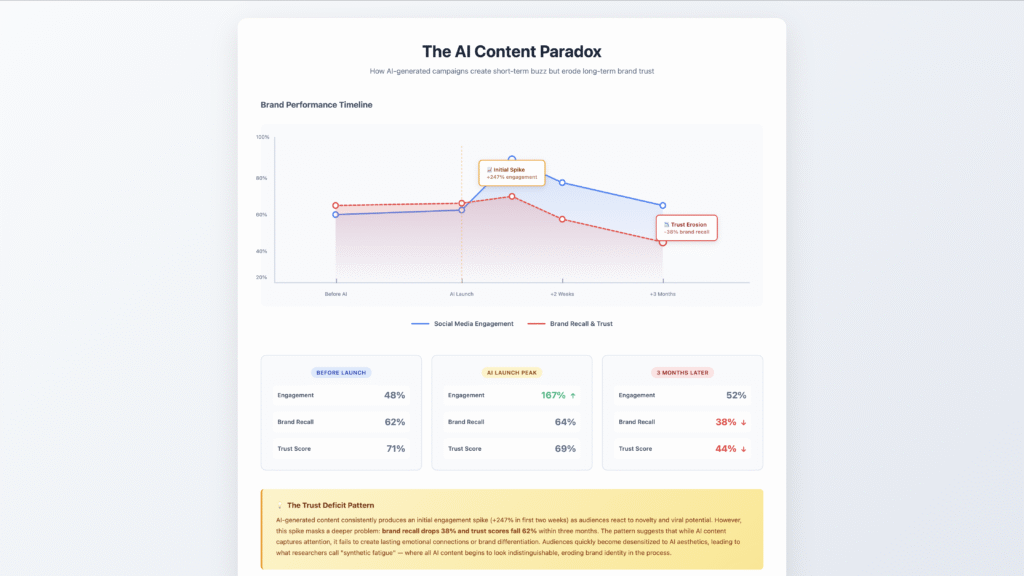
AI video production moves quickly. HeyGen says using avatars for brand videos can reduce costs by 70 per cent. Timelines drop from weeks to hours, and dozens of social formats are generated instantly.
The “democratisation” story—more creators with access—sounds compelling.
Yet access doesn’t always bring deeper creativity. Alzheimer, another Kling contest winner, uses an AI-painting style to evoke dementia’s confusion. Their algorithm keeps visuals smooth and stylistically consistent.
But even the most elegant AI videos lack the nuance and emotion that real-life storytellers bring. Many are polished but predictable. Research supports this conclusion.
For deeper discussion on output versus impact: Apple’s iPhone 17 Pro Marketing highlights what’s lost when speed outruns real storytelling.
Short-term engagement can look good, but long-term brand memorability suffers.
“Authenticity remains the missing link.”
Who is the Author?
Who creates the story when AI does nearly all the work? The US Copyright Office says:
“For the content to be protected, there must be significant human input.” This isn’t just a legal issue. For brands, it’s about creative control and originality.
“The more a team relies on prompts and AI, the higher the risk that campaigns start to look and sound the same—no matter the brand. Each frame might reference a thousand past videos but bring little original vision.”
I’m Not a Robot, a Kling contest piece, explores this irony. It asks viewers to spot the difference between a human and a generated image, but ultimately, the system blurs the line rather than clarifying it.
“Style can be imitated, but meaning is harder to fake. Transparency helps—85 per cent of customers say they prefer brands who explain their use of AI—but transparency alone doesn’t solve the problem.” Read more on transparency
Culture Needs More Than a Prompt
Viral: The Last Reel imagines a world where an endless digital reel keeps people scrolling—until cities empty out and everyone is trapped by their screens.
“Endless attention doesn’t equal meaningful attention.”
AI tools tend to smooth over cultural differences. They create visuals that could fit anywhere, but rarely nail local detail—Indian street scenes, regional accents. Training datasets, trying to avoid bias, often remove context and specificity. Read about cultural impact.
For more, explore your Digital Marketer page and wider blog archives for insights about nuance and creative culture.
Brands running global campaigns have to fight this temptation. AI can make dozens of language variants of a video, but can’t embed regional uniqueness.
What Should Marketers Do for 2026?
The numbers make AI video hard to resist. Use AI for product demos, quick A/B tests, and internal training—where speed and realism matter more than emotion.
But use caution for campaigns that need connection and relevance. “This could be from any brand” is not the goal. Engagement does not always signal deeper value. Trust—and brand memory—still depend on human authorship, regional fluency, and creative risk.
“The best brands will not use AI video as their main creative approach. Instead, they’ll blend speed and cost savings with real creative input.”
Sources & Further Reading
See the numerical footnotes for full references.
Visit these internal articles on suchetanabauri.com for more on digital, storytelling, and authenticity.
- Netherlands Institute for Marketing. “Consumer Attitudes Toward AI-Generated Marketing Content.” https://nim.org/consumer-attitudes-toward-ai-generated-marketing-content
- Barchart. “Kling AI Showcases AI Video Generation Capabilities on International Stage.” https://barchart.com/story/news/30055906/kling-ai-showcases-ai-video-generation-capabilities-on-international-stage
- Sora AI. “Kling AI vs Sora AI: Which Is Best For You?” https://soraai.onl/kling-ai-vs-sora-ai-which-is-best-for-you/
- Rank Market. “Sora vs Kling: Best AI Video Creation Tools in 2025.” https://rankmarket.org/sora-vs-kling-best-ai-video-creation-tools-in-2025/
- Reel Mind. “Pika 3.5: The Latest in AI Video Generation.” https://reelmind.ai/pika-3-5-the-latest-in-ai-video-generation/
- Cursor IDE. “Sora V2 API Free Access Guide.” https://cursor-ide.com/sora-v2-api-free-access-guide-complete-2025-breakdown/
- John Rector. “AI-Generated Works and Copyright Authorship.” https://johnrector.me/ai-generated-works-and-copyright-authorship/
- HeyGen. “AI Video Cost Reduction in Digital Marketing.” https://heygen.com/blog/ai-video-cost-reduction-digital-marketing/
- Timbre Media. “Brand Storytelling in the Age of AI.” https://timbremedia.in/brand-storytelling-in-the-age-of-ai-what-machines-cant-imitate/
- Raindance. “Impact of AI on Cultural Narratives.” https://raindance.org/impact-of-ai-on-cultural-narratives/
- WhizCrow. “AI in Marketing: 5 Game-Changing Transparency Wins.” https://whizcrow.com/ai-in-marketing-5-game-changing-transparency-wins/
- Charlie Chaplin Archive. “Final Speech from The Great Dictator.” https://charliechaplin.com/en/articles/29-the-final-speech-from-the-great-dictator-