
A meaningful share of customer interactions will shift from human-to-agent to agent-to-agent by late 2026, with early indicators already visible in e-commerce, financial services, and enterprise software procurement.
“This isn’t distant futurism—the foundations are already in place. Rather, it’s a considered prediction from Gareth Cummings, chief executive of eDesk, based on buying patterns emerging now in e-commerce, financial services, and enterprise software sales, with full-scale adoption expected within 12-18 months.” Gareth Cummings, chief executive of eDesk. Shoppers increasingly delegate discovery, comparison, and purchase execution to AI assistants. Those assistants communicate directly with retailer agents to check stock, confirm delivery times, and verify returns policies. The conversations that used to take minutes between human customers and human support teams now collapse into single automated exchanges measured in seconds.
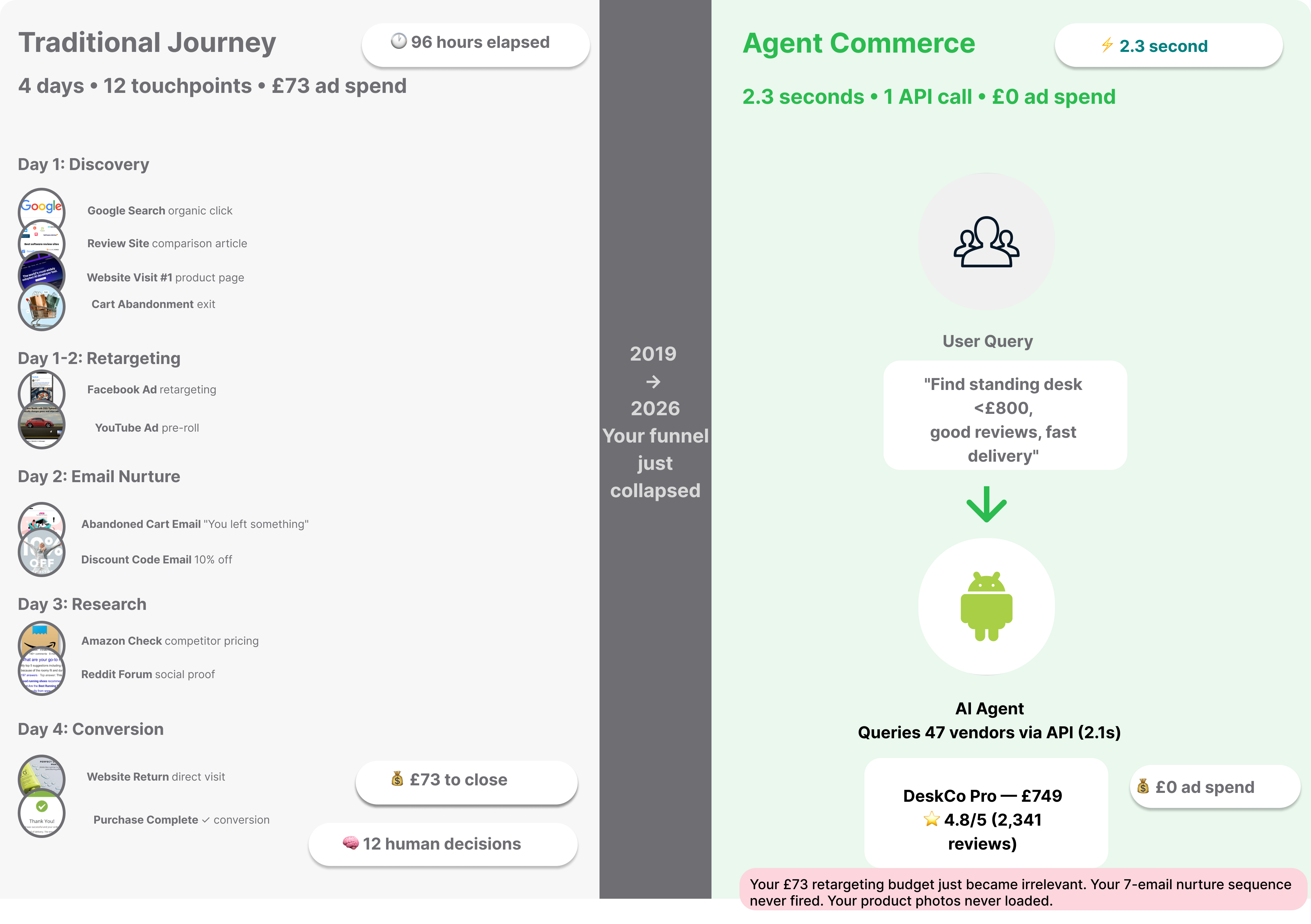
For marketers who spent the past decade mastering omnichannel strategy—optimising for mobile screens, voice search, and social commerce—the shift to agentic commerce represents a fundamental reset. Your playbook designed for human psychology won’t work on machine decision-making. Search engine optimisation becomes irrelevant when there’s no search results page. Ad targeting loses purpose when autonomous agents comparison-shop based on structured data feeds rather than browsing behaviour.
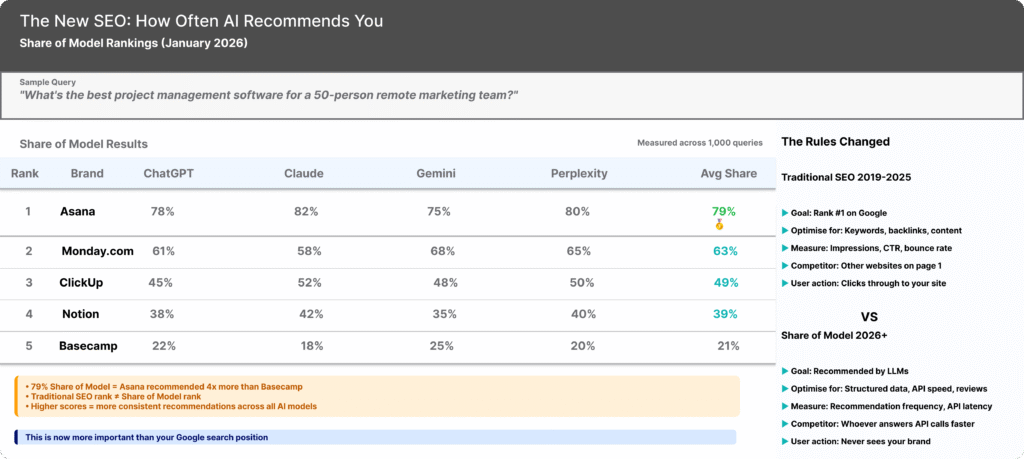
Welcome to the era of “Share of Model”—the emerging metric for how often AI systems recommend your brand when users ask for product suggestions. If you’re not optimising for this, you’re becoming invisible to the fastest-growing segment of purchase decisions.
“Conversations that used to take minutes between human customers and human support teams now collapse into single automated exchanges measured in seconds.” — The velocity at which marketing funnels are collapsing into API calls.
The Death of Browsing
Think about the last time you shopped online. Probably, you visited multiple websites, compared specifications, read reviews, abandoned carts, and returned days later. The entire journey—from awareness to purchase—involved dozens of touchpoints that marketers painstakingly optimised: landing page conversion rates, email nurture sequences, retargeting ads, abandoned cart reminders.
Now imagine that entire process handled not by you, but by your AI assistant. You say: “Find me a standing desk under £800 with good reviews and fast delivery.” Subsequently, the agent queries multiple retailers simultaneously via APIs. It compares specifications against your preferences (which it remembers from past interactions). Thereafter, it checks real-time inventory and delivery estimates, evaluates warranty terms, and presents a single recommendation—or directly completes the purchase if you’ve granted it authority.
The marketer’s carefully constructed funnel collapses into one API call. The attention-grabbing product photos never loaded. The persuasive copy went unread. The retargeting pixel never fired because there was no browser session to track.
This isn’t hypothetical. Autonomous agents are already executing transactions in categories from grocery delivery to business software procurement. Importantly, the velocity is what changes—conversations that used to take minutes will collapse into a single automated exchange. Retailers with unified systems and API-exposed catalogues thrive. Conversely, those with legacy tech stacks and data silos become functionally invisible to agent-based commerce.
This scenario isn’t universally deployed yet—most AI assistants in early 2026 still present recommendations for human review rather than executing purchases autonomously. But the infrastructure is being built now. The question isn’t whether this happens, but how quickly—and whether your organisation is ready when it does.
“The marketer’s carefully constructed funnel collapses into one API call. The attention-grabbing product photos never loaded. The persuasive copy went unread.” — Why traditional marketing tactics become invisible to autonomous agents.
From Omnichannel to API-First
Where We Are (January 2026): AI assistants can research, compare, and recommend products. Most still require human approval for purchase. Where We’re Going (Q4 2026): Autonomous agents executing transactions without human intervention at meaningful scale. The Window: Organisations have 6-9 months to establish API-first infrastructure before this becomes table stakes rather than competitive advantage.
Mark Menell, managing director at Silicon Foundry, frames the transition starkly: “Retail evolves from omnichannel to agentic commerce. AI agents surface, compare, and purchase for consumers. Retailers who expose catalogue and loyalty data via APIs become agent-friendly storefronts and win share.”
The architectural requirements are specific. First, consider real-time responsiveness: agents don’t wait for batch updates or overnight syncs. Inventory levels, pricing, and delivery estimates must be accurate to the second. Consequently, an agent that receives stale data will deprioritise your brand in future queries.
Secondly, structured data matters critically. Product specifications, warranty terms, return policies, and customer reviews need to be machine-readable—formatted in schemas that LLMs can parse, compare, and rank without human interpretation.
Furthermore, protocol integration is now table stakes. Support for emerging standards like OpenAI’s Agent Communication Protocol (ACP) and Google’s AP2 becomes essential. These protocols define how agents negotiate on behalf of users, request information, and execute transactions.
Finally, interoperability is non-negotiable. Your commerce stack must allow agents to check inventory, create orders, process payments, and initiate returns through programmatic interfaces. Friction at any step sends the agent to a competitor.
The shift mirrors the mobile-first transformation a decade ago, but crucially, the timeline is compressed. Organisations that took years to rebuild desktop websites for mobile have months—not years—to become agent-ready. The competitive advantage accrues to early movers who establish “Share of Model” before rivals recognise the game changed.
“Retailers who expose catalogue and loyalty data via APIs become agent-friendly storefronts and win share.” — Mark Menell, Silicon Foundry. The API-first imperative for agentic commerce.
Banking on API Access, Not App UX
Eii Promisel, also with Silicon Foundry, extends the thesis beyond retail: “Shopping, payments, and financing increasingly move to autonomous agents, reshaping the end-to-end consumer journey. Banks compete not on app UX, but API access and trust.”
This inverts how financial services have competed for the past 15 years. Banks invested billions in mobile app experiences—streamlined interfaces, biometric authentication, personalised dashboards. The implicit assumption: customers would continue interacting directly with banking applications.
Agentic commerce breaks that assumption. Users delegate financial tasks to AI assistants that route transactions based on optimisation criteria the user defines: lowest fees, fastest processing, best exchange rates, or alignment with sustainability commitments. Consequently, the bank’s beautifully designed app becomes irrelevant if its API doesn’t support agent-initiated transfers or if authentication workflows require manual intervention.
The winners in this environment expose comprehensive APIs, maintain rigorous uptime (agents won’t retry failed calls—they’ll route to alternatives), and establish trust signals that AI systems can verify: regulatory compliance badges, encryption standards, fraud protection guarantees.
“Trust” in agent-to-agent commerce means something fundamentally different than brand reputation in consumer marketing. Rather, it’s machine-verifiable proof: certifications from recognised authorities, public audit trails, cryptographic signatures on transaction records. An agent evaluating payment processors doesn’t care about your brand heritage or advertising budget. Instead, it queries for ISO 27001 certification, PCI DSS compliance status, and median fraud rates from independent monitors.
“Banks compete not on app UX, but API access and trust.” — Eii Promisel, Silicon Foundry. The shift from experience design to infrastructure reliability.
AgentOps: The Operational Layer You Didn’t Know You Needed
If agents are becoming customers, then managing agent relationships becomes a core operational capability—as important as customer service or supply chain management. Enter “AgentOps,” the emerging discipline for deploying and managing fleets of AI agents at enterprise scale.
Joao Moura, chief executive of CrewAI, draws the parallel to DevOps: “Just as DevOps reshaped software deployment in the 2010s, AgentOps will reshape AI operations in 2026. It’ll sit between engineering and operations and will be responsible for managing fleets of AI agents, monitoring cost, reliability, and compliance.”
The functional requirements include several critical areas. Cost monitoring is foundational: AI agents consume computational resources with every query, comparison, and transaction. At scale, these costs compound rapidly. AgentOps teams track spend across agent types, identify optimisation opportunities, and set budget guardrails.
Reliability orchestration is equally essential. When an agent fails—API timeout, data format mismatch, authentication error—AgentOps systems detect the failure, attempt remediation, and route to fallback options. Uptime for agent-facing systems must match or exceed traditional customer-facing SLAs.
Additionally, compliance oversight cannot be overlooked. Agents operating across jurisdictions must respect regional regulations: data residency requirements, consumer protection laws, accessibility standards. AgentOps implements policy engines that evaluate agent actions against compliance frameworks before execution.
Finally, performance benchmarking drives continuous improvement. Which agent configurations drive highest conversion? Which API response times correlate with completed transactions? AgentOps teams establish metrics, run experiments, and iterate on agent behaviours—functions analogous to conversion rate optimisation for human customers.
Marketing organisations that fail to establish AgentOps capabilities will struggle to compete in agentic commerce environments. Significantly, your carefully optimised human-facing campaigns become secondary to whether your agent-facing infrastructure delivers the speed, structure, and reliability that autonomous systems demand.
“Just as DevOps reshaped software deployment in the 2010s, AgentOps will reshape AI operations in 2026.” — Joao Moura, CrewAI CEO. The operational infrastructure demanded by agent-to-agent commerce.
SaaS Didn’t Die—It Evolved
Early predictions suggested AI agents would replace software-as-a-service entirely. Why buy CRM systems when an agent could manage customer relationships through natural language? Why purchase marketing automation platforms when agents could orchestrate campaigns directly?
Reality proved more nuanced. Ross Meyercord, chief executive of Propel Software, observes: “In 2026, the winners will be those who combine the agility of AI agents with the reliability of SaaS to deliver measurable business value. SaaS brings the workflows, governance, and guardrails that enterprises demand, whilst AI agents extend productivity and speed.”
The synthesis is clear: agents operate across SaaS platforms, not instead of them. A marketing agent might coordinate across your CRM (Salesforce), marketing automation system (HubSpot), customer data platform (Segment), and advertising platforms (Google, Meta) to execute multi-channel campaigns. But it uses these systems’ APIs rather than replacing their core functions.
This creates new requirements for SaaS vendors: comprehensive APIs exposing all functionality available in graphical interfaces, webhook systems allowing agents to subscribe to events and trigger workflows, and authentication frameworks supporting agent-based access patterns distinct from human user sessions.
For marketing teams, the implication is architectural: your technology stack must be agent-navigable. If critical functions live in tools without robust APIs, or if workflows require manual steps that break agent automation, you’ve created bottlenecks that competitors using agent-friendly stacks will exploit.
“The winners will be those who combine the agility of AI agents with the reliability of SaaS.” — Ross Meyercord, Propel Software. The hybrid future of marketing technology.
The Measurement Revolution
Marketing has always been a measurement-obsessed discipline: impressions, click-through rates, conversion rates, customer acquisition cost, lifetime value. These metrics assume human decision-makers moving through observable funnels.
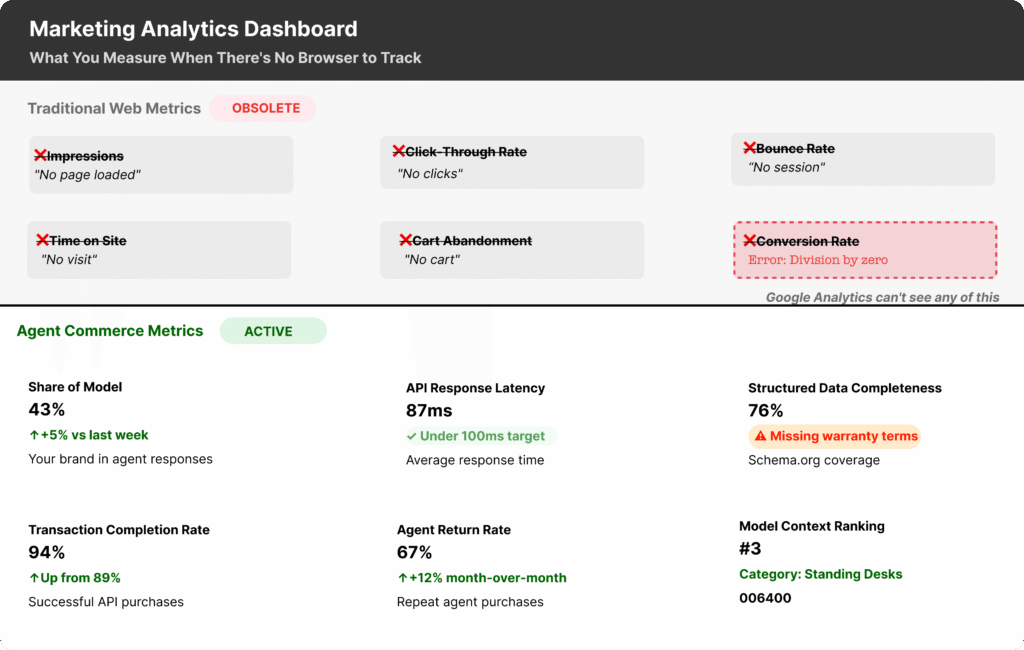
Agent-based commerce scrambles the measurement framework entirely. When an autonomous agent evaluates 47 alternatives in 3.2 seconds and completes a purchase without visiting your website, what did you measure? There was no impression (the agent didn’t render your landing page). No click-through (no browser session existed). The “conversion rate” calculation—purchases divided by visitors—returns a division-by-zero error.
The new metrics marketers must instrument are fundamentally different:
Share of Model: How frequently do major LLMs (ChatGPT, Claude, Gemini, Perplexity) recommend your brand when queried about your product category? This becomes the agentic equivalent of search ranking.
API response latency: What’s your median time to respond to agent queries for inventory, pricing, or specifications? Agents optimise for speed—milliseconds matter at scale.
Structured data completeness: What percentage of your product catalogue includes machine-readable specifications in recognised schemas? Incomplete data means agents can’t fully evaluate your offerings.
Transaction completion rate: Of agent-initiated purchase attempts, what percentage successfully complete without requiring human intervention? Failed transactions signal friction that agents will remember.
Agent return rate: Do autonomous agents who transacted with you once return for subsequent purchases, or do they route to alternatives? This measures the agent’s “satisfaction” with your API experience.
These metrics require new instrumentation. Your Google Analytics setup won’t capture them. Marketing teams must collaborate with engineering to implement logging, establish baselines, and build dashboards tracking agent-specific interactions separately from human traffic.
“Share of Model becomes the agentic equivalent of search ranking.” — The new metric that determines visibility in agent-to-agent commerce.
The Competitive Moat Is Speed
In human-centric commerce, competitive advantages come from brand recognition, customer loyalty, switching costs, and network effects. In agent-centric commerce, however, speed dominates absolutely.
As agent-centric commerce scales throughout 2026, speed will dominate absolutely. Early adopters building API-first infrastructure now establish advantages that late movers find difficult to overcome.
An agent evaluating 50 potential vendors in parallel will deprioritise those with slow API responses, incomplete data, or multi-step authentication that requires manual intervention. Significantly, it doesn’t “decide” to exclude you based on rational evaluation—it simply times out and moves to alternatives that respond faster.
This creates a power-law distribution: the fastest, most agent-optimised vendors capture disproportionate share. Second place doesn’t mean 90% of the winner’s volume—it might mean 10%, because agents route the bulk of transactions to whoever responds first with complete, accurate data.
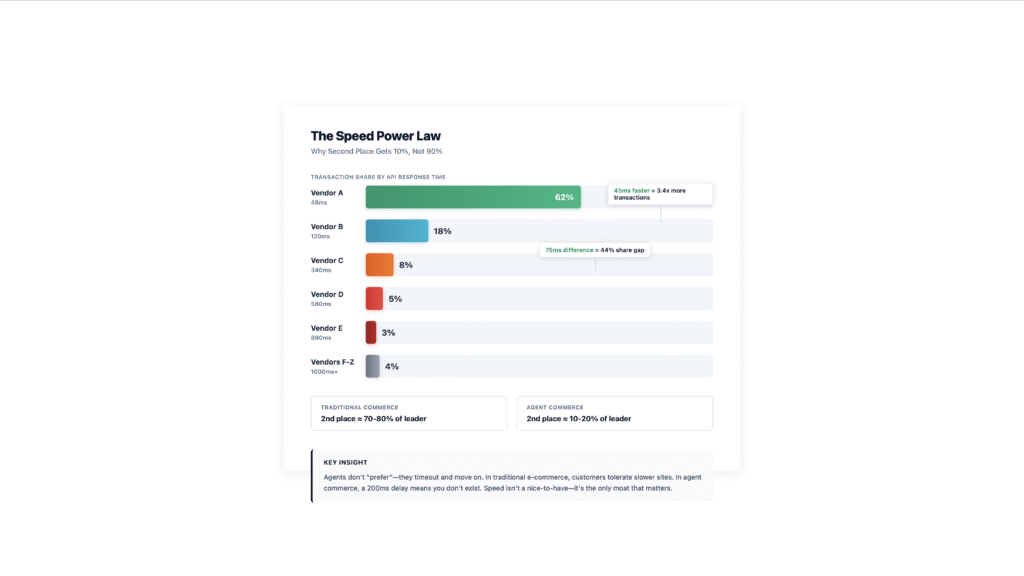
Conversations that used to take minutes will collapse into a single automated exchange. If your systems aren’t architected for sub-second responses, you’re losing transactions you’ll never know you were considered for.
“An agent doesn’t decide to exclude you—it simply times out and moves to alternatives that respond faster.” — Why milliseconds matter more than messaging in agentic commerce.
The Human Paradox
Here’s the uncomfortable paradox: as agents become customers, marketing becomes simultaneously more technical and more human.
More technical because optimising for machine interpretation requires API architecture, structured data engineering, protocol implementation, and real-time infrastructure that traditional marketers never needed to understand. More human because the strategic questions remain rooted in psychology: What job is the customer hiring our product to do? What anxieties prevent purchase? What would make someone delegate this decision to an agent versus insisting on personal evaluation?
The brands thriving in agentic commerce aren’t those who built the fastest APIs at the expense of human connection. Rather, they’re those who recognised that whilst agents execute transactions, humans still define goals, express preferences, and grant authority. The marketing function must simultaneously optimise for machine efficiency and human motivation—so agents can find and transact with you, and so people choose to delegate those decisions to their agents in the first place.
“Whilst agents execute transactions, humans still define goals, express preferences, and grant authority.” — Why human psychology remains central to agent-driven commerce strategy.
What to Do Monday Morning
If you’re leading marketing for a business where autonomous agents could plausibly become customers—e-commerce, financial services, business software, travel, hospitality—here’s where to start:
Audit your structured data. What percentage of your product catalogue, pricing, inventory, and policies exists in machine-readable formats? If the answer is “it’s all on our website,” you’re not ready. Implement schema.org markup, expose JSON feeds, and ensure specifications include units, dimensions, and compatibility information.
Map your API coverage. Which customer-facing capabilities are accessible via API versus only through your website or mobile app? Inventory checking, order placement, payment processing, returns initiation, customer support—if any of these require manual steps, you’ve created agent-unfriendly friction.
Establish agent monitoring. Begin querying major LLMs weekly about your brand, products, and competitors. Track whether AI systems accurately represent your offerings, where hallucinations occur, and how you rank when users ask for recommendations. This baseline lets you measure progress.
Calculate agent readiness score. On a scale of 0-100, how prepared is your infrastructure for agent-based commerce? Score across dimensions: API completeness (25 points), response latency (20 points), structured data coverage (20 points), protocol support (15 points), real-time accuracy (20 points). Anything below 60 means you’re vulnerable.
Calculate Your Agent Readiness Score
Take the 2-minute interactive assessment to evaluate your infrastructure readiness across 5 critical dimensions. Take the Scorecard →
Your score reveals if you’re an Agent-Ready Leader, Competitive but Vulnerable, or Functionally Invisible.
Experiment with your own agents. Deploy AI agents to interact with your systems and competitors’ systems. Where do you create friction? Where do competitors excel? Hands-on testing surfaces issues that abstract planning misses.
“If your systems aren’t architected for sub-second responses, you’re losing transactions you’ll never know you were considered for.” — The urgency of API-first architecture for agentic commerce readiness.
The Future Arrived Quietly
The transition to agent-based commerce won’t announce itself with a discrete launch date or platform shift. Rather, it’s happening now, incrementally, in thousands of individual transactions where users discover that delegating decisions to AI assistants is simply easier than managing them personally.
By the time you notice the channel mix shift—”Why is our direct website traffic declining whilst revenue holds steady?”—competitors who established agent readiness early will have claimed “Share of Model” dominance that’s difficult to dislodge.
Your customers are becoming agents. Your agents need to be ready. And “ready” means fundamentally rethinking how you present products, structure data, expose capabilities, and measure success.
The organisations winning in 2026 aren’t those with the most sophisticated human-facing campaigns. Rather, they’re those who recognised that whilst humans still want products, agents increasingly handle the shopping—and optimised accordingly.
“By the time you notice the channel mix shift, competitors will have claimed ‘Share of Model’ dominance that’s difficult to dislodge.” — The silent transition to agent-driven commerce is already underway.
Sources & Footnotes
Internal Links to Your Blog Content
This article strategically links to the following pages on suchetanabauri.com:
- “The Tungsten Cube Theory: Why Anthropic Is Betting on the Clumsy Intern” — Explores autonomous agent capabilities and limitations (https://suchetanabauri.com/tag/agentic-ai/)
- “The Challenger’s Playbook: How to Market Against Entrenched AI Incumbents” — Addresses competitive positioning and API-first strategy (https://suchetanabauri.com/tag/competitive-differentiation/)
- “Swiggy Wiggy 3.0 Campaign and the Playbook for People-Powered Marketing” — Demonstrates human psychology driving marketing decisions (https://suchetanabauri.com/swiggy-wiggy-3-0-campaign-employee-advocacy/)