
Figma opened its Bengaluru office on 12 November 2025 with a 90-second video that feels like eavesdropping on a chaotic design sprint—dripping taps, meowing cats, overlapping demands for sliders and glow-in-the-dark mode.1 The energy is clear. The entertainment value is undeniable. Yet it’s also a lesson in how companies accidentally bury their own story under product features when the moment demands something bigger.
This matters right now because we’re watching a fundamental shift in how global tech platforms approach India. Rather than viewing it as a market to extract from, they now see it as a creative engine to build with. Microsoft counts 22 million Indian developers on GitHub; moreover, 51% of Indian companies report excellent business results from design investment, the standout performer across Asia-Pacific.23 When Figma’s VP of Engineering Abhishek Mathur says they want to change how developers see Figma—moving beyond “just a design tool” among India’s massive developer community—that signals a real shift with genuine business importance.
Yet the launch film treats this milestone like a product demo. In fact, it accidentally became the main announcement. That disconnect reveals something uncomfortable about how tech companies think about launches in 2025. Instead of building trust with new communities, they chase viral moments with existing fans.
What the Film Gets Breathtakingly Right
Let me start with what works, because there’s real craft here that deserves recognition.
The video captures true team chaos; voices demand specific hex codes (#2DDFFF, #FF01E5), arguments break out about electronic versus traditional music, and demands fly for 3D displays and 8D audio. That overlapping noise mirrors real design sprints.1 Everyone talks at once. Somehow a product still emerges. This messy reality is what corporate launch films rarely allow themselves to show.
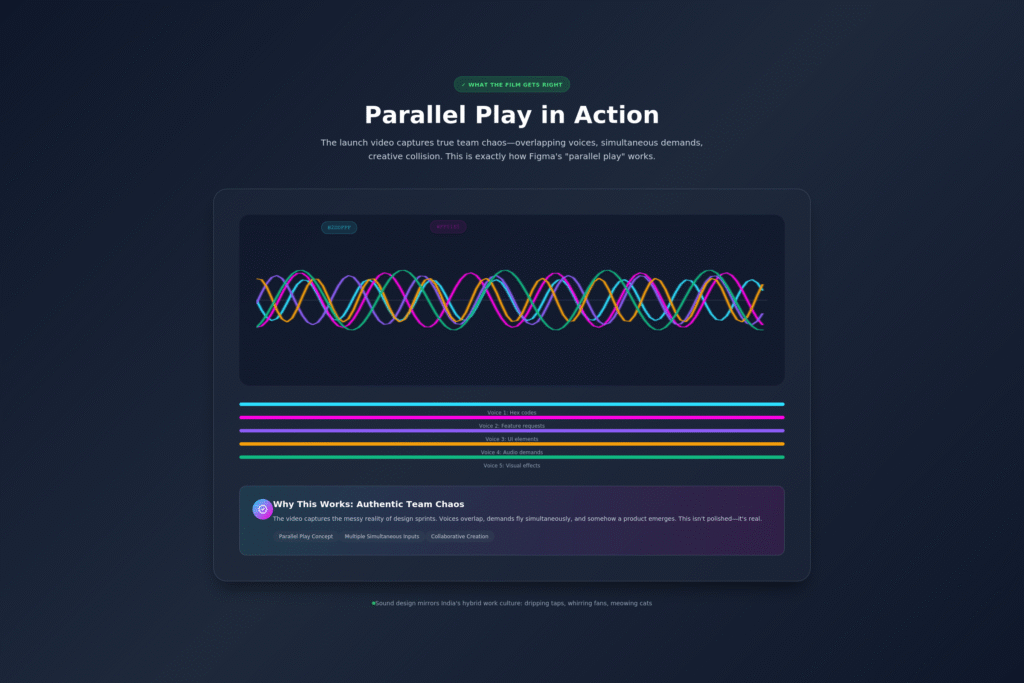
Furthermore, this aligns beautifully with Figma’s refreshed brand centred on “parallel play.”4 The idea: different creative work happens at the same time in shared spaces, and that collision creates better outcomes. Watch the video again; notice it’s structured exactly this way. Multiple voices make demands at once; there’s no clean order. Just team momentum building toward “Make it.”
The sound design matters too—a dripping tap, whirring fan, and meowing cat ground the action in everyday Indian homes, not sterile offices.1 Remote and hybrid work dominate India’s tech sector. Additionally, Bangalore’s design culture runs on co-working spaces and teamwork rather than traditional corporate buildings. So this cultural specificity stands out—something most global tech videos erase.56
And the closing line—”Whatever you’re thinking, you can just Make it”—points directly to Figma Make, their AI-powered product.7 Prompts become working prototypes. Therefore, the entire chaotic conversation becomes a live example of what Make does: transforming rough creative talks into shippable work.8 That’s clever; people who already know the product get the reference.
Where It Stumbles: The Announcement That Wasn’t
Here’s the uncomfortable bit: this isn’t really an office opening announcement.
Figma’s Bengaluru launch featured their global executive team—VP of Engineering Abhishek Mathur, VP APAC Scott Pugh, and Chief Marketing Officer Sheila Vashee.29 Leaders delivered keynotes on “Designing growth at scale” and hosted panels exploring how Digital India is lifting UX. Notably, networking sessions drew creators, and a livestream reached everyone else.9 This was meant as a community celebration, not just another product push.
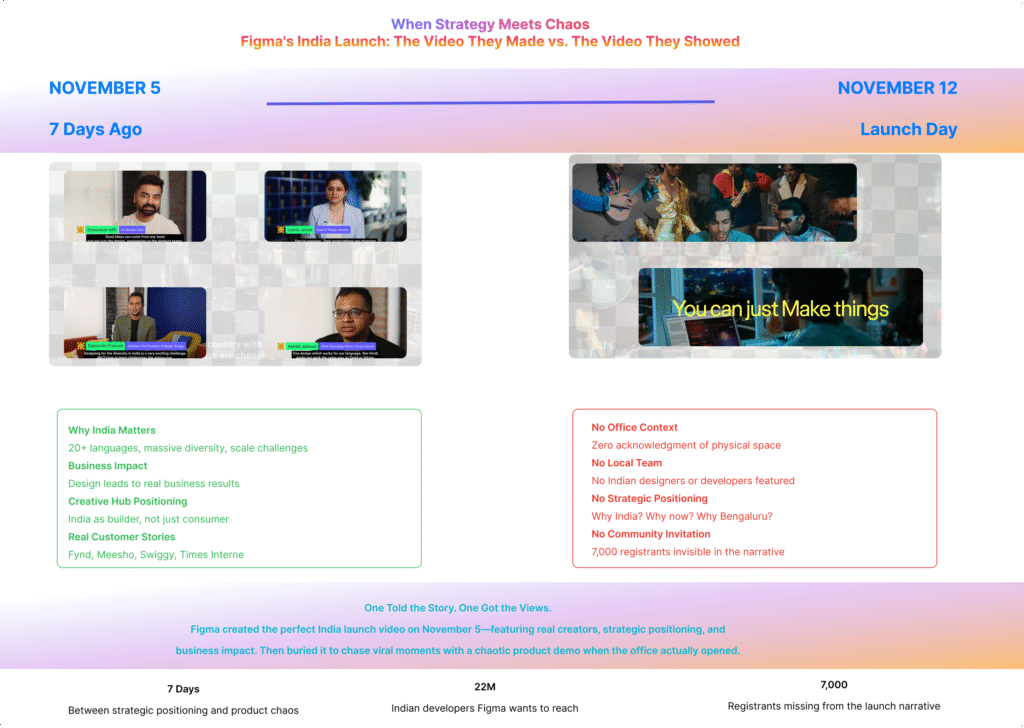
However, the film shows none of this. Zero acknowledgment of the physical space; nothing about the local team; no explanation of why India specifically matters to Figma. Additionally, no Indian designers or developers explain what Figma enables for them.
Finally, no connection appears to Bangalore’s tech scene—which grew as a hub because software companies clustered there.
Figma Already Made the Right Video
Here’s what makes this even more puzzling: Figma already made the video they should have used for the announcement.
Seven days before the office launch, Figma released “How teams in India design for diversity and scale with Figma.”10 That video features real Indian creators—leaders from Fynd, Meesho, Swiggy, and Times Internet speak on camera with their names and titles: Sreeraman MG, Leena Jacob, Saptarshi Prakash, and Ashish Jaiswal. What do they explain? Exactly what this article argues the launch video should have shown.
Why does India matter? Twenty-plus official languages, massive diversity, and scale challenges unlike anywhere else. How does design become “what sets companies apart” for business results? Indian startups use it to outpace competitors. Finally, why is India “not just a consumer of tech” but “a creative hub”? Because Indian teams solve unique problems with solutions designed locally.10
Seven days before the office launch, Figma released a video featuring real Indian creators—leaders from Fynd, Meesho, Swiggy, and Times Internet speaking on camera with their names and titles. They explain why India matters, how design becomes what sets companies apart, and why India is a creative hub. Then, seven days later, Figma announces the actual office opening with a 90-second product demo about sliders and glow-in-the-dark mode.
This November 5 video demonstrates real Figma value: speed to market, better cross-team work, and real-time collaboration. Moreover, customer success stories show clear business impact. India gets positioned as strategically important, not just another market. The video features the exact companies mentioned earlier—Swiggy, plus Meesho and Fynd that prove the point about Indian startups using Figma for growth.
Then, seven days later, Figma announces the actual office opening with a 90-second product demo about sliders and glow-in-the-dark mode. No named creators; no business context; no explanation of why this matters. Just anonymous voices and abstract product features.
This isn’t about Figma not knowing how to position in India—the November 5 video proves they do. Rather, this is about choosing a product-focused viral moment over careful positioning when it mattered most. The office opening was the chance to amplify that November 5 message to everyone: investors, developers who don’t yet see Figma as relevant, and companies wondering if design investment matters. Instead, they led with entertainment for people who already love the product.
Compare this to how other tech firms handle India office openings. They show the actual office, introduce local team members, and add cultural elements (sometimes awkwardly). But they signal one thing clearly: “we’re part of this place now” rather than “we’re broadcasting to your market.” That difference matters; it shapes whether people see you as a partner or just a tool they happen to use.
The Strategic Context Figma Isn’t Saying Out Loud
The backdrop makes this disconnect even sharper. Figma opened the Bengaluru office to deepen ties with Indian users and shift how developers see the platform.2 Many still view Figma as strictly a design tool; they don’t see it as a complete system for prototyping, development work, and cross-functional tasks.2 VP Mathur explicitly stated: “India has such a large population of developers who might not currently think of Figma as their tool, and that’s the thing that we want to do.”2
This isn’t casual expansion. Figma is pushing toward its IPO; the company has doubled its product offering (Sites, Draw, Buzz, Make). About 85% of monthly active users sit outside the United States.1112 India is their third-largest global market with aggressive growth plans. Additionally, design-led companies outperform their peers on business outcomes.3
But the video doesn’t advance any of these goals. Viewers must already understand why Figma is opening an office in India; they must grasp what Figma Make does and why it matters; they must see how this benefits local teams; and they must know what makes Bengaluru important. That’s dangerous when you’re trying to shift perceptions in a market where people don’t yet know your product well.
What Effective Launch Videos Actually Do (And This Doesn’t)
The most effective tech launch videos combine storytelling with clear value fast. Within the first 5–10 seconds, they explain “why now” and connect through relatable scenarios.1314 They don’t just showcase features. Furthermore, these videos take an approach based on understanding. New audiences need different information than internal teams already deep in product knowledge.14
This isn’t unique to tech product launches. I’ve written about how Canva’s ‘Dil Se Design Tak’ campaign balanced emotional storytelling with product information. Yet even that campaign had holes in how it positioned the brand.
A Sharper Structure Could Have Worked Better
The November 5 video already showed a better path. Figma could have:
Opened with the announcement itself. “Figma in India: our Bengaluru office is officially open” shouldn’t sit in the description. Rather, make it the opening frame to establish “why now” immediately and give the product demo narrative purpose.
Featured the creators they already filmed. The November 5 video featuring Sreeraman MG (Fynd), Leena Jacob (Meesho), Saptarshi Prakash (Swiggy), and Ashish Jaiswal (Times Internet) was filmed and ready.10 Use that content; let those named leaders talk about building for India’s diversity and scale. That’s the India story—not anonymous voices demanding abstract features.
Connected business impact to the office opening. The November 5 video explains how “good design leads to real business results” and why design is “what sets companies apart” in competitive Indian markets.10 Link that to why Figma opened an office: to get closer to customers driving those results. That’s positioning, not just product talk.
Ended with an invitation to join the community. Close with a call to join the celebration—either in person or via livestream. Turn watchers into participants, not observers. The actual event offered keynotes, roundtables, and networking valuable to India’s designers and coders.9 Pull people into that, using the November 5 video as proof of the community already building with Figma.
The frustrating part? Figma doesn’t lack the content. They chose not to lead with it when the big moment arrived.
The Broader Pattern This Reveals
This isn’t unique to Figma. Across tech launches in 2025, we see this pattern repeatedly. Companies chase shareability with existing fans rather than clear positioning within new audiences. The thinking goes: make something fun to watch, show off product power, and let sharing do the work.
Why Viral Moments Don’t Build Strategic Positioning
But social shares don’t build real positioning. They don’t shift what people believe about your product or who it serves. Consequently, shares won’t create the community trust that transforms a market from “place we sell to” into “place that shapes our future.”
For Figma, the stakes are higher than they might appear. The company went public in July 2025; valuation briefly hit $70 billion before settling around $22 billion.1516 In Q3 2025, they crossed $1 billion in annual recurring revenue. Moreover, about half their revenue now comes from international markets.1517 India isn’t just a growth market—it’s part of the IPO growth story they’re selling to investors, employees, and analysts. When you’re a newly public company justifying a multi-billion dollar valuation with aggressive international expansion, getting the India narrative right is critical for investor confidence.
The company went public in July 2025; valuation briefly hit $70 billion before settling around $22 billion. In Q3 2025, they crossed $1 billion in annual recurring revenue. Moreover, about half their revenue now comes from international markets. India isn’t just a growth market—it’s part of the IPO growth story they’re selling to investors.
The irony cuts deep. Figma’s brand centres on working together and bringing people to a shared canvas.4 Their product is built around the idea that better work happens when diverse thinkers meet in real time. Yet the India launch film feels oddly alone by comparison; Figma talking about making things rather than showing how Indian creators are already building and welcoming more people to join.
What This Means for Marketers Right Now
If you’re launching products or expanding into new markets in 2025–26, ask yourself this: Are you announcing the thing or proving you can do it well?
Product features are just baseline. AI-powered building tools exist everywhere; shared workspaces are standard. A sleek demo? That’s the bare minimum. What makes launches effective is whether you’re truly positioned within the communities and markets you’re trying to reach.
How Real Positioning Works
That positioning doesn’t come from feature lists. Instead, it comes from showing you understand the real challenges people face. Furthermore, it comes from knowing local culture and work patterns, and from featuring the actual people who’ll use your product. Most importantly, it comes from inviting them in rather than telling them what you’ve built.
The move from broadcasting to building together isn’t just nice branding; it’s essential when you’re trying to shift perceptions in markets where people don’t yet know your product.3 Figma’s research shows that Indian companies investing in design lead in their markets, but plenty of developers still don’t think Figma is for them.3 A launch featuring Indian developers solving real problems with Figma would shift minds more powerfully than a clever product demo, no matter how entertaining.
The Missed Opportunity
I’ll admit my bias here: Figma is the reason I got into UX/UI design. The tool made design accessible in ways that matter—bringing team work and rapid building to spaces previously locked behind expensive software and steep learning curves. I’m thrilled Figma has arrived in India, even if I selfishly wish they’d chosen Hyderabad instead of Bengaluru.
That genuine enthusiasm makes the missed opportunity in this launch film sting.
To be fair, Figma is investing meaningfully in India. Currently hiring for sales and marketing roles, they’ll add design advocacy and customer support positions soon.181915 This makes sense: India is Figma’s second-largest active user market globally. Over 40% of BSE100 companies already use Figma.15 The focus on sales and marketing signals they understand the real challenge—it’s not product development but market positioning and changing how people see Figma.
What the Marketing Team Could Do Next
So why doesn’t the launch video showcase that positioning work? Seven thousand people registered for the in-person event, yet they don’t appear in the 90-second film that became the public face.17 That’s the opportunity. Figma is building the exact team needed to tell the India story better; the launch film just arrived before that team could shape the narrative.
Here’s what makes this genuinely exciting for anyone pursuing marketing roles at companies like Figma: the work ahead is exactly what the launch video should have been doing.
The local marketing team needs to shift developer thinking from “Figma is just for designers” to “Figma is how we build products.” Moreover, they’ll surface Indian customer stories. Flipkart, Myntra, Zomato, Swiggy, and Razorpay are already customers.15 Additionally, they’ll build community trust with India’s 22 million developers and design students in smaller cities, and they’ll position against the IPO narrative: half their revenue comes from international markets, and India is critical to that growth story.
That’s not just “selling software.” It’s work that changes how an entire market sees a product.
95% of Fortune 500 companies globally already use Figma, but Indian developers still see it as design-only.15 The gap between global reach and local perception is exactly the marketing challenge the launch video didn’t solve.
It’s the kind of work a strong local marketing team can fix.
What Could Be Built
The story they could tell—about Indian creators using Figma to build products for India’s specific needs, about students in smaller cities accessing design education through Figma’s community, about startups building fast with Make because they can’t afford months-long design cycles—that story would connect globally, not just locally.
Furthermore, it would show Figma as a company that genuinely understands what “expand beyond design” means—not just adding developer features to your product but changing how your entire platform serves modern teams building together. That’s bigger and bolder than “look at our cool new AI feature.” And it requires local marketing expertise to execute well.
The good news: this isn’t broken beyond repair. Figma’s Friends of Figma community in Bangalore is active, hosting regular meetups and showcases.2021 With 25 chapters and 25,000 members across Indian cities, they have the community foundation to build on.1917 The company’s focus on hiring sales and marketing talent locally suggests they recognize the real issue—it’s not product capability but market narrative. The team they’re building now could create the follow-up content that centres Indian creators, highlights real use cases, and builds the community trust the launch film didn’t establish.
For anyone pursuing marketing roles at companies expanding into India: this is what good positioning work looks like when it’s needed most. Launch films don’t have to be the final word; they can start a longer conversation. The question is whether the marketing team gets the mandate and resources to tell that bigger story.
The Craft Versus Strategy Tension
Here’s what makes this tricky to review: the Figma launch film demonstrates real craft. The pacing works well; the overlapping voices have genuine energy; the commentary about Make is smart. Additionally, the sound design and conversational tone show thoughtfulness. None of that deserves dismissal.
But craft serving the wrong approach is still mismatched work. It’s like writing a brilliant essay that answers a different question—the work shines but the direction doesn’t.
This tension matters most in tech marketing right now. The tools for creating polished content have never been more accessible. You can build something that looks and feels like effective marketing without necessarily doing the job. Therefore, the gap between how good something looks and what it actually does has grown wide. Companies that close that gap—that match skill to purpose—will outperform peers who choose one at the expense of the other.
What Comes Next
Figma’s India expansion will likely succeed regardless of how this launch film performed. The product is strong; the market opportunity is real. Physical presence in Bengaluru creates the foundation for deeper community work that no single video could replace.
But for the rest of us watching how global platforms enter new markets, this launch offers a case study. When you’re trying to shift how people see you, build community roots, and position yourself as a true partner rather than just a seller, the announcement itself counts—it counts as much as the thing you’re announcing.
Get that framing right and clever features become proof. Get it wrong and you’re left with entertainment that leaves people confused about why they should care. That’s the exact perception issue Figma came to India to solve in the first place.
Footnotes
- Figma, “Shipped: Figma in India” ↩ ↩2 ↩3
- TechCrunch, “Figma bets on India to expand beyond design” ↩ ↩2 ↩3 ↩4 ↩5
- Figma, “India’s design-led growth story – APAC report” ↩ ↩2 ↩3 ↩4
- Figma Blog, “Our Latest Brand Refresh” ↩ ↩2
- École Intuit Lab, “Bangalore Design Scene: Tradition Meets Innovation” ↩
- Plum, “Bengaluru’s Tech Events: Uniting Innovators & Entrepreneurs” ↩
- Figma Blog, “Introducing Figma Make: A New Way to Test, Edit, and Ship” ↩
- Figma, “Figma Make: Create with AI-Powered Design Tools” ↩
- Figma Events, “Shipped: India builds with Figma” ↩ ↩2 ↩3
- Figma, “How teams in India design for diversity and scale with Figma” ↩ ↩2 ↩3 ↩4
- UX Playbook, “Config 2025: Complete Analysis of Figma’s New Product Launches” ↩
- Figma, “Config 2025 Launches Deepen Figma’s Design to Development Capabilities” ↩
- Vidico, “8 Best Product Launch Video Examples That Drive Results” ↩
- Descript, “The Best Product Launch Videos and How to Make Your Own” ↩ ↩2
- Moneycontrol, “Figma opens first India office in Bengaluru, to hire local talent” ↩ ↩2 ↩3 ↩4 ↩5 ↩6
- Economic Times, “Design platform Figma opens office in Bengaluru, to begin hiring” ↩
- Figma, “Figma Opens a New Hub in India” ↩ ↩2 ↩3
- Deccan Herald, “Design platform Figma opens Bengaluru office, to begin hiring” ↩
- Times of India, “Design firm Figma taps India’s creator economy” ↩ ↩2
- Friends of Figma, Bangalore ↩
- Friends of Figma Events ↩