
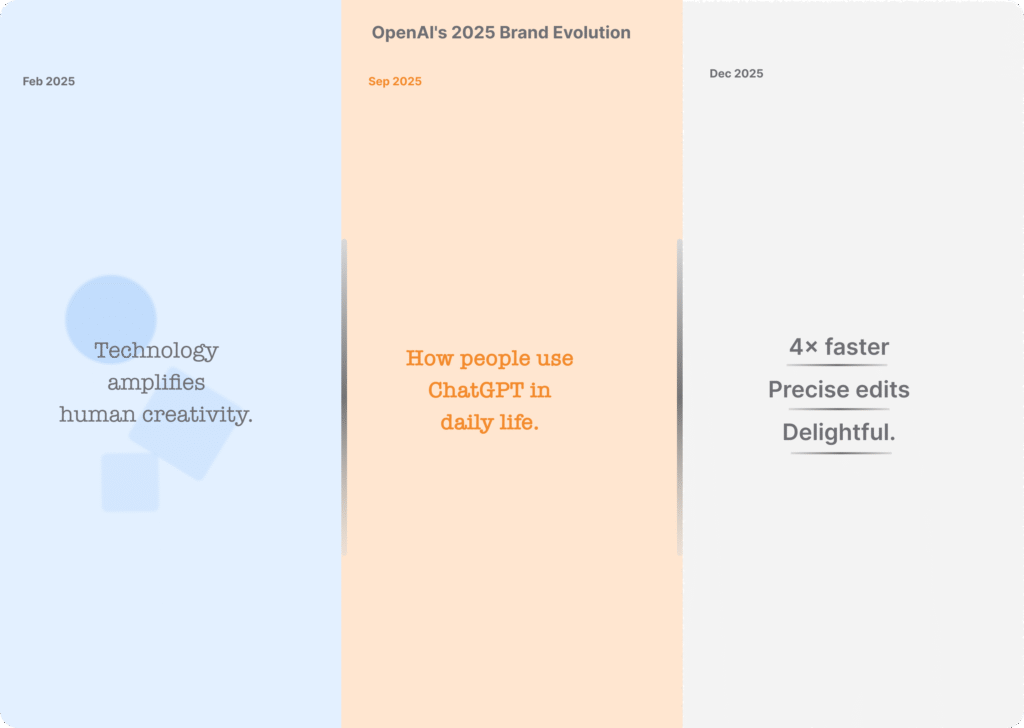
On 16 December 2025, OpenAI released a 55-second advertisement for its new image generation model. The spot was brief, clinical, and utterly unremarkable—which is precisely what makes it remarkable. This is a company that have spent the last ten months cultivating a “human-centric” brand identity, complete with 35mm film campaigns emphasising warmth, everyday moments, and emotional resonance. Yet when competitive pressure intensified, that carefully constructed positioning evaporated in favour of bare technical specifications and vague promises about being “delightful.”
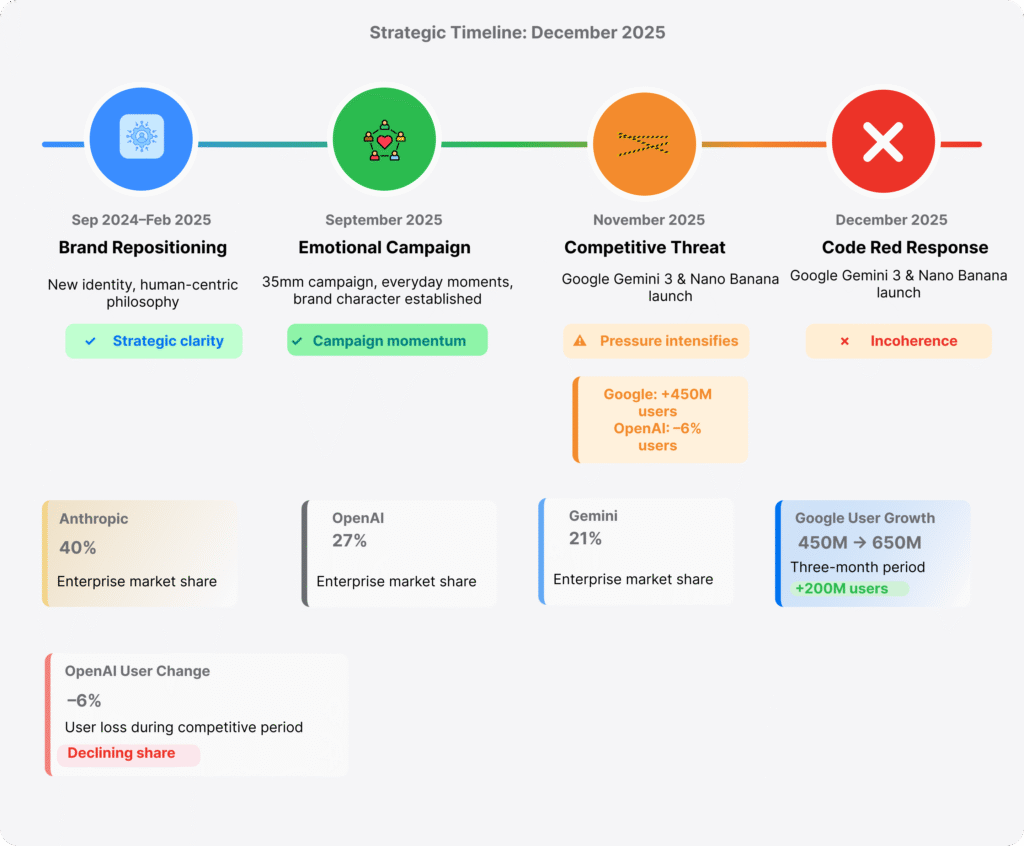
The advertisement arrived during what internal memos called “code red”—an acknowledgement that Google’s Gemini 3 had topped industry benchmarks, that Nano Banana Pro had gone viral, and that OpenAI had haemorrhaged 6% of its user base in the aftermath. The company that pioneered conversational AI was suddenly losing the conversation.
Here’s why this matters to you: December 2025 isn’t just OpenAI’s crisis. It’s yours. This is the month when conversion rates peak and ad costs fluctuate hourly, when year-end targets collide with holiday pressure, when competitors launch products specifically designed to steal your momentum. And the question facing every marketing leader right now is the same one OpenAI failed to answer: What do you do when competitive pressure forces you to choose between brand consistency and survival?
What do you do when competitive pressure forces you to choose between brand consistency and survival?
The Pattern Marketers Need to Recognise
The Warning Signs Before the Collapse
OpenAI’s 2025 reads like a brand strategy case study written by someone who kept changing their mind. In February, the company unveiled a sweeping brand identity overhaul—minimalist design language, a custom typeface, a philosophy centred on “technology amplifying human creativity.” By September, this manifested in a major consumer campaign shot on 35mm film: people planning meals, organising trips, starting fitness routines. The creative direction explicitly rejected tech-first messaging. “The primary strategy is to lift up how people are using [ChatGPT] in their daily lives,” said Chief Marketing Officer Kate Rouch.
Then came December’s GPT Image 1.5 announcement. No warmth. No everyday moments. Just a text-heavy slide deck racing through claims about speed and precision, devoid of demonstration or proof. The tonal whiplash was complete.
This isn’t just OpenAI’s problem—it’s a diagnostic pattern. When organisations oscillate this dramatically between strategic positions, it signals panic at the decision-making level. The warning signs are recognisable to anyone who’s worked in a marketing department under pressure:
Your team is constantly working with no time to plan ahead. You’re executing campaigns in the short term, asking “what should we post this week?” rather than “what position are we building over the quarter?” Leadership starts asking “can we respond faster?” without interrogating whether speed serves strategy. Metrics-driven panic replaces strategic thinking—you’re reacting to competitor moves rather than advancing your own narrative.
These are the conditions that precede brand collapse. I’ve written about this pattern before in the context of September’s smartphone marketing chaos, where every major player abandoned strategic positioning to crowd launch calendars in proximity to Apple’s annual event.
When Strategy Becomes a Luxury You Can’t Afford
The research on brand consistency is unambiguous. Consistent brand presentation can increase revenue by up to 33%. Maintaining a consistent voice across touchpoints boosts revenue between 23% and 33%. Consistency can quadruple visibility. The business case is settled.
But what happens when the alternative to inconsistency is losing market share? OpenAI wasn’t facing a hypothetical threat. It had lost users. It trailed Anthropic (40% enterprise market share) and was watching Google’s ecosystem balloon from 450 million to 650 million monthly active users in three months. Chief Executive Sam Altman acknowledged “temporary economic headwinds”. These are not abstract pressures.
So the company made a choice: abandon the carefully constructed brand positioning and compete on technical specifications. It was the wrong choice, but it wasn’t an incomprehensible one. When you’re in crisis mode, strategy feels like a luxury. The problem is that treating it as optional guarantees a longer, deeper crisis.
What OpenAI’s Ad Reveals About Crisis Marketing
The Anatomy of Panic-Driven Messaging
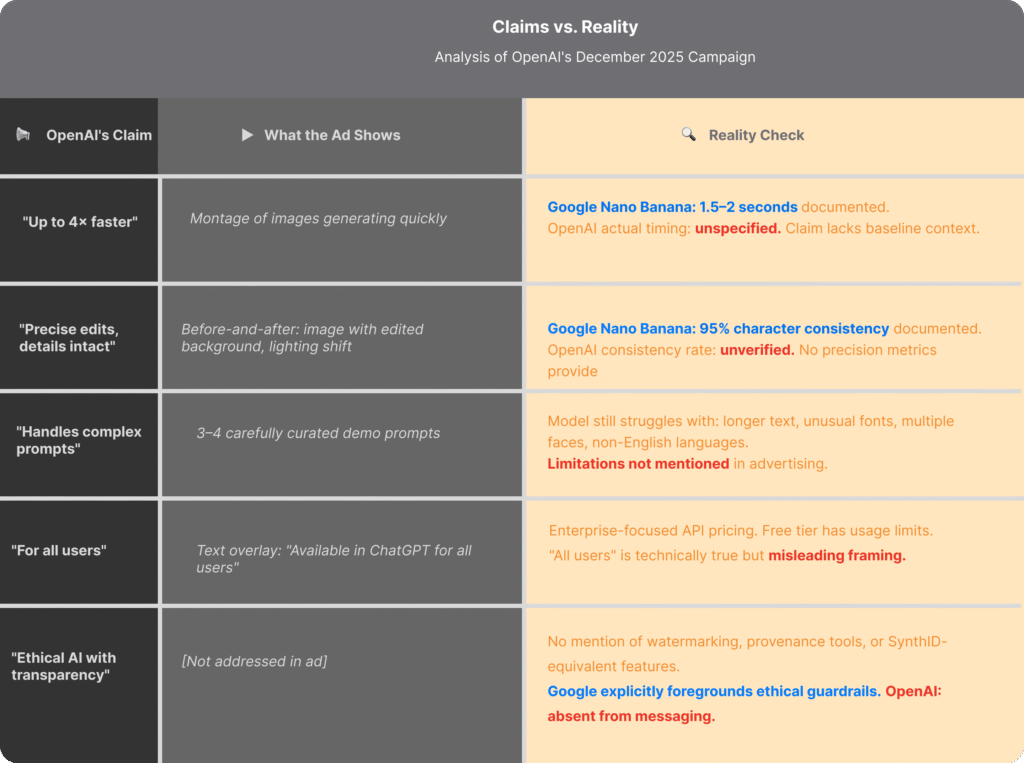
Let’s deconstruct the advertisement. It makes five core claims in 55 seconds: new flagship model, precision output, intact detail preservation, “up to 4x faster” generation, and a “delightful” user experience. Not one of these claims is demonstrated. For a product whose entire purpose is visual generation, the advertisement contains no before-and-after transformations, no side-by-side comparisons, no user testimonials. It’s a text-driven announcement for an image tool.
The “4x faster” claim is particularly instructive. “Up to” creates an upper bound without guaranteeing typical performance—the same linguistic hedging broadband providers use when regulators aren’t watching closely. Faster than what baseline? Google’s Nano Banana Pro generates images in 1.5 to 2 seconds. Without absolute figures, the metric is meaningless.
Then there’s “delightful.” This is aspirational adjective work—language that gestures toward an idealised user experience without defining or measuring it. It’s the rhetorical equivalent of saying “trust us” when you have no demonstration to offer. I explored this phenomenon in depth when analysing OpenAI’s earlier “documentary-style” testimonial videos, which sacrificed authenticity for polish.
What the advertisement doesn’t mention: the model still struggles with longer text, unusual fonts, multiple faces, and non-English content. It makes no reference to watermarking or provenance tools—features Google explicitly foregrounds through its SynthID system. The ethical silence is notable for a company that spent months positioning itself around transparency and responsibility.
This is what panic-driven messaging looks like: quantitative fig leaves over qualitative gaps, claims without substantiation, speed prioritised over coherence.
The Cost of Abandoning Your Own Positioning
Brand voice functions like character. When your brand speaks to audiences in a way that feels familiar and genuine, it builds trust. When that character suddenly shifts—warm to clinical, human-centric to spec-driven—audiences experience it as betrayal or confusion.
The research backs this up: 81% of consumers need to trust a brand to consider buying. 60% of consumers prefer to engage with brands that share their values.
When you oscillate between positions, you signal that you don’t actually stand for anything—you’re just reacting.
OpenAI’s September campaign emphasised humanity, everyday use cases, and approachability. The creative strategy was explicit: show up “with humanity, creativity, and a clear focus on people.” Three months later, the company dropped a technical specs slide with no demonstration, no human context, and vague productivity promises. If you’re a user who responded to the September positioning, what are you supposed to make of December? Which version of OpenAI is real?
The invisible cost here isn’t just confused messaging—it’s eroded trust in every future claim the company makes.
If they abandoned their positioning this quickly under pressure, what else will they abandon?
For a contrasting approach, consider how Anthropic has maintained remarkably consistent brand voice across multiple product launches, even when facing similar competitive pressures.
What Gets Lost in Translation
The most revealing aspect of the advertisement is its ethical silence. OpenAI’s February brand overhaul emphasised transparency and responsibility as core values. Yet this product announcement makes no mention of watermarking, provenance tracking, or safeguards against misuse.
Compare that to Google, which explicitly promotes its SynthID watermarking system to identify AI-generated content. This isn’t peripheral concern—it’s central to debates about misinformation, deepfakes, and creative labour displacement. By framing image generation purely through creativity and efficiency, OpenAI evaded harder questions about societal impact.
Then there’s the democratisation rhetoric. The advertisement emphasises that GPT Image 1.5 is “rolling out today in ChatGPT for all users.” This deploys the language of universal access whilst obscuring critical context: API pricing remains enterprise-focused, meaningful use requires paid tiers, and the “all users” framing masks a developer and business audience.
The gap between stated brand values (transparency, human benefit, accessibility) and actual product communication (vague claims, ethical silence, enterprise targeting) is where credibility dies.
The Uncomfortable Truth About Brand Guidelines
When to Break Your Own Rules
Not every crisis demands abandoning your brand. In fact, most don’t. Research on crisis communication is clear: organisations need speed and transparency, but speed doesn’t mean strategic incoherence. Brands that respond to crises within 24 hours whilst maintaining consistent messaging protect both reputation and market position.
The key is acknowledging the crisis within your brand framework rather than abandoning the framework entirely. When brands handle crises with empathy, honesty, and efficiency whilst staying true to their voice, they often emerge stronger. The mistake is assuming that pressure requires a personality transplant.
OpenAI treated competitive pressure as an existential crisis demanding total strategic pivot. But competitive pressure is not the same as brand death. A better response would have maintained the human-centric positioning whilst addressing technical capabilities: “We’re making image generation faster and more precise so you can focus on creativity, not waiting.” That message serves both the product improvement and the established brand character.
The Difference Between Adapting and Capitulating
Adaptive brand voice means evolution within character. Your brand can shift emphasis, adjust tone for context, and respond to market conditions without ceasing to be recognisable. Capitulation is reactive oscillation that confuses your audience about who you actually are.
OpenAI’s mistake was treating the choice as binary: either maintain human-centric positioning or compete on technical performance. In reality, the strongest positioning would have been “We’re human-centric AND technically excellent.” Instead, the company signalled: “Forget everything we said about humanity and values—look how fast we are.”
This matters because maintaining visual and messaging consistency during crisis can increase revenue by up to 33% precisely because it reassures audiences that you haven’t fundamentally changed.
Adaptation says “we’re responding to new conditions.” Capitulation says “we were never serious about our positioning.”
I’ve explored this tension extensively in my analysis of Apple’s iPhone 17 Pro campaign, which demonstrates masterful brand consistency even when introducing technical innovations.
What Good Crisis Branding Actually Looks Like
Effective crisis branding requires three elements: transparency about challenges, consistency in values even when tactics shift, and corrective action paired with reinforced brand messaging.
Acknowledge the crisis immediately with clear communication across major channels. Implement corrective actions whilst reinforcing core brand values. Maintain consistent messaging across all platforms to reassure stakeholders that your identity remains stable even as circumstances change.
The contrast with OpenAI is instructive. Google’s Nano Banana Pro launch generated substantial organic buzz through user-generated demonstrations—people showing what the tool could do in real contexts. OpenAI issued a corporate announcement with no proof points. One approach invites participation and builds community; the other broadcasts defensiveness.
For another example of crisis communication done well, consider my analysis of Google’s DigiKavach campaign, which maintained brand authenticity whilst addressing serious security concerns.
What Marketers Should Actually Do
Build Flexible Brand Systems, Not Rigid Guidelines
Think of your brand as a character with range, not a script. Characters can respond to different situations without ceasing to be themselves. A flexible brand system defines the emotional and ethical core whilst allowing tactical variation.
This means creating crisis-specific style guides that maintain your brand voice whilst adapting format, channel, or emphasis. Develop pre-approved alternative visual treatments so you can move quickly without improvising from scratch. Establish rapid response protocols that accelerate execution without bypassing brand review.
Research shows that organisations with flexible brand systems respond 40% faster to crisis situations than those with rigid guidelines. The goal isn’t constraint—it’s clarity about what remains constant so you can adapt everything else with confidence.
Know Your Non-Negotiables Before Crisis Hits
Document two lists: what can change (tactics, channels, format, emphasis) and what cannot change (values, voice, ethical commitments). OpenAI’s failure was having no clarity about what “human-centric” meant in practice. When pressure hit, they had no anchor—so they abandoned the positioning entirely.
Your exercise: write down three brand non-negotiables that survive any crisis. Not marketing tactics. Not campaign themes. Core identity elements that define who you are regardless of market conditions. These might be: “We always explain trade-offs honestly, even when competitors oversimplify.” “We never claim capabilities we can’t demonstrate.” “We prioritise long-term customer relationships over short-term conversion metrics.”
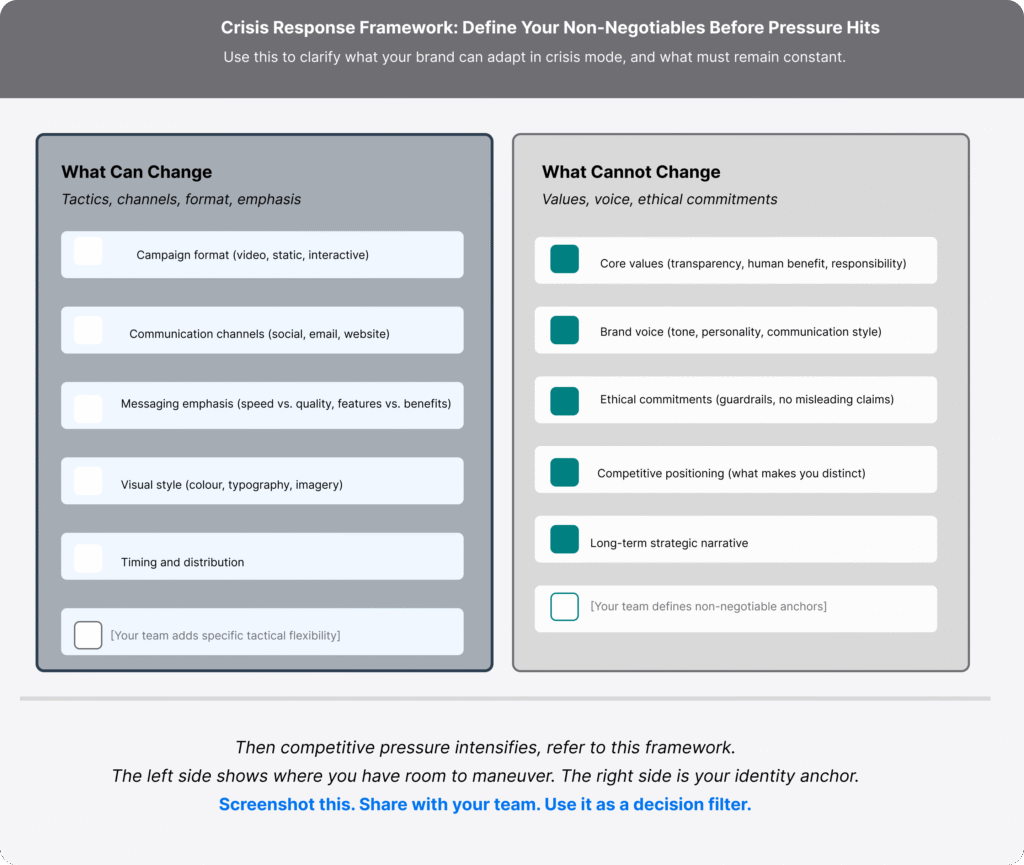
These non-negotiables become decision-making filters. When competitive pressure mounts, you ask: does this response align with our non-negotiables? If not, it’s the wrong response regardless of tactical appeal.
Stop Treating Competitors as Existential Threats
Market share loss is not brand death. Short-term defensive moves damage long-term brand equity. Research shows that brand consistency quadruples visibility—which means the compounding value of maintaining position typically outweighs the immediate cost of competitive concession.
A better strategy acknowledges competitor strengths within your brand framework. “They’re fast, we’re thoughtful.” “They optimise for scale, we optimise for precision.” “They automate everything, we keep humans in the loop.” These positions differentiate without panic. They say: we see what they’re doing, and here’s why we’re doing something different.
Contrast that with OpenAI’s implicit message: “WE’RE FAST TOO (forget everything we said about being human-centric).” That’s not competitive positioning—it’s capitulation disguised as response. I explored similar dynamics in my examination of NVIDIA’s marketing strategy, which maintains clear brand voice consistency despite operating in an intensely competitive environment.
The Real Question Isn’t “Should We Respond?” But “How?”
Every product launch involves a speed-versus-substance trade-off. OpenAI could have demonstrated capabilities, maintained human-centric framing, and shown ethical guardrails. Instead, they issued a bare announcement with vague claims and no proof.
Product launch research is unforgiving: demonstrations drive engagement and conversion. Videos under one minute achieve 66% completion rates when they front-load value. But 78% of launch videos fail to meet objectives—usually because teams panic and skip the demonstration in favour of announcement.
This is the pattern: pressure leads to shortcuts, shortcuts lead to weak execution, weak execution fails to move the competitive needle, failure intensifies pressure. The cycle compounds.
The Bigger Stakes
What This Means for AI Marketing Broadly
The dominant AI marketing trends for 2025 emphasise hyper-personalisation, transparency, and ethical deployment. 78% of CMOs are actively integrating generative AI into marketing ecosystems, and consumer expectations have shifted accordingly: people want brands that share their values and demonstrate responsible AI use.
OpenAI’s approach ignored this context entirely. The advertisement offered technical specifications divorced from values, speed claims without ethical framing, and productivity promises without human benefit articulation. It was a category error—competing on metrics that Google already owns (speed, scale, integration) whilst abandoning the differentiation OpenAI had spent months building (humanity, transparency, responsible deployment).
The missed opportunity is stark. In a market where every major player claims speed and scale, differentiation comes from values and trust. OpenAI could have positioned GPT Image 1.5 as the image generation tool with ethical guardrails, transparent limitations, and human-centred design. Instead, they chose to compete on “4x faster”—a claim that’s both unverifiable and easily matched.
The December 2025 Lesson
December 2025 is the most competitive, data-rich, and opportunity-packed month in online marketing. Consumer behaviour peaks, ad costs fluctuate hourly, and every brand faces the same pressure: convert now or miss the year’s most valuable window. This is when maintaining brand consistency becomes a competitive differentiator precisely because everyone else is panicking.
Companies that maintain consistent owned audiences protect profitability during high-pressure periods. Those that oscillate between positions lose both trust and market advantage. OpenAI’s case study demonstrates the compound cost: they lost users, lost narrative control, and lost brand coherence—all whilst failing to meaningfully close the competitive gap.
The December lesson isn’t “ignore competitors.” It’s “maintain your identity whilst responding to them.” The brands surviving this month aren’t the ones responding fastest—they’re the ones staying recognisable whilst responding intelligently.
Choose Your Crisis
Every marketer reading this faces pressure. Competitors launch products designed to steal momentum. Boards demand faster response times. Metrics show market share erosion. Year-end targets loom. The temptation is always the same: abandon strategy for tactical reaction, sacrifice brand consistency for competitive speed.
Here’s the uncomfortable reality: inconsistency creates a bigger crisis than competition ever could. OpenAI’s actual crisis isn’t Google’s success—it’s the company’s own incoherence. When you oscillate between strategic positions, you don’t just confuse your audience. You erode the trust that allows any future positioning to work. You become the brand that stands for nothing except reacting to whoever moved last.
The choice facing marketing leaders isn’t comfortable versus uncomfortable. It’s short-term reactive marketing versus long-term brand integrity. Both involve discomfort. Only one builds sustainable advantage.
Before your next crisis hits—and it will hit, probably before January—define what your brand cannot abandon no matter what. Not campaign themes. Not tactical choices. Core identity: the three things that remain true about who you are regardless of competitive pressure, market conditions, or board demands. Write them down. Share them with your team. Treat them as decision-making filters.
Because when pressure mounts and leadership asks “can we respond faster?” the question you need to answer is: respond how? Within our brand framework or by abandoning it? The first path is difficult. The second is catastrophic.
The brands that survive crises aren’t the ones that respond fastest. They’re the ones that stay recognisable whilst responding.
OpenAI forgot that. Don’t make the same mistake.
Sources & Further Reading
Related Articles on SB
AI & Technology Marketing Analysis
- When Testimonials Dress Up As Truth – Analysis of OpenAI’s documentary-style marketing and the authenticity paradox in AI advertising
- Claude Sonnet Marketing Analysis – How Anthropic maintains brand consistency across product launches
- NVIDIA Marketing Strategy Analysis – Brand voice consistency in competitive technology markets
Brand Crisis & Consistency
- The September Siege: When Smartphone Brands Lost Their Collective Sanity – Pattern analysis of strategic abandonment under competitive pressure
- Apple’s iPhone 17 Pro Marketing: A Critical Campaign Analysis – Maintaining brand identity whilst introducing technical innovation
- Google DigiKavach Campaign Analysis – Crisis communication done well whilst maintaining brand authenticity
External Sources
OpenAI’s “Code Red” & Competitive Context
- OpenAI Declares ‘Code Red’ as Google Threatens AI Lead – The Wall Street Journal
- Inside OpenAI’s Fragile AI Lead – Fortune
- OpenAI Releases New Image Model as It Races to Outpace Google’s Nano Banana – Fortune
- OpenAI Has Lost 6% of Its Users After Gemini 3 Launch – Mashable
- Sam Altman: Google Gemini 3 Poses ‘Economic Headwinds’ for OpenAI – Outlook Business
OpenAI’s Brand Evolution
- OpenAI Unveils New Brand Identity 2025 – Jurnals
- OpenAI’s Biggest Campaign Repositions ChatGPT for Daily Life – ContentGrip
Technical Analysis & Competitive Comparison
- OpenAI’s New ChatGPT Image Model Matches Google’s Nano Banana Pro – The Decoder
- Google’s Nano Banana Takes on the AI Image Generation Market – LinkedIn Analysis
Brand Consistency Research
- How to Maintain Visual Branding Consistency During a Crisis – 5W Public Relations
- How to Maintain a Consistent Brand Voice—and Why – Grammarly Business
- 9 Keys to Maintain Brand Voice Consistency – Growbo
- Ensure Consistent Brand Voice Across Touchpoints – Mural
Crisis Management Best Practices
- Steps to Be Taken by Brands in Crisis Management 2025 – Teamology
- 7 Proven Strategies to Recover from a Branding Crisis – Determ
- Essential Do’s and Don’ts to Protect Your Brand’s Reputation – Pollack Group
Marketing Team Pressure & Warning Signs
Product Launch Effectiveness
- Best Practices for Product Launch Videos – N2 Productions
- 7 Tips for Impactful Product Launch Videos – Atlassian
- Product Launch Video Production: Creating Buzz That Sells – Castleview Agency
December 2025 Marketing Context
- December 2025 Digital Marketing Guide – Faster Solutions
- Online Marketing in December 2025: Trends, Strategies, and What’s Winning – Website Marketing
AI Marketing Trends
- Q4 Marketing Trends for Success – Allied Insight
- The Best AI Marketing Trends & Strategies in 2025 – Sprinklr