
If you want to understand the identity crisis gripping digital strategy, you don’t need a McKinsey report. You just need to look at the comments section under an Adobe tutorial.
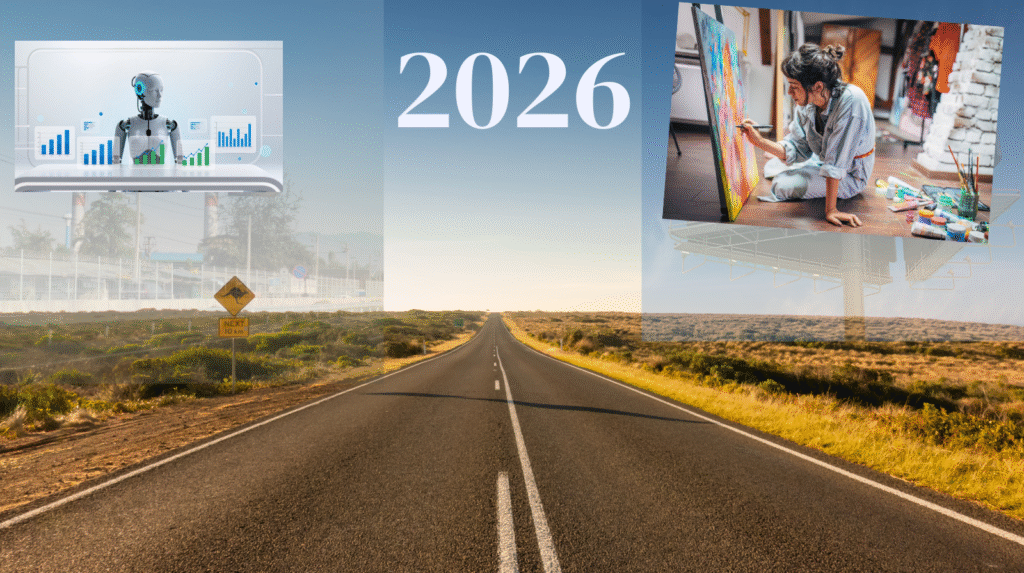
On one side, you have the “teleporters”—creators using AI to mask, blur, and jump-cut their way to viral fame in seconds. On the other, the “painters”—artists spending hours projecting light onto physical canvas, meticulously masking vines and shadows to create something that feels undeniably real.
For years, marketing leaders have been told they can have it all: speed, quality, and scale. As we step into 2026, the tools that defined the last year—from Premiere Pro’s generative object masking to text-based editing—have finally exposed this for the lie it is.
The middle ground is dead. The era of “good enough” corporate video is over.
We are entering a bifurcated economy of Fast Food (algorithmic, efficient, ephemeral) and Fine Dining (physical, textured, scarce). As a marketer, the most dangerous place you can be right now is standing in the middle, serving a lukewarm burger on a silver platter.
The Efficiency Trap: When Magic Becomes Mundane
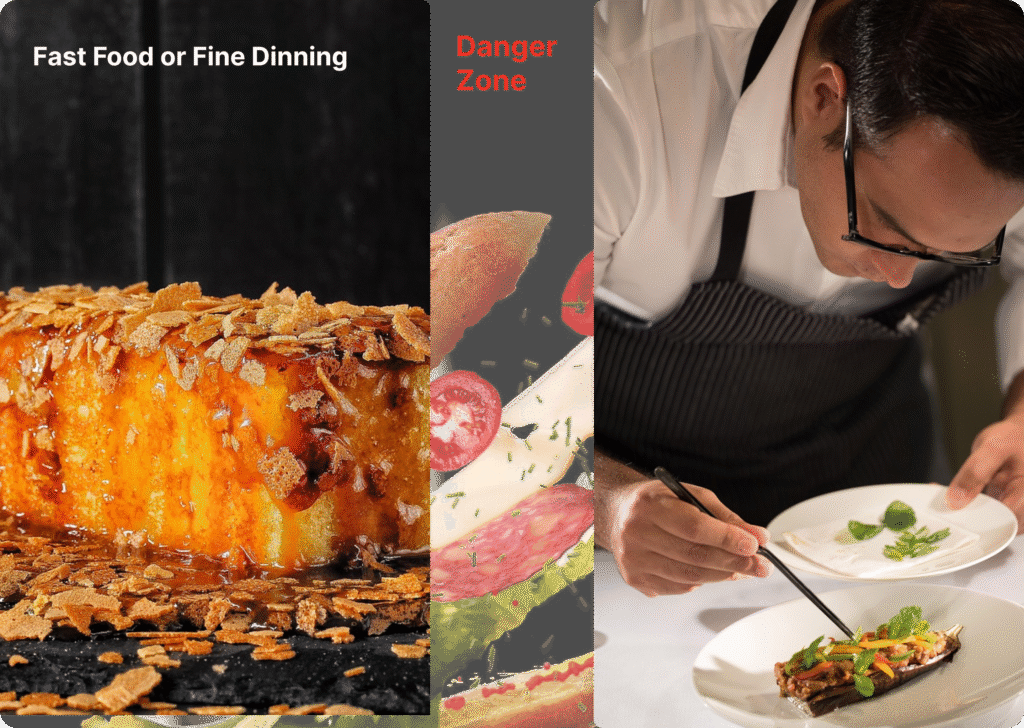
Let’s talk about the “Fast Food” first. It has never been cheaper to be spectacular.
Take the case of the “teleportation” effect. Three years ago, masking a moving subject to create a seamless jump-cut was a job for a junior VFX artist and a pot of coffee. Today, as demonstrated by creators like Jafar Alwash, it is a drag-and-drop operation. The Object Mask tool in Premiere Pro doesn’t just speed up the workflow; it eliminates the skill gap entirely.
This is the democratisation of wizardry. But when everyone is a wizard, no one is impressed by magic.
For marketers, this presents a paradox. The efficiency gains are undeniable—reports like How Generative AI is Reshaping Digital Marketing in 2025 suggest that AI tools have increased creative throughput for agencies significantly. But efficiency is not effectiveness. When you flood the feed with “teleporting” influencers and AI-generated transitions, you are participating in a race to the bottom of the attention span.
The stats back this up. While short-form video currently offers the highest ROI according to 67 Video Marketing Statistics To Drive Your Strategy in 2025, there is a looming “trust penalty.” A study on Consumer attitudes toward AI-generated marketing content by the Nuremberg Institute found that content explicitly labelled or perceived as AI-generated suffers a significant drop in consumer trust and emotional engagement. We see similar patterns when analysing video marketing best practices—high volume often masks low engagement.
The Takeaway: If you choose the “Fast Food” lane, commit to it. This is a volume game. Use AI to drive down costs, test 50 variations of an ad overnight, and treat the content as disposable. But do not mistake this efficiency for authentic brand building. It is a sugar rush, not a meal.
The Return of the Physical: Why Texture is the New Luxury
If the screen is cheap, the physical is expensive—and therefore valuable.
While the “teleporters” are saving time, artists like Lucinda (@dil.worth3) are spending it. Her workflow for animating paintings is practically medieval by modern standards: physical paint, physical canvas, physical projector. She uses digital tools (After Effects, Lightroom), but only to service the physical object.
Why does this matter to a CMO? Because in a digital ecosystem drowning in generative slop, physics is the only thing that cannot be faked.
The flaws—the grain of the canvas, the way light bleeds around a painted vine, the slight imperfection of a projector’s focus—are subconscious signals of authenticity. They tell the viewer: “This exists in the same world you do.”
This aligns with the explosion of “phygital” (physical + digital) experiences. As noted in Top 10 Marketing Trends of 2025, 90% of consumers now cite authenticity as a key factor in brand support. They are tired of the glossy, frictionless aesthetic of the mid-2020s. They want texture. We have seen this fatigue before, most notably in the September Smartphone Marketing 2025 – Hype or Real Value?, where brands traded genuine innovation for “AI washing” and empty spectacle.
The Takeaway: High-end brands must pivot to “Fine Dining.” Stop spending budget on mid-tier animated explainers that look like every other SaaS video. Invest in tangible, mixed-media assets. If you are shooting a product, put it in a real room. If you are animating a logo, project it on a brick wall. The friction is the value.
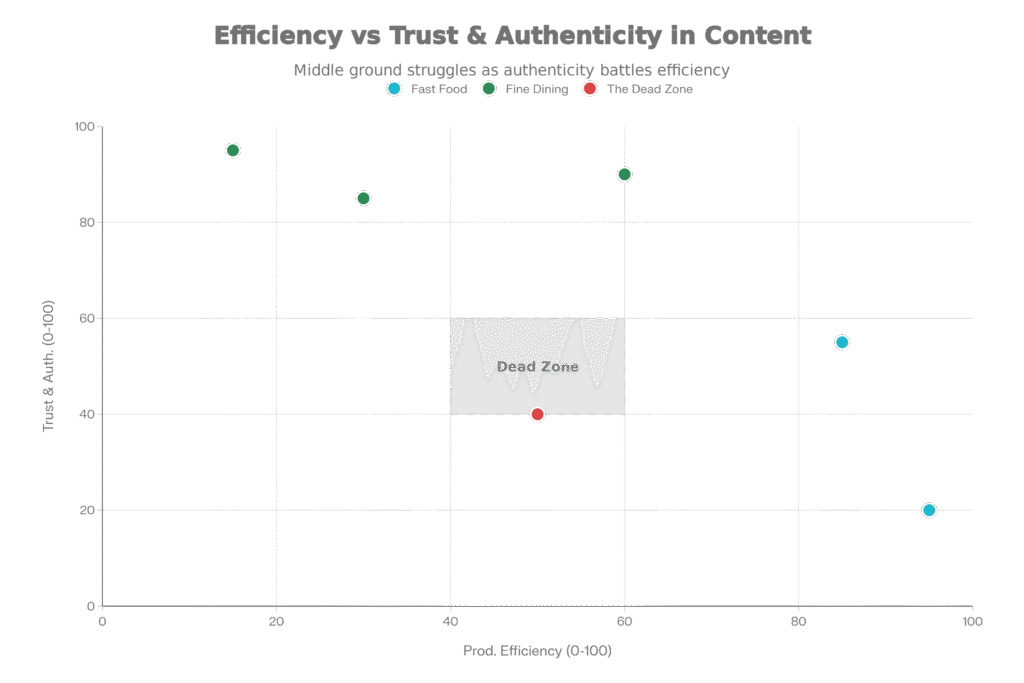
The “Middleman” Squeeze: Efficiency vs. Authenticity in 2025 Video Marketing
The Invisible Bureaucracy: Managing the Chaos
There is a third story here, one that isn’t about the customer at all, but about your team.
Behind the scenes of every “effortless” viral video or cinematic masterpiece is a crushing weight of logistics. The interview with editors Kirk Baxter and Jennifer Chung regarding the thriller A House of Dynamite reveals the unsexy truth of professional creativity: it is mostly file management.
Their reliance on Text-Based Editing—searching through dialogue transcripts to find a specific line reading—highlights a critical shift. We are moving from editing (cutting footage) to curating (managing databases of assets).
This is where the “AI fatigue” sets in. The Adobe 2025 AI and Digital Trends report highlights that a staggering 56% of marketing and CX teams report that implementing generative AI has actually added strain to their workflows. Why? Because we have given them Ferrari engines (generative tools) but put them in a horse-and-cart infrastructure.
Marketing leaders need to stop obsessing over “generative” features (making new images) and start investing in “assistive” features (organising existing ones). The ability to search video by text, or use AI to auto-tag thousands of hours of B-roll, is worth infinitely more to your bottom line than a tool that can swap a background. This is a recurring theme in content creator tools—the best ones remove friction, they don’t just add noise.
The Takeaway: Your team doesn’t need more creative tools; they need better plumbing. Invest in systems that allow for “Production” style workflows—shared projects, automated transcription, and intelligent asset retrieval.
The Art of the Imperceptible
Finally, we must address the “Uncanny Valley” of detail. The tutorial on creating digital snow by Film Riot serves as a masterclass in why “good enough” fails.
Amateurs (and bad AI models) throw white particles on a screen and set the blending mode to ‘Screen’. It looks bright, it looks digital, and it looks fake. Professionals understand that snow is opaque; it blocks light. They understand that snow accumulates. They use ‘generative fill’ not to replace the shot, but to add subtle piles of snow on a window ledge, then composite it back in with perfect lighting matches.
This attention to detail—the physics of light, the temperature of a shadow—is what separates a premium brand from a drop-shipper. Consumers might not be able to articulate why a video feels “off,” but they vote with their thumbs instantly. It is the difference between AI in brand storytelling and a cheap imitation.
The Verdict: Pick a Lane for 2026
The lesson from the video landscape of 2025 is clear as we head into 2026: Fence-sitting is fatal.
The middle market of video production—the generic, decently lit, stock-music-backed corporate video—is being eaten from both ends. It is too expensive to compete with the AI-generated “Fast Food” and too soulful to compete with the “Fine Dining” of physical artistry.
Your Action Plan for 2026:
- Audit your “Middle”: Identify every piece of content you produce that is “just okay.” Kill it.
- Automate the Bottom: Use tools like Object Mask and text-based editing to ruthlessly efficientise your social clips, internal comms, and A/B testing assets. Aim for 95% efficiency.
- Humanise the Top: Take the savings from step 2 and pour them into a few “Hero” assets that are undeniably physical. Hire the painter. Rent the projector. Build the set.
- Fix the Plumbing: Stop buying AI tools that make more stuff. Buy AI tools that help you find stuff.
The tools have changed, but the rule remains: You can be fast, or you can be real. Just don’t try to be both.
Need help defining which lane your brand should be in for the year ahead? Let’s talk about strategy that sticks.