
Marketers are about to learn the hard way that “vibe coding” isn’t a strategy. It’s a gamble with someone else’s risk profile.
Lovable’s recent videos – a “71% better” product update, a SheBuilds founder webinar, a $150k cake‑business story, and now a full agent walkthrough – aren’t just tech content. They’re a mood board for how non‑technical founders and marketers are being sold software power without software responsibility. If you’ve already watched AI campaigns over‑promise in Big Tech launches, from Claude’s “thinking partner” to Copilot’s workplace fantasy, this will feel grimly familiar.[ppl-ai-file-upload.s3.amazonaws]lovable+3
If you work in marketing, growth, or brand, you are exactly the target. This isn’t tool‑porn. It’s a new class of dependency your team is sleepwalking into.
Marketers should absolutely use vibe‑coding tools like Lovable – but only if they stop believing the fairytale those videos are pushing, and start treating themselves as product owners who are accountable for the risk.
Why this matters right now
Three forces have collided in the last 12 months.
First, AI dev platforms have gone from toy to unicorn. Lovable raised $330m at a $6.6bn valuation in late 2025, positioning itself as the platform where “anyone can build full‑stack apps in plain English”. That pitch has migrated straight into marketing decks and LinkedIn carousels – the same pattern you see in enterprise AI, where pilots rarely translate into impact, but the hype cycle keeps resetting.techcrunch+2
Second, marketers are being told they no longer need engineering to build funnels, referral engines, reporting dashboards, or even full products. This is the logical next chapter after generative AI “content at scale”: once AI writes your posts, why shouldn’t AI also build the tools around them?lovable+2
Third, the security data has arrived – and it is not flattering. Veracode’s GenAI Code Security Report and follow‑up findings show that nearly half of AI‑generated code they assessed contained security vulnerabilities, including OWASP Top 10‑grade issues.baytechconsulting+2
If you’re a marketer in 2026, you’re under pressure to do more with fewer engineers. Vibe coding looks like a cheat code. The Lovable videos are the glossy version of that promise:
- “Lovable is now 71% better at solving complex tasks.”
- “From Problem to Product” – a non‑technical woman wins SheBuilds with an AI learning product.
- “How He Vibe Coded a $150K/Year Cake Business.”
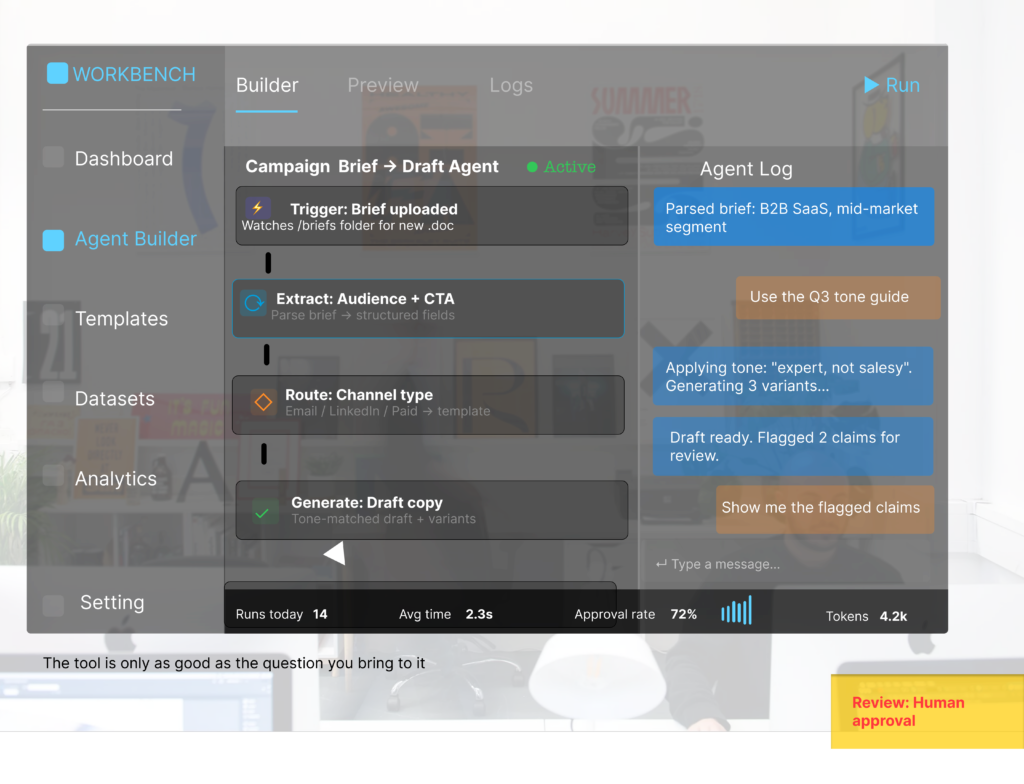
- “Lovable Agent Update – Full Walkthrough” – the agent now plans, tests, fixes, and ships features for you.[lovable][ppl-ai-file-upload.s3.amazonaws]
If that mix of aspiration and omission reminds you of recent AI‑heavy phone launches or “quietly magical” AI assistants, that’s because the playbook is converging.suchetanabauri+2
The 71% claim: confidence theatre, not evidence
The “Lovable is now 71% better at solving complex tasks” video is a tidy piece of confidence theatre.[lovable]
In 94 seconds, it:
- Shows a demo: Caroline describes a Swedish language learning app, the agent builds it.
- Promotes new features: planning, automated browser testing, prompt queueing, and Google sign‑in.
- Slaps on the headline: “71% better at solving complex tasks.”
There is no explanation of:
- 71% better than which baseline.
- On which task set.
- Measured how, over what time, using what evaluation.
It’s the same move critiqued in breakdowns of recent AI‑first hardware and assistant launches: benchmarks as vibe, not accountability. A number precise enough to sound empirical, vague enough to be unfalsifiable.suchetanabauri+1
For a marketer, that matters because the number isn’t just dressing. It’s an invitation to trust the system – to delegate real workflows to the agent.
When “self‑testing” hides real risk
Take the automated browser testing. Lovable “tests your app like a real user”, notices issues, and fixes them on its own. The new agent walkthrough doubles down: you watch the agent open a LinkedIn‑content app, click through flows, fail to link posts to calendar entries, notice its own bug, then edit code until it passes its own tests.[ppl-ai-file-upload.s3.amazonaws][lovable]
It’s impressive. It’s also exactly the context where the Veracode findings should be clawing at the back of your mind: across dozens of LLMs and tasks, about 45% of AI‑generated code introduced vulnerabilities. The syntax looks right; the security posture does not.via.tt+2
So when a platform promises “we’ll test and fix your app for you”, the honest version for a marketing leader is closer to:
“We’ll generate and ship plausible fixes quickly. Some will be insecure in ways you are not equipped to detect.”
That might still be an acceptable trade‑off for throwaway experiments. It is not a safe default for tools handling customer data, auth, or money.
The agent era: automation without accountability?
The new “Lovable Agent Update – Full Walkthrough” video is the quiet confession that the simple “type idea, get app” story has broken down.[ppl-ai-file-upload.s3.amazonaws]
What Alex and Isaak introduce is effectively Lovable 2.0:
- Plan Mode – the agent now creates a structured plan before touching code; you can edit that plan as if it were a PRD.
- Long‑running agents – the agent can execute dozens of steps, open the browser, click around, test flows, and keep iterating until it decides the app “works”.
- Prompt queueing – you can stack 50–100 prompts in a queue and let the agent chew through them “like a playlist” while you go and do something else.[ppl-ai-file-upload.s3.amazonaws]
If you’ve been tracking how AI assistants are being positioned as “thinking partners” rather than tools, this will feel like the builder version of the same move: a friendly agent that quietly rewires your stack while you’re away.[suchetanabauri]
For marketers, this sounds blissful: set up the work, walk away, come back to a finished app.
Plan Mode as PRD in disguise
Plan Mode is, in effect, a PRD in disguise. Alex admits the agent falls over when your instructions are vague, and that power‑users already write plans because it saves credits and frustration. So Lovable has productised the idea: you’re nudged to write a more precise, structured description of your feature before the machine gets going.[ppl-ai-file-upload.s3.amazonaws]
That is good product thinking. It also tacitly acknowledges what the marketing gloss refuses to:
This only works if you already think like a product manager.
You are not just “telling the app an idea”. You are designing a system. The agent is an over‑enthusiastic junior developer following your brief.
Queues, autonomy, and invisible changes
The queuing and long‑running loops are the more worrying part. The walkthrough explicitly recommends things like:
- “Queue up a prompt to generate the feature.”
- “Then queue another to test it in the browser.”
- “Then another to fix anything that’s broken.”
- “Go do something else while the agent works through the list.”[ppl-ai-file-upload.s3.amazonaws]
You are now running unattended automation that:
- Edits your codebase.
- Exercises external APIs.
- Modifies data and behaviour.
Security research around AI‑generated code is already clear that mistakes cluster around subtle edge cases, not immediately obvious bugs. Turning up the autonomy dial without matching human review simply means you get to the “plausible but flawed” state faster.kaspersky.co+2
It’s the same pattern you see in generative‑AI‑at‑scale content operations: speed goes up, scrutiny goes down, brand risk compounds quietly in the background. The agent video is honest enough to show you what’s happening. The question is whether marketing teams will watch it as a hype reel or as a warning label.suchetanabauri+1
The empowerment story: when “anyone can build” becomes a trap
The SheBuilds webinar, From Problem to Product: Building AI Recess, is framed as a non‑technical founder success story.[lovable]
Kat Hill Contag walks through how she:
- Uses her PTO framework (Pain, Time, Openness) to choose what problems are worth building for.
- Spends the first two hours of a 48‑hour hackathon writing a proper PRD while others rush into building.
- Builds “AI Recess”, an internal‑training‑meets‑Duolingo product on Lovable, wins the hack, and keeps iterating on it.[ppl-ai-file-upload.s3.amazonaws]
There’s a lot to admire. The PTO framework is sharp, the PRD discipline is excellent, and her emphasis on design systems and constraints is genuinely sophisticated – very much the “slow thinking” many enterprise AI pilots are missing.[suchetanabauri]
Empowerment or unpaid product management?
But the details, again, undercut the fantasy:
- When Lovable “isn’t seeing eye to eye” with her, she uses Claude as a debugging intermediary – asking it to generate better prompts Lovable will understand.[ppl-ai-file-upload.s3.amazonaws]
- She describes spending hours debugging a Google Forms‑style survey when she skipped the planning step.
- She relies on a carefully curated workflow of tools and mental models to keep the agent from wandering off.
This is not “anyone can build an app in 10 minutes”. It’s a non‑technical founder slowly acquiring a product‑manager’s mindset, under duress.
Put that next to what developers themselves are reporting. The 2025 Stack Overflow Developer Survey and related analysis highlight a “productivity tax” of AI tools: developers ship more, but spend more time debugging “almost right” code.survey.stackoverflow+2
Kat’s story is exactly that pattern, retold through a more inspirational lens. The pain – getting trapped in loops of half‑working flows – is framed as a personal growth challenge, not as a limitation of the tool.
For marketers, this is the trap:
Vibe coding is sold as liberation from dev teams; in practice it makes you an unpaid, semi‑technical product owner inside an opaque codebase.
If you’re not ready to hold that responsibility, you’re not being empowered. You’re being stranded. The same lesson runs through critiques of AI‑heavy launches from Anthropic to Microsoft: position AI as infrastructure, not magic, or your users pay the price.suchetanabauri+1
The cake business: scaffolding, not the building
Then there’s the irresistibly clickable one: How He Vibe Coded a $150K/Year Cake Business.[lovable]
The surface narrative is pure founder candy:
- A 20‑year‑old in Norway discovers Lovable.
- He starts by vibe‑coding websites live on sales calls, making around $60,000 in a couple of months.
- He then builds Daymaker, an automated birthday‑cake service for companies.
- In five months, they hit $150,000 ARR and raise angel funding.
If you only read the title, Lovable built a cake SaaS.
What really built the business
If you actually listen, a different picture emerges:
- Before Daymaker, he got very good at one thing: selling. Cold calls, live demos, closing deals.[lovable]
- Lovable gave him a working prototype and enough of a platform to onboard the first 50 customers and handle early orders.
- Once they wanted to scale – 60 HR integrations, 7 accounting systems, bakery partners across cities – they moved to Cursor and more traditional engineering.[lovable]
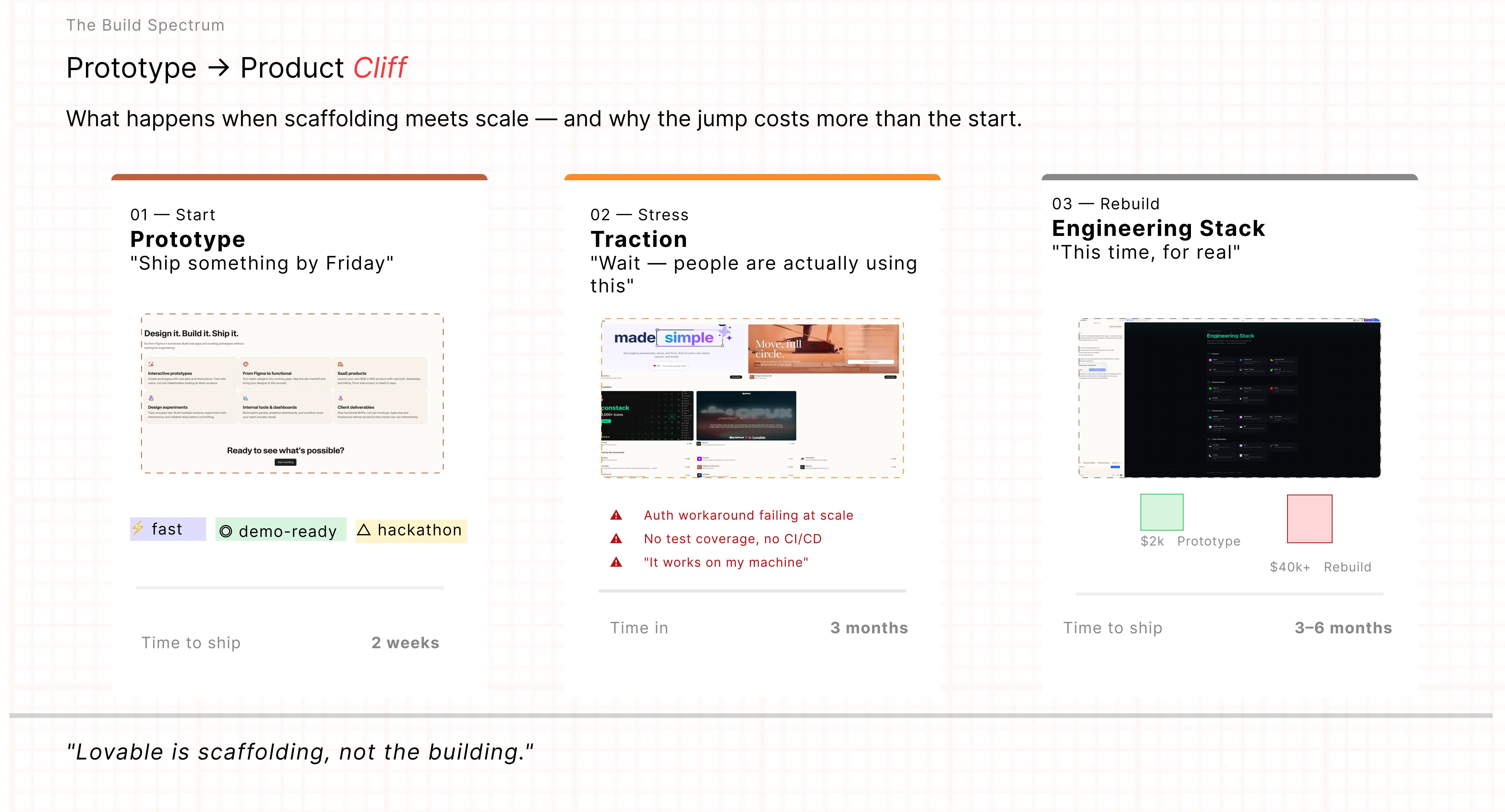
Lovable was scaffolding. The building – the thing with actual weight on it – was built elsewhere.
That doesn’t make Lovable irrelevant. It makes the marketing narrative misleading.
For marketers, the useful takeaway is not “you can vibe code your way to $150k ARR”. It is:
- You can use tools like this to prove an idea should exist.
- Once it’s proven, you will probably have to rebuild it properly.
- The value is in shortening the path to evidence, not in eliminating engineering.
Confusing those roles – treating the scaffolding as the building – is how teams end up running serious revenue through something that started life as a hackathon project. It’s the same pattern seen in AI cinema experiments and indie creators using AI: the tool is an accelerant, not the art.[suchetanabauri]
What marketers actually risk when they “just ship it” on AI code
Let’s strip the romance out. If you’re running growth, brand, CRM, or “marketing ops”, you’re already responsible for more software than your job title admits: attribution logic, enrichment workflows, audience builders, referral engines, promo rules, reporting layers.
Vibe‑coding platforms offer you a deal: cut engineering out, build it yourself.
Here’s what comes with that.
1. Security incidents with your logo on them
Veracode’s findings, plus follow‑up coverage, are blunt: AI‑generated code frequently contains security vulnerabilities. Kaspersky and others have warned about common patterns – exposed secrets, client‑side auth logic, unsafe input handling – becoming endemic in AI‑assisted codebases.veracode+5
Now put that inside:
- A microsite collecting first‑party data for your “privacy‑first” campaign.
- A discount engine wired to your billing system.
- An internal tool with broad access to customer records.
The fact it was built “by marketing” instead of “by engineering” does not dilute the brand damage when something leaks. If anything, it undermines the trust you’ve been trying to build by positioning AI as thoughtful, restrained, and human‑centred.suchetanabauri+1
2. The “almost right” productivity tax
Stack Overflow’s survey data and analysis show a subtle pattern: AI tools make developers feel more productive, but debugging AI‑generated code often takes longer than writing it in the first place.linearb+2
In a marketing context, that manifests as:
- Flows that work perfectly in user‑testing and fall apart under real traffic.
- Attribution numbers that are “off by just a bit” – but enough to skew spend decisions.
- Forms that silently fail for certain browsers or edge‑cases.
You save time on the first pass. You pay it back, with interest, when you realise nobody quite knows how the thing works.
The agent walkthrough’s prompt queue is the purest expression of this: queue up a long list of changes, let the AI refactor your app while you’re in a meeting. You’ll certainly move faster – the question is towards what. It’s the same speed‑versus‑substance trade‑off playing out in AI‑generated content, where brands risk saying more and meaning less.[suchetanabauri][ppl-ai-file-upload.s3.amazonaws]
3. Scale as the silent cliff
Stories around Lovable and similar tools increasingly follow a familiar arc:
- An MVP is vibe‑coded.
- It gains some users, maybe some revenue.
- Under the weight of real usage, it starts to creak.
- A partial or full rebuild with engineers becomes inevitable.superblocks+2
Some founders frame that as a feature, not a bug: the cheap Lovable prototype got them to a point where spending serious money on a rebuild made sense.[linkedin]
For marketing teams, the equivalent looks like:
- An internal Lovable app becomes mission‑critical for a sales or CS process.
- Six months later, nobody remembers how it works; the original builder has left.
- IT reviews it, goes pale, and insists on a rebuild or a migration.
Congratulations: you accidentally launched a SaaS product from your department.
So, should marketers touch vibe coding at all?
Avoiding these tools entirely would be as naïve as believing the hype. The job is to draw a boundary between smart use and reckless dependence – the same line your content strategy probably already draws around when to use generative AI and when to write from scratch.suchetanabauri+1
Where vibe coding makes sense
Use it aggressively for:
- Prototypes and proof‑of‑concepts
Landing page experiments, interactive calculators, quizzes, micro‑tools to test whether an idea actually lands. Failure is cheap, learning is fast. - Internal research tools
Content idea explorers, persona generators, message testing sandboxes – anything that doesn’t require deep integration or sensitive data. - Short‑lived campaigns
Seasonal experiments with clear end dates, limited blast radius, and tight access controls.
Here, Lovable’s strengths are real: fast iteration, reasonable UI out of the box, and connectors that make it easy to pretend you’ve built a “mini‑product” for a few weeks.marketingagent+1[ppl-ai-file-upload.s3.amazonaws]
Where vibe coding becomes dangerous
Treat as red‑flag territory:
- Tools handling PII, financial, or health data.
- Systems that talk directly to billing, core CRM, or production databases.
- Anything always‑on that becomes part of your operational backbone.
These need real engineering: security reviews, audit logs, maintainability plans, and code ownership. Vibe‑coding them in the corner of a sprint board because “it’s just marketing stuff” is how you end up in the post‑mortem deck.netlas+2
If you do ship, don’t skip the boring bits
If you are going to ship something meaningful from Lovable or a similar platform:
- Get an engineer to review it – not to rewrite everything, but to sanity‑check architecture, auth, and data flows.
- Write down who owns it – ownership means uptime, bug triage, user questions, and the decision to kill or rebuild it.
- Set a rebuild threshold – decide a line in advance: “If this thing touches X customers, Y revenue, or Z systems, we budget for a rebuild on our main stack.”
- Lock down access and connectors – use the Lovable connectors for experimentation, but explicitly restrict which APIs and environments it’s allowed to touch.
The Lovable agent’s queue and browser‑automation make it almost too easy to forget there is real code being edited behind the friendly UI. The boring steps are the price of not waking up to an incident – the same way guardrails around AI copy and UX microcopy are what keep “clever” from becoming “chaotic”.[suchetanabauri][ppl-ai-file-upload.s3.amazonaws]
How to talk about this inside your company
The real work now is not choosing tools; it’s framing them internally. Lovable’s videos sell leadership a story: “we can ship software without the headaches of being a software company.”
You need a better story than “this feels risky”.
1. Use vibe coding as a velocity layer
Position platforms like Lovable as:
“Our rapid‑experimentation layer. We use it to get from idea to test quickly. Anything that proves it deserves to exist is then built properly.”
This keeps:
- Leadership excited about speed.
- Engineers involved instead of marginalised.
- Marketing out of the business of quietly running production systems alone.
It mirrors the healthier way teams are starting to talk about AI content: as a first draft or sparring partner, not as “the content strategy”.suchetanabauri+2
2. Ground guardrails in evidence
When you argue for limits, bring receipts:
- Veracode’s finding that nearly half of AI‑generated code is vulnerable.baytechconsulting+2
- Security vendors’ warnings about common AI‑code mistakes in auth and data handling.kaspersky+2
- Stack Overflow’s data showing the debugging tax of “almost right” AI code.venturebeat+2
You’re not the Luddite in the room. You’re the one who read the small print.
3. De‑romanticise the case studies
When you share Lovable case studies or videos, add your own footnotes:
- “Notice that the founder moved off Lovable once scale hit.”
- “This hackathon project is still pre‑revenue.”
- “This agent demo is wired into Google and Stripe; in our world that would trigger security review.”
You’re not raining on the parade. You’re doing what marketers do best: interrogating the story behind the story – the same muscle you use when you pull apart Apple’s latest campaign or Anthropic’s quietly poetic launch films.suchetanabauri+2
A more honest future for marketers who build
There is something genuinely magical about describing an idea and watching a working prototype appear on screen. People aren’t exaggerating when they say it feels like their imagination has been given a render button.linkedin+1
But the job of marketers in 2026 isn’t to be dazzled by that magic. It’s to wield it with adult supervision.
Two things can be true at once:
- Vibe‑coding platforms are a step change in how quickly marketers can ship real, interactive experiences.
- Vibe‑coded systems, left unreviewed, are a fantastic way to ship insecure, unmaintainable, misleading experiences under your brand.
Lovable’s own product evolution – Plan Mode, agent queues, browser testing, managed auth – quietly acknowledges this. It assumes you’re ready to think like a product manager, not just a campaign owner.[ppl-ai-file-upload.s3.amazonaws]
So perhaps the right story for marketers is not “anyone can build a product now.” It’s closer to:
“Anyone can ship a prototype. Professionals decide what deserves to become a product – and make sure it’s built like one.”
If you’re already rethinking how you market AI – from Claude’s “thinking partner” to enterprise AI pilots that actually deliver – this is the same shift, just one layer deeper in the stack.suchetanabauri+2
The tools aren’t going away. The only live question is whether marketing teams choose to use them like grown‑ups, or let the vibe decide.
Here’s a simplified list with just the hyperlinked article names you can drop in as footnotes.
Footnotes
External sources
- 2025 GenAI Code Security Report
- AI‑Generated Code Poses Major Security Risks in Nearly Half of All Development Tasks
- AI Vibe Coding: Why 45% of AI‑Generated Code is a Security Risk
- Security Risks of Vibe Coding and LLM Assistants
- Common Vulnerabilities in AI‑Generated Code
- 2025 Stack Overflow Developer Survey
- Stack Overflow Data Reveals the Hidden Productivity Tax of “Almost Right” AI Code
- My Lovable.dev Review (2026): Is It Any Good?
- Why Most Projects Built on Lovable.dev Fail (And How You Can Avoid It)
- Why 90% of Lovable Apps Fail: A Founder’s Test
- Vibe‑Coding Startup Lovable Raises $330M at a $6.6B Valuation
- Lovable Valued at $6.6 Billion in Latest Funding Round
- Lovable Raises $330M at $6.6B Valuation
- Why Non‑Tech Founders No Longer Need a Developer to Launch Software
- Lovable’s Two Failed Launches and What We Got Wrong About PLG
- Lovable is Now 71% Better at Solving Complex Tasks
- From Problem to Product: Building AI Recess & Winning SheBuilds Season 01
- How He Vibe Coded a $150K/Year Cake Business
- Lovable Agent Update – Full Walkthrough (with Alex)
- No‑Code, Low‑Code, Vibe Code: Comparing the New AI Coding Trend to Its Predecessors
- No‑Code or Vibe Coding? 9 Tools to Consider
- Lovable AI: Benefits, Limitations & How to Prepare for Production
- How to Troubleshoot Lovable AI App Builder
- What AI Can (and Can’t) Do for Non‑Technical Founders
- Why Non‑Tech Founders Hold the Advantage in the AI‑First Era
- The Hidden Cost of Building Without a Technical Co‑Founder
- Using AI‑Generated Code Safely
Internal SB articles / tags
- Claude Sonnet Marketing Analysis: Anthropic’s AI Launch Critique
- Selling AI Without Showing Product: How Anthropic Markets Claude
- From Indie Frames to Marketing Funnels: How India’s AI Cinema Revolution Inspires Digital Marketers
- UX & Microcopy
- AI Marketing (tag)
- AI Marketing Best Practices (tag)
- Generative AI (tag)
- Generative AI Limitations (tag)
- Generative AI Branding (tag)
- Digital Assistant UI Design (tag)
- Marketing Lessons from Indian Cinema (tag)
- Apple’s iPhone 17 Pro Marketing: A Critical Campaign Analysis