
Perplexity AI unveiled its slides, sheets, and documents feature last week with the sort of breathless enthusiasm that makes you wonder whether anyone in Silicon Valley has ever used software in an actual workplace. The pitch: why toggle between research and creation when you can do everything in one place? The reality: you’ve just added another tool to a stack that’s already collapsing under its own weight.
This isn’t really about Perplexity. It’s about a pattern that’s reached breaking point across organisations: the relentless accumulation of productivity tools that, paradoxically, make work slower, more fragmented, and considerably more exhausting.
New research from Yooz reveals that one in seven employees have outright refused to use new workplace technology, whilst 39% identify as reluctant adopters. More striking still: 51% report that technology rollouts create internal chaos rather than operational improvement. These aren’t Luddites resisting progress. They’re people drowning in a sea of overlapping apps, each promising to streamline workflows whilst actually splintering attention across incompatible interfaces.getyooz+1
One in seven employees have outright refused to use new workplace technology, whilst 39% identify as reluctant adopters. These aren’t Luddites resisting progress. They’re people drowning in a sea of overlapping apps.
The problem has a name: tool sprawl. And it’s killing productivity in ways that make Perplexity’s “revolutionary” feature look less like innovation and more like accelerant on an already raging fire.
The Productivity Paradox Returns
Economist Robert Solow’s observation that “we see computers everywhere but in the productivity statistics” has aged like a fine wine that keeps getting opened for the wrong reasons.
The IT productivity paradox of the 1990s—massive technology investments yielding anaemic efficiency gains—isn’t historical curiosity. It’s the lived reality of knowledge workers in 2025.skilllake+1
A recent MIT study tracking AI adoption in manufacturing firms found that organisations experienced a measurable decline in productivity after introducing AI technologies, with losses as high as 60 percentage points when correcting for selection bias. The pattern follows a “J-curve”: initial performance drops, followed—if firms survive the transition—by eventual gains. But that initial dip “is very real,” researchers noted.mitsloan.mit
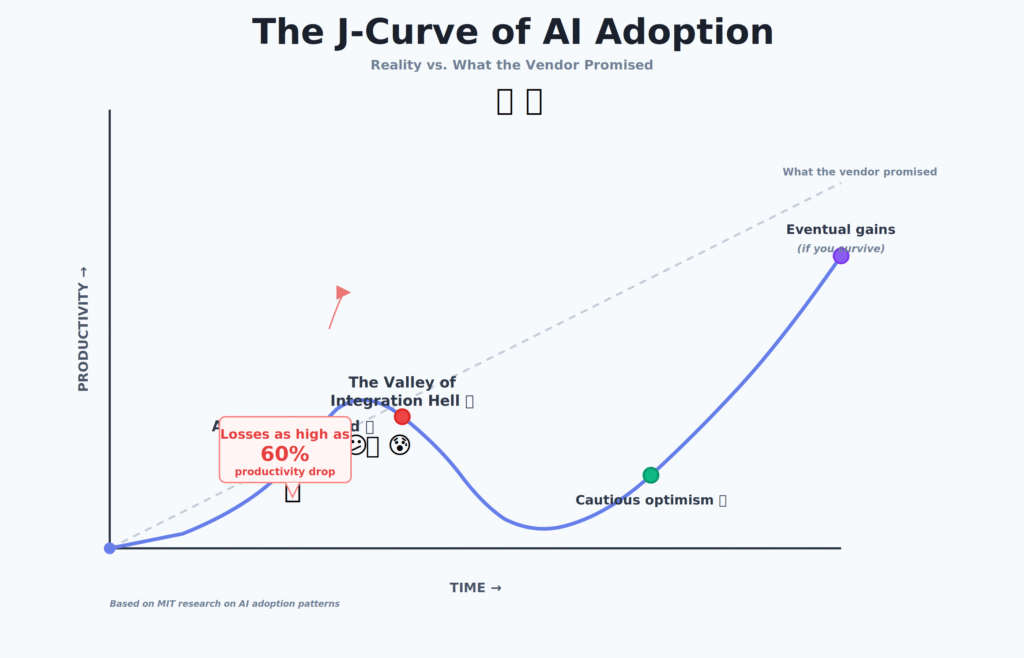
Based on MIT research on AI adoption patterns in manufacturing.
Why? Because new technology doesn’t slot neatly into existing workflows…
Organisations experienced a measurable decline in productivity after introducing AI technologies, with losses as high as 60 percentage points. That initial dip is very real.
Why? Because new technology doesn’t slot neatly into existing workflows. It demands data infrastructure upgrades, staff retraining, process redesign, and workflow reconfiguration. Without those complementary investments, even sophisticated tools create bottlenecks rather than removing them.linkedin+1
Perplexity’s asset creation feature epitomises this myopia. The company assumes the friction point is switching between research and document creation. But for most organisations, the actual friction is navigating a chaotic ecosystem where information lives in Notion, data sits in Excel, presentations get drafted in Canva, research happens in Google Scholar, and someone inevitably asks “which Slack channel has the latest version?”
Adding Perplexity to this mix doesn’t solve tool sprawl. It contributes to it—much like the AI-washing epidemic that plagued smartphone launches in September 2025, where every device promised revolutionary AI capabilities whilst delivering marginal improvements dressed in marketing hyperbole.
When More Becomes Measurably Less
![[INFOGRAPHIC: Tool-sprawl-infographic.jpg]
**Figure 1:** Tool Sprawl by the Numbers — The quantified cost of productivity theater. *Sources: Yooz workplace technology survey, MIT productivity studies, Perplexity financial disclosures.*
This isn't about individual tool quality. It's about architectural incoherence...](https://suchetanabauri.com/wp-content/uploads/2025/11/Tool-sprawl-infographic-1024x893.png)
The consequences of tool proliferation aren’t theoretical. They’re quantifiable, and they’re brutal.
A 2025 survey of over 1,000 IT and security professionals found that tool count directly correlates with team burnout and attrition. The overwhelming number-one demand from these teams? Better integration between tools (61%), followed by better automation (48%) and lower total cost (41%). Not shinier features. Not more capabilities. Less fragmentation.the-sequence
The overwhelming number-one demand from IT teams? Better integration between tools. Not shinier features. Not more capabilities. Less fragmentation.
The pattern holds across sectors. A separate study found that 54% of employees struggle to improve work efficiency despite—or perhaps because of—productivity tool investments. Nearly half (45%) say new tools make their jobs only slightly easier, whilst 23% see no benefit whatsoever.getyooz+1
The underlying issue is attention drainage. Tool sprawl scatters information across disconnected systems, forcing workers to reconstruct context repeatedly. Marketing teams track creative approvals in one tool whilst project deadlines live in another, creating constant cognitive overhead. IT teams manage security protocols across disparate platforms, multiplying compliance burden rather than reducing it.upscale+1
This isn’t about individual tool quality. It’s about architectural incoherence. As one survey respondent put it: “Overall SaaS sprawl is a huge headache. In terms of unifying management of our tools, would love to see more native integrations”.the-sequence
The Feature Bloat Epidemic
Perplexity’s expansion into productivity assets illustrates a related pathology: feature bloat, the tendency for products to accumulate capabilities until they become unwieldy, unfocused, and ultimately less valuable.userguiding+1
Research indicates that nearly 45% of software features are rarely or never used, yet continue consuming development and maintenance resources. This isn’t users being difficult. It’s products losing coherence.sonin
Feature bloat happens when companies prioritise competitive mimicry over user value—when “everyone else has this feature” becomes sufficient justification for building it. It happens when stakeholder pressure overwhelms product discipline, when fear of missing out drives roadmaps, and when success metrics are absent.launchnotes+2
The result? Products that are simultaneously over-engineered and under-optimised.
Eight in ten users delete apps because they can’t figure out how to use them.
Complex feature sets create higher churn rates, longer onboarding periods, and escalating customer acquisition costs.digital-adoption+1
Perplexity’s pivot from search assistant to document generator feels less like strategic evolution and more like reactionary feature accumulation.
The company hasn’t articulated why it should produce spreadsheets rather than, say, Google Sheets. It’s simply noticed that competitors offer document creation and decided to match them.
This is the feature-based differentiation trap: any meaningful capability gets copied within months, leaving you with a bloated product and no sustainable advantage. Instagram adding Threads-like features. Microsoft embedding ChatGPT. Google integrating Gemini everywhere. The pattern is depressingly consistent—and I’ve explored similar dynamics in my analysis of ChatGPT Pulse, where OpenAI added proactive notifications without adequately considering whether users actually wanted constant AI interruptions.cxl
Who Actually Benefits?
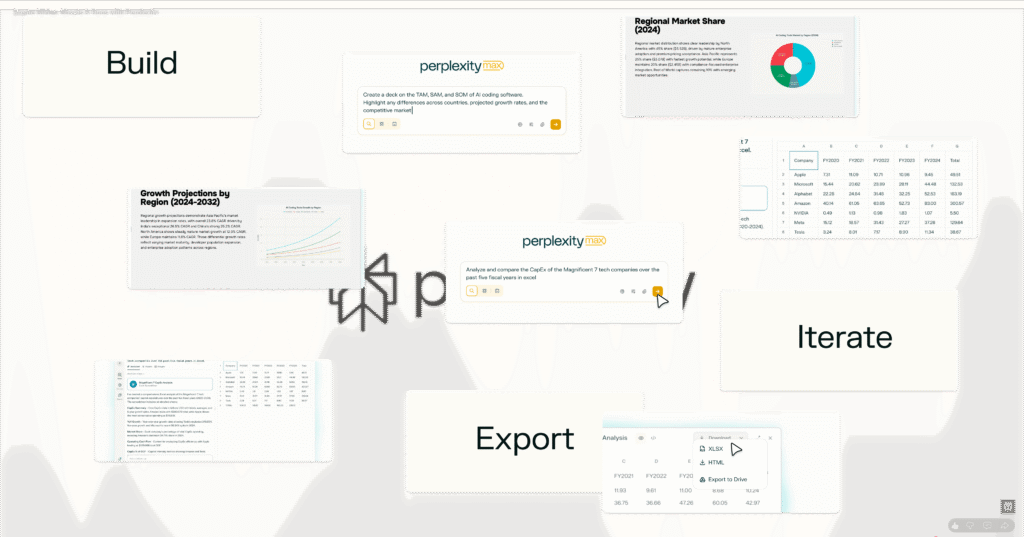
To be fair—and critics should always be fair—Perplexity’s feature serves legitimate constituencies. Solo practitioners who already use Perplexity as their primary research tool gain genuine utility from asset creation. A freelance consultant can move from competitor analysis to client presentation without context-switching. A graduate student researching renewable energy policy can generate slide scaffolding directly from cited sources.reddityoutube
The feature excels as a quick draft accelerator—a way to escape the tyranny of the blank page. For users paralysed by starting, an AI-generated first pass provides structure, even if every element requires subsequent refinement.
But this represents a narrow use case: individuals working alone, producing documents as iterative outputs rather than collaborative artefacts, willing to trade polish for velocity. That’s not most knowledge work. Most work happens in teams, requires version control and co-editing, demands institutional templates and brand compliance, and exists within ecosystems (Google Workspace, Microsoft 365, Notion) that organisations have spent years embedding.
For those users—the enterprise majority—Perplexity’s feature introduces friction rather than removing it. They’d need to export assets, convert formats, integrate with existing collaboration tools, and somehow maintain a separate subscription to Perplexity alongside their existing productivity suite. The workflow fragmentation is self-evident.
The Hidden Costs of “Seamless Integration”
Even when tools promise integration, the reality often resembles duct tape and wishful thinking. Stanford research found that 47% of companies using multiple AI platforms reported that those systems don’t communicate effectively. The productivity gains projected on vendor slide decks vanish when data doesn’t flow cleanly between systems, when APIs break unexpectedly, or when employees simply give up and revert to manual workarounds.aicerts+2
Integration complexity creates what researchers call the “workslop effect”: excess time spent managing AI systems negates projected productivity gains.
You save five minutes on document generation but lose 20 minutes troubleshooting export errors or reformatting outputs to match corporate templates.aicerts
This dynamic explains why employees remain sceptical of AI hype despite executive enthusiasm.
A recent survey found that 62% of employees believe AI is significantly overhyped, whilst 86% consider it unreliable—compared to just 53% of managers who share that scepticism. The gap reflects lived experience: workers encounter the friction; managers see the pitch decks.nojitter
The trust deficit extends to accuracy. General-purpose language models hallucinate in 58–82% of legal queries. Even domain-specific tools produce errors in 17–34% of cases. For asset creation—where a fabricated statistic in a client presentation carries professional liability—this error rate is catastrophic. Yet Perplexity’s value proposition rests on automation and speed, qualities antithetical to careful verification.knostic
General-purpose language models hallucinate in 58–82% of legal queries. For asset creation—where a fabricated statistic carries professional liability—this error rate is catastrophic.
The Real Problem: Strategic Incoherence
Perplexity’s feature announcement embodies a deeper malaise: strategic drift. The company built its reputation as an answer engine providing cited responses to queries—a positioning distinct from Google’s link-based results and ChatGPT’s uncited outputs. Users valued research efficiency, not document production.affiliatebooster+1
By expanding into productivity assets, Perplexity dilutes that identity.
Is it a search tool? A document generator? A presentation designer? The lack of clarity invites unfavourable comparisons.
Google Slides offers template libraries, real-time collaboration, and seamless integration with Drive and Meet. PowerPoint provides advanced design tools, presenter coaching, and enterprise security. What, exactly, does a Perplexity-generated presentation offer beyond novelty?
The business model contradictions compound the confusion. Perplexity reported $80 million in annual recurring revenue in 2024, derived from subscriptions and, increasingly, advertising. But document creation is time-intensive work that reduces query volume and advertising exposure.
The company spent $57 million on AI compute against $34 million in revenue—unit economics that asset creation will only worsen.sacra+2
CEO Aravind Srinivas himself noted that AI agents reduce “human eyeballs on ads and fewer clicks to sell”. The same logic undermines Perplexity’s own monetisation strategy. You can optimise for ad-supported search or for time-intensive productivity work, but not both simultaneously.businessinsider
This pattern mirrors what I’ve documented in my analysis of Claude Sonnet 4.5’s launch strategy—where Anthropic demonstrated that successful AI product positioning requires clarity about who you serve and what problem you uniquely solve, not simply matching competitor feature lists.
What Actually Works?
If tool sprawl is the problem, consolidation is the obvious solution. Except consolidation done poorly—forced standardisation on inadequate platforms—creates its own dysfunction.
The research points to specific practices that mitigate adoption resistance:
- Prioritise intuitive design over feature accumulation. Thirty-nine percent of employees want tools that require minimal training. User-friendly interfaces and seamless integration reduce adoption friction more than additional capabilities ever will. This principle underlies effective UX microcopy—the smallest design decisions that make or break user adoption.getyooz
- Involve employees in tool selection. Thirty-six percent believe adoption would improve if they had input in choosing technologies. Top-down mandates breed resistance; co-created implementations foster ownership.getyooz
- Invest in training that’s contextualised, not perfunctory. Over half of employees receive only basic training for new tools, whilst 20% get little to no guidance. Yet 48% believe better training would significantly improve adoption rates. The gap between what’s provided and what’s needed is glaring.getyooz
- Focus on outcomes, not outputs. The Lean principle of solving problems rather than accumulating features naturally combats bloat. Teams that start by asking “What outcome are we trying to achieve?” rather than “What features should we build?” create simpler, more focused products.airfocus
- Audit ruthlessly. Nearly half of software features go unused. Regular reviews that ask “Does this feature still serve user goals?” and “Does it align with our strategic vision?” prevent creeping complexity.blossom+2
The Ideological Reckoning
Beneath the tactical failures lies an ideological assumption worth interrogating: that knowledge work is essentially mechanical, that research and synthesis and communication can be automated away without loss of insight or nuance.
Document creation—especially presentations and strategic reports—involves rhetorical choices grounded in expertise, judgment, and situational awareness. Which arguments receive emphasis? How is data visualised to persuade specific audiences? What narratives contextualise findings? AI systems cannot replicate these decisions because they lack organisational context, audience understanding, and strategic framing.
A Perplexity-generated slide deck may technically convey information. But it cannot grasp office politics, gauge audience expertise, or calibrate messaging for executive buy-in. The tool risks producing competent mediocrity—assets that pass superficial review but lack persuasive power.
This matters more than efficiency metrics suggest.
Tools that treat documents as outputs rather than thinking instruments fundamentally misunderstand knowledge work.
Writing clarifies thought. Structuring presentations reveals argument gaps. Designing visualisations surfaces data relationships. These processes have intrinsic cognitive value beyond their artefacts.
Automation that short-circuits this thinking doesn’t save time; it outsources judgment to systems incapable of exercising it—a dynamic I’ve explored in the context of purpose marketing during crisis, where brands using AI-generated sentiment analysis miss the human context that determines whether a campaign lands or catastrophically misfires.
Where This Leaves Us
Perplexity’s slides, sheets, and documents feature isn’t uniquely problematic. It’s representative—a symptom of an industry that conflates activity with progress, feature velocity with user value, and technological capability with organisational readiness.
The feature will find its audience: solo practitioners who’ve already embedded Perplexity in their workflows, students producing quick presentation drafts, content creators accelerating research phases. These are legitimate uses. They’re also narrow ones that don’t justify the expansive rhetoric of “revolutionary integration” and workspace disruption.
For everyone else—teams navigating collaboration requirements, organisations managing compliance and brand standards, professionals requiring provenance guarantees—the feature represents one more tool in an already-unmanageable stack. One more login to remember, one more export format to wrangle, one more vendor promising seamless integration that delivers duct-taped workarounds.
The productivity software market doesn’t suffer from insufficient features. It suffers from architectural incoherence, inadequate integration, and tools that disrespect the craft of knowledge work.
Perplexity’s entry addresses none of these.
What it offers instead is the illusion of productivity: fast, automated, and ultimately hollow. In a workplace already drowning in tool sprawl, that’s not innovation. It’s just more noise.
Sources:
Research for this article drew on workplace technology adoption studies from Yooz and Pollfish, productivity paradox research from MIT and Stanford, tool sprawl surveys from IT and security professionals, feature bloat analysis, AI adoption barrier studies, and productivity tool market research. Perplexity-specific information came from company financial disclosures, user demographic data, and competitive analysis. Integration complexity and workflow challenges were sourced from enterprise AI implementation studies.techmonitor+26youtube