
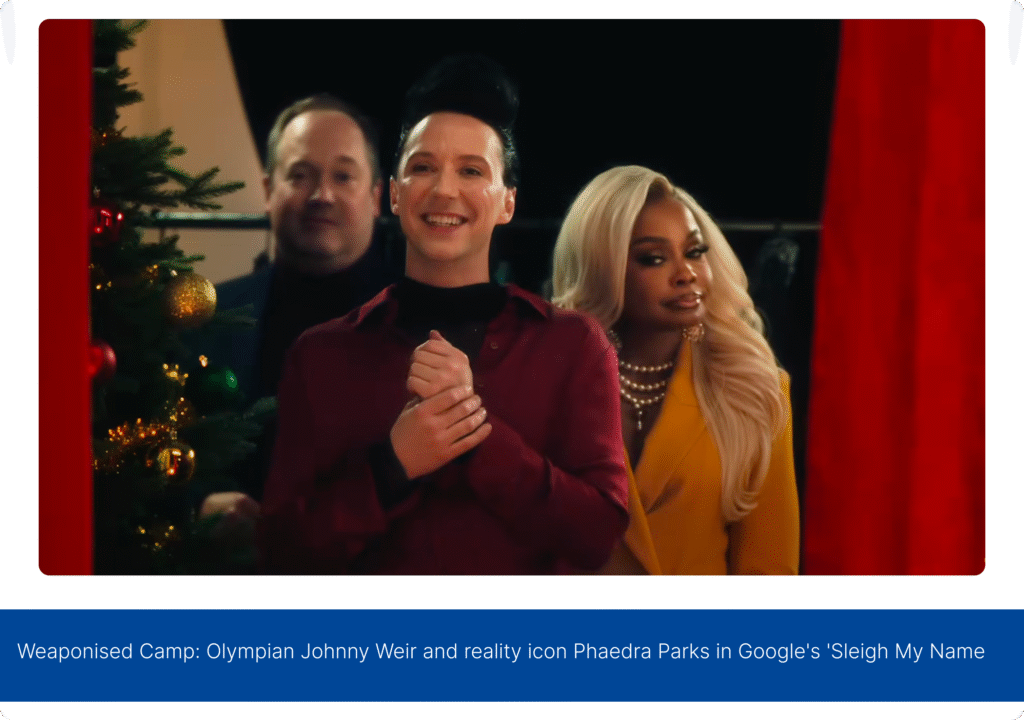
Why Google’s “Sleigh My Name” isn’t just a holiday joke—it’s the blueprint for the next five years of tech marketing.
By the time Johnny Weir appears on screen, clad in a sequinned blazer that would make Liberace squint, looking for redemption in a town called “Snowberry Falls”, you realise something has fundamentally shifted in tech marketing strategy AI conversations.
For the last three years, Big Tech has been shouting at us. They have screamed about Large Language Models, neural networks, and generative capabilities. They have produced sombre, cinematic adverts featuring floating particles and piano scores, earnestly promising that AI will cure cancer, fix the climate, and write your best man speech.
And the public response has been, largely, a collective shrug. Or worse: suspicion.
With its 2025 holiday campaign, specifically the chaotic, high-camp masterpiece “Sleigh My Name”, Google has finally admitted defeat in the “features war” and opened a new front in the “culture war”. They have stopped trying to explain how the sausage is made. Instead, they are serving it up on a glittery platter with a side of drag queens and reality TV stars.
This is not just a funny advert. It is a strategic pivot that every marketer—whether you’re selling SaaS platforms or sparkling water—needs to dissect. It signals a new era for tech marketing strategy AI execution: the end of the “Tech Demo” and the arrival of the “Post-Hype” reality.
The Death of the Tech Demo
To understand why “Sleigh My Name” matters, we have to look at what came before in the world of tech marketing strategy AI.
Throughout 2023 and 2024, the industry suffered from a severe case of “solutionism”. Brands were desperate to prove their tools were powerful, so they focused on the utility. We saw endless 30-second spots of screens recording screens: a cursor blinking, a prompt being typed, a magical image appearing.
It was boring. It was cold. And frankly, it was often creepy.
The problem with selling AI based on its power is that power is intimidating. When you show a tool that can do everything, the consumer often hears: “This tool will replace you.”
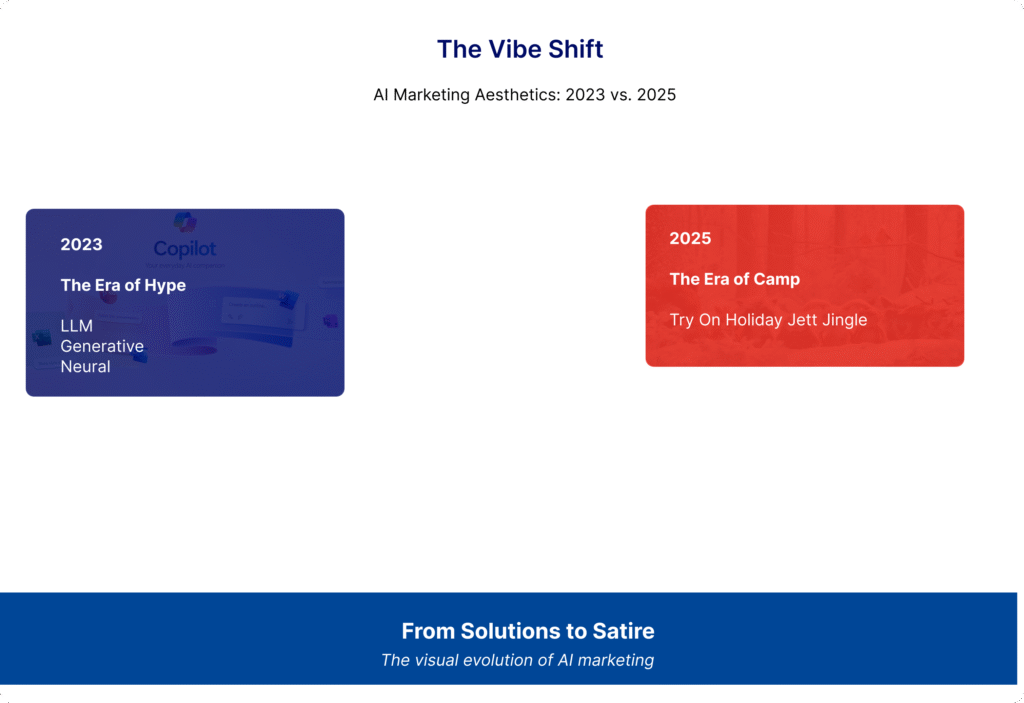
Google’s new approach flips the script on traditional tech marketing strategy AI. They aren’t showing you AI that can write a novel; they are showing you a specific, low-stakes utility—Virtual Try-On—wrapped in a narrative so absurd that it disarms your cynicism.
The 2:30-minute spot is a pitch-perfect parody of the Hallmark/Netflix holiday movie genre.
By adopting this format, Google achieves something the “particle effect” adverts never could: Safety. They have taken a complex piece of computer vision technology and turned it into a plot device for a Christmas rom-com. It makes the AI feel as harmless and familiar as a cup of cocoa.
Weaponising Camp: A Lesson in Casting
If you are a marketer targeting Gen Z or Millennials in 2025, you cannot just hire a celebrity. You have to hire a meme.
The casting of “Sleigh My Name” is a masterclass in “dog whistle” marketing. To the casual observer, it looks like a colourful, slightly weird cast. But to the “chronically online”—the core user base for mobile shopping—the casting is a series of specific, coded signals.
First, Johnny Weir. The figure skater turned commentator is known for his unapologetic flamboyance and biting wit. He represents the “main character energy” that dominates TikTok.
Second, Phaedra Parks. If you don’t know who Phaedra Parks is, you are likely not the target audience for this ad. A veteran of The Real Housewives of Atlanta and The Traitors, Parks is internet royalty. She is a walking GIF.
Third, Bob the Drag Queen. A winner of RuPaul’s Drag Race, Bob brings a level of queer credibility and comedic timing that signals to the audience: “We know you’re watching. We know what you think is funny.”
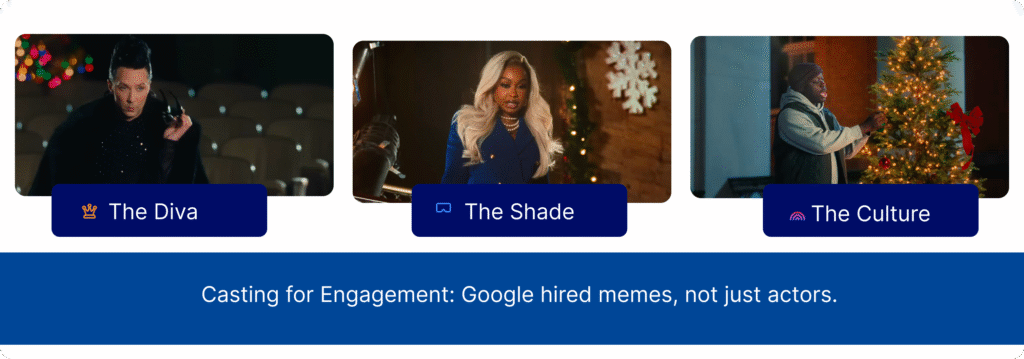
This is “Weaponised Camp”. As Susan Sontag famously wrote in 1964, camp is the love of the unnatural: of artifice and exaggeration. This aesthetic is the antithesis of traditional tech marketing strategy AI, which is usually self-serious and minimalist. By leaning into maximalism, Google says: “We are not the scary corporation; we are the fun aunt.”
It is a manipulation, of course. But it is a highly effective one.
The “Vegetables in the Candy” Strategy
Let’s get down to the mechanics. How do you actually sell the product in a video like this?
The challenge with Google’s “Virtual Try-On” feature is that, visually, it is not very exciting. You upload a photo, and the clothes change. If you put that in a standard commercial, people tune out.
Google’s solution is what I call the “Vegetables in the Candy” approach.
The “candy” is the fake movie trailer—the drama, the costumes, the puns (“Sleigh My Name” is a groan-worthy nod to Destiny’s Child ). The “vegetable” is the product demo.mediapost
In a traditional rom-com, there is always a “makeover montage”. The protagonist tries on twelve different outfits while upbeat music plays, usually emerging with a new look that wins the heart of the love interest.
Google simply replaced the physical changing room with the digital interface.
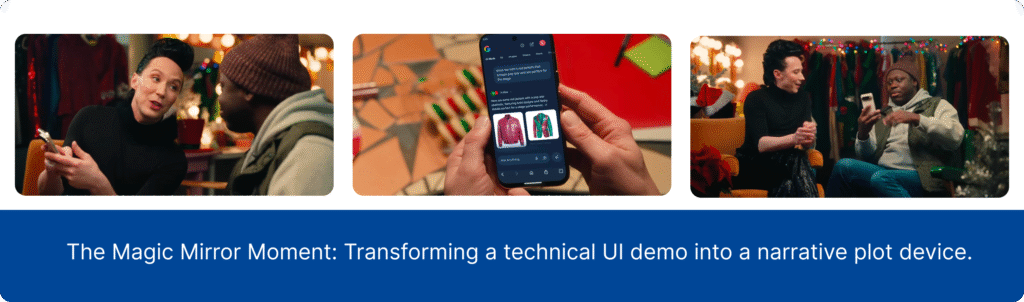
- The Setup: Jett Jingle needs a new look to save his reputation.
- The Action: Instead of going to a boutique, he pulls out his phone.
- The Demo: We see the interface. We see the “Try On” button. We see the results.
- The Payoff: He finds the perfect outfit (“Snowberry Falls may be a good look on you,” says the Mayor).
The product usage is diegetic. It drives the plot forward. If Jett didn’t use Google, the movie couldn’t resolve. This is infinitely more powerful than a tutorial because it shows the emotional result of the technology (confidence, acceptance) rather than just the functional result (clothes on a picture).
Why “Mass Appeal” is Dead
For decades, the “Holy Grail” of Super Bowl-level advertising was mass appeal. You wanted a joke that the grandmother in Leeds and the teenager in London would both get.
That world is gone. The algorithmic fragmentation of culture means that there is no longer a “mass” culture to appeal to. There are only micro-cultures.
Google has realised that it is better to be intensely loved by a specific 25% of the population than to be mildly ignored by 100%.
By satirising the “Made-for-TV Christmas Movie”, they are tapping into a very specific vein of irony. We all know these movies are “bad”. But we watch them because they are bad. We hate-watch them. We live-tweet them. They are a communal ritual.
The tagline at the end of the video—“Not actually a real movie”—is the final wink. It acknowledges the absurdity. It treats the viewer with intelligence. A lesser brand would have tried to make a “good” short film. Google made a “bad” one on purpose.
This requires a level of brand bravery that is rare. It requires a CMO to look at a script that involves a “viral meltdown” and “bad harmonies” and say: “Yes, this represents our trillion-dollar search algorithm.”
The Shift from “Search” to “Answer”
There is a subtle, secondary layer to this campaign that touches on the existential crisis facing Google: the shift from Search to Answers.
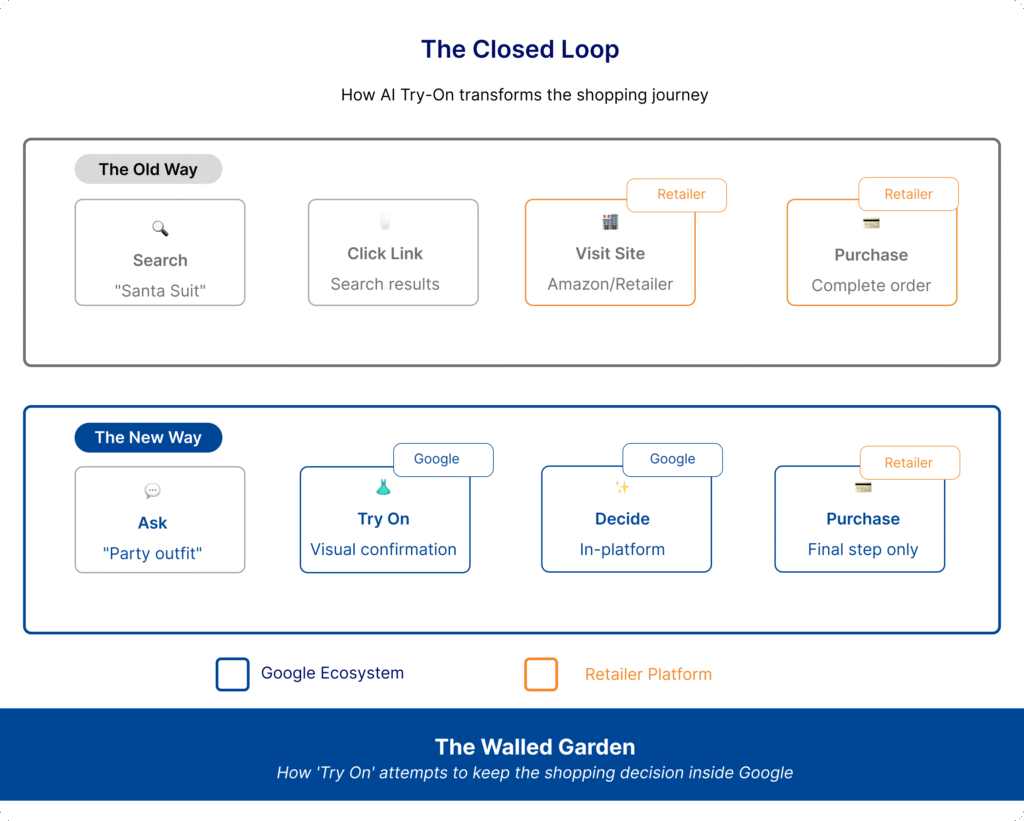
For twenty years, Google was a signpost. You searched, and it sent you somewhere else (a website, a shop). With AI, Google is trying to become the destination.
In the companion short-form video, “Big Night Out? Just Ask Google”, we see Santa Claus (“Kris”) using the same Try-On feature. The voiceover mimics ‘Twas the Night Before Christmas, but with a consumerist twist: “He searched on Google… ‘Try it on’ he clicked… and could see how it looked on a picture he’d picked.”
Note the closed loop. He didn’t go to a retailer’s website to see the fit. He did it on Google.
This is the business model shift. Google wants to keep the transaction, or at least the decision-making process, within its walled garden for as long as possible. By marketing the “Try On” feature so aggressively, they are training users to treat Google not just as a library, but as a changing room.
Actionable Lessons for Marketers
So, what do we do with this? If you don’t have Google’s budget or access to Olympic skaters, how do you apply these principles?
Stop Explaining the Tech.
Nobody cares how your LLM works. Nobody cares about your parameters. They care about the story. If you are selling an AI scheduling tool, don’t show the calendar syncing. Show the father making it to his daughter’s play on time because the tool managed his day. Focus on the relief, not the computation.
Embrace the Cringe.
We are entering an era of “Post-Cringe”. Sincerity is out; irony is in.
If your brand can poke fun at itself—or the tropes of your industry—you gain instant credibility. “Sleigh My Name” works because it admits that Christmas movies are ridiculous. What is the ridiculous trope in your industry? Can you parody it?
Cast for Engagement, Not Recognition.
Don’t hire the famous actor; hire the relevant creator. Look at who your audience is actually engaging with in the comments sections of TikTok and Instagram. The engagement rate on a Phaedra Parks meme is likely higher than the engagement rate on a generic A-list celebrity endorsement.
Diegetic Product Placement.
Stop engaging in “interruptive” marketing. If your product can solve a problem within the narrative of the content, it will be remembered.
If it’s just a logo slap at the end, it will be ignored.
Visualise the Invisible.
AI is invisible. This is a marketing nightmare. You have to find a visual metaphor. Google used the “changing room mirror”. Apple used the “crushed instruments” (disastrously). You need to find the physical manifestation of your digital tool.youtube
The Takeaway
“Sleigh My Name” will likely not win a Cannes Lion for “Best Cinematography”. It is garish, loud, and silly.
And that is exactly why it is the most important piece of tech marketing of 2025.
It marks the moment when the industry stopped treating AI like a terrifying alien god and started treating it like a utility belt. It humanises the algorithm.
When Johnny Weir looks at his phone and says, “Snowberry Falls may be a good look on you,” he isn’t just selling a feature. He is selling a feeling. And in a holiday season defined by economic uncertainty and digital fatigue, feelings are the only currency that matters.
Sidebar: The “Just Ask” Framework
The tagline for this campaign is “Just Ask Google”. This is a subtle but critical rebrand of user behaviour.
- Old Behaviour: “Google it” (implying a keyword search).
- New Behaviour: “Ask Google” (implying a conversational, natural language query).
With the rise of ChatGPT and Perplexity, Google is terrified of losing its status as the default answer engine. By framing the interaction as “Asking”—which implies a dialogue, a relationship, and a direct answer—they are trying to retrain 25 years of muscle memory.
The “Sleigh My Name” ad subtly reinforces this. Jett Jingle doesn’t type “red velvet suit men’s size medium”. He has a need, and Google fulfils it. It is a shift from Search Syntax to Intent Fulfilment.
If you are writing copy for search in 2025, you need to stop thinking in keywords and start thinking in questions. Because that is how the platforms are now begging to be used.
Footnotes & Citations
youtube Google. (2025). Sleigh My Name | Google. YouTube. Available at: https://www.youtube.com/watch?v=pjAu7dSgcto
Google. (2023). Try on clothes with generative AI. The Keyword. Available at: https://blog.google/products/shopping/virtual-try-on-google-search-generative-ai/youtube
Sontag, S. (1964). Notes on “Camp”. Partisan Review. Available at: https://monoskop.org/images/5/59/Sontag_Susan_1964_Notes_on_Camp.pdfmediapost
Destiny’s Child. (1999). Say My Name. Columbia Records.mediapost
Hern, A. (2024). “Apple apologises for ‘Crush’ iPad Pro ad that sparked backlash”. The Guardian. Available at: https://www.theguardian.com/technology/article/2024/may/09/apple-apologises-ipad-pro-ad-crush-creative-destructionyoutube
- https://www.youtube.com/watch?v=pjAu7dSgcto
- https://www.youtube.com/watch?v=XVgoPFHLTfs
- https://www.mediapost.com/publications/article/411028/
- https://www.mediapost.com/publications/article/411028/google-solves-holiday-miracles-in-series-of-storyt.html?edition=140757
- https://www.youtube.com/watch?v=SHhyZ1nNYeY