
platform strategy

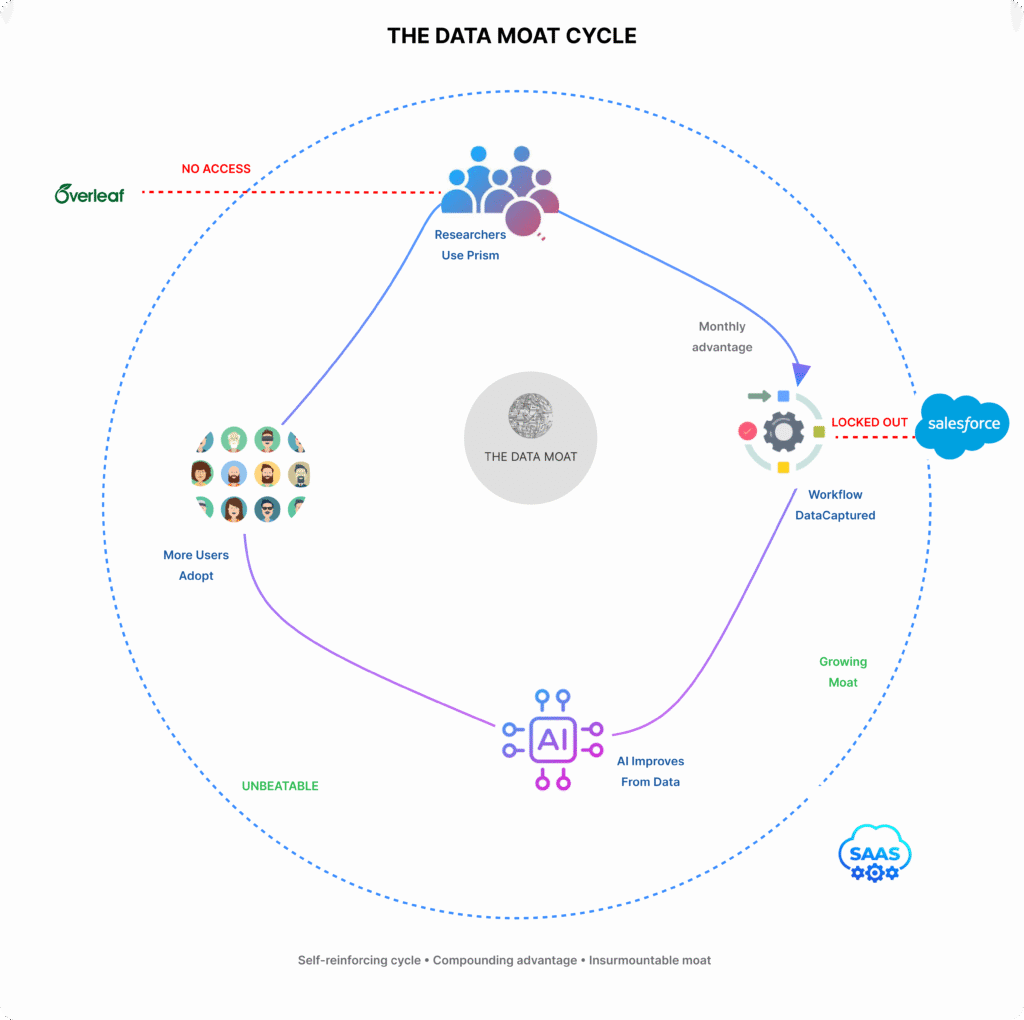
Circular flywheel diagram showing OpenAI's self-reinforcing data moat: researchers use Prism generating workflow data, captured data improves AI models, better AI attracts more users, creating growing moat that locks out competitors like Overleaf and Salesforce

OpenAI’s Prism Isn’t for You—And That’s Exactly Why You Should Care

OpenAI’s Prism launch signals a seismic shift in how vertical software gets built. Rather than competing in commoditised general-purpose AI, OpenAI is embedding AI directly into industry-specific workflows—exactly where scientists, doctors, and engineers spend their time. This isn’t about being smarter than ChatGPT; it’s about owning the workflow layer. The free-tier pricing strategy targets institutional lock-in, not individual adoption. Within 18 months, every category leader in your vertical will face an AI-native competitor with OpenAI’s balance sheet strength and data advantage. The companies that survive are those realising that AI isn’t a feature to bolt on—it’s the foundation your business must be built on. Your competitive advantage is no longer “how do we use AI better” but “how do we build systems where AI drives our core value.”

OpenAI’s Prism Isn’t for You—And That’s Exactly Why You Should Care Read More »

Split-screen audio visualisation comparing a smooth blue waveform labelled as the promised interview voice with a jagged yellow‑orange waveform showing tonal shifts, amplitude spikes and strain indicators representing the real ChatGPT voice.

OpenAI’s Voice Revolution Is a Trojan Horse—And Users Are Carrying It Inside

OpenAI’s voice AI demo promised seamless, global, inclusive conversation. Real-world testing reveals something far darker: a foreign-accented, wavering voice that systematically fails marginalised users. When an Indian woman prepares for a job interview using ChatGPT’s interview prep tool, she hears a confident female voice in the demo. In practice, she gets a man’s jarring, foreign accent struggling with Hindi. Maps work. Complex topics don’t. Indian languages break entirely. This is the Trojan Horse—not a broken feature hidden in pretty marketing, but a fully functional platform designed to exclude. The 5% vocal instability affecting disabled users, non-English speakers, and interview candidates isn’t a bug. It’s the architecture itself.

OpenAI’s Voice Revolution Is a Trojan Horse—And Users Are Carrying It Inside Read More »

YouTube Just Broke the Internet’s Muscle Memory—and Your Marketing Strategy

YouTube’s October 2025 redesign broke a decade of muscle memory. Translucent controls fail accessibility standards. Creators report 15-30% slower workflows. This isn’t just controversial—it’s quantifiably problematic. Here’s what changed, why it matters, and what marketers and creators must do now.

YouTube Just Broke the Internet’s Muscle Memory—and Your Marketing Strategy Read More »

Scroll to Top