Campaign analysis

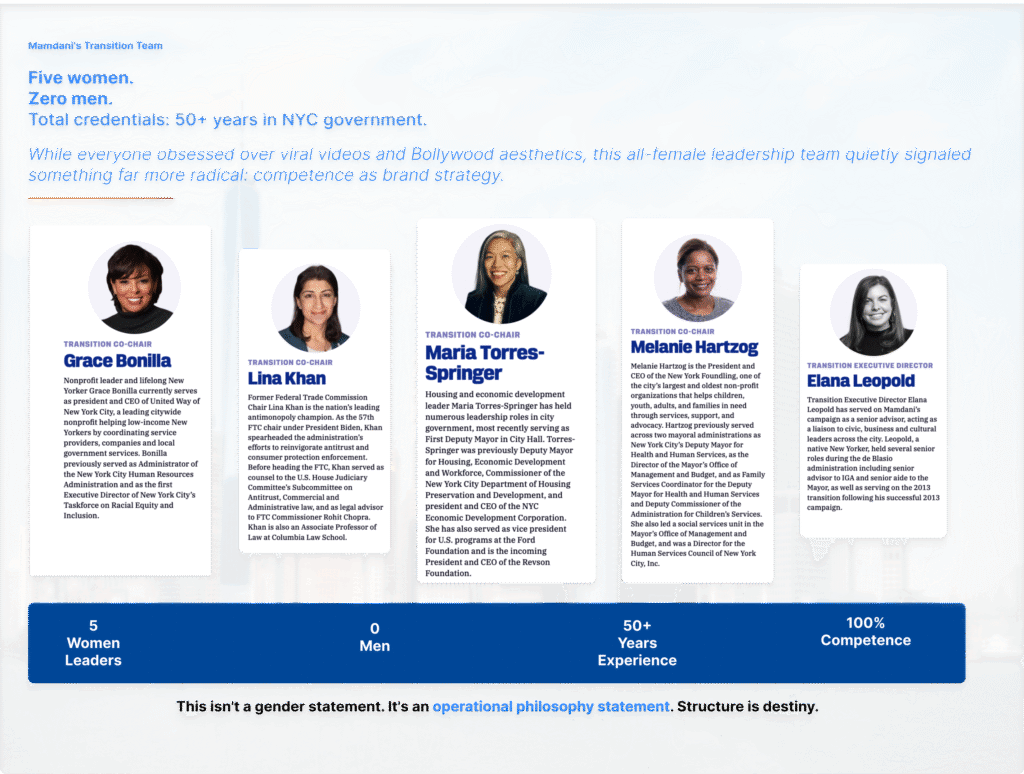
Zohran Mamdani's all-female transition team comprises five women with 50+ years combined NYC government experience and zero men: Grace Bonilla (nonprofit leader, United Way NYC), Lina Khan (former FTC chair and antimonopoly champion), Maria Torres-Springer (housing and economic development leader, First Deputy Mayor), Melanie Hartzog (president and CEO of New York Foundling), and Elana Leopold (transition executive director). Infographic includes text: "While everyone obsessed over viral videos and Bollywood aesthetics, this all-female leadership team quietly signalled something far more radical: competence as brand strategy" and concluding statement "This isn't a gender statement. It's an operational philosophy statement. Structure is destiny."

The All-Women Transition Team Nobody’s Talking About: Why Zohran Mamdani’s Real Victory Isn’t About Vibes

Zohran Mamdani won New York’s mayoral race with viral TikToks and Bollywood aesthetics. But what nobody noticed: his all-female transition team signalled something far more important—structural authenticity matters more than viral content.

The All-Women Transition Team Nobody’s Talking About: Why Zohran Mamdani’s Real Victory Isn’t About Vibes Read More »

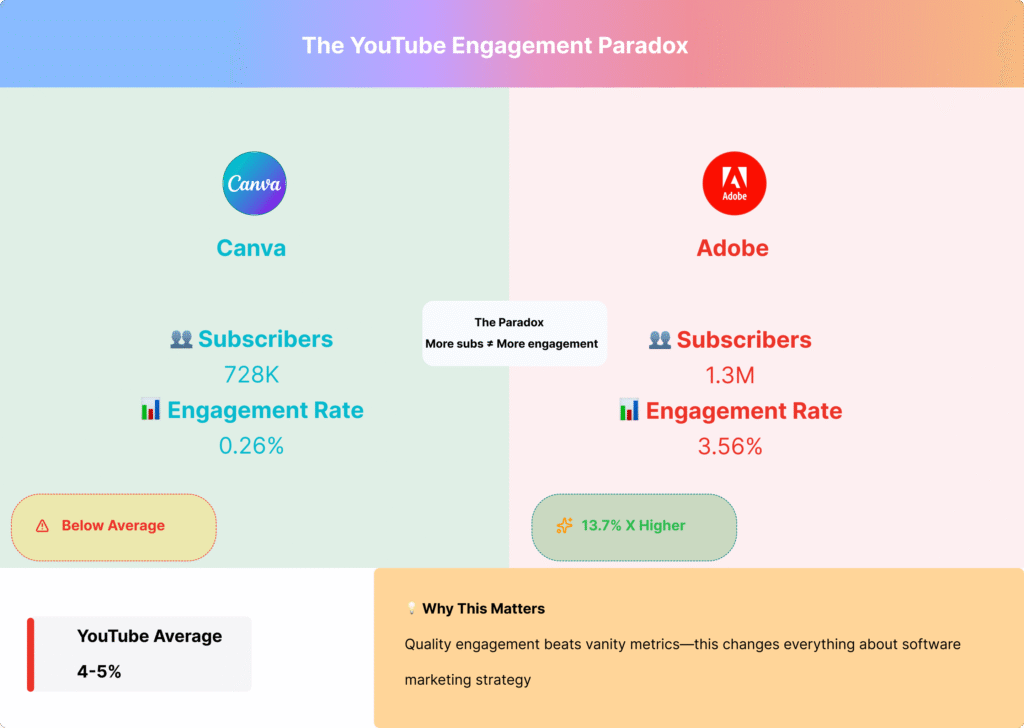
nfographic comparing Canva and Adobe YouTube channels. Canva: 728K subscribers, 0.26% engagement rate (below average). Adobe: 1.3M subscribers, 3.56% engagement rate (13.7x higher). Shows central paradox: more subscribers does not equal more engagement. Includes YouTube average benchmark and key message that quality engagement trumps vanity metrics.

Why Canva’s Engagement Crisis Reveals the Real Problem With Marketing to Creators

The numbers look impressive. Canva’s YouTube channel has 728,000 subscribers and uploads 8.5 videos every week. But then you see the engagement rate: 0.26%. That’s not just low—it’s a crisis hiding behind a success story. Meanwhile, Adobe is quietly embedding Premiere Pro into YouTube Shorts, showing that integration beats education. Here’s why this battle for the creator economy matters to every marketer.

Why Canva’s Engagement Crisis Reveals the Real Problem With Marketing to Creators Read More »

Priyanka Raina in a cream waistcoat holding her infant son beside an array of Maate baby-care products displayed against a white backdrop

The Label-Reading Revolution

This in-depth analysis examines how Suresh and Priyanka Raina’s #EffectiveBabyCare×Maate campaign transformed a simple baby care product launch into a cultural movement about ingredient transparency and conscious parenting. Written in The New Yorker’s signature style, the piece dissects the strategic brilliance and potential pitfalls of founder-led marketing, exploring how the campaign capitalised on millennial parents’ research obsessions while addressing their blind spots in baby care product selection.

The article reveals how Maate’s authenticity-driven approach—combining cricket celebrity credibility with entrepreneurial expertise—successfully bridged traditional Indian Ayurvedic wisdom and modern safety standards. Through detailed analysis of their digital storytelling techniques, cultural positioning, and competitive landscape, the piece offers valuable insights for digital marketers seeking to balance authentic brand building with measurable performance outcomes in an increasingly skeptical consumer environment.

The Label-Reading Revolution Read More »

A Meal That’s Lost in Translation

McDonald’s India’s collaboration with Ranveer Singh is less a celebration of fast food than a spectacle in overdrive—a campaign where branding drowns out appetite, and the celebrity’s kinetic persona eclipses the meal itself. In this pointed critique, we unravel how the advertisement trades visual deliciousness for personality cult, offering a seminar in sensory overload and marketing gone awry. As the meal itself struggles for screen time amid a feverish montage, what emerges is not so much a fast food promotion as a case study in how volume and celebrity can obscure the pleasures of food. The article interrogates both the intent and the execution, suggesting that in the noise, the actual product is lost—an object lesson in contemporary advertising’s excess.

A Meal That’s Lost in Translation Read More »

When Seoul Met Mumbai: The Complete Cultural Revolution Story That Rewrote Marketing’s Future

From the monsoon-soaked streets of Mumbai to the cultural laboratories of YouTube’s comments section, one Tuesday morning revelation changed everything I thought I knew about marketing. When Crocs paired Bollywood’s Siddhant Chaturvedi with Korean actress Chae Soobin in their monsoon campaign, they didn’t just create an advertisement—they wrote the future playbook for cross-cultural commerce. This isn’t the story of another trending campaign; it’s the complete cultural cartography of how Korean food culture, K-drama aesthetics, and Indian Gen Z sophistication converged to create the most sophisticated audience response to cross-cultural marketing I’ve witnessed in my career. Through 445 YouTube comments, ₹500 crore in Korean content spending, and a 3,150% explosion in Korean food imports, the data reveals what happens when brands stop appropriating trending culture and start celebrating authentic cultural synthesis. For digital marketers willing to embrace this complexity, the opportunities are limitless—and the responsibility is enormous.

When Seoul Met Mumbai: The Complete Cultural Revolution Story That Rewrote Marketing’s Future Read More »

Scroll to Top