Brand Strategy

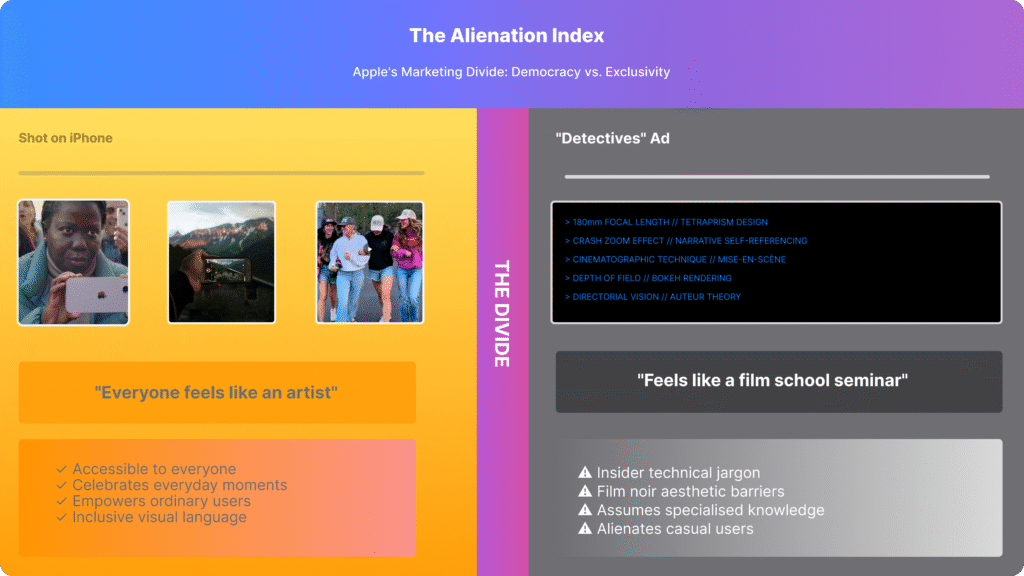
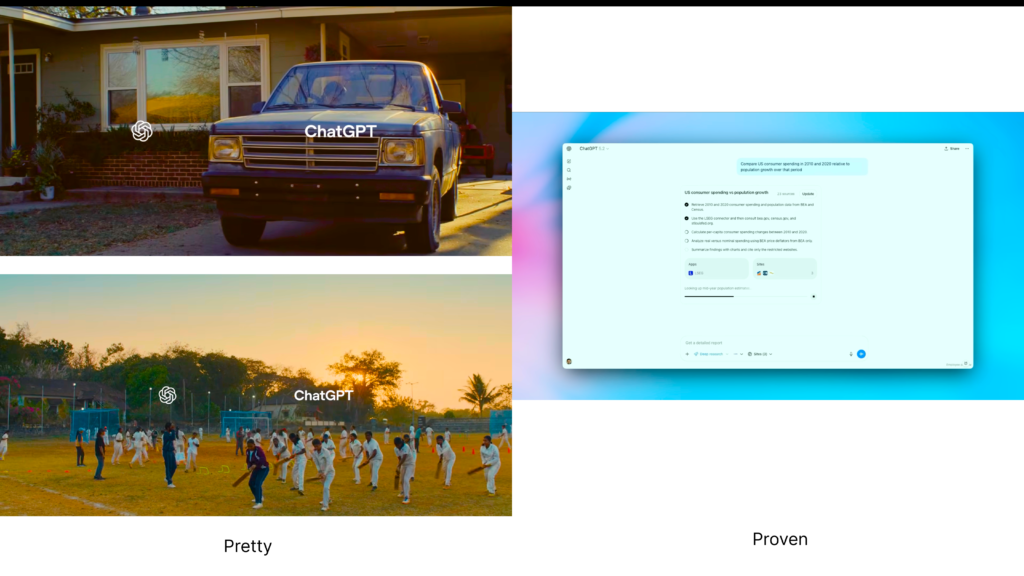
Split-screen comparison showing Shot on iPhone's democratic approach with real people versus Detectives ad's exclusionary film school aesthetic with technical jargon

When Cleverness Becomes Alienation: What Apple’s ‘Detectives’ Ad Gets Wrong About Selling Cameras

On New Year’s Eve, Apple released a 65-second advertisement that epitomises everything going awry in contemporary marketing. Two detectives stand in a shadowy warehouse, lecturing about the “crash zoom”—how it “heightens tension,” “builds suspense,” and “foreshadows danger.”

The ad is arch, knowing, deliberately theatrical. And it’s precisely the sort of clever advertising that risks making ordinary people feel uninformed and alienated.

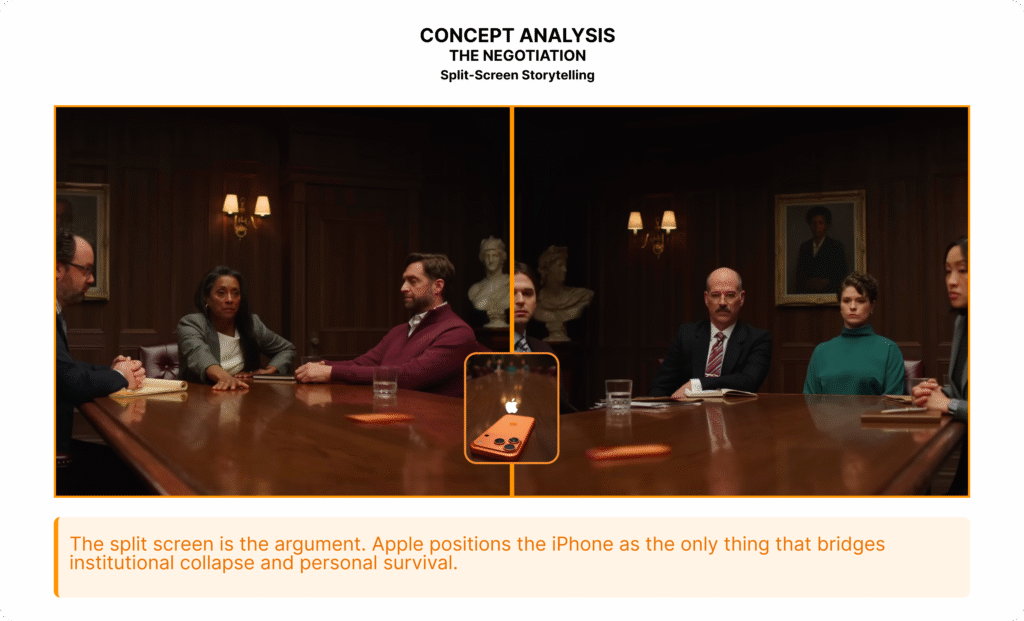
Apple’s “Detectives 8x Zoom” ad arrives at a peculiar inflection point for marketing. The ad forms part of the “Shot on iPhone” campaign—one of modern marketing’s most successful platforms, generating $14 billion in incremental iPhone sales since 2015. Yet Apple abandoned the democratic authenticity that built this franchise for something altogether more exclusionary: a meta-commentary that assumes viewers understand what a crash zoom is.

This isn’t universal language. It’s film school semiotics.

The ad is arch, knowing, deliberately theatrical. And it’s precisely the sort of clever advertising that risks making ordinary people feel uninformed and alienated.

Apple’s “Detectives 8x Zoom” ad arrives at a peculiar inflection point for marketing. The ad forms part of the “Shot on iPhone” campaign—one of modern marketing’s most successful platforms, generating $14 billion in incremental iPhone sales since 2015. Yet Apple abandoned the democratic authenticity that built this franchise for something altogether more exclusionary: a meta-commentary that assumes viewers understand what a crash zoom is.

This isn’t universal language. It’s film school semiotics.
When Cleverness Becomes Alienation: What Apple’s ‘Detectives’ Ad Gets Wrong About Selling Cameras Read More »

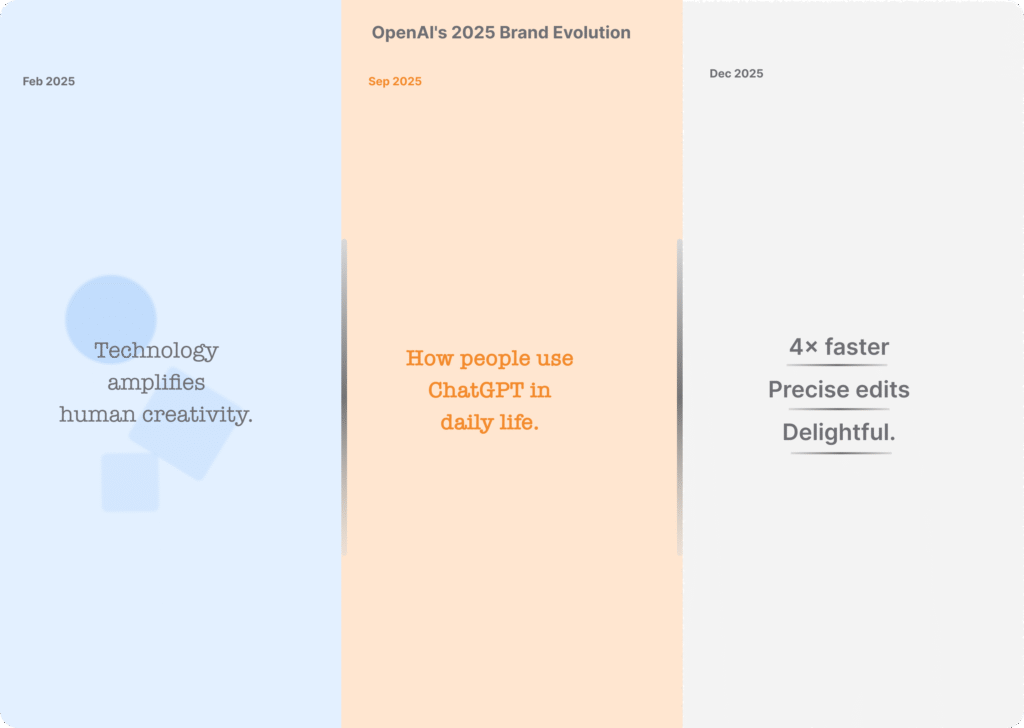
Three-panel visual comparison showing OpenAI's brand positioning across 2025: February panel displays minimalist blue aesthetic with text "Technology amplifies human creativity," September panel shows warm peach tones with text "How people use ChatGPT in daily life," and December panel features stark white background with clinical text "4x faster, Precise edits, Delightful." Visual demonstrates strategic incoherence and tonal whiplash in brand evolution.

When Your Brand Strategy Collapses Under Pressure: What OpenAI’s Panic Reveals About Marketing in Crisis Mode

When competitive pressure intensifies, marketing leaders face an impossible choice: maintain brand consistency or respond fast. OpenAI’s December 2025 crisis reveals what happens when you choose wrong. The company abandoned a carefully constructed “human-centric” brand positioning in favour of defensive technical specifications—losing both users and narrative control in the process. This isn’t just OpenAI’s failure. Every marketer reading this faces the same pressure: competitors launching, boards demanding speed, metrics showing erosion, year-end targets looming. The uncomfortable truth is that inconsistency creates a bigger crisis than competition ever could. When you oscillate between strategic positions, you signal that you stand for nothing except reacting to whoever moved last. This analysis examines what OpenAI got wrong, why it matters to your marketing strategy, and how to build brand resilience before the next crisis hits.

When Your Brand Strategy Collapses Under Pressure: What OpenAI’s Panic Reveals About Marketing in Crisis Mode Read More »

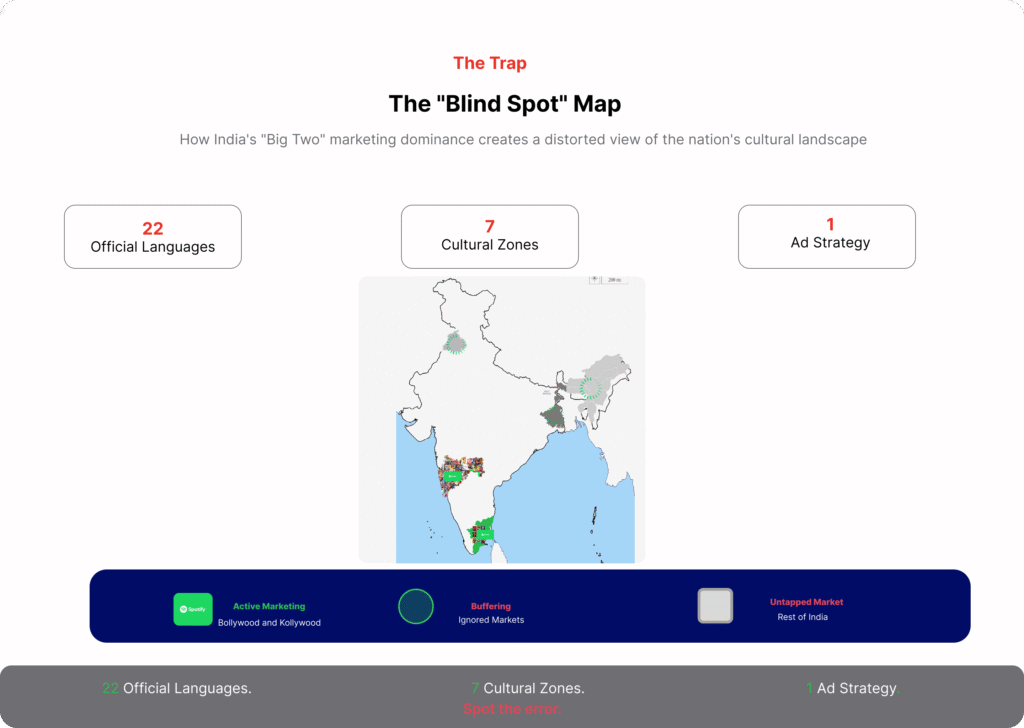
Infographic map of India titled 'The Blind Spot Map' showing Spotify's marketing strategy. Maharashtra and Tamil Nadu are highlighted with images representing 'Active Marketing' (Bollywood/Kollywood), while Punjab, West Bengal, and North East India show 'Buffering' icons representing ignored markets. The graphic highlights the disparity: 22 official languages, 7 cultural zones, but only 1 ad strategy.

Spotify Wrapped 2025: The Triumph (and the Trap) of Hyper-Local Marketing

Spotify India’s 2025 Wrapped ads are a masterclass in hyper-local marketing for Mumbai and Chennai. But by focusing only on Bollywood and Kollywood, they’ve highlighted a massive “blind spot,” ignoring the cultural and economic power of Bengal, Punjab, and the country’s Tier-2 heartland. This is both a triumph of execution and a failure of strategy. Here’s what marketers can learn from it.

Spotify Wrapped 2025: The Triumph (and the Trap) of Hyper-Local Marketing Read More »

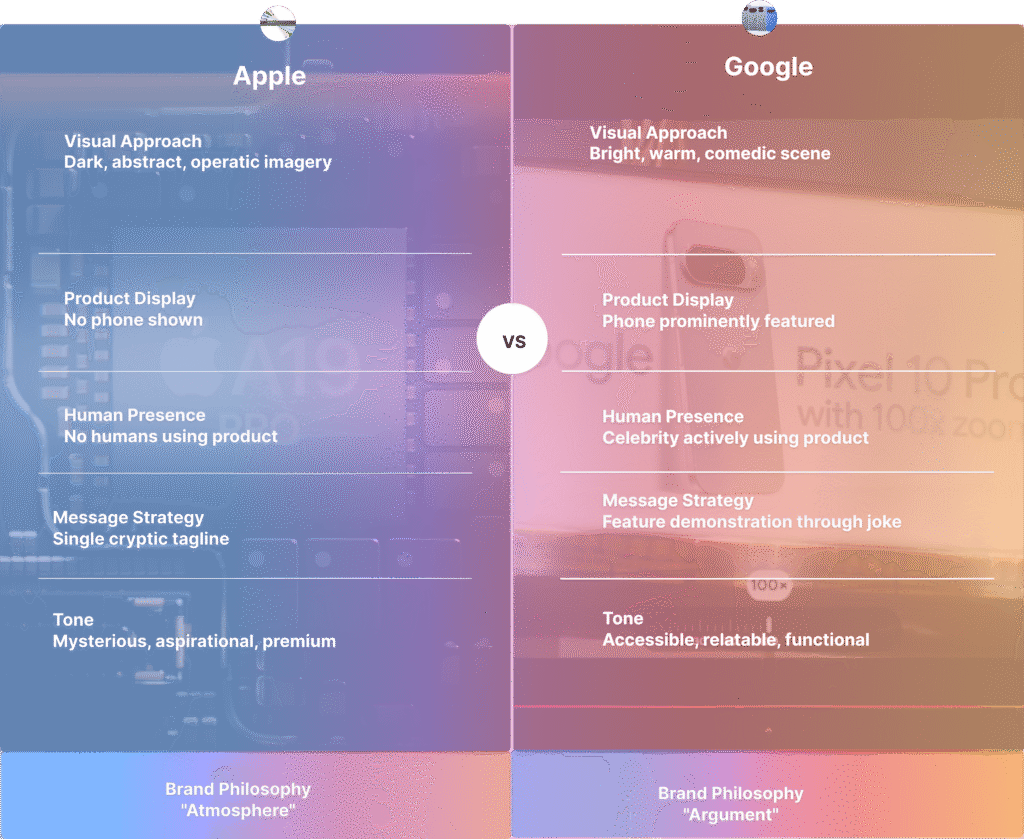
Split-screen comparison of Apple and Google advertising approaches: Apple side shows dark, abstract imagery with no phone and text reading 'Atmosphere'; Google side shows bright, comedic scene with phone featured and text reading 'Argument'

Apple Doesn’t Know You Exist. Google Wants You to Know It Knows.

Two smartphone ads dropped on the same day. Apple’s 65-second spot for the iPhone 17 Pro features men in dinner jackets performing surreal feats to an operatic crescendo, never once showing the phone in use. Google’s “It’s Pixel, Actually” reunites Thomas Brodie-Sangster and Martine McCutcheon from Love Actually to demonstrate the Pixel 10 Pro’s 100x zoom. These aren’t merely advertisements—they’re philosophical declarations answering a question every marketer confronts: Should you acknowledge your competitors, or pretend they don’t exist? The surprising truth? Both strategies are working. Apple advertises from overwhelming market power. Google advertises from rapid growth against a dominant incumbent. This article breaks down why opposite approaches both succeed, and what your brand should do about it.

Apple Doesn’t Know You Exist. Google Wants You to Know It Knows. Read More »

AI-generated Coca-Cola holiday campaign showing illuminated red delivery truck driving through snowy mountain landscape with lit Christmas trees. Caption states: 70,000 video clips, 30 days of production, 1,300+ brutal comments.

Why Coca-Cola’s 2025 Holiday AI Ads Reveal What’s Broken in Big-Brand Marketing

Coca-Cola spent a year perfecting AI technology, then used it to make animated animals stare blankly at illuminated trucks. With 1.3 billion people online asking “Did anyone actually watch this?”, the answer was apparently no. This case study reveals what happens when brands confuse efficiency with empathy, and why the fastest route to market isn’t always the one that makes people feel something.

Why Coca-Cola’s 2025 Holiday AI Ads Reveal What’s Broken in Big-Brand Marketing Read More »

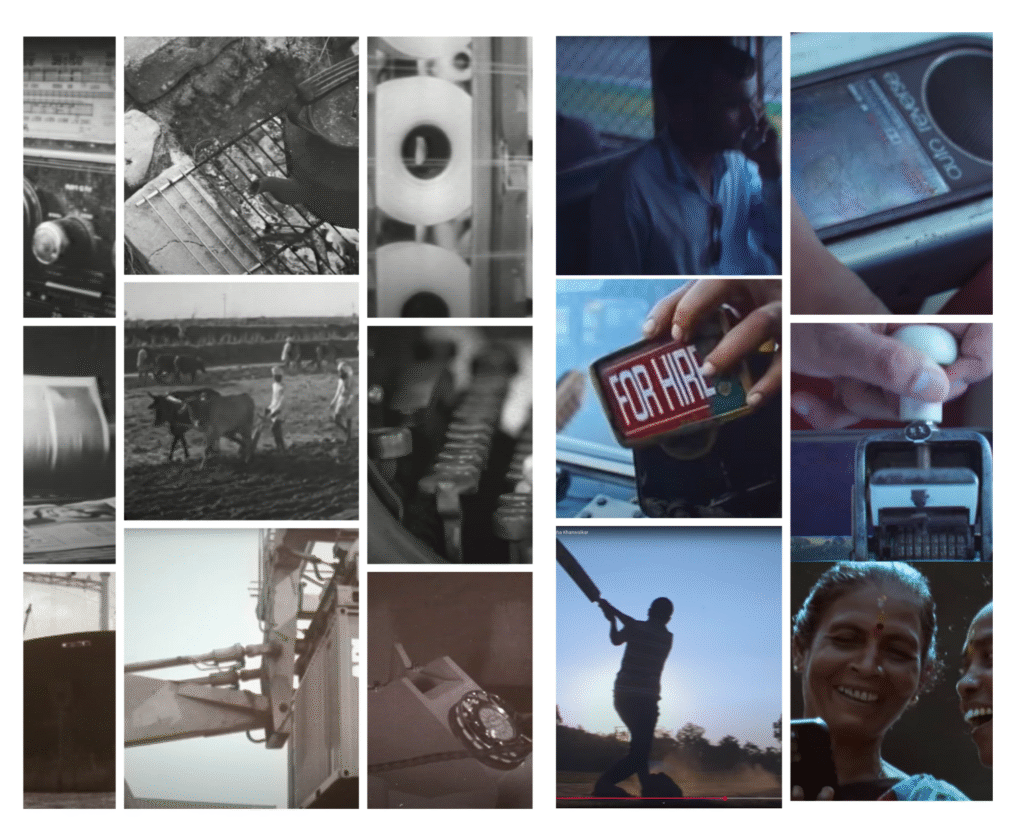
Vertical collage juxtaposing vintage and modern Indian scenes, blending black-and-white Doordarshan-era motifs with contemporary images inspired by SBI General’s Sound Symphony campaign.

When the National Anthem Becomes a Ringtone: The Troubling Arc of SBI General’s Sound Symphony

In the August of 2025, SBI General Insurance—a subsidiary of State Bank of India, the nation’s largest public sector undertaking—commissioned Sneha Khanwalkar to reimagine the national anthem through India’s sonic journey. The result echoes the earnest patriotism of Doordarshan’s golden era, but strips away the sincerity that made classics like Mile Sur Mera Tumhara cultural touchstones. What makes this appropriation particularly troubling is SBI’s status as a government-owned institution with 500 million customers and 57.51% public ownership. When such an entity enlists the anthem for subsidiary insurance marketing, it transforms from corporate overreach into institutional cultural colonisation—commodifying not just heritage, but citizenship itself.

When the National Anthem Becomes a Ringtone: The Troubling Arc of SBI General’s Sound Symphony Read More »

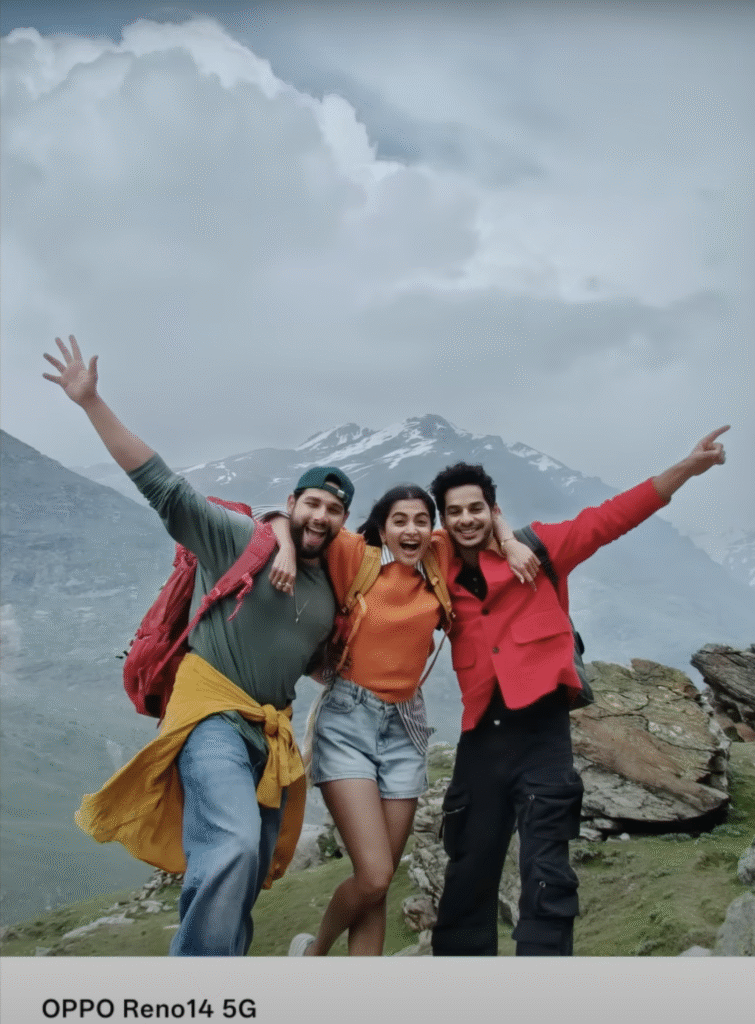
A joyful trio of young trekkers—two men and one woman—stand arm-in-arm on a grassy mountain ledge, backpacks on, raising their free arms against a backdrop of cloud-shrouded, snow-capped peaks.

When Music Becomes Memory: The Aawara Triumph That Shouldn’t Have Worked

There’s something rather marvellous about watching a marketing campaign succeed for precisely the wrong reasons. OPPO India’s “Live the Aawara Life” campaign for the Reno14 Series has achieved that rarest of modern marketing miracles: it’s made people voluntarily choose not to skip an advertisement. In an era where ad-blocking is a survival skill, this represents nothing short of a cultural coup. Yet, beneath the surface of this viral triumph lies a paradox—music and emotion have so thoroughly eclipsed the product that the ad’s greatest triumph may also be its greatest flaw. This is the curious anatomy of a campaign where nostalgia, melody, and the hunger for authenticity collide, leaving even the most seasoned marketers wondering: what, exactly, are we selling when we sell a feeling?

When Music Becomes Memory: The Aawara Triumph That Shouldn’t Have Worked Read More »

Digital Lightbulb Representing Innovation and Creativity

Creativity Meets Commercial Clout: Turning Big Ideas into Bottom-Line Results

Creativity used to live on mood boards and Post-its. Now it sits next to the CFO.
In a world obsessed with efficiency, the biggest competitive edge might just be a quirky idea backed by KPIs. This article breaks down how to turn offbeat brilliance into boardroom-ready strategy—without losing the spark that made it brilliant in the first place. Budgets, buzz, and business value included.

Creativity Meets Commercial Clout: Turning Big Ideas into Bottom-Line Results Read More »

Scroll to Top