
AI adoption

Circular flywheel diagram showing OpenAI's self-reinforcing data moat: researchers use Prism generating workflow data, captured data improves AI models, better AI attracts more users, creating growing moat that locks out competitors like Overleaf and Salesforce

OpenAI’s Prism Isn’t for You—And That’s Exactly Why You Should Care

OpenAI’s Prism launch signals a seismic shift in how vertical software gets built. Rather than competing in commoditised general-purpose AI, OpenAI is embedding AI directly into industry-specific workflows—exactly where scientists, doctors, and engineers spend their time. This isn’t about being smarter than ChatGPT; it’s about owning the workflow layer. The free-tier pricing strategy targets institutional lock-in, not individual adoption. Within 18 months, every category leader in your vertical will face an AI-native competitor with OpenAI’s balance sheet strength and data advantage. The companies that survive are those realising that AI isn’t a feature to bolt on—it’s the foundation your business must be built on. Your competitive advantage is no longer “how do we use AI better” but “how do we build systems where AI drives our core value.”

OpenAI’s Prism Isn’t for You—And That’s Exactly Why You Should Care Read More »

Side-by-side comparison showing a curated demo environment with smiling team members and green status indicators versus grainy CCTV-style footage of a 3:47 AM incident with error dashboards, cold pizza, and engineers rolling back deployment

Your AI Coding Demo Looked Perfect. Your Production Deployment Is a Mess. Here’s Why.

AI coding demos look magical: agents fixing builds, shipping features, and letting developers “stay in flow”. Reality is messier. Teams see more debugging, governance headaches, and underwhelming ROI. This piece breaks down the demo-to-production gap—and what engineering leaders should actually do about AI coding tools.

Your AI Coding Demo Looked Perfect. Your Production Deployment Is a Mess. Here’s Why. Read More »

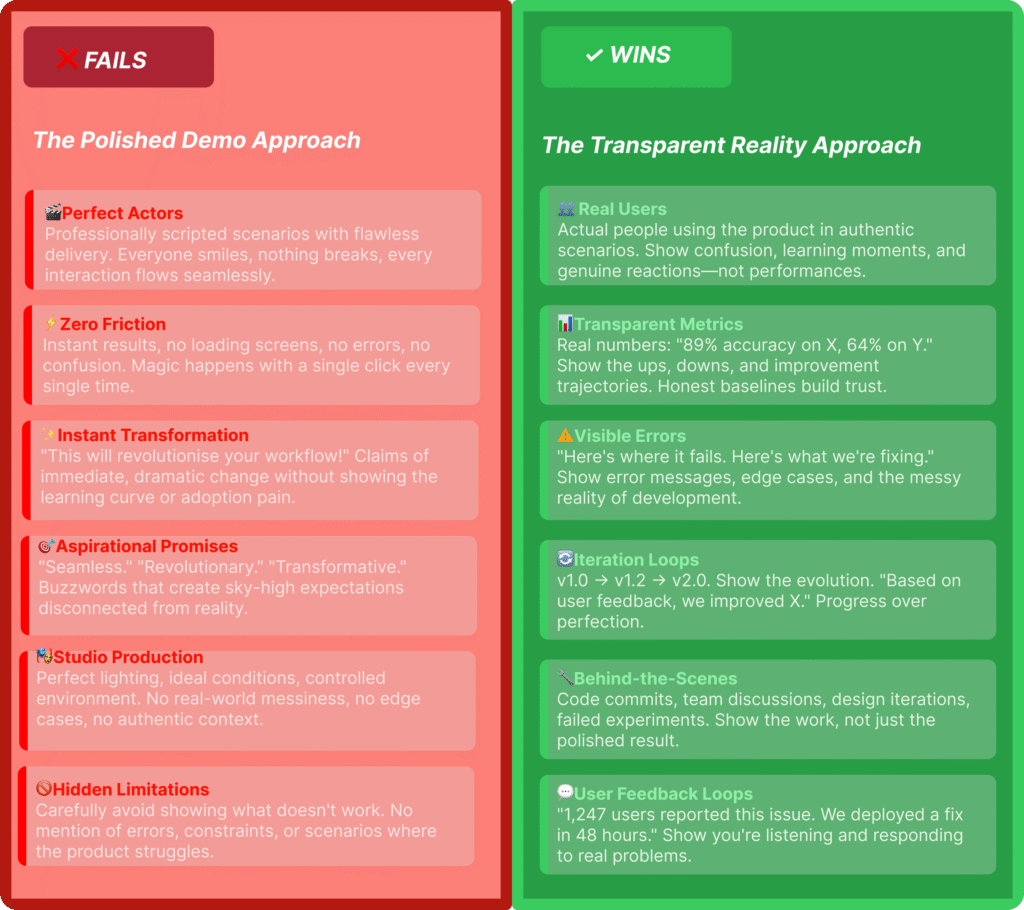
Side-by-side comparison showing Google's failing polished demo approach versus the winning transparent reality approach in AI marketing.

ARTICLE 2 : The Challenger’s Playbook: How to Market Against Entrenched AI Incumbents

Google’s Gemini videos fail because they don’t answer the question consumers actually ask: Why switch from ChatGPT? In mature markets with entrenched incumbents, that’s the only question that matters. The companies winning AI adoption have figured out a completely different playbook—one that acknowledges the incumbent, demonstrates differentiation, and treats switching costs as real barriers. If you’re marketing AI products to consumers in 2025, this is the approach that actually works.

ARTICLE 2 : The Challenger’s Playbook: How to Market Against Entrenched AI Incumbents Read More »

Scroll to Top