
Salesforce just launched Slackbot as your “AI agent for work.” The slick demo video shows it co-hosting an internal podcast, finding documents during conferences, and prepping for meetings with zero effort.
It’s free for enterprise customers, learns your communication style, and promises to eliminate productivity-killing context switching.
There’s just one problem: nearly every claim rests on assumptions that workplace AI research is systematically disproving.
Why this matters now
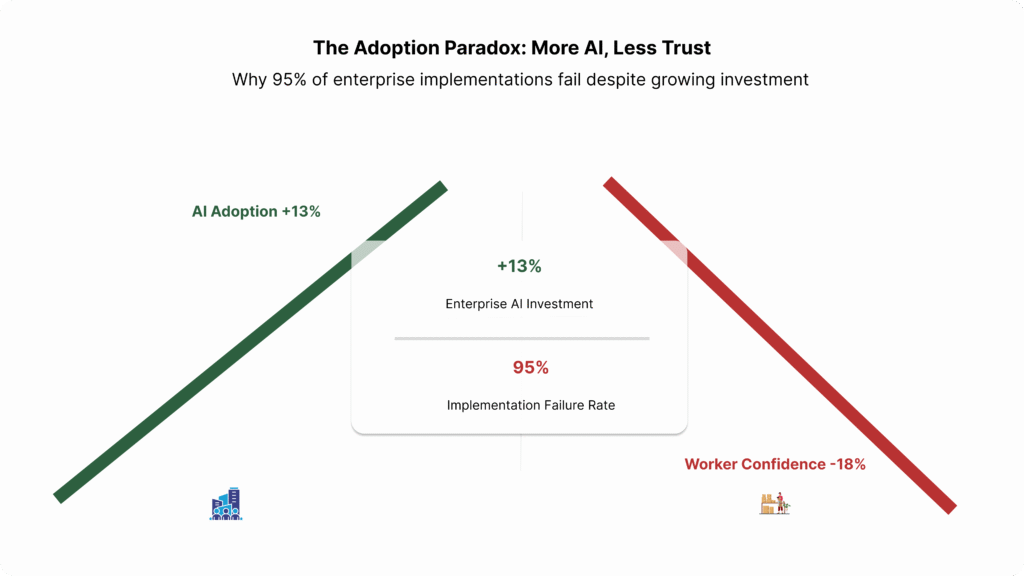
Enterprise AI adoption has reached an inflection point. Usage jumped 13% in 2025, but worker confidence collapsed 18% in the same period.
ManpowerGroup surveyed 14,000 workers across 19 countries. The data reveals a troubling pattern: companies are handing employees AI tools without training, context, or honest conversations about what these systems can and cannot do.
Slack’s promotional video epitomises this disconnect.
I spent a day analysing Slackbot’s launch against current enterprise AI implementation data, workplace trust research, and competitive positioning. What emerged isn’t a story about whether the technology works (it often does) but whether organisations can deploy it successfully (they usually don’t).
Here’s what marketers, HR leaders, and enterprise decision-makers need to understand before buying into the hype.
The trust crisis no one wants to discuss
Workers are losing confidence fast
Slackbot launched into a workplace where AI trust is in freefall. Baby boomers showed a 35% confidence decrease in AI tools during 2025. Gen X dropped 25%.
Most critically, 56% of workers globally report receiving zero recent skills training despite AI becoming embedded in their daily tools.
The demo obscures reality
The video shows Slack’s host casually asking Slackbot to co-host an episode. He receives perfectly formatted responses with appropriate emojis and voice matching his communication style.
It’s an impressive demo. It’s also a masterclass in obscuring the actual user experience most workers will have.
What happens when AI gets it wrong?
What’s missing? Any discussion of what happens when Slackbot makes mistakes. And it will get things wrong frequently.
“AI usage jumped 13% in 2025, but worker confidence collapsed 18% in the same period—companies are handing employees tools without training, context, or support.”
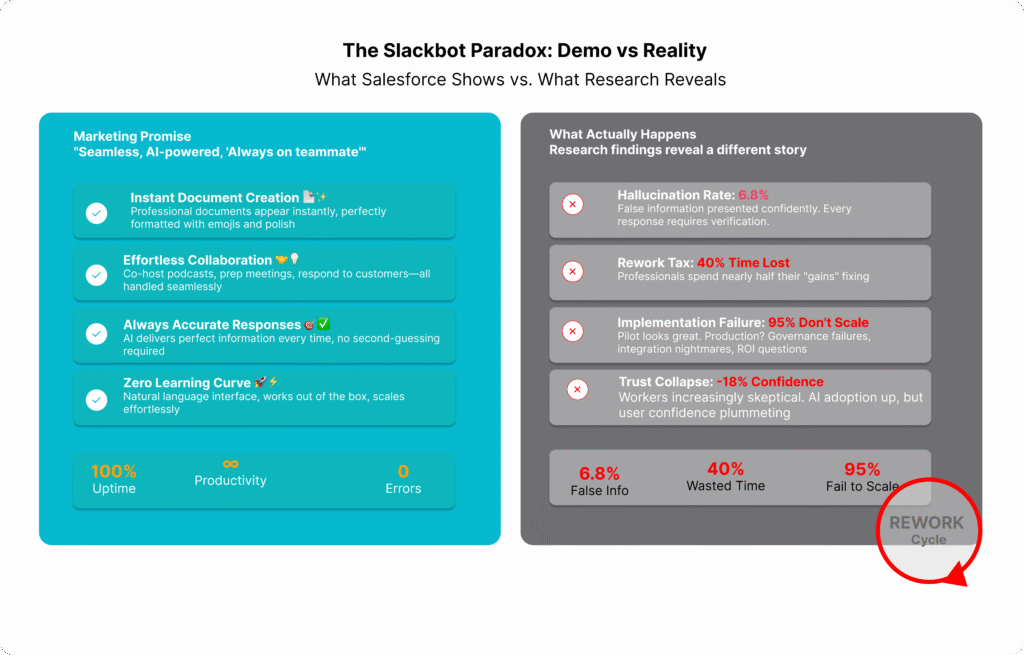
Anthropic’s Claude—the large language model powering Slackbot—demonstrated a 6.8% hallucination rate in independent testing. That’s among the best in the industry. But it means roughly one in fifteen AI responses contains fabricated information.
OpenAI’s newer “reasoning” models hallucinate 33-51% of the time on fact-based queries. Counterintuitively, these advanced models make confident mistakes at higher rates than their simpler predecessors.
The real-world consequences
For an AI agent performing dozens of searches, summaries, and document retrievals daily, this translates to multiple false statements per user per week.
Brief an executive with fabricated customer data from Salesforce integration? You damage a client relationship.
Rely on an AI-summarised conversation that misunderstood context? You miss critical project details.
Search for company policy and receive plausible but incorrect guidance? You create compliance exposure.
The video never mentions accuracy rates, verification protocols, or what happens when AI-generated content causes business harm. That silence isn’t an oversight. It’s a pattern across enterprise AI marketing that research shows is creating real productivity costs.
Much like Apple’s iPhone 17 Pro campaign prioritised durability demonstrations over AI capabilities, Slackbot’s promotional approach emphasises seamless functionality whilst systematically avoiding the messy reality of AI limitations.
The rework tax eating your efficiency gains
The uncomfortable truth about AI productivity
Here’s the reality about workplace AI that vendors won’t put in their demo videos: nearly 40% of productivity gains are lost to rework and low-quality output.
Workday’s research reveals a troubling pattern. For every 10 hours of efficiency gained through AI, almost four hours are spent fixing errors. Workers correct misunderstandings or rewrite substandard content constantly.
Who’s hit hardest?
HR workers—precisely the audience most likely to use communication tools like Slack—report the highest AI rework levels at 38%.
Highly engaged employees lose 1.5 weeks per year exclusively to fixing AI outputs.
“For every 10 hours of efficiency gained through AI, almost four hours are spent fixing errors—only 14% of workers achieve net-positive outcomes from AI use.”
Most critically, only 14% of workers achieve net-positive outcomes from AI use. The vast majority experience either net-negative results or marginal gains insufficient to justify the cognitive overhead.
What Slackbot’s demo doesn’t show
Slackbot’s video showcases generating meeting notes, summarising conversations, and drafting channel updates. These are precisely the use cases where research demonstrates high rework rates.
Without discussing quality control mechanisms or audit processes, it presents an idealised workflow. Most users will find it requires constant human intervention.
Why this matters for marketing teams
This matters for marketing and communications teams specifically. When AI generates customer-facing content, brand messaging, or strategic briefings, the stakes for accuracy intensify.
A summary that misses nuance can’t simply be “fixed later.” A document search that returns outdated policy may have already caused damage.
Why enterprise AI projects keep failing
The implementation crisis
If Slackbot’s capabilities are real (and they are), why such scepticism about outcomes? Because capability demonstrations tell you nothing about implementation success. And the implementation data is devastating.
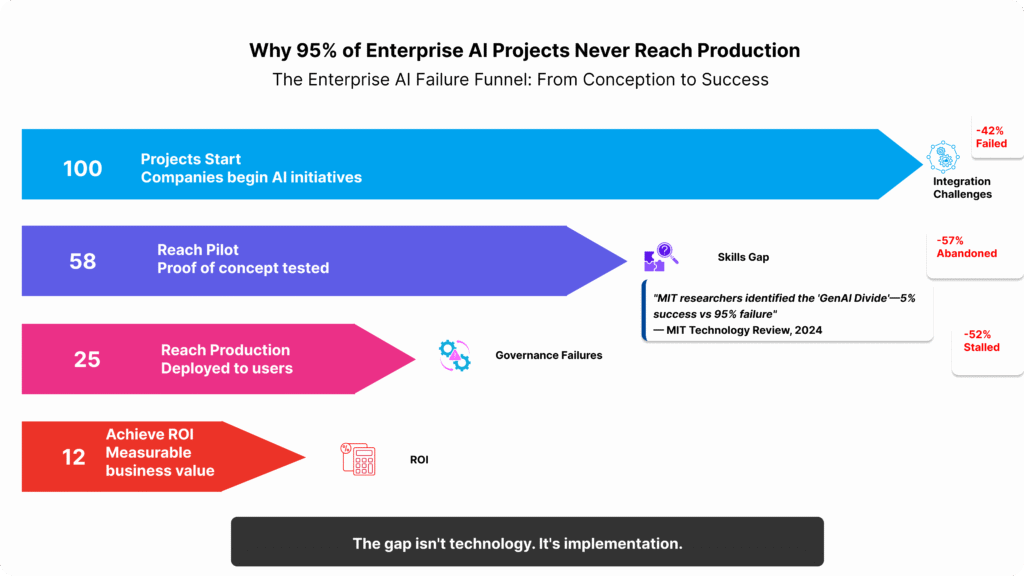
Research from 2025-2026 reveals that 42% of companies scrapped most AI initiatives in 2025. This is up dramatically from 17% in 2024.
The average organisation abandoned 46% of AI proof-of-concepts before reaching production. More broadly, 87-95% of enterprise AI projects fail to escape pilot phase. IDC reports that 88% of AI POCs fail to reach production.
The ROI reality check
Most devastating: only 10-12% of companies see actual revenue or cost benefits from AI. Meanwhile, 56% state they’ve gotten “nothing out of it” in PwC surveys.
“87-95% of enterprise AI projects fail to escape pilot phase—the gap stems not from model capabilities but from flawed integration and treating adoption as technical implementation rather than organisational transformation.”
MIT researchers identified the “GenAI Divide”—the 5% of successful implementations versus the 95% that fall short. Generic tools excel for individuals due to flexibility. But they “stall in enterprise use since they don’t learn from or adapt to workflows.”
Where Slackbot fits in
Slackbot positions itself as different. It’s embedded in the flow of work with organisational context. The core integration and change management issues that cause most AI initiatives to fail are still not being addressed.
The gap stems not from model capabilities but from flawed enterprise integration. Learning gaps persist. Companies treat AI adoption as technical implementation rather than organisational transformation.
Salesforce provides the technology. But it offers minimal guidance on the governance infrastructure, training programmes, and verification workflows that separate successful deployments from expensive failures.
The competitive reality Salesforce isn’t mentioning
Catching up, not leaping ahead
Slack’s video positions Slackbot as an innovative leap forward. But industry analysts characterise it as “catching up” to capabilities already provided by Microsoft Copilot and Google Gemini.
The market dynamics are brutal. Microsoft Teams commands 37% market share with 320 million monthly active users. This dwarfs Slack’s 13-18.6% share and 42-47 million users.
Microsoft generated over $8 billion from Teams in 2023. That’s nearly double Slack’s projected $4.22 billion revenue for 2025.
Microsoft’s structural advantages
Microsoft’s advantages remain formidable. Teams bundles with Microsoft 365, making it effectively free for existing customers. It integrates natively with Office applications where most enterprise work happens. It dominates in healthcare, education, and government sectors.
For organisations deeply embedded in the Microsoft ecosystem, adding Slack’s Business+ plan at $15/user/month becomes a premium expense. They can access similar functionality through their existing licences.
The interoperability admission
The video mentions Slackbot can search Microsoft Teams and Google Drive. Slack frames this as interoperability. It’s actually an admission: Slack must operate in an environment where Microsoft owns the productivity infrastructure and calendar systems that define enterprise workflows.
Slackbot’s “free inclusion” strategy creates competitive pressure on Microsoft’s $10/user/month premium pricing. But price alone rarely shifts enterprise platform decisions. IT infrastructure, security policies, and compliance frameworks are already built around Microsoft’s governance tools.
The accessibility gap creating a two-tier workforce
What “free” actually means
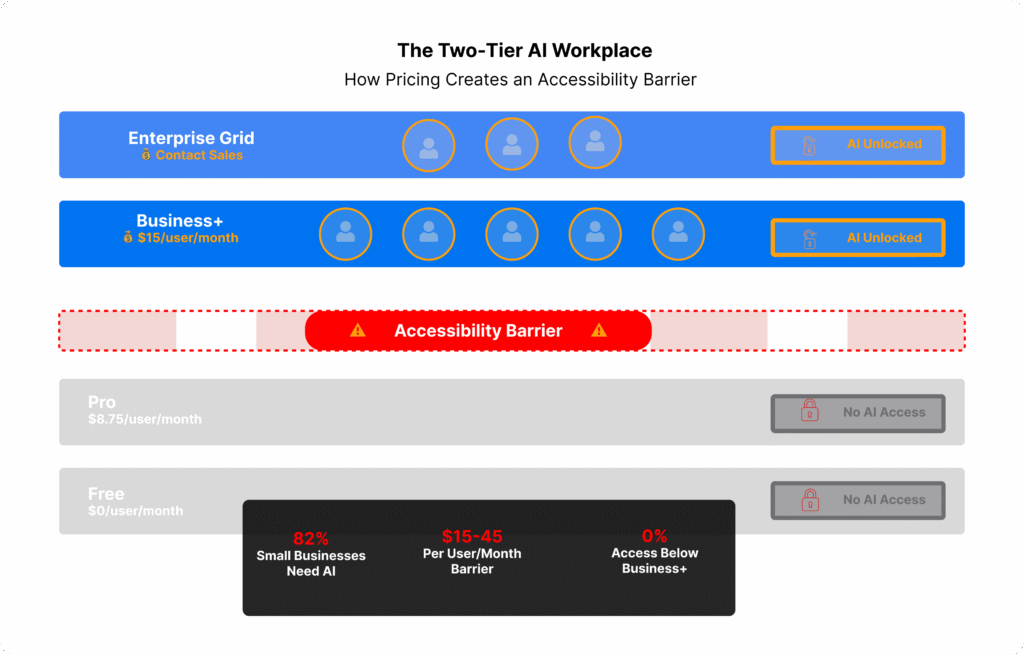
Here’s what “free with Enterprise Grid” actually means: accessible only to organisations spending hundreds of thousands to millions of pounds annually on Slack subscriptions.
Business+ requires a minimum of $15/user/month with annual billing. Enterprise Grid involves custom pricing typically ranging from $10-45/user/month depending on scale.
Free and Pro tier users—representing the bulk of Slack’s user base—are entirely excluded. This demographic is particularly dominant amongst small businesses and startups.
The two-tier AI landscape
This creates a two-tier AI landscape. Enterprise employees receive autonomous AI assistance. Meanwhile, small business workers, freelancers, and non-profit organisations are left behind.
“82% of small businesses consider AI essential to remain competitive, yet most AI workplace tools price themselves exclusively for enterprise markets—creating a digital divide in productivity technology.”
The irony is sharp: 82% of small businesses consider AI essential to remain competitive. Yet most AI workplace tools price themselves exclusively for enterprise markets.
Breaking the viral growth cycle
For Slack specifically, this exclusion undermines the network effects and viral adoption that fuelled the platform’s initial growth. Slack thrived because users at one company enthusiastically introduced it to colleagues elsewhere. This created organic expansion.
If Slackbot becomes a defining feature but remains accessible only to enterprises spending six or seven figures annually, that viral growth mechanism weakens. Small teams experiencing Slack without AI assistance may increasingly view it as comparable to free alternatives like Discord or Teams Free.
The innovation divide
The global collaboration tools market is projected to grow from $27.1 billion in 2024 to $116.3 billion by 2033. Remote work and small business adoption drive this significantly.
If AI capabilities remain concentrated in enterprise tiers, the market may bifurcate. Large organisations get comprehensive AI assistance. Smaller organisations use increasingly outdated non-AI tools.
This digital divide in workplace productivity technology carries implications for economic competitiveness, employment dynamics, and innovation capacity.
The agent sprawl crisis waiting to explode
The orchestration fantasy
The video’s most aspirational claim positions Slackbot as a “super agent” orchestrating multiple AI agents across an organisation. It makes Slack the “agentic work OS.”
This vision depends on successful governance. Current evidence suggests enterprises are catastrophically unprepared.
The SoftBank cautionary tale
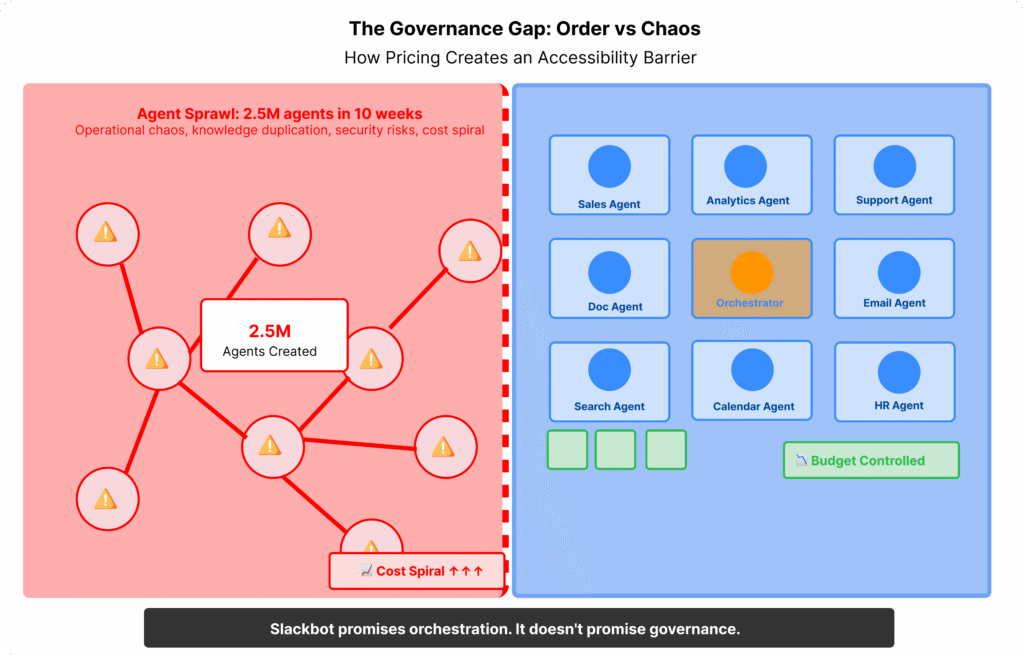
SoftBank’s highly publicised AI adoption initiative created 2.5 million agents in 10 weeks during summer 2025. Initially, this was celebrated as a triumph of democratisation.
The outcome revealed agent sprawl—a multi-dimensional crisis that compounds over time.
How agent sprawl manifests
Agent sprawl manifests through several problems:
- Operational inefficiency: Employees spend more time searching for existing agents than creating new ones.
- Knowledge fragmentation: Common patterns get duplicated across thousands of individual agents.
- Security risks: Every agent represents a potential vulnerability.
- Computational cost spiral: Redundant agents multiply infrastructure bills.
- Organisational confusion: Leadership loses visibility into AI capabilities.
The governance gap
The video demonstrates Slackbot’s ability to “know” various agents and coordinate handoffs. It presents this as a solution to complexity.
Yet it doesn’t discuss the prerequisite governance infrastructure. Agent registries, access control policies, monitoring systems, audit trails—none of this gets mentioned. This vision amounts to aspirational marketing rather than actionable guidance.
Enterprises already struggle with “shadow AI.” Teams launch agents outside IT purview with unknown prompts, data flows, and permissions.
Slackbot as an orchestration layer could impose order on this chaos. Or, more likely without explicit governance tools, it simply adds another complexity layer to an already unmanageable landscape.
What Salesforce’s own struggles tell us
The CEO’s admission
The most revealing context doesn’t come from competitors but from Salesforce itself. CEO Marc Benioff recently admitted the company “massively overestimated AI’s capabilities”. This led to strategic pivots and workforce restructuring.
Agentforce’s documented failures
Agentforce—the underlying platform powering Slackbot—has exhibited critical failures. These include omitting instructions when given more than eight directives and unpredictably failing to execute specified tasks.
“Salesforce CEO Marc Benioff admitted the company ‘massively overestimated AI’s capabilities’—characterising large language models as ‘suicide coaches’ and acknowledging ‘the LLM is not sufficient.'”
Vivint, a home security company using Agentforce for 2.5 million customers, reported problems. The system sometimes inexplicably failed to send customer satisfaction surveys despite explicit instructions.
The “suicide coaches” controversy
In an extraordinary public reversal, Benioff characterised large language models as “suicide coaches”. He acknowledged that “the LLM is not sufficient.”
This led Salesforce to pivot towards deterministic execution and governance layers to compensate for AI unpredictability. The company’s stock has fallen 34% from its December 2024 peak.
What this means for Slackbot
This context reframes the confident Slackbot demonstration. It launched amidst internal acknowledgement that Salesforce’s broader AI strategy faces fundamental reliability challenges.
These aren’t theoretical concerns. They’re documented failures in production systems serving millions of users.
The context switching paradox
The promised solution
A core value proposition centres on eliminating context switching by consolidating work in Slack. Research confirms context switching imposes severe costs.
Interrupted tasks take 50% longer and result in 50% more errors. They cause higher stress and frustration.
The new problem it creates
The paradox emerges when examining how AI assistants themselves create new forms of context switching. The average professional attends 25.6 meetings per week and switches context 5.1 times per day.
Developers switch tasks 13 times per hour. They spend only six minutes per task before switching.
Always-on doesn’t mean better
In this environment, an “always-on AI teammate” doesn’t reduce interruptions. It monitors all conversations, surfaces information, sends reminders, and generates summaries. This creates a new, persistent interruption source.
When Slackbot proactively surfaces information or suggests actions, it demands cognitive resources. Users must evaluate whether AI-generated content is relevant, accurate, and actionable. These decisions interrupt whatever task they were performing.
The cognitive load problem
The promise that Slackbot enables users to “stay in Slack” addresses application-level context switching. But it ignores task-level cognitive disruption.
Each AI interaction represents a cognitive context switch. You transition from creation work to evaluation work. You move from deep focus to AI output assessment.
The timing and context awareness problem
Reading the room matters
One critical lesson from recent marketing campaigns involves reading the room. You need to understand not just what your message says but when it lands.
Swiggy’s Durga Puja campaign demonstrated how brand storytelling can celebrate frontline workers and build authentic connections. But timing matters as much as intention.
The disconnect in Slackbot’s launch
Slackbot’s launch emphasises seamless productivity in an environment where workers are overwhelmed, undertrained, and increasingly anxious about AI replacing human judgment.
The promotional tone—breezy, confident, and devoid of acknowledging legitimate concerns—mirrors the disconnect that happens when brands launch campaigns without accounting for the broader context their audiences inhabit.
What successful adoption looks like
The most successful technology adoption stories involve brands that acknowledge complexity. They provide transparent limitations. They meet users where they are emotionally and practically.
Slackbot’s marketing does none of this. Instead, it presents a frictionless future that research suggests few organisations will actually experience.
What this means for your organisation
Pilot conservatively
If you’re evaluating Slackbot—or any enterprise AI tool—here’s what research suggests matters more than feature demonstrations.
Deploy to 50-100 users across diverse roles. Measure actual productivity impact including rework time, not just gross time savings. Track how much time users spend verifying AI-generated content versus using it directly.
Build verification protocols first
Establish workflows for validating AI-generated content before it becomes enterprise AI infrastructure. This is particularly critical for customer-facing communications and strategic decisions.
A legal brief with fabricated case citations can result in sanctions. A customer briefing with wrong data damages relationships.
Invest seriously in change management
Provide comprehensive training that addresses why AI makes mistakes. Teach how to work effectively with imperfect agents, not just feature tutorials.
“The 56% of workers receiving no skills training despite AI proliferation aren’t failing—their organisations are failing them.”
The 56% of workers receiving no skills training despite AI proliferation aren’t failing. Their organisations are failing them.
Implement governance infrastructure before scaling
Create agent registries, access control policies, and monitoring systems before allowing proliferation. The agent sprawl crisis isn’t a technical problem.
It’s an organisational design problem that technology alone won’t solve.
Maintain competitive optionality
Deploy Slackbot as part of a hybrid AI toolchain, not a platform-exclusive commitment. Enterprises building successful AI strategies use multiple tools for different contexts. They don’t bet everything on a single vendor.
The transparency gap
Technology versus implementation
Slackbot represents sophisticated technology that could genuinely enhance productivity for specific use cases. The gap between that potential and likely outcomes stems not from technological limitations.
It comes from the chasm between marketing narratives and implementation realities.
The expectation problem
When vendors showcase AI capabilities without discussing accuracy rates, training requirements, governance needs, failure modes, or verification protocols, they create unrealistic expectations. This guarantees disappointment.
When 95% of enterprise AI projects fail to scale and only 14% of workers achieve net-positive outcomes from AI use, the problem isn’t user adoption. It’s organisational readiness and vendor transparency.
The real question
The question for decision-makers isn’t whether Slackbot has impressive capabilities (it does). It’s whether your organisation has the training infrastructure, governance frameworks, verification workflows, and realistic expectations required to capture value rather than simply adopt technology.
Much like how Apple’s marketing approach sometimes prioritises technical specifications over human benefits, Slackbot’s promotional strategy emphasises AI sophistication. It systematically avoids the organisational realities that determine implementation success.
The path forward
Salesforce wants Slackbot positioned as the inevitable future of work. The evidence suggests it’s more likely to become another chapter in the history of technologies that promised transformation but delivered disappointment.
Unless organisations approach it with clear-eyed realism about both its potential and its profound limitations.
“The AI revolution won’t be won by vendors with the flashiest demos—it will be won by organisations honest enough to acknowledge that automation without verification, adoption without training, and deployment without governance creates more problems than it solves.”
The AI revolution in workplace productivity is real. But it won’t be won by the vendors with the flashiest demos.
It will be won by the organisations honest enough to acknowledge that automation without verification, adoption without training, and deployment without governance creates more problems than it solves.
Related reading:
- Brand Anthem in the Age of Algorithms: Swiggy Wiggy 3.0 Campaign – How authentic storytelling builds brand loyalty in the gig economy
- Apple’s iPhone 17 Pro Marketing: A Critical Campaign Analysis – When technical demonstrations overshadow human benefits
Footnotes and sources:
- ManpowerGroup 2026 Global Talent Barometer – 14,000 workers across 19 countries on AI trust crisis
- Workday research on AI productivity tax – 40% of gains lost to rework
- Forbes on AI hallucination rates – Claude’s 6.8% error rate, OpenAI’s 33-51%
- MIT report on GenAI failure rates – 95% of enterprise projects fail to scale
- Beam.ai analysis of AI ROI – 42% of companies scrapped AI initiatives in 2025
- SoftBank agent sprawl case study – 2.5 million agents in 10 weeks
- Slack vs Teams market analysis – 320M vs 42-47M users
- Salesforce AI struggles – CEO admits overestimation
- Context switching research – 50% longer task completion
- Small business AI accessibility – 82% consider AI essential