
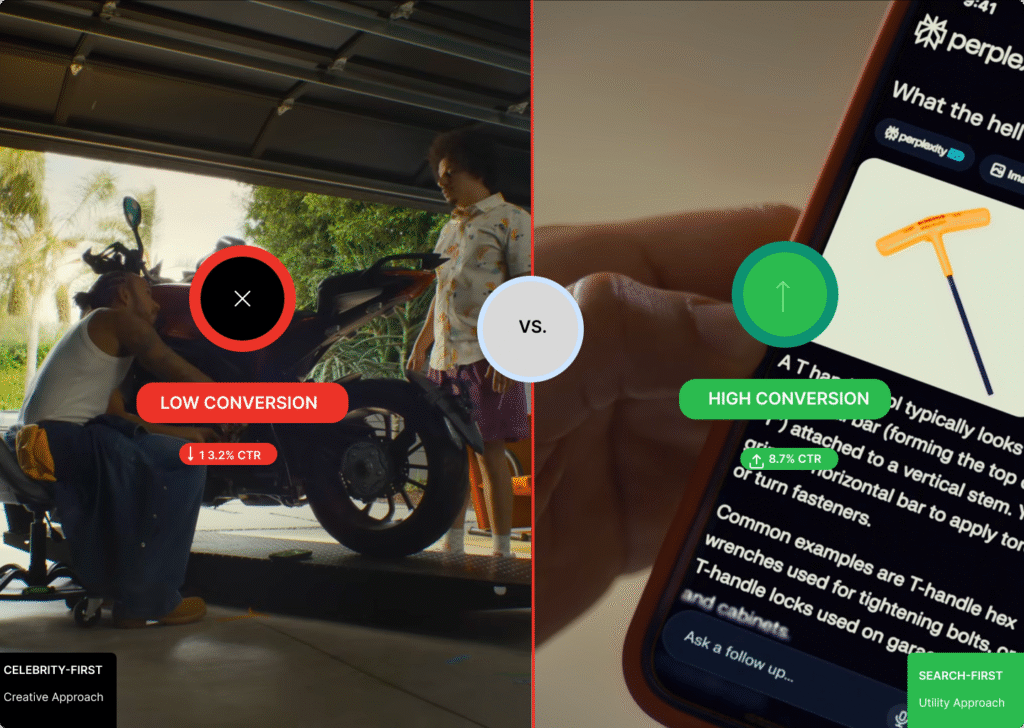
Selling attention without conversion is a luxury AI search startups cannot afford
Lewis Hamilton and Eric André are standing in a garage. Hamilton’s tuning a motorcycle. André hops the gate, panics when asked to prove his expertise, frantically searches something on Perplexity, rattles off specs about Brazilian soil content and tyre pressure, then bolts with Hamilton’s phone.
It’s funny. It’s weird. For marketing professionals, it should trigger real concern.
Why this ad matters now
Perplexity’s “The Garage” isn’t badly made. The banter feels natural, production values are high, and the dry humour lands. But here’s the structural problem: in November 2025, with AI search ad spending set to double between 2025 and 2026 and top £19.6 billion by 2029, Perplexity released a campaign that prioritises entertainment over education. This happened precisely when consumer confusion about AI search tools remains the biggest barrier to adoption.
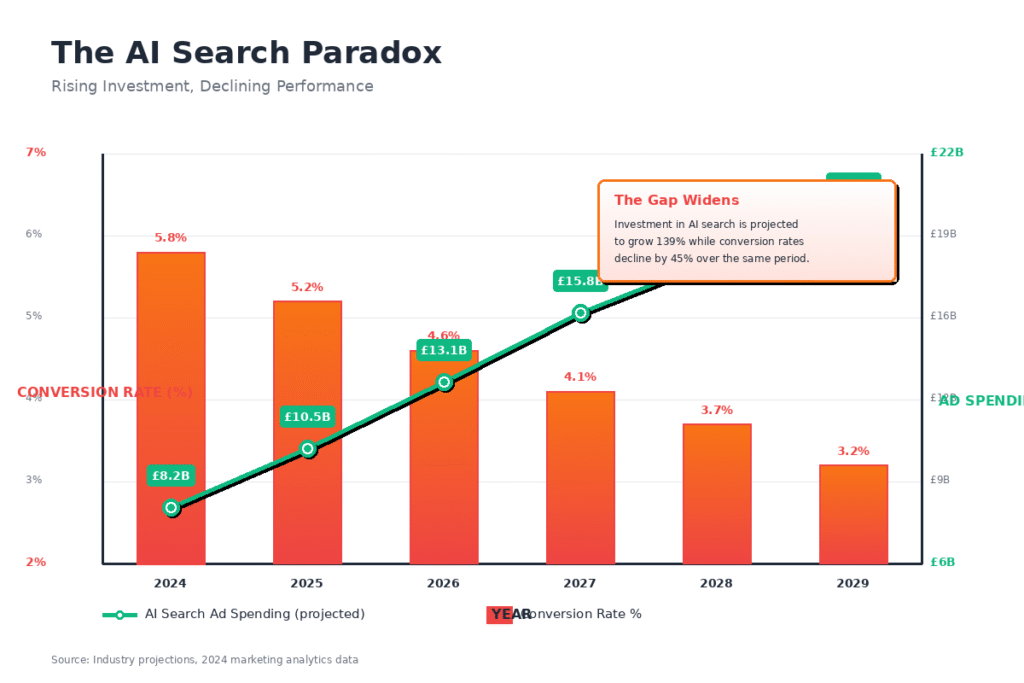
The real issue? Brand awareness without conversion isn’t just wasted opportunity. For a company competing against Google’s 90% market share, it’s existential.
The search landscape is shifting faster than you think
The discovery funnel is collapsing. By 2026, AI-powered assistants and large language models will handle roughly 25% of global search queries. Zero-click searches—where users get answers directly on results pages—now account for 60% of all searches, up from roughly 50% just two years ago. When AI Overviews appear, position-one click-through rates have dropped by 34.5%.
This isn’t gradual change. It’s systemic disruption. Perplexity reached 780 million monthly queries by mid-2025, up from 230 million a year prior. That’s impressive growth, but it’s still a rounding error compared to Google’s billions. ChatGPT saw 44% traffic growth in November 2024 alone. The market opportunity exists. The urgency is undeniable.
Then, in September 2025—just two months before “The Garage” launched—Perplexity’s leadership publicly pulled back on advertising. This timing creates a strategic puzzle: if you’re not ready to scale, why invest in celebrity-driven brand campaigns that don’t explain why anyone should switch?
The answer reveals a misunderstanding about where celebrity endorsements actually work—and where they fail.
The celebrity endorsement trap
Celebrity partnerships can deliver solid returns. Industry data shows average ROI of 4:1 to 4.5:1 when done right. Lewis Hamilton, motorsport’s most marketable athlete for 12 consecutive years, brings global credibility. Eric André brings cultural currency with digitally native audiences through collaborations with Opera GX and Drumstick.
Yet here’s what research consistently shows: celebrity endorsements only work when two conditions align. First, authentic alignment must exist between celebrity values and brand identity. Second, audiences must already understand what the product does. Research on humorous advertising reveals that when product-humour fit drops, effectiveness plummets. Perception of the ad showed the highest correlation with purchase intention (r = .701, p < .001), meaning consumers needed to understand, find appropriate, and perceive ads as intelligent before purchase intent increased.
“The Garage” violates both principles. The humour positions Perplexity as a crutch for faking expertise, not as a tool for genuine learning. André’s most memorable line—”I’ve never talked to a celebrity this long. I got to go”—actually undermines the value proposition.
For existing users, it resonates as self-aware comedy. For everyone else, it’s a celebrity sketch that happens to mention a brand name.
Consider the contrast with effective tech advertising. When Opera GX partnered with André for “Bury Boring,” they gave him a clear enemy: boring browsers. The humour supported the value proposition. “The Garage” has no enemy. Google isn’t mentioned. The problem being solved isn’t articulated. The ad assumes you already know why Perplexity matters. You don’t. And this mirrors patterns I’ve analysed in authentic celebrity partnerships—when endorsements feel transactional rather than genuine, they generate awareness without trust.
Zero-click searches changed the game
Beyond celebrity dynamics, Perplexity faces a deeper structural challenge. The platform fights against two forces simultaneously: Google’s incumbency and the zero-click search paradigm eroding website traffic across the internet.
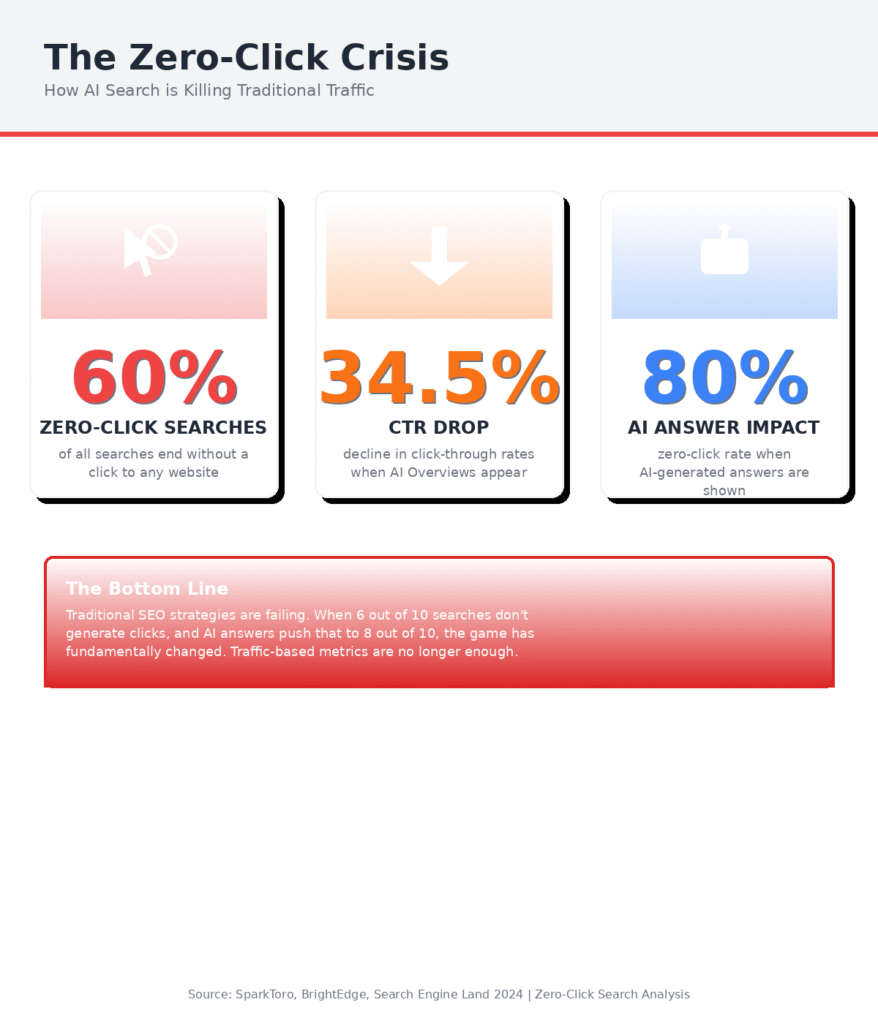
Consider the current landscape. According to Bain’s 2025 research, roughly 80% of consumers rely on zero-click results for at least 40% of their searches. AI Overviews have grown 116% since March 2025. When AI answers appear, organic web traffic drops 15% to 25%. News publishers saw monthly visits fall from 2.3 billion to 1.7 billion in under a year.
McKinsey’s October 2025 report found that half of consumers now intentionally seek out AI-powered search engines, with a majority saying it’s the top digital source they use to make buying decisions. By 2028, $750 billion in US revenue will funnel through AI-powered search. The result? Unprepared brands may experience 20% to 50% traffic decline from traditional search channels.
This creates a marketing paradox: brands gain visibility through AI citations without receiving clicks. Appearing in featured snippets or AI Overviews builds awareness and authority, yet users never visit your site.
Marketing becomes pure exposure with delayed—or non-existent—ROI.
“The Garage” operates precisely in this zone. It generates exposure and awareness. Yet awareness without understanding is worthless in a market where switching costs are behavioural, not financial. Google is free. Perplexity is free. The friction isn’t price—it’s habit.
You don’t break habit with charm. You break it with clarity.
Additionally, vanity metrics are the peacocks of digital marketing—beautiful, useless, and everywhere. Brand awareness campaigns often prioritise impressions over intent, creating this exact trap.
What should Perplexity have done instead?
Here’s where strategy matters more than celebrity star power:
Demonstrate the product in action. Show Hamilton using Perplexity on his phone with split-screen comparisons to Google. Make the interface clean, citations visible, conversational flow obvious. Make the “why switch” tangible, not abstract.
Solve the switching problem directly. Create “switching challenge” content where real users compare Perplexity versus Google on specific queries. Include humour, but anchor it to utility. Entertainment without substance is a luxury no AI startup can afford.
Build on Hamilton’s actual story. His quote—”Questions help you win. Perplexity has the answers”—is perfect brand messaging. Create a campaign series around “questions that changed the game,” featuring Hamilton’s F1 career decisions driven by curiosity. Make the product emotional and functional.
Leverage cultural credibility differently. The ad was produced by Sata Studios, a Black-owned company with credits including Nike and Guinness. Expand into creator-led content showing diverse use cases: students researching, designers prototyping, entrepreneurs validating ideas. Make Perplexity feel like a cultural movement, not just another search tool.
Highlight the publisher partnership. Perplexity’s revenue-sharing model with publishers genuinely differentiates it from Google. Show how Perplexity credits sources, compensates creators, maintains journalistic integrity. Trust determines endorsement effectiveness—build on this strength.
Compare this to how Google’s celebrity AI campaigns at least attempt product utility alongside star power. Or consider how effective AI brand marketing prioritises emotional intelligence over feature comparison, acknowledging real concerns while building trust.
The fundamental tension in 2025 marketing
Modern marketing requires simultaneous achievement of opposing goals. You need awareness and understanding. Entertainment and education. Brand recall and conversion intent.
“The Garage” succeeds at roughly half. It’s culturally engaging—something to share, laugh at, remember. Hamilton and André have genuine chemistry. The production is polished. The humour lands.
Yet in a market where 70% of Gen Z trust influencers more than celebrities<sup>5</sup>, where micro-influencers deliver £4.32 ROI per £1 spent versus celebrities’ £3.73, and where 73% of business leaders agree AI will redefine personalisation, entertainment without utility becomes a vanity metric.
Furthermore, this connects to a broader pattern across tech marketing: AI washing—using AI buzzwords without demonstrating substance. When every device claims AI power, the concept loses all meaning. Perplexity needs users to actively choose them over Google repeatedly until it becomes automatic.
That doesn’t happen because Hamilton looks cool in a garage. It happens because someone asks a complex question, gets a better answer than Google provided, and remembers the difference.
The ad doesn’t create that memory. It creates a vibe. Vibes don’t win search wars.
The broader implications for marketers
If you’re watching “The Garage” and thinking “at least it’s creative,” ask yourself harder questions: Can your brand afford creativity without clarity? Can you spend on awareness when conversion is the constraint? Can you rely on celebrity star power when audiences increasingly trust micro-communities?
The data suggests no. AI search ad spending will hit £19.6 billion by 2029<sup>1</sup>. The influencer marketing industry will reach £25.5 billion by 2025. Personalised CTAs outperform generic ones by 202%. Brands using AI-driven segmentation see 40% to 70% higher conversion rates.
The winners aren’t the funniest or most celebrity-studded. They’re the clearest.
As Ahrefs CMO Tim Soulo notes<sup>7</sup>, “The key to building a successful brand with ads is that those ads need to actually convert people into buyers—otherwise you’ll waste a ton of money and could bankrupt your company if everyone knows your brand but doesn’t buy it.”
This pattern repeats across categories—from smartphone launches where data-driven deception masks the gap between metrics and meaning, to streaming where celebrity endorsement credibility becomes primary concern rather than authentic connection.
The verdict
Perplexity’s “The Garage” is a well-executed answer to the wrong question. The question isn’t “How do we make people laugh?” It’s “How do we make people switch?”
Until AI search startups answer that question with precision, they’ll keep spending on awareness campaigns that entertain but don’t convert. In this market, that’s a luxury no one can afford.
Footnotes & Sources
- eMarketer (2025). “GenAI Search Advertising Trends 2025” – AI search ad spending will double between 2025 and 2026 and top $25 billion by 2029.
- Bain & Company (2025). “Goodbye Clicks, Hello AI: Zero-Click Search Redefines Marketing” – About 80% of consumers rely on zero-click results for at least 40% of their searches, reducing organic web traffic by 15-25%.
- Al Hadid, A.Y.B. (2025). “Exploring How Perception Mediates the Effect of Humorous Advertisements” – Study showing perception of ad (r = .701, p < .001) as strongest predictor of purchase intention, demonstrating that product-humour fit matters for effectiveness.
- McKinsey & Company (2025). “New Front Door to the Internet: Winning in the Age of AI Search” – Half of consumers now intentionally seek out AI-powered search engines; by 2028, $750 billion in US revenue will funnel through AI-powered search.
- The Trend (2022). “The Rise of Micro Influencers” – 70% of teens trust creator content more than celebrity endorsements.
- Stack Influence (2025). “Micro vs. Macro: Partnership Model Delivers Top ROI 2025” – Micro-influencers deliver average cost per engagement of $0.20 versus $0.33 for macro influencers, with campaigns achieving 13:1 ROI compared to celebrities’ 3-5x range.
- Ahrefs (2025). “How to Measure Brand Awareness in 2025” – Tim Soulo, CMO of Ahrefs, on the importance of converting brand awareness into buyers.
Additional Research:
- Marketing-Interactive (2024). “Perplexity Taps Lewis Hamilton and Eric André to Bring AI to Life in Comedy Short” – Campaign background and production details.
- eMarketer (2025). “2025 Trend: Generative Search Will Become the New Normal, Shaking Up Ad Spend” – Consumer behaviour shifts and organic traffic impact analysis.
- ContentGrip (2025). “Why AI Search is Killing SEO and What Marketers Must Do” – Analysis of McKinsey’s October 2025 report on AI search’s impact on traffic.
About this analysis: This article examines Perplexity’s November 2025 celebrity advertising campaign through the lens of AI search market trends, zero-click search research, celebrity endorsement effectiveness data, and brand awareness measurement strategies. All statistics are sourced from industry reports, academic research, and marketing analytics firms published between 2024-2025.