
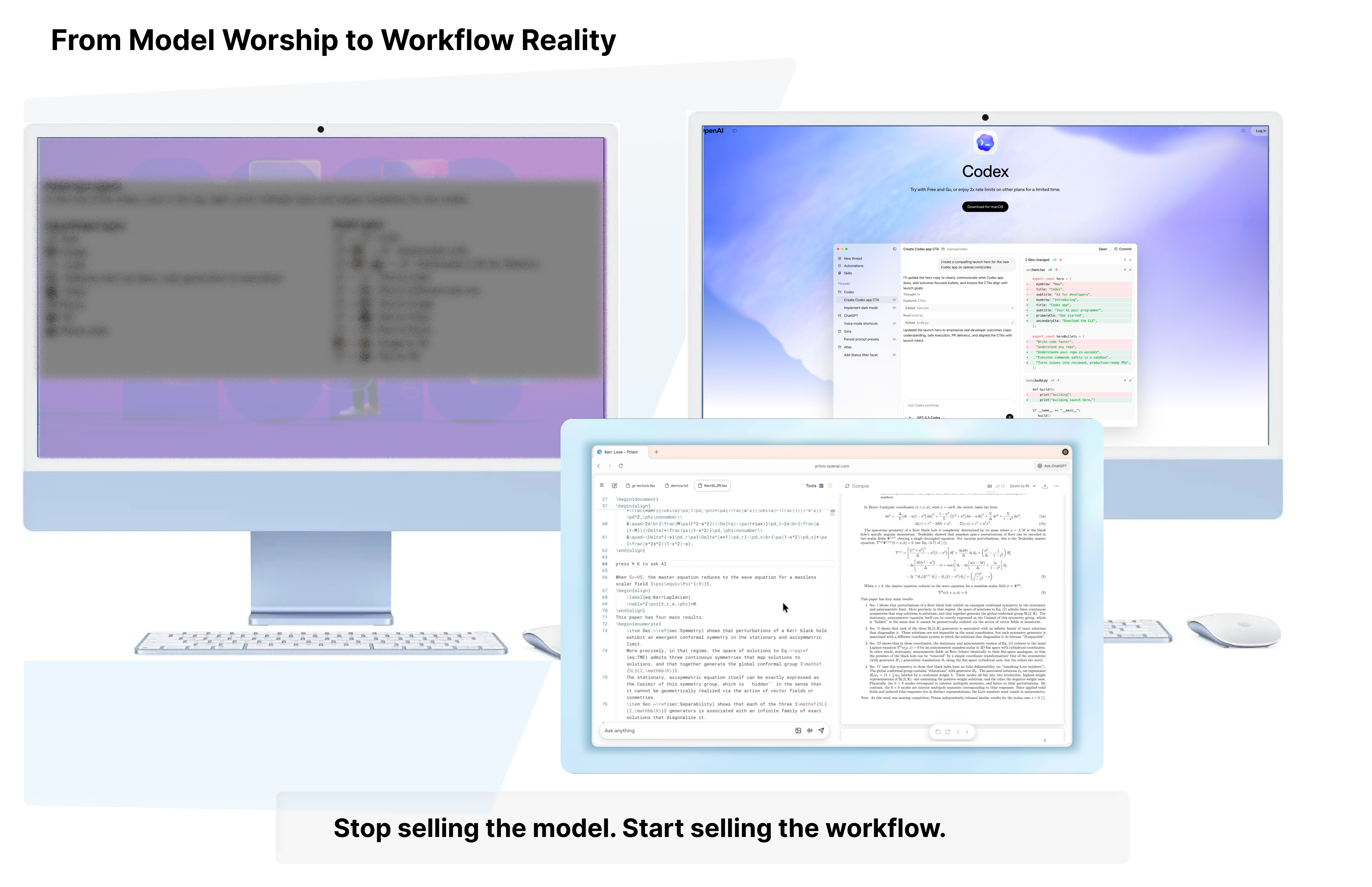
Marketers keep saying “AI‑powered”. OpenAI is quietly asking a harder question: what if AI rewrote how work feels? Codex, Prism and the latest demos aren’t really ads; they’re attempts to redefine what “normal” looks like in an AI‑native workplace. If you’re still shipping sizzle reels about “productivity” while your product behaves like a slightly cleverer autocomplete, you’re not in the same game.youtube+1
Previously, I’ve written about Anthropic’s restraint and OpenAI’s selective honesty. Codex and Prism sit somewhere between those extremes: heavy on product, light on governance, but razor‑sharp on workflow. Below is a take on what these campaigns are actually doing, why they land now, and what they demand from anyone marketing AI in 2026.suchetanabauri+1
“In 2026, you’re not selling AI. You’re selling a story about how work should feel.”
AI marketing is moving from model worship to workflow myth‑making
Until very recently, AI marketing lived and died on model bragging rights: more parameters, better benchmarks, cheaper tokens. That world hasn’t vanished, but the interesting work has moved on.
Consider how Codex is framed in the “Automate tasks” video: a command centre for agentic coding that runs automations to summarise commits, triage Sentry, and keep PRs green without being asked every time. Over in the Prism universe, creator videos pitch a LaTeX‑native workspace where GPT‑5.2 lives inside your paper, handling formatting, citations and even whiteboard‑to‑TikZ conversion.youtube+4[openai]
The shift is clean and blunt:
- The unit of value is no longer the model; it’s the workflow.
- The story isn’t “look how smart the AI is”; it’s “look how your day actually unfolds now”.
Crucially, this lines up with broader enterprise data. Round‑ups of AI productivity platforms show that meaningful wins are described in workflow terms: Asana AI Studio users shipping projects around 25% faster, compliance teams cutting reporting time by roughly 70% with agentic tools like Sana, and Microsoft Copilot users completing tasks nearly 30% faster inside the apps they already live in. People aren’t begging for “AI”; they’re begging for their calendar, pipeline or editor to hurt less.[sanalabs]
So if your pitch still opens with “powered by GPT‑X” and a latency graph, you’re selling yesterday’s differentiator. In a world where anyone can rent a strong foundation model, the real contest is: whose myth about how work happens feels inevitable?
“The unit of value is no longer the model, it’s the workflow.”
These films aren’t launch spots; they’re doctrine for an AI‑native workplace
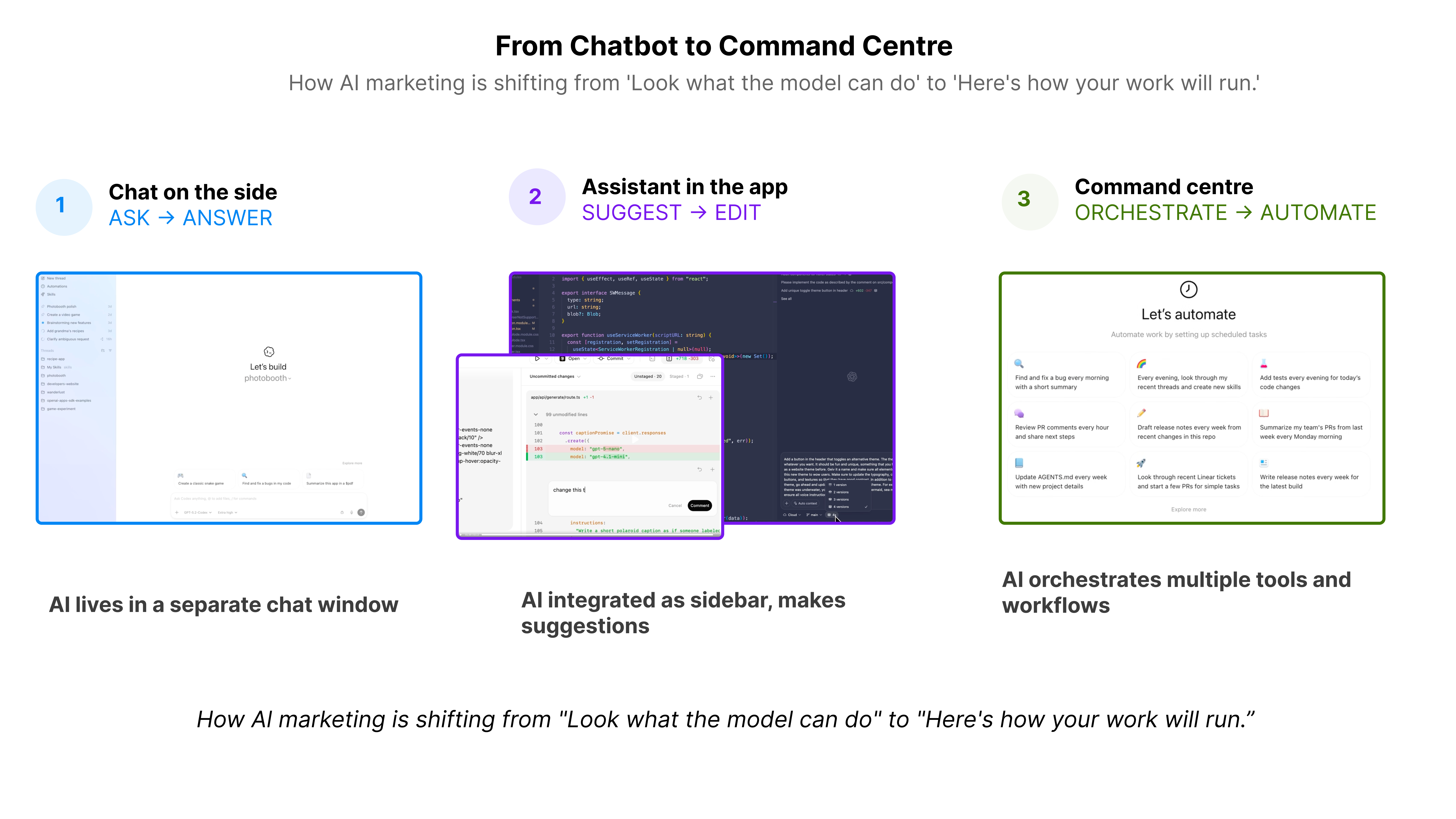
Watch Andrew’s Codex walkthrough and the Prism explainers with that in mind. At first glance they look like straightforward product demos. Look again, and they behave like doctrine.youtube+2
Codex: everyday dev work as liturgy
In Codex:
- We see a real engineer complaining about “the least fun parts of my job”: commit summaries, CI failures, merge conflicts.[youtube]
- We see Sentry pipelines, GitHub PRs and Xcode, not abstract diagrams.[youtube]
- We see scheduled automations that run while he sleeps, carry context across runs, and update shared docs like
AGENTS.md.[developers.openai][youtube]
The message is simple: serious engineers will soon orchestrate work from an AI command centre, with agents quietly handling the queue in the background.
Prism: scientific writing as an AI‑native workspace
In Prism:
- We see a world where LaTeX errors, missing citations and messy diagrams are the villain, not a side note.youtube+2
- We see Prism as the place where your paper, references and AI assistants co‑exist, with multiple chat panels tied to the same document checking conclusions against figures and pulling relevant literature.youtube+3
The worldview is clear:
- Agentic coding: multiple agents working across a real codebase, orchestrated from one command centre.openai+1
- AI‑native research: papers as live environments, not static PDFs; GPT‑5.2 as co‑author and lab assistant, inside your editor.youtube+3
Doctrine needs more than features; it needs ritual and language. That’s why we get:
- “Automations”, “skills”, “worktrees”,
AGENTS.md, “morning pulse” in Codex.openai+1[youtube] - “LaTeX‑native”, “embedded AI”, “academic search and citations”, “whiteboard to LaTeX” in Prism.youtube+2
In an earlier piece on Anthropic, I argued that Claude’s “thinking partner” launch did this in a whisper: almost no interface, but a very clear doctrine of AI as calm, deliberative companion. OpenAI speaks in full sentences instead, yet the core sermon is the same: sell a way of working, not a widget.[suchetanabauri]
Most AI launch videos still behave like one‑night stands: flashy, forgettable, zero ongoing worldview. By contrast, OpenAI’s pieces act like onboarding rituals. They teach you how to imagine your job with AI inside it.
“If your campaign doesn’t give users new vocabulary and rituals, you’re not changing behaviour. You’re just broadcasting.”
The real persuasion shift: from assistant to invisible colleague
The most overused line in AI marketing is some version of “we augment, we don’t replace”. Marketers usually say it over footage of robots doing everything.
Codex and Prism quietly choose a more interesting line: AI as invisible colleague, not chat window.
Agency, not just answers
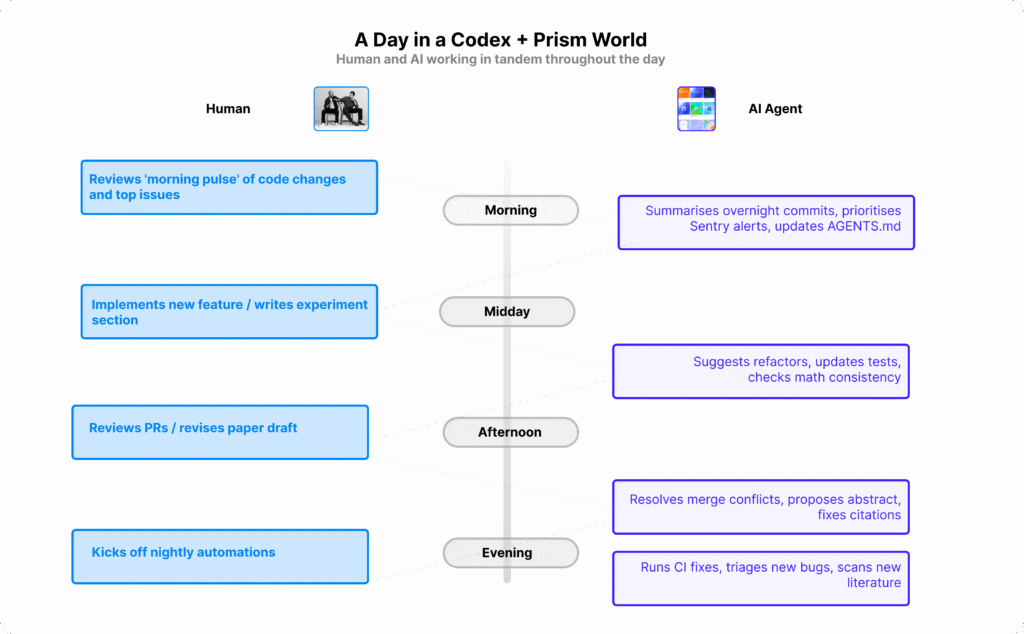
Codex in “Automate tasks” mode doesn’t sit there waiting for prompts. Instead, it:
- Runs on a schedule.
- Carries memory across runs.
- Updates shared documentation and its own skills.
- Fixes CI failures and resolves merge conflicts in the background.[developers.openai][youtube]
That’s the behaviour of a junior engineer or ops teammate, not a toy. Prism in the newer explainers doesn’t just “help you write” either. Rather, it:
- Generates abstracts by reading your actual results.
- Checks whether your conclusions match your charts.
- Manages citations and related work.
- Converts whiteboard scribbles into LaTeX diagrams that actually compile.youtube+3
What you’re seeing is a research assistant with opinions, living in your editor.
Consequently, the value story is no longer “ask a smart thing, get a smart answer”. It’s “set up systems that act without you constantly babysitting them”: scheduled jobs, automated triage, long‑lived context. If your hero shot is still someone typing a witty prompt into a chatbox, you’re frozen in 2023.[sanalabs][youtube]
Delegation of judgement, not just tasks
There’s a second, sharper shift here. When Codex decides which Sentry issue to tackle, or auto‑resolves a merge conflict “based on what people have been trying to do”, it’s exercising judgement. Similarly, when Prism chooses which papers to pull into your references pane, it’s shaping whose work is surfaced and cited. That’s not spellcheck; it’s opinionated automation.youtube+3[openai]
Anthropic’s Claude Sonnet launch hinted at this by positioning Claude as a “thinking partner” rather than a fast typist. OpenAI leans into it more aggressively, but the underlying move is the same: stop pretending AI is just a faster keyboard shortcut; admit it’s making decisions.[suchetanabauri]
A new emotional contract
Finally, notice the mood. There’s no breathless product manager on a dark stage. Instead, you get mildly amused professionals saying, in effect, “this finally fixes the boring bits”. Awe makes nice virals; relief creates daily active use.youtube+2
“Awe makes for viral videos. Relief builds retention.”
A lot of AI marketing clings to awe because it looks good in a deck. In daily work, though, awe is exhausting. Relief is addictive.
Why this matters now: AI fatigue, sceptical buyers, and the workflow land‑grab
All of this is landing in a very specific climate.
By late 2025, enterprise AI had gone from “innovation lab toy” to “please put this everywhere” – and promptly hit familiar walls: governance, hallucinations, change fatigue, plus the realisation that many “AI‑powered” tools were just a chat interface bolted onto existing systems.glean+2
What enterprise AI adoption actually looks like
Analyses of enterprise AI roll‑outs highlight three realities:
- Procurement has learnt to say no. Buying committees have seen enough prototypes to recognise yet another generic chatbot with a slightly different skin.[glean]
- Users have learnt to be wary. They’re juggling tools that promise to save time but quietly add cognitive load, and they’ve all seen hallucinations in the wild.bizdata360+1
- Everyone wants the “AI workspace” layer. Microsoft is pushing Copilot through 365; Asana touts AI Studio for project workflows; Sana pitches agentic orchestration over a raft of connectors.bizdata360+2
Given that backdrop, OpenAI’s move becomes obvious: Codex and Prism are not just apps; they are claims on the orchestration layer.
- Codex wants to be the place where engineering work is planned, automated, executed and reviewed.openai+1[youtube]
- Prism wants to be the default canvas for serious scientific writing and reasoning.youtube+2
If you’re marketing AI in any B2B category, this is your competitive reality: you’re not just fighting peers; you’re fighting platforms that want your product to feel like a feature of their workspace.
“If you don’t own a doctrine of work, you’re just another plug‑in.”
Therefore, your narrative has to answer a harder question: what doctrine of work do we own – inside their ecosystems or despite them?
“AI‑powered productivity” is not an answer. It’s a shrug.
The awkward question: is your “AI story” just UI varnish?
Here’s where most AI marketing quietly collapses.
This week’s pitch deck says:
- “AI summarises your docs.”
- “AI prioritises your tasks.”
- “AI lets you chat with your data.”
Meanwhile, Microsoft can already summarise your inbox and documents. Asana AI already prioritises tasks and drafts status updates. Dozens of vendors let you chat with an index of your Confluence or Notion. When functionality converges, philosophy and specificity become your only honest differentiators.sanalabs+1
Codex and Prism are interesting precisely because they commit to narrow, opinionated worlds:
- Scientific LaTeX workflows – not “content creation”.youtube+3
- Complex engineering pipelines with CI, Sentry, PR queues – not “developers in general”.developers.openai+1[youtube]
The films dwell on specific pains:
- Merge conflicts at 2am.
- Sentry storms no one has time to triage.
- LaTeX compilation errors blocking submission.
- Lost citations and fudged diagrams.youtube+3
AI isn’t a mood here; it’s ritual change. The story is not “what if AI handled the boring stuff”; it’s “this Tuesday ritual will never work the same way again”.
So if your product is genuinely narrow and opinionated, your marketing should be ruthless about that. Show me AI that knows the rituals of:
- A CA firm in Mumbai doing GST and TDS.
- A logistics control room in Chennai juggling driver locations, toll slips and UPI payments.
- A newsroom in Delhi trying to verify sources in three languages before a 4pm edition.
On the other hand, if your product is broad and horizontal by design, your marketing has to stop pretending it’s magic and start being painfully precise about:
- Where in the existing SaaS spaghetti you plug in.
- How you handle governance, audit and compliance (which, notably, OpenAI’s own films still mostly skate past).openai+1[youtube]
- What behaviour change you actually expect from users.
“When everyone can summarise a document, the only differentiation left is what you believe that summary is for.”
Everything vaguer is just more AI wallpaper. It looks current. No one remembers it.
What these campaigns get wrong – and where you can out‑play them
For all their sophistication, Codex and Prism leave big gaps. Those gaps are opportunities.
1. The onboarding blind spot
We see Codex when Andrew already has a tidy universe of automations humming in the background, making him look superhuman. We don’t see:[youtube]
- The first (broken) automation.
- The failed run that spams the wrong Slack channel.
- The half‑hour spent debugging scopes and permissions.
Similarly, we see Prism when the scientist already trusts it enough to accept an AI‑generated abstract or diagram. We don’t see:youtube+2
- The first hallucinated citation.
- The moment the equation checker gets something subtly wrong.
- The conversation about when to credit the AI.
For real buyers, the first 30 days are the whole story. That’s when tools either become “how we work” or “that AI thing we tried”.
If you want to out‑play the platforms, put the messy middle on screen:
- Show misfires, corrections, governance interventions.
- Show rollback; show the kill switch.
- Turn trust‑building into part of the plot, not a nervous FAQ at the end.
Marketers are so afraid of blemishes that they forget: most adults only trust systems that have visibly survived failure.
2. Governance as the missing character
From workflow‑automation blogs to enterprise AI trend pieces, one pattern is consistent: robust AI adoption now sits under councils, security reviews, red‑teaming and board‑level risk appetite. OpenAI’s own Operator pitch – agents that can act on your behalf in the browser – is exactly the kind of thing that sets off security alarms.openai+2
Yet Codex and Prism films largely show lone engineers and scientists adopting powerful tools as if procurement, IT and legal simply do not exist.youtube+2
If you’re selling into any serious organisation, this is fiction. Use that.
- Put the compliance lead, security architect or sceptical PM into your story.
- Dramatise the negotiation between speed and control: what gets automated, what doesn’t, who signs off.
- Show your logging, audit trails, approval flows and policy controls as first‑class features.
In earlier pieces on digital‑assistant UX and proactive AI, I’ve argued that attention, context and consent are now part of the interface. Governance isn’t just a mood; it’s part of the product. Treat it that way.[suchetanabauri]
“In enterprise AI, governance is not a constraint on the story. It is the story.”
3. The global blind spot
OpenAI’s visual world is almost caricature Silicon Valley:
- Sentry dashboards and Linear tickets.
- arXiv PDFs and pristine LaTeX templates.
- High‑bandwidth, English‑first Mac ecosystems.youtube+2
It says very little about:
- Patchy connectivity.
- Mixed‑language workflows.
- Legacy stacks and messy data, which define a lot of Indian and emerging‑market enterprises.bizdata360+1
If you’re building or marketing from Hyderabad, Bengaluru or anywhere similar, this is your wedge.
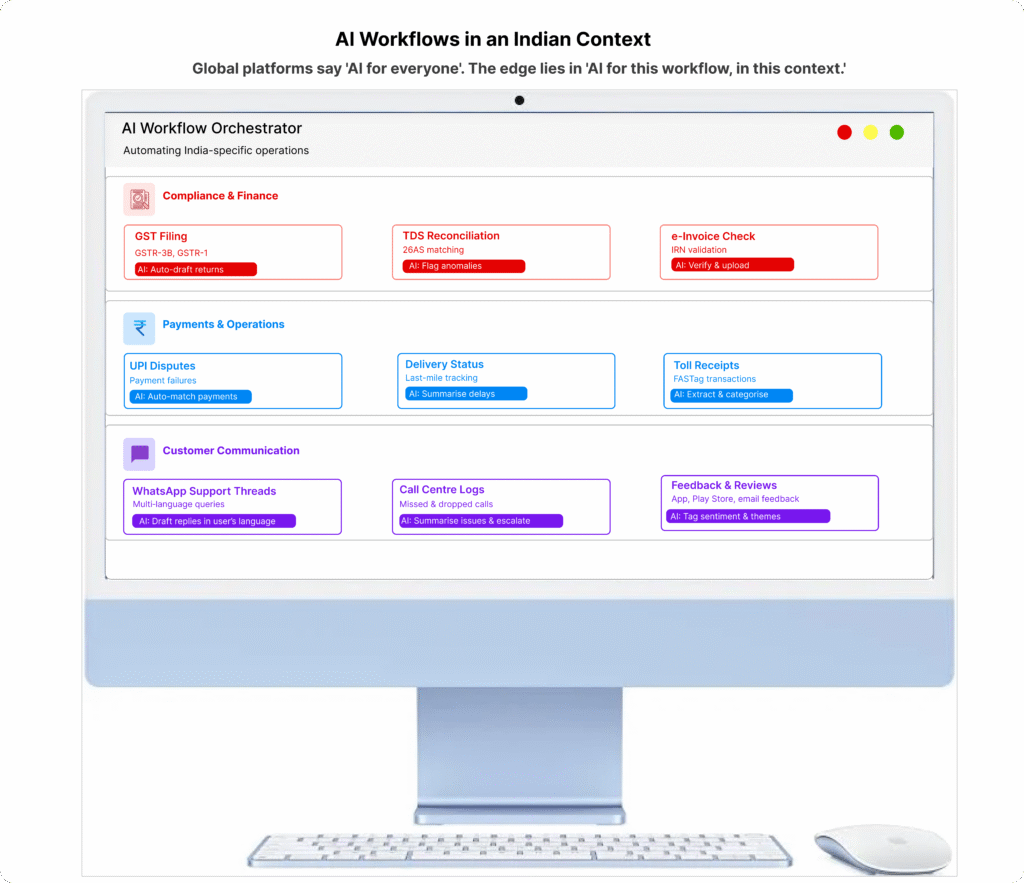
- Tell stories rooted in our frictions: GST filings, UPI disputes, e‑Seva queues, multilingual customer support.[suchetanabauri]
- Show AI working with WhatsApp groups, government portals and old ERPs – not just Slack and Notion.
- Build the visual grammar of an Indian AI‑native workplace, rather than cloning a Bay Area one.[suchetanabauri]
Global platforms will always say “AI for everyone”. The brands that win locally will show they understand someone very specific.
So what should AI marketers actually do differently?
Boil this down and you get a simple, slightly impolite playbook.
1. Stop worshipping the model; market the ritual
- Lead with a day‑in‑the‑life, not a model spec.
- Anchor your story in one recurring ritual where you change the script: the Monday pipeline review, the nightly reconciliation, the weekly editorial conference.
- Give those rituals names users can adopt: automations, playbooks, scripts, skills. Language is part of the product.
“If you can’t point to the meeting or moment your product changes, you’re not marketing a workflow. You’re marketing vibes.”
2. Design content as doctrine, not decoration
- Make fewer, deeper pieces that actually teach people how to live with your product – like Codex’s engineer walkthroughs and Prism’s scientific writing demos.youtube+2
- Be opinionated. Tell people what not to automate, what “good” looks like in your doctrine of work.
- Assume your buyer is doing homework, not scrolling; 10–20 minutes is fine if every minute earns its keep.
If you want a counterpoint in style, Anthropic’s “Claude as thinking partner” shows what it looks like to sell AI mostly through philosophy, with almost no product on screen. OpenAI is the other end of that spectrum: unapologetically product‑heavy, but still about workflows, not wow‑shots.[suchetanabauri]
3. Put trade‑offs on the table
- Acknowledge hallucination risk, bias, mis‑prioritisation and skill atrophy.sanalabs+1
- Show your product constraining itself – approval queues, rate limits, data boundaries – as much as it frees users.
- Use this honesty as a wedge against vendors pretending AI is frictionless.
4. Localise for real workflows, not just language
- Don’t stop at Hindi labels or British spelling. Localise the jobs you help people do.
- In India, that might mean integrations with tally‑style accounting, government portals, vernacular‑heavy content, or field data captured offline.[suchetanabauri]
- Your case studies should sound like a day in the life of a CA in Pune or a supply‑chain manager in Surat, not a generic “knowledge worker” in a co‑working space.
5. Own a doctrine of work, or accept you’re a feature
Most fundamentally, write down – in one uncomfortably clear sentence – what you believe about how your users’ work should feel.
- “No scientist should ever think about LaTeX errors again.”
- “Senior engineers should treat AI as a team of juniors handling the queue.”
- “Every CA should have an AI that understands GST as well as they do.”
That’s doctrine. It’s risky, narrowing, and therefore useful. Doctrine attracts believers. Features attract tourists.
The uncomfortable but useful takeaway
The OpenAI campaigns you’re reacting to are imperfect. They flatten the mess of adoption, sidestep governance, and assume a very homogenous, Western workflow. Even so, they understand something a lot of AI marketers still haven’t faced:youtube+3
“In 2026, the question isn’t ‘what can your AI do?’ It’s ‘what kind of working life are you trying to make normal?’”
Codex sells a world where engineering feels like directing a team that never sleeps, instead of fighting CI and dashboards all day. Prism sells a world where doing serious science feels like thinking about the science, not wrestling with LaTeX and citations.openai+1youtube+3
If your own marketing can’t answer, cleanly, what your product believes work should feel like – for the specific people you serve, in the places they actually work – then no benchmark chart or model name will save you.
That’s the bar now. And whether you cheer for OpenAI or not, Codex and Prism have just raised it for everyone trying to market AI.
External
- Automate tasks with the Codex app
- OpenAI Prism Explained | New AI Tool for Scientists & Researchers
- Mastering Scientific Writing with OpenAI Prism
- OpenAI Just Dropped PRISM: Things Just Got Serious
- OpenAI Prism: Transforming Scientific Writing Through AI Integration
- Introducing Codex
- Codex | AI Coding Partner from OpenAI
- Introducing Operator
- 6 AI productivity tools revolutionizing enterprise workflows 2025
- AI tools for human knowledge
- Top 10 trends in AI adoption for enterprises in 2025
- 10 AI Workflow Trends Transforming Enterprise Automation in 2026
- OpenAI’s Codex: A Guide With 3 Practical Examples
Internal (SB)
- Selling AI Without Showing Product – Claude as a Thinking Partner
- Claude Sonnet Marketing Analysis – How Anthropic Launches AI Without Hype
- OpenAI 10 Years: What the Anniversary Film Doesn’t Say
- ChatGPT Pulse and the Future of Proactive Assistants
- AI Marketing
- Enterprise AI Marketing
- From Indie Frames to Marketing Funnels: How India’s AI Cinema Revolution Inspires Digital Marketers