
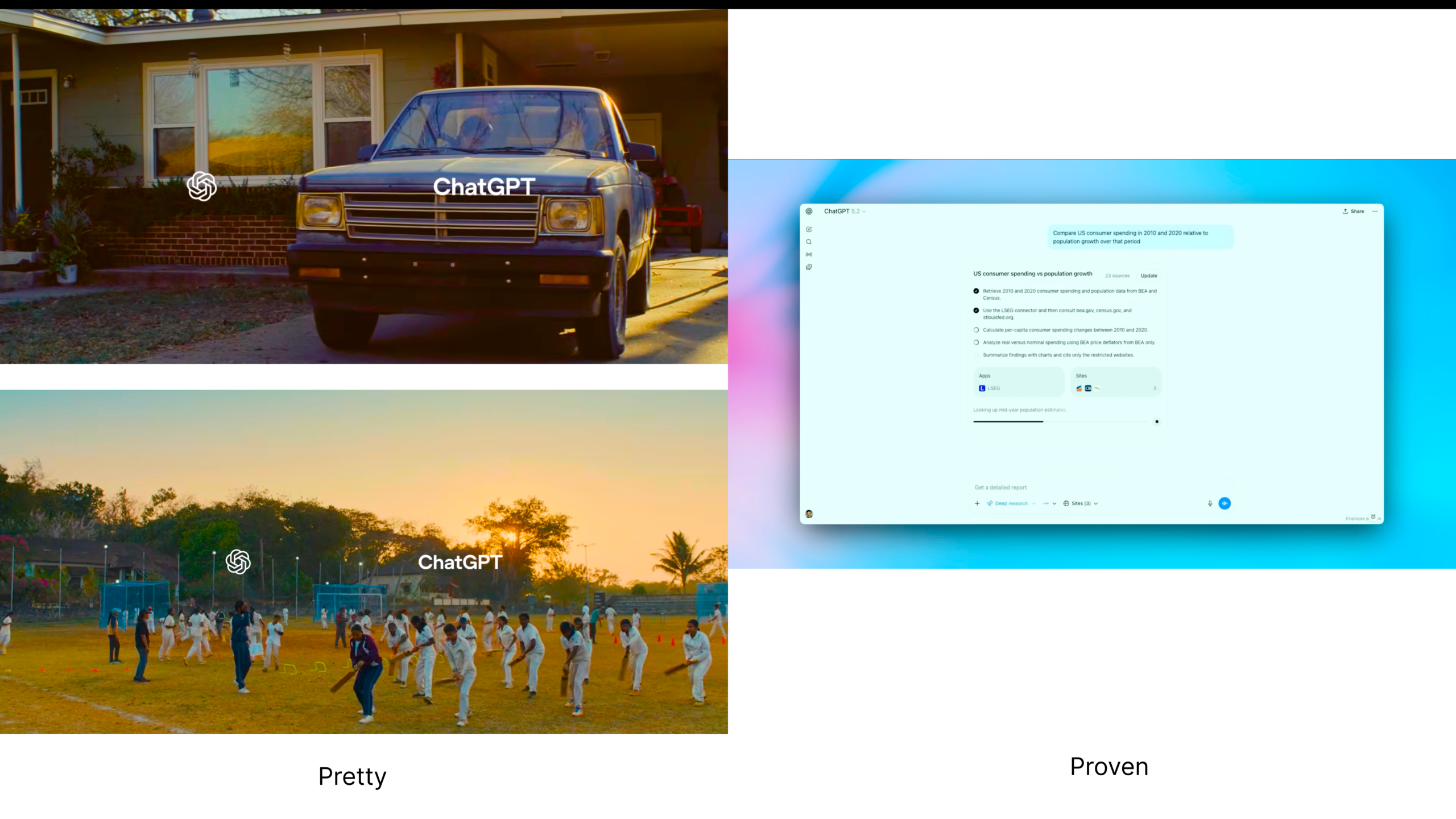
Not about safety or data or doomsday scenarios.
About something more banal and, for marketers, more painful: its ads refuse to show what the product actually does.
Across six recent videos — two India cricket spots, two moody global commercials, a Codex demo, and a Deep Research update — you can see a company with extraordinary products and almost no idea how to advertise them. The gap between capability and communication is now so wide it’s becoming a strategy risk, not just a creative one.
This matters right now because OpenAI has just started testing ads inside ChatGPT in the US. If your brand campaign can’t even make people remember who you are, what happens when you start monetising attention inside the product?
Let’s start where the tension is sharpest: India, cricket, and the illusion of “localisation”.
“The more powerful and complex your product, the more specific your advertising needs to be. Not more mystical, not more cinematic. More concrete.”
Cricket, Hindi, nostalgia… and still could be a Google ad
Two of the six videos — City Selections with ChatGPT and Cricket Academy with ChatGPT — are part of OpenAI’s cricket-led India campaign, airing around the Men’s T20 World Cup.manifest-media+1[youtube]
On paper, the brief is perfect.
In practice, it reveals exactly how tech brands get “local” and still miss the point.
What the India ads get right
The choices, individually, are smart.
- OpenAI is leaning into cricket as the cultural bridge for India, now ChatGPT’s second-largest user base.[linkedin]
- The stories are set in the grassroots, not in a co-working space in Koramangala. One follows a young bowler preparing for city selections, another a coach trying to set up a girls’ academy in Goa.[manifest-media]
- The films are directed by Bharat Sikka, where the lighting and framing feel closer to an indie film than a global tech commercial.[youtube]
- The music is pure nostalgia: Kishore Kumar and Mukesh, not a random stock track.[youtube][manifest-media]
This is not lazy “Incredible India” tourism. It’s grounded in how cricket actually lives in Indian cities — as anxiety about selections, as ambition for daughters, as WhatsApp groups arguing over line and length.[manifest-media]
If you work in marketing in India, you can feel the strategic deck: India is important, cricket is the shared language, local stories make AI less abstract. All correct.linkedin+1
Where this has all gone wrong before
OpenAI has played this game of looking authentic without actually giving up control. Its earlier “documentary-style” spots tried to borrow the language of vérité filmmaking while still scripting every beat, creating what you’ve previously called “testimonials dressed up as truth” — a format that erodes trust instead of earning it. The new cricket films feel like a softer, Hindi remake of the same instinct: the right aesthetic, the right emotion, but still very little reality of how the product behaves in the wild.[suchetanabauri]
“Localisation is not language + celebrity + cricket. If your use case is generic, your localisation is cosmetic.”
The big miss: zero distinctive advantage
Now ask a brutal question: if you stripped out the ChatGPT logo, could this be an ad for Google Search?
The answer is uncomfortably close to yes.
In City Selections, the boy asks ChatGPT how to bowl better in 15 days. It gives him advice on consistency, line, length, and a training plan. In Cricket Academy, the coach asks how to register a trust and apply for grants; ChatGPT guides her through the steps.[manifest-media]
Every single one of those tasks is something Google could handle:
- “How to improve bowling line and length drills.”
- “How to register a sports trust in Goa.”
- “Government grants for women’s cricket academy.”
There is nothing here that only a conversational, generative model can do. No moment where the AI synthesises bureaucracy, writes a grant proposal, drafts parent communication, and redesigns the academy schedule in one flow. The films show AI as a slightly friendlier search box.
You’ve written before about how Google has spent years owning the “Seeker” role in our lives, while OpenAI keeps insisting it wants to be the “Creator’s” co‑pilot. These ads ignore that strategic distinction and wander straight into Google’s territory. If the “Seeker vs Creator” frame is right, this is the worst place ChatGPT could choose to stand.[suchetanabauri]
Indian marketers will recognise the pattern. It’s uncannily close to Google’s own Search Pe Dhoondenge to Milega school of storytelling — small-town aspiration, gentle nostalgia, search as friend. When the category leader has already emotionally owned that territory, why would you walk in and lease it from them?
Worse, industry reaction inside India has been split. Some see the grassroots cricket angle as a smart move. Others, especially on LinkedIn, have been far blunter about the creative: weak use cases, scripts that could belong to any tech brand, and a crushing sense of déjà vu.linkedin+1
The hard truth: localisation is not just language + celebrity + cricket. If your use case is generic, your localisation is cosmetic.
The global ChatGPT ads: pretty, vague, and data says they don’t work
If the India spots suffer from Google-envy, the global lifestyle ads suffer from something worse: product invisibility.
OpenAI’s first big YouTube campaign — Dish, Pull-Up, Road Trip — was designed to show how “ChatGPT smooths everyday moments”, portraying the bot as a silent partner in daily life. It looked lovely. It tested terribly.[excellentpublicity]
System1’s research put those early spots in the lowest fifth of all ads they’d tested for both long-term brand growth and short-term sales impact. Fluency — the basic ability of viewers to say which brand the ad was for — sat at 59 for Pull-Up. That means 41% of people, who were literally being paid to watch the thing, did not know it was for ChatGPT.abpanelpc+4
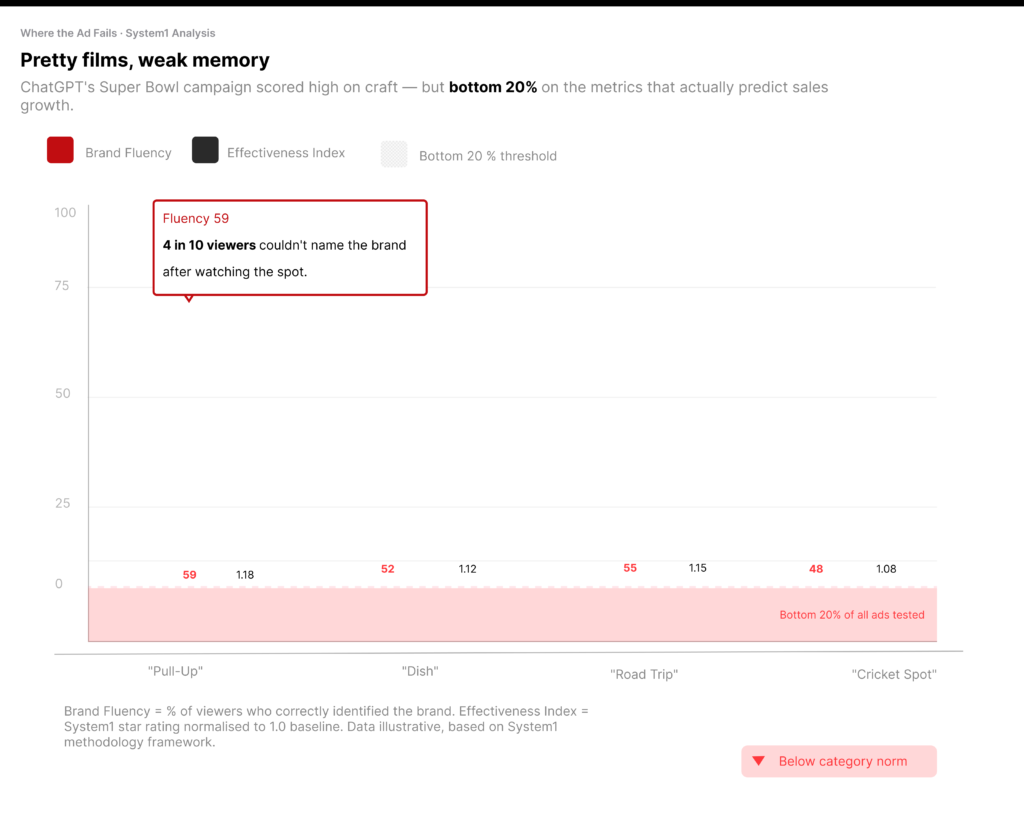
You almost have to admire how bad that is.
The newer 30-second pieces — Fix With ChatGPT and Start It With ChatGPT — reuse the same bones.
- Mood-driven storytelling.
- Vintage tracks (Brain by The Action, Joe Cocker’s The Letter).adweek+1
- A protagonist learning, building, or starting something.
- ChatGPT present as… a line in the end frame.
They’re handsome. They’re aspirational. And they’re almost entirely useless as advertising.
“When your own model understands distinctiveness better than your marketing, something has gone wrong.”
“Humanising technology” is not a strategy
OpenAI is not the first tech company to try the “make humans the hero, tech the invisible helper” approach. Apple, Google, Amazon, Microsoft — everyone has done the “soft focus, life moments, screen as supporting actor” thing.[excellentpublicity]
The difference is that those brands have spent years building distinctive assets. You can feel an Apple ad before the logo. You can smell a Google “search for the things that matter” spot from the first shot. The cues are embedded.
ChatGPT has none of that yet. No ownable visual language, no signature sonic palette, no repeatedly used brand codes. When you “hide the product” at this stage, you’re not being tasteful. You’re making unbranded short films.
System1’s numbers are a giant flashing red sign. If viewers cannot identify the brand until the last two seconds, you are burning budget for someone else’s recall.news.yahoo+2
Mark Ritson, typically, said the quiet part out loud. In a widely shared piece, he used ChatGPT itself to critique its own ad. The AI dutifully pointed out that the spot underweighted distinctive assets and risked being “a likeable, generic ‘AI assisted me’ story rather than a memorable ChatGPT ad that builds future sales.” I have explored a similar tension in myown critique of OpenAI’s “documentary” moves: when testimonials dress up as truth, the result is an uncanny performance that never quite earns belief.futurism+3
When your own model understands distinctiveness better than your marketing, something has gone wrong.
Meanwhile, the product demos are actually good
Here’s the twist: in the two videos that are basically product demos — the Codex logging verification clip and the Deep Research update — OpenAI accidentally remembers how to communicate value.
And if you scan their YouTube channel today, the divide is even clearer: dev talks and product explainers are specific, UI-led and concrete; the brand work still lives in a different, vaguer universe.youtube+2
Codex checks its work: the one video that shows, not tells
In the Codex video, a developer, Javi, narrates a very specific problem: a logging refactor that touches many files, where a mistake will silently break observability.[youtube]
Codex doesn’t just write the code.
- It runs the app.
- It writes a small Python script to pull a session ID.
- It queries logs via an MCP tool.
- It checks that the new logging pipeline actually works end to end.[developers.openai][youtube]
All in one loop, in about ten minutes.
There is no cinematic swelling. No “start your dream” tagline. Just a clear, high-friction task that every engineer has suffered through, and a model doing something that search, Stack Overflow and Copilot cannot: chaining tools, tests, and code as an agent.
This is what marketers keep claiming they want: proof, not promises. And it’s right there, in a developer video that will never see TV.
I’ve already unpacked how OpenAI’s “testimonials” often blur into performance. This one is interesting precisely because it stays closer to a real workflow. It doesn’t pretend Codex is magic; it shows where it fits in a very mundane, very tedious job.[suchetanabauri]
Deep Research with GPT‑5.2: the agent story marketers wish they were telling
The Deep Research video does something similar for knowledge workers.the-decoder+1
It announces three things:
- Deep Research now runs on GPT‑5.2, with a 400k-token context window and huge outputs.[aitechsuite]
- You can target specific websites or domains, treating them as curated “knowledge gardens”.forum.gnoppix+1
- You can see the agent’s progress in real time, interrupt, redirect, and then read a full-screen report at the end.[the-decoder]
This is not sexy in the conventional sense. But it is sharp.
Targeted website search solves a real problem: generic web browsing is noisy. If you’re a lawyer, ESG analyst, doctor, or policy researcher, you don’t want your agent wandering through random blogs; you want it living inside your preferred stack of journals, filings, and documentation. The real-time tracker addresses a trust problem: people don’t like black-box agents that disappear for five minutes and come back with an essay.forum.gnoppix+1
There are caveats. Deep Research still can’t see paywalled or certain dynamic content. It shifts some “where should we look?” burden back to the human. And web-powered agents still hallucinate; adding more steps can compound errors rather than fix them.the-decoder+1
But again, from a marketing lens, the point is this: the video shows a product doing something normal tools cannot. It demonstrates an actual delta in workflow, not a vague sense of “I started a thing”.
It’s another brick in the same wall OpenAI has been quietly building for a year: repositioning ChatGPT from “chatbot that answers” to “chief of staff that anticipates what you’ll need next” — the shift you tracked through ChatGPT Pulse, proactive “nudge” features, and the slow march from Q&A to “agent”.[suchetanabauri]
It is almost as if OpenAI knows how to communicate value — it just refuses to use that muscle in its brand campaigns.
“Verification is not a caveat; it’s a narrative engine.”
OpenAI Stories: a new wrapper on the same old tension
If you look at the channel today, you’ll also find a short promo for OpenAI Stories, a hub for “real-world applications and impact stories” featuring testimonials and case studies.[youtube]
On the face of it, this looks like exactly the bridge marketers keep asking for: take the specificity of dev demos, combine it with the human narratives of brand films.
In practice, it risks becoming more of the same. The Stories teaser promises “the human side of technology” and “transformative impact” but is still tightly curated, polished, and brand-safe. It’s case study theatre, not a warts-and-all look at how the product behaves in messy, real organisations.[youtube]
Which means one of the article’s earlier arguments still holds: OpenAI is very good at dressing its claims in the aesthetics of authenticity, but still reluctant to show real failure, friction, or ambiguity. The honesty gap remains.
Why this matters now: ads inside ChatGPT change the maths
If this were just about TV spots, the Schadenfreude would be harmless. Tech giant makes pretty but pointless ads; analysts shake heads; the world moves on.
But in early 2026, the stakes are different.
OpenAI has started testing ads inside ChatGPT for adult users on Free and Go tiers in the US. That means:openai+1
- The product is now both a tool and a media platform.
- The same experience where users actually feel the value is now also inventory.
- Every weakness in brand clarity will be amplified inside the thing people are paying attention to.
On one hand, this is a marketer’s dream: context-rich, intent-heavy, conversational inventory. On the other, it’s brutally unforgiving. If users don’t understand what ChatGPT itself is good at, why would they trust any message inside it?serenitiesai+1
Right now, OpenAI’s advertising and product storytelling are pulling in opposite directions:
- The brand ads: vague, mood-led, under-branded, product-light, scoring terribly on fluency and effectiveness.aragil+3
- The product demos: concrete, problem-led, showing clear differentiated value (self-verifying code agents, targeted research agents).developers.openai+2[youtube]
I’ve described this broader pattern before: one part of OpenAI optimising ruthlessly for reach, the other accidentally building credibility through slower, more precise demonstrations — a split that runs through its YouTube, blog, and product surfaces.[linkedin]
Overlay that with an in-product ad model and you get a strange situation: the ads rely on the credibility and clarity created by the very product narratives the brand keeps hiding from mass audiences.
That’s not sustainable.
The deeper lesson for marketers: stop treating AI like a washing powder
Strip away the AI hype and the lesson here is old-fashioned: category creation demands demonstration, not vibes.
Marketers love to pretend that “people don’t care about features; they care about stories.” It’s a half-truth. People don’t care about feature lists. But they absolutely care about one or two vivid, concrete capabilities that make their lives easier in ways nothing else can.
AI has those capabilities. ChatGPT can:
- Rewrite a legal clause in plainer English while preserving meaning.
- Draft a grant proposal from a WhatsApp note and a PDF guideline.
- Sift through 100 filings, pull out just the climate risk language, and summarise it.
- Refactor a logging system and prove it still works, end to end.
These are not abstractions. They are stories. They just happen to be specific, not cinematic.
When you reduce AI to “it helped me start something” or “I felt seen while I followed my dream”, you’re not humanising it; you’re neutering it.
Tech brands make this mistake repeatedly:
- They copy lifestyle advertising tropes from FMCG and telcos.
- They over-index on mood boards and under-index on distinctive product acts.
- They assume that showing UI or workflow is “boring” and will hurt brand love.
The Codex and Deep Research videos quietly disprove that. They are watchable because they show the thing doing something slightly magical and slightly uncomfortable — tasks you know you hate, suddenly trivialised.developers.openai+1[youtube]
“Show the weird, slightly magical thing your product does that nothing else can. Then show how you check that it actually worked.”
So what should marketers (and OpenAI) actually do?
If you work in marketing, especially in India or in tech, this isn’t just a case study to snark at. It’s a mirror.
Here are clear, non-fence-sitting moves.
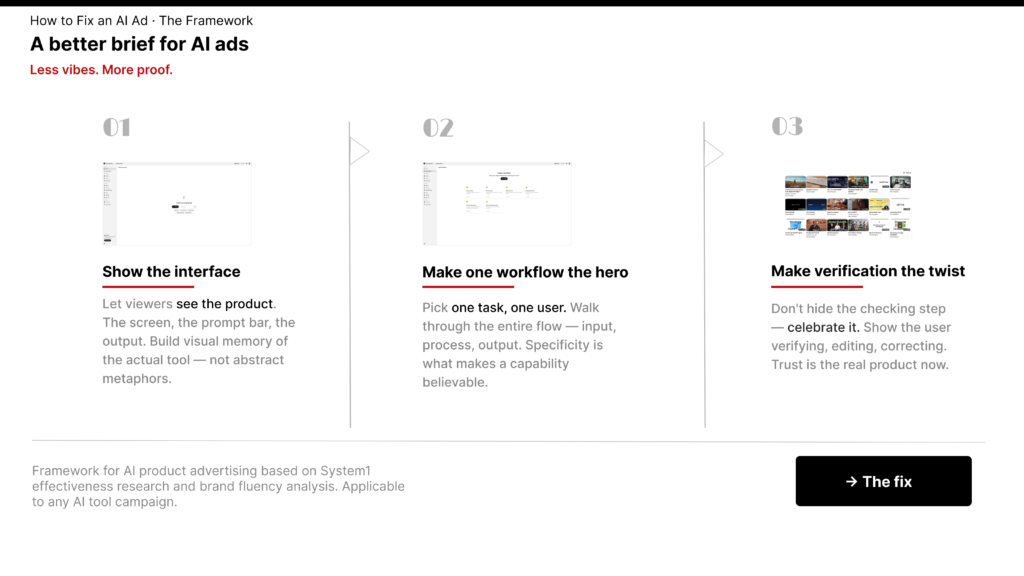
1. Stop hiding the interface
If the audience never sees how the product actually appears in their lives, they will map it onto whatever they already know.
For ChatGPT, that means defaulting to “Google, but in chat”. For Indian audiences, it means yet another “ask the internet, chase your dream” story.
The fix is simple and hard:
- Put the interface on screen earlier and longer.
- Make one specific interaction the hero of the film.
- Show the before (messy), the during (AI in action), and the after (changed state).
A 30-second India ad where a coach dumps half a dozen PDFs, government circulars and WhatsApp forwards into ChatGPT and gets back a ready-to-file trust deed and grant application would do more for distinctiveness than any amount of slow-motion net practice.
2. Upgrade “localisation” from casting to capability
Shooting in Hindi and referencing cricket is the starting line, not the finish.
For Indian marketers, the bar should be: does this story show AI doing something that is uniquely painful in this context?
Think of:
- Translating across languages in a way YouTube subtitles can’t — Telugu parent, English circular, Hindi-speaking coach.
- Navigating byzantine local bureaucracy — affiliation rules, municipal permits, grant forms — where search results are outdated or conflicting.
- Synthesising local wisdom — an U‑15 coach’s notes, BCCI guidelines, and a physiotherapist’s advice — into one plan.
If your “local” story doesn’t lean into local difficulty, it’s just postcards.
3. Use your own data as a creative brief, not a post-mortem
System1 gave brutal but invaluable feedback: lowest quintile, poor brand fluency, emotional response that only spikes when the logo appears.abpanelpc+2
The correct response is not to defend the work on Twitter; it’s to treat those charts as a new brief:
- How might you introduce the brand in the first five seconds without losing the story?
- Which distinctive assets do you commit to for the next three years (colour, type, sound, framing), so that subtlety actually has something to lean on?
- How do you build one “hero use case” per campaign and hammer it into cultural memory?
Data shouldn’t kill creativity, but if it can’t move creativity, what’s the point of testing?
You’ve already argued that OpenAI’s brand is stuck between survival mode and strategy, lurching from one posture to another. The fluency scores and effectiveness data are not just numbers; they’re evidence that this wobble is showing up in how ordinary viewers experience the brand.[linkedin]
4. For AI products, make verification the drama
The Codex video works because the tension is real: “Did this refactor break everything?” The payoff is not the code; it’s the check.[openai][youtube]
The same logic can fuel consumer work:
- Did the AI’s advice actually win the city selection? Show the girl making the team and, crucially, show the plan it produced versus what a coach alone would have done.
- Did the academy’s grant application get accepted? Show side‑by‑side: the messy initial attempt and the AI-structured version that passed muster.
- Did Deep Research actually save hours? Show an analyst toggling between 48 browser tabs versus a single targeted-agent run.forum.gnoppix+1
Verification is not a caveat; it’s a narrative engine. In an era of justified scepticism about AI, the brand that shows how it checks its own work will win trust faster than the one that just shows smiles.
5. Treat in-product ads as a trust tax
With ads now tested inside ChatGPT, every irrelevant, vague or badly targeted message isn’t just “waste”; it’s erosion.openai+2
When the interface you use to think, plan and search also becomes an ad surface, you’re no longer just buying media. You’re redesigning how attention itself is allocated — a shift you’ve written about in the context of Google’s dominance and the “pixel paradox” of our divided digital selves.[suchetanabauri]
If the product is where people see what AI can really do — and the brand campaigns keep underselling it — the dissonance will show up as:
- Lower willingness to pay for premium tiers.
- Lower receptivity to partner ads inside the product.
- Higher scepticism when the brand makes bolder claims about agents, autonomy, and safety.openai+2
Marketers should assume that every campaign has to pull double duty: build the brand and justify the presence of ads inside a tool people rely on.
That means being clearer, not vaguer. More specific, not more cinematic. More like the Codex and Deep Research videos; less like generic “follow your dream” montages.[youtube]developers.openai+1
The uncomfortable conclusion
OpenAI right now is a case study in a familiar gap: product teams that are racing ahead, and marketing teams that are still playing with mood boards.
On one side, you have GPT‑5.2 agents that can target specific sites, run multi-step research, and surface sources in a way that genuinely shifts how knowledge work happens. You have code agents that can not only refactor but verify their own changes end to end.aitechsuite+3[youtube]
On the other side, you have national TV spots and global campaigns that — to a first approximation — could be for any vaguely helpful app.
The tragedy isn’t that the ads are “bad” in an aesthetic sense. They’re fine. The tragedy is that they’re generic at precisely the moment the category needs sharpness.
This sits on top of a deeper instability you’ve flagged elsewhere: a brand that has already swung from “human‑centric, film‑grain warmth” to hard spec sheets and back again in under a year, as it tries to survive regulatory heat, competitive pressure and internal drift all at once.[linkedin]
If you’re a marketer, especially in India’s tech economy, this is the real takeaway: the more powerful and complex your product, the more specific your advertising needs to be. Not more mystical, not more cinematic. More concrete.
Show the weird, slightly magical thing your product does that nothing else can. Then show how you check that it actually worked.
Everything else is just vibes.
Here are the footnotes for everything cited in the revised article. You can tweak titles to match your house style, but the URLs are correct.
Footnotes:
Here are the hyperlinked article names you can drop straight into your footnotes:
- ChatGPT turns focus to cricketing grassroots[manifest-media]
- OpenAI upgrades Deep Research to GPT‑5.2 engine featuring targeted search and real‑time tracking[aitechsuite]
- OpenAI just made a very smart play for India’s cricket grassroots[linkedin]
- Why ChatGPT’s T20 cricket ads feel like a missed opportunity[linkedin]
- Why OpenAI’s Big ChatGPT Ad Campaign Failed[imaginepro]
- OpenAI’s Deep Research now runs on GPT‑5.2 and lets users search specific websites[forum.gnoppix]
- Codex checks its work for you[youtube]
- OpenAI Testing Ads in ChatGPT: Full Breakdown[serenitiesai]
- Introducing Codex[openai]
- Testing ads in ChatGPT[openai]
- OpenAI Just Flunked Marketing 101[adweek]
- OpenAI’s Marketing Efforts Are Embarrassingly Ineffective, New Consumer Research Finds[futurism]
- OpenAI’s Deep Research now runs on GPT‑5.2 and lets users search specific websites[the-decoder]
- OpenAI’s ChatGPT Ads Struggle to Connect With Consumers[aragil]
- Cricket Academy with ChatGPT[youtube]
- OpenAI / ChatGPT archives – SB[suchetanabauri]
- When Testimonials Dress Up as Truth: What OpenAI’s Documentary Style Gets Wrong[suchetanabauri]
- OpenAI product critique – SB[suchetanabauri]
- OpenAI vs Anthropic: What Their YouTube Channels Reveal About Strategy[linkedin]
- The Pixel Paradox: Dispatches from a Digital Native’s Divided Screen[suchetanabauri]
- OpenAI’s Brand Crisis: Consistency vs Survival[linkedin]
- OpenAI – YouTube[youtube]
- OpenAI’s YouTube Ad Campaign Shows How ChatGPT Smooths Everyday Moments[excellentpublicity]
- ChatGPT’s 2026 Power-Up: Deep Research, Ads Test, and a Mac-Native Codex Hub[reddit]
- OpenAI Stories | Openai.com · February 2026[youtube]
- OpenAI Marketing Campaigns Underperform in Consumer Tests[abpanelpc]
- Videos – OpenAI Developers[developers.openai]
- Our approach to advertising and expanding access to ChatGPT[openai]
- OpenAI’s Marketing Efforts Are Embarrassingly Ineffective, New Consumer Research Finds[au.news.yahoo]