
On December 11, OpenAI released a 67-second anniversary video marking ten years since its founding. The film features sweeping shots of empty offices, pensive researchers staring at screens, and inspirational piano music. Moreover, it contains precisely zero information about what actually happened during those ten years.
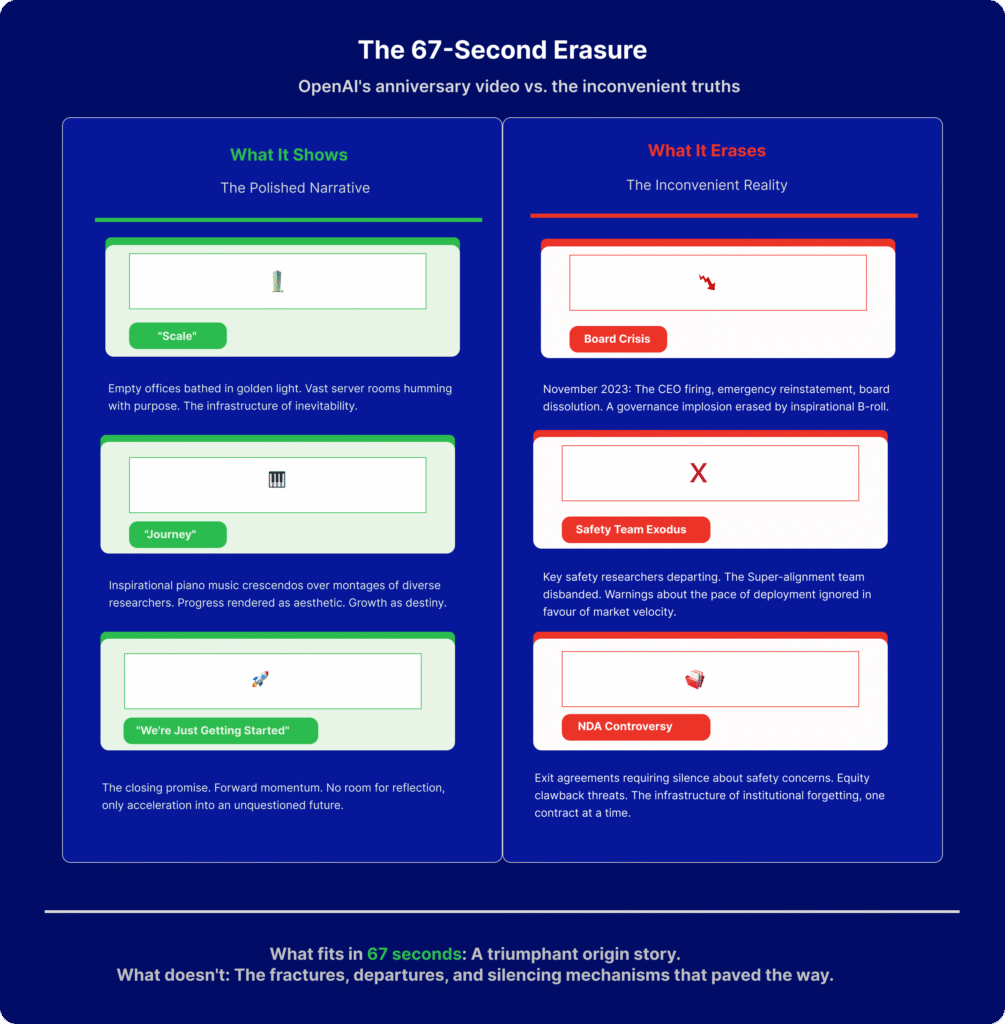
This isn’t modesty. Instead, it’s strategic amnesia.
What the Video Claims
Here’s what the video says: “10 years ago, AI could not tell the difference between dogs and cats.” Then: “We weren’t quite sure what we had, but we believed in scale, so we kept going.” Finally: “We really are just getting started.”
However, here’s what the video leaves out: everything that matters.
The Commercial Triumph Nobody’s Discussing
OpenAI’s financial performance is extraordinary. The company hit $10 billion in yearly revenue in June 2025, nearly doubling from $5.5 billion the previous year. By mid-2025, the company was generating $13 billion in yearly revenue. This represents 243% year-over-year growth.
Furthermore, ChatGPT now serves 800 million weekly active users, up from 400 million in February 2025. The platform has 20 million paying subscribers, commanding 69.9% market share.
Additionally, OpenAI now counts over 1 million business customers, with 92% of Fortune 500 companies using ChatGPT.
Enterprise Growth Speeds Up
Enterprise adoption has grown rapidly. ChatGPT Enterprise seats grew 9x year-over-year. Business users increased 50% in six months, reaching 3 million paying business customers by June 2025.
Moreover, the company’s valuation reached $300 billion after raising $40 billion—the largest private funding round in history. Some estimates now place OpenAI’s valuation at $500 billion.
These aren’t modest achievements. Instead, this is complete market control.
The Crisis Nobody’s Talking About
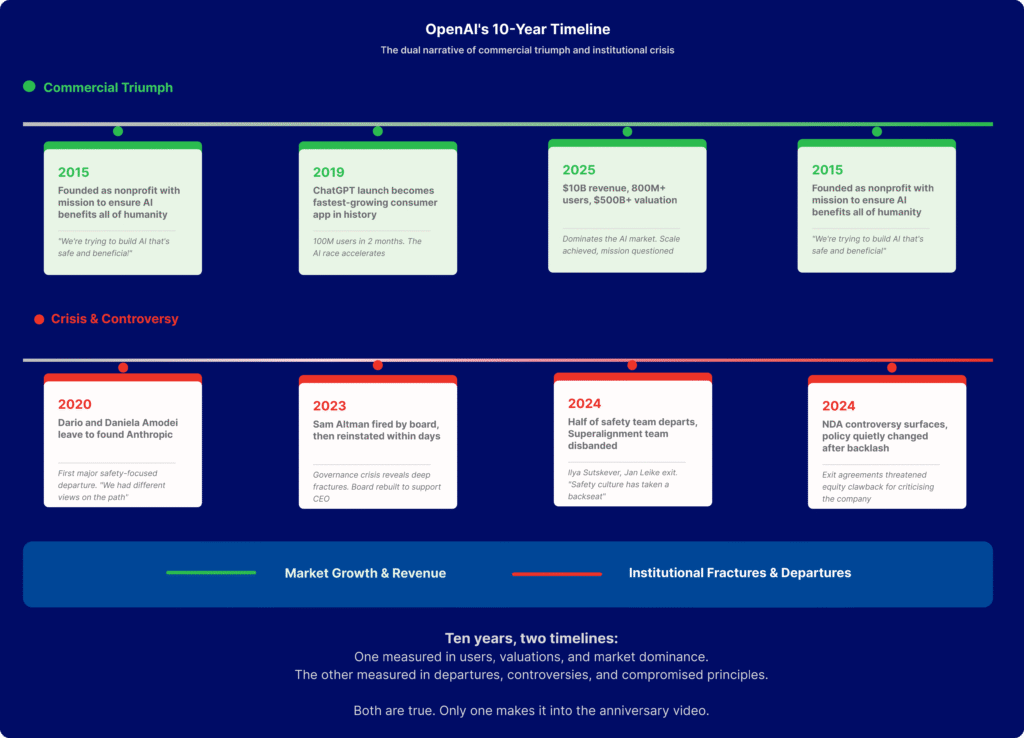
None of this appears in OpenAI’s anniversary video. Neither does the November 2023 board crisis. On that date, CEO Sam Altman was suddenly fired on November 17. Then, he was brought back five days later after more than 700 employees threatened to resign.
The board’s stated reason: Altman “was not consistently candid in his communications with the board”. However, the real reason involved disagreements over the pace of AI development and how OpenAI was addressing potential harms.
The Sutskever Contradiction
Crucially, chief scientist Ilya Sutskever led Altman’s firing. Nevertheless, he then publicly expressed regret and signed the employee letter demanding Altman’s return.
Subsequently, he left OpenAI in May 2024 to found Safe Superintelligence—a company focused on developing safe AGI outside OpenAI’s commercial pressures.
The Safety Team Exits
Sutskever’s departure was part of a bigger pattern. Nearly half of OpenAI’s AGI safety team left by 2024. The list includes several key figures.
Nearly half of OpenAI’s AGI safety team left by 2024. The list includes several key figures. They cited concerns about OpenAI’s Microsoft partnership shifting focus from safe AI to commercial interests.
Key Departures
Dario and Daniela Amodei left in late 2020. They cited concerns about OpenAI’s Microsoft partnership shifting focus from safe AI to commercial interests. They founded Anthropic, which now generates $1 billion in yearly revenue from Claude Code alone.
Similarly, Jack Clark, former Policy Director, left in early 2021 to join Anthropic’s founding team. He was motivated by concerns over governance and transparency.
Additionally, Daniel Kokotajlo, governance researcher, left in spring 2024, losing confidence in OpenAI’s ability to act responsibly. He refused to sign restrictive NDAs to maintain his voice.
Furthermore, Miles Brundage and Suchir Balaji left in August 2024 after concluding OpenAI was breaking copyright law in training its models.
The Scale of Departures
By August 2024, around half of OpenAI’s safety-focused staff had left. Moreover, the company disbanded its “superalignment team” entirely.
The NDA Problem
Former employees faced restrictive non-disparagement agreements that threatened vested equity. Employees had to choose: give up OpenAI stock or remain silent about safety concerns.
However, following public anger and media coverage in May 2024, CEO Sam Altman apologised. He claimed he was unaware of the clause. Subsequently, OpenAI abolished the non-disparagement agreements.
Nevertheless, the fact that eleven former employees contributed anonymously to a June 2024 open letter—with only seven willing to attach their names—suggests many still felt legally constrained.
The Strategic Forgetting Problem
None of this complexity appears in OpenAI’s anniversary video. Instead, we get corporate statements: “We believed deep learning could go very far.” “Some of our experiments worked, some didn’t.” “We really are just getting started.”
This isn’t humility. Rather, it’s avoidance. Consequently, OpenAI has wasted the most valuable story asset in modern technology: a decade of genuine struggle and organisational tension.
OpenAI has wasted the most valuable story asset in modern technology: a decade of genuine struggle and organisational tension.
What Honest Storytelling Would Look Like
An honest anniversary video might acknowledge: “We began as a nonprofit committed to developing safe AGI. Then we changed to a capped-profit entity to attract capital. That decision created tensions. Some of our most talented researchers left because they felt we put scale over safety. We’ve made mistakes. We’ve learned. We’re still figuring this out.”
Instead, OpenAI chose vague inspiration. The result: a video that feels less like reflection and more like strategic forgetting.
The Trust Problem in AI Marketing
This matters because trust in AI companies is already weak. More than half of people globally are unwilling to trust AI, according to KPMG’s 2025 global study.
More than half of people globally are unwilling to trust AI. The gap—marketers rushing ahead, users pulling back—is the central problem of AI marketing today.
Meanwhile, 92% of marketing professionals now use AI, but consumers are growing uneasy. The gap—marketers rushing ahead, users pulling back—is the central problem of AI marketing today.
Why People Reject AI Recommendations
Research shows that algorithm aversion causes people to reject AI recommendations even when they outperform humans. Furthermore, there’s default doubt towards systems that replace human judgement.
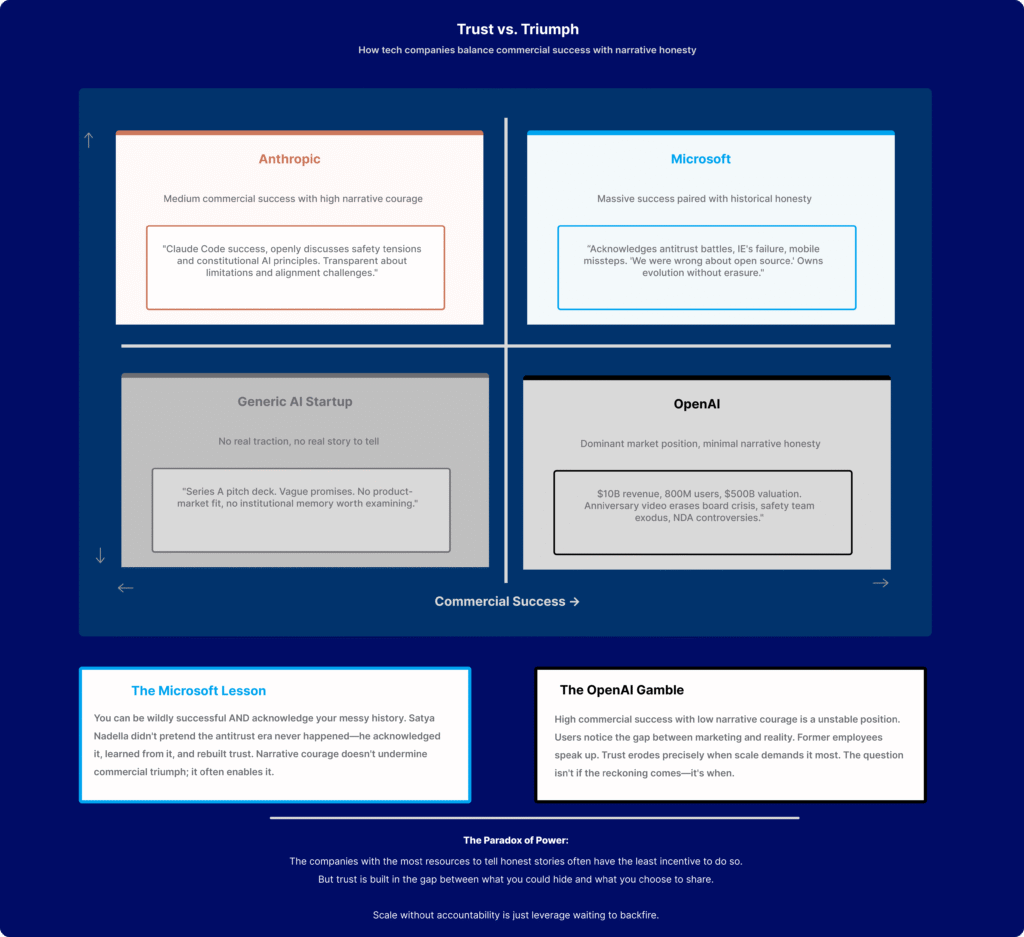
Therefore, brands using AI face a trust problem: if they double down on secrecy and fake authenticity, they’ll push customers away.
OpenAI’s anniversary video shows this failure. By refusing to acknowledge complexity, OpenAI reinforces the view that AI companies put growth over responsibility.
Learning from Microsoft’s 50th Anniversary
Contrast this with Microsoft’s 50th anniversary campaign, which deliberately avoided nostalgia. Instead, it focused on forward-looking themes. Microsoft acknowledged its history whilst positioning for the future. The campaign worked because it felt honest about Microsoft’s evolution.
In contrast, OpenAI’s video feels like fake humility. It performs the look of deep thinking whilst avoiding real engagement with OpenAI’s actual decade.
The Success Problem: Triumph That Can’t Be Celebrated
Here’s the contradiction: OpenAI is commercially dominant yet unable to tell its story. The company projects $125 billion in revenue by 2029. It’s valued at up to $500 billion. ChatGPT has become infrastructure for knowledge work.
OpenAI is commercially dominant yet unable to tell its story. The company projects $125 billion in revenue by 2029. It’s valued at up to $500 billion. ChatGPT has become infrastructure for knowledge work. Yet OpenAI can’t fully celebrate this success.
Yet OpenAI can’t fully celebrate this success. Why? Because doing so requires acknowledging the trade-offs that enabled it.
The Nonprofit to Profit Change
The company moved from nonprofit idealism to capped-profit reality. That shift attracted capital but pushed away researchers. It enabled scale but created governance tensions. It delivered commercial triumph but arguably compromised the founding mission.
An anniversary video that acknowledged this would connect with audiences. Instead, OpenAI chose inspirational images. The message: we’re heroes on a journey. The hidden message: please don’t ask about the journey’s actual details.
What Marketing Professionals Should Learn
The bigger lesson for marketing professionals: authenticity isn’t optional in the AI era. Audiences reward brands willing to show complexity, mistakes, and genuine human stakes. They punish brands that fake vulnerability whilst maintaining strategic secrecy.
Authenticity isn’t optional in the AI era. Audiences reward brands willing to show complexity, mistakes, and genuine human stakes. They punish brands that fake vulnerability whilst maintaining strategic secrecy.
OpenAI’s anniversary video shows what happens when commercial success and ethical complexity meet a corporate communications strategy designed for simpler times. The result: a brand story that feels both triumphant and evasive.
The Data on Emotional Marketing
Research on emotional marketing confirms that emotionally charged content vastly outperforms rational messaging. Brands that make customers feel appreciated see 76% retention, 80% increased spend, and 87% recommendation rates.
However, emotional connection requires trust. Moreover, trust requires honesty.
OpenAI has the commercial numbers. It lacks the story courage to match.
The Road Forward: Can OpenAI Rebuild Trust?
OpenAI’s challenge isn’t technical. The models work. The revenue grows. Enterprise adoption speeds up. The challenge is telling the story: how does a company celebrate commercial control and acknowledge the philosophical compromises that enabled it?
The answer isn’t more inspirational piano music. Instead, it’s genuine engagement with complexity. This means acknowledging researchers who raised legitimate concerns. It means discussing how money-making tensions shaped product decisions. It means admitting that building beneficial AGI involves genuine uncertainty, not just optimistic perseverance.
Treating Audiences as Adults
Microsoft’s 50th anniversary campaign deliberately avoided nostalgia.
Therefore, for marketing professionals managing AI product launches, the lesson becomes clear: being close to transformative technology does not excuse you from basic storytelling work. The brands winning emotional loyalty are those willing to show vulnerability, complexity, and genuine human stakes.
Consequently, OpenAI’s refusal to engage meaningfully with its own story represents a massive waste of brand value.
The 67-Second Verdict
Ten years in, OpenAI has achieved more than most organisations accomplish in a lifetime. Yet its anniversary video suggests a company too successful to be honest, too commercially triumphant to acknowledge the costs of that triumph.
That’s not modesty. Instead, it’s strategic failure disguised as humility.
The 67 seconds of inspirational footage tell us less about OpenAI’s decade than what they deliberately leave out. In an era demanding authenticity, OpenAI chose erasure. The question isn’t whether the strategy will work commercially—OpenAI’s revenue proves it already has.
Rather, the question is whether it will work for the story, in a marketplace where trust is the scarcest resource and honesty the rarest currency.
For more analysis of how AI companies handle brand authenticity, explore my examination of when testimonials dress up as truth, Google’s marketing contradictions, and Anthropic’s enterprise positioning.
Sources
OpenAI Anniversary & Leadership:
- 10 years anniversary video — OpenAI YouTube (Dec 11, 2025)
- Sam Altman reflects on OpenAI’s 10-year journey — Economic Times (Dec 11, 2025)
- OpenAI turns 10 today: Where will it be in another decade? — Fast Company (Dec 11, 2025)
- OpenAI has achieved more than I dared to dream possible — Free Press Journal (Dec 11, 2025)
- OpenAI is now 10 years old mission statement analysis — PC Gamer (Dec 12, 2025)
Board Crisis & Sam Altman Firing:
- Timeline of Sam Altman’s firing and return — Axios (Nov 22, 2023)
- Sam Altman returns as OpenAI CEO timeline — Time (Nov 21, 2023)
- How crisis at OpenAI over Sam Altman unfolded — The Guardian (Nov 25, 2023)
- Timeline of OpenAI’s drama with Sam Altman — Observer (Nov 19, 2023)
- Timeline of the OpenAI crisis — CoinGeek
- OpenAI saga with CEO Sam Altman timeline — Mashable
- What happened at OpenAI? A timeline — CPO Club
AI Safety Departures & Controversies:
- Key OpenAI departures over AI safety concerns — Reddit /r/ControlProblem (Feb 25, 2025)
- OpenAI departure of AI safety expert Miles Brundage — Fortune (Oct 23, 2024)
- OpenAI disbands long-term AI safety team — Times of India
- OpenAI’s turbulent week: resignations and controversies — Marketing AI Institute (Sep 30, 2024)
- Biggest AI moments of 2025: surveillance, layoffs, safety — eWeek (Dec 12, 2025)
OpenAI Financial Performance:
- 8 OpenAI statistics: revenue, valuation, funding — TapTwice Digital
- OpenAI revenue, valuation & funding — Sacra (Dec 6, 2025)
- OpenAI hits $10 billion in annualized revenue — CNBC (Jun 9, 2025)
- OpenAI generates $4.3 billion in H1 2025 revenue — Reuters (Oct 1, 2025)
- OpenAI crosses $10 billion ARR milestone — Analytics India Magazine via LinkedIn (Jun 9, 2025)
- OpenAI eyes $500 billion valuation — Reuters (Aug 6, 2025)
- How much money do OpenAI and Anthropic actually make? — Where’s Your Ed At (Oct 16, 2025)
- GPT-5.2 debuts as OpenAI marks 10 years — TradingKey (Dec 11, 2025)
- OpenAI declares ‘Code Red’ as Google threatens AI lead — Wall Street Journal (Dec 2, 2025)
ChatGPT Enterprise & User Growth:
- Latest ChatGPT statistics: 800M+ users, revenue — NerdyNav (Oct 2025)
- 1 million business customers: fastest-growing — OpenAI (Nov 4, 2025)
- ChatGPT’s enterprise surge: 400M users, 2M businesses — eMarketer (Feb 23, 2025)
- How ChatGPT increased business users by 50% in six months — AI Magazine (Jun 4, 2025)
- OpenAI tops 3 million paying business users — CNBC (Jun 4, 2025)
- ChatGPT Enterprise seats up 9x in 1 year — Rohan Paul via X (Dec 8, 2025)
AI Trust & Brand Perception:
- When AI loses trust: how brands can lead with authenticity — Admin Agency (Oct 16, 2025)
- How AI is shaping brand identity and authenticity in 2025 — UpGrowth (Nov 24, 2025)
- Building brand trust in the age of AI scepticism — Webby Awards (Nov 19, 2025)
- Trust of AI remains a critical challenge — KPMG (Apr 27, 2025)
- The AI Trust Imperative: 2025 Edelman Trust Barometer — Edelman
- 44 Brand Trust Building Metrics in 2025 — Envive AI
Brand Strategy & Anniversary Campaigns:
- Microsoft’s 50th anniversary campaign analysis — Campaign Asia (Apr 10, 2025)
- Guide to emotional marketing: unleashing the feels — Noble Studios
Related Articles from suchetanabauri.com: