
The company nailed the product strategy and spokesperson. Then it forgot what enterprise buyers actually need.
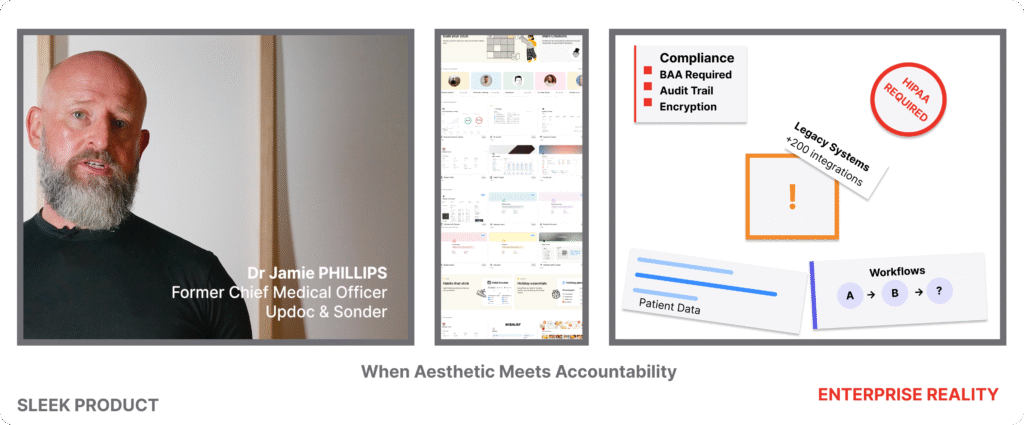
At the 33-second mark of Notion’s new healthcare testimonial video, you can pinpoint the exact collision between enterprise ambitions and consumer-origin DNA. That’s when Dr Jamie Phillips—Chief Medical Officer at Australian telehealth firms Updoc and Sonder—finally mentions the actual product. For the first third, viewers get credentials instead: military service, knowledge-sharing philosophy, rural medicine expertise. All genuine, all credible, yet entirely useless until you establish why any of this matters to a healthcare executive watching on a Friday afternoon.
“It’s democratised access to my brain”
By the time Notion delivers this value proposition, your viewer has already mentally skipped to their next tab. Testimonial videos that bury the product 37% of the way through simply don’t convert.
What makes this worth examining isn’t harshness—it’s utility. Ultimately, Notion’s stumble reveals something fundamentally broken in how enterprise-scale SaaS companies market to serious buyers. If you’re managing brand campaigns at scale (like I analysed in Swiggy’s Wiggy 3.0 campaign), this should prompt hard questions about your messaging strategy too.
Why This Campaign Matters
Notion crossed $500m in annual revenue last September, with roughly 90% from enterprise teams. Meanwhile, the company is doubling down on regulated verticals—specifically healthcare—where $10bn in telehealth platforms wrestle with the exact problem Dr Phillips articulates: clinical governance frameworks that slow down innovation instead of enabling it. Clearly, that’s a genuine pain point. More importantly, it’s a market. And that’s precisely why Notion AI Agent, launched alongside Notion 3.0, genuinely solves something real.
Crucially, Notion chose the right person to tell this story. Dr Phillips isn’t a mid-level product manager. Rather, he’s a former military doctor and C-suite CMO who has actually implemented clinical governance at scale in telehealth. With him, the company has authenticity with healthcare decision-makers—that’s arguably 60% of the battle won.
So what went wrong? Surprisingly, the problem isn’t strategy. Rather, it’s execution. And more troublingly, it’s a fundamental misunderstanding of what enterprise buyers need versus what community audiences want. If you’ve encountered the tension between bold creative ideas and strategic clarity, you’ve already spotted this exact tension in Notion’s video.
The Metrics Problem: Enthusiasm Isn’t Evidence
Here’s what the video conspicuously doesn’t say: how much time Dr Phillips saved. How many clinicians his team onboarded. What percentage of documentation the AI actually automated. Additionally, how quickly new governance protocols became searchable across the organisation.
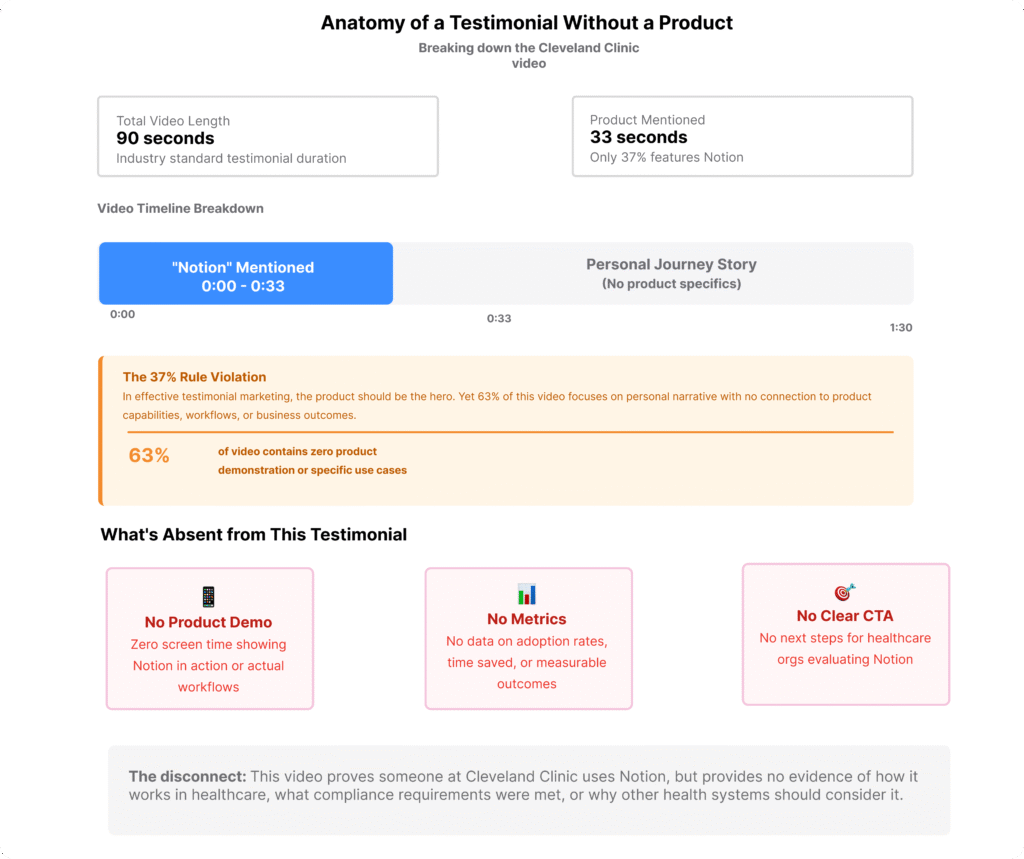
Zero metrics. None whatsoever.
This omission matters more than it might seem. Healthcare buyers—individuals making $50k decisions about compliance infrastructure—operate in a world of clinical trials, evidence-based medicine, and regulatory audits. Consequently, they’re trained to demand proof. When you tell them “this AI offloads my busy work,” their response isn’t “brilliant, let’s buy it.” Instead, they ask: “by how much, and can you prove it?”
Research from Bayleaf Digital demonstrates that B2B testimonials with “specific metrics build credibility,” yet 73% of SaaS testimonial videos skip them entirely.
Notably, a healthcare SaaS case study showed 3x lift in qualified leads and 42% lower cost-per-lead when they quantified every claim. Not some. Every single one.
Consider the irony: Notion is fundamentally a company built on data visualisation and knowledge organisation. Naturally, its users are obsessed with metrics, dashboards, and traceable outcomes. Yet when marketing their flagship product, they opt for warm feeling and metaphor instead. Frankly, that’s not just a missed opportunity—it’s a direct contradiction.
KitKat succeeded because it managed both emotional resonance and structural clarity. Notion failed because it chose emotional over structural.
This tension echoes what we explored when auditing KitKat’s latest musical break: the balance between emotional resonance and structural clarity.
The Demonstration Vacuum: Why Notion Never Shows Notion
Rewatch the video with fresh eyes and you’ll notice something glaring: the product never appears. Not once. Zero interface. No database screenshots. Furthermore, no glimpse of how Notion’s clinical governance template actually works or what separates its AI Agent from a $200 enterprise search platform.
This directly violates basic SaaS demo doctrine. Best-practice software marketing consistently shows the interface, the clicks, the outcome in real-time—not because it’s flashy, but because it converts. Significantly, research from the elearning industry confirms 98% of explainer video viewers expect to actually see the product they’re considering.
Consider Notion AI Agent in particular: a technology claiming to “democratise access to my brain” through intelligent automation, yet showing zero demonstration. How does it democratise access? What does the workflow look like? What learning curve are teams facing? Most crucially, what does a healthcare team actually do after they pay?
Rather than answering these critical questions, the video leans entirely on warm vibes and metaphor. Such an approach works brilliantly when marketing to individual knowledge workers making personal purchasing decisions. (Notion built a $10bn company precisely this way.) However, it fails spectacularly when you’re asking hospital procurement committees to justify major software purchases to their CFO.
Therein lies the core problem: good UX copy becomes essential—the kind that guides rather than mystifies. Unfortunately, Notion’s testimonial delivers only the latter.
The Competitive Vacuum: Why Notion Isn’t Different
Healthcare organisations already use SharePoint, Google Workspace, Confluence, and specialist clinical governance platforms. Walk into any hospital IT department and ask “why not Notion?” and you’ll encounter silence—because the video offers no answer.
Effective B2B testimonials “address specific pain points, providing reassurance that the software has been tested in similar situations.”
Yet this video gestures vaguely at governance challenges without explaining Notion’s specific solution architecture. How does enterprise search actually help clinicians? What distinguishes Notion AI from ChatGPT wrapped in a SharePoint layer? Regarding compliance, how does the company handle HIPAA? Most importantly, what does the audit trail look like?
Admittedly, the video’s closest approximation to differentiation—”it’s democratised access to my brain”—is undeniably memorable. Yet it’s functionally meaningless. Democratised how? Through what mechanism? At what cost?
In contrast, healthcare SaaS leaders market their solutions differently: they address multiple stakeholder pain points, provide peer validation networks, and explain regulatory compliance explicitly. Surprisingly, Notion provides none of these elements. This proves surprising, given that the company’s own brand voice work emphasises clarity and specificity.
The Audience Problem: Who Is This For, Exactly?
If this video targets C-suite healthcare executives, it’s missing ROI data, implementation timelines, and integration requirements. Alternatively, if it targets CMOs like Dr Phillips, it needs comparative validation from multiple organisations—not a single anecdote. Meanwhile, if it targets frontline clinicians, it needs to prove the interface won’t add administrative burden.
Ultimately, the video tries to serve all audiences and satisfies none. Marketing research consistently emphasises focused targeting and personalised communication tailored to specific personas. Healthcare technology purchasing, crucially, involves 10+ stakeholders: clinical leadership, IT security, compliance officers, procurement, frontline users. Each stakeholder has different information needs. Similarly, each requires different proof points.
Notion’s historical strength was targeting individual knowledge workers—creators who make personal productivity decisions. Enterprise healthcare requires top-down validation.
Yet Notion’s historical strength was targeting individual knowledge workers—creators making personal productivity decisions. Building a genuine community moat through this approach is no small feat. However, enterprise healthcare demands something fundamentally different: top-down validation. When attempting enterprise marketing with community instincts, as Notion does here, the strain becomes immediately visible.
This mirrors what we observed in the Maybelline Mumbai Mirage campaign—when brands fail to align their message with their actual audience, even beautiful execution falls flat.
The Authenticity Paradox: Why Scripting Kills Credibility
Throughout the video, we observe constant oscillation between corporate messaging and genuine moments. When Dr Phillips opens with “knowledge sharing is central to what I do. It’s about building relationships,” it sounds like a marketing brief read aloud. Yet contrast that with his later statement about “changing lives and removing access blocks to care”—that radiates authentic passion.
Research from Lundblad House Productions demonstrates viewers can reliably detect scripted testimonials. Specifically, they notice unnatural phrasing, halting delivery, absent genuine emotion. Conversely, the most effective testimonials feel like peer advice delivered with unscripted enthusiasm.
Ultimately, this video feels directed, not discovered. It attempts to have it both ways—the authenticity of genuine enthusiasm paired with the messaging control of corporate PR. Ultimately, it achieves neither.
Enterprise marketing demands message discipline. Community marketing thrives on authenticity. You can’t serve both masters in a 90-second video.
Here lies the core tension: enterprise marketing demands strict message discipline (you can’t let salespeople ad-lib through compliance claims). Yet community marketing thrives on authenticity (people smell corporate messaging instantly). Serving both masters in a 90-second video proves, quite simply, impossible.
The Missing Call-to-Action: Just Do It Isn’t a Strategy
As the video concludes, Dr Phillips says “100% for me it’s the AI assistance,” then cuts to his response about choosing Notion over alternatives: “that’s JFD. Just do it.”
“Just do it”
And then it ends. No contact button. No “book a demo.” No “download the clinical governance template.” Furthermore, no “speak to a healthcare specialist.”
For a company launching a major product update to enterprise markets, this omission genuinely surprises. Every B2B marketing framework emphasises clear next steps and decisive endings with explicit conversion opportunities. Here, the video requests emotional commitment yet provides no pathway for commercial commitment.
Admittedly, “just do it” works brilliantly as a tagline for shoes. Applied as a go-to-market strategy for regulated healthcare technology, however, it simply doesn’t function.
For anyone building campaigns, this matters deeply: every word should earn its place, and every campaign must know what it’s asking for. Unfortunately, Notion’s video fails on both counts.
The Bigger Problem: Consumer DNA vs Enterprise Demands
Fundamentally, this campaign exposes a tension plaguing consumer-origin SaaS at scale. Notion built a $10bn company by empowering individual knowledge workers to create systems without IT approval. Essentially, that represents a radically different market dynamic than enterprise healthcare, where every decision involves regulatory oversight, patient safety liability, and formal procurement processes.
Notably, these two markets fundamentally require different marketing approaches:
Community-led approach (Notion’s traditional playbook): Bottom-up adoption, viral templates, user-generated content, authentic peer recommendations.
Enterprise-led approach (what healthcare actually requires): Top-down sales, compliance validation, ROI quantification, multi-stakeholder education.
Notion attempts both simultaneously, and this video plainly shows the tension. It’s too corporate for community advocates, yet too vague for enterprise procurement.
Your community moat doesn’t translate to enterprise sales. Community marketing builds bottom-up momentum, whereas enterprise marketing requires proof, process, and patience.
Similar struggles are already emerging across consumer-origin SaaS companies: Figma building enterprise sales teams, Slack fighting for security validation, Canva pursuing B2B contracts. Each has discovered the same fundamental insight—your community moat doesn’t translate to enterprise sales. Community marketing builds bottom-up momentum, whereas enterprise marketing requires proof, process, and patience.
What Notion Should Have Done Instead
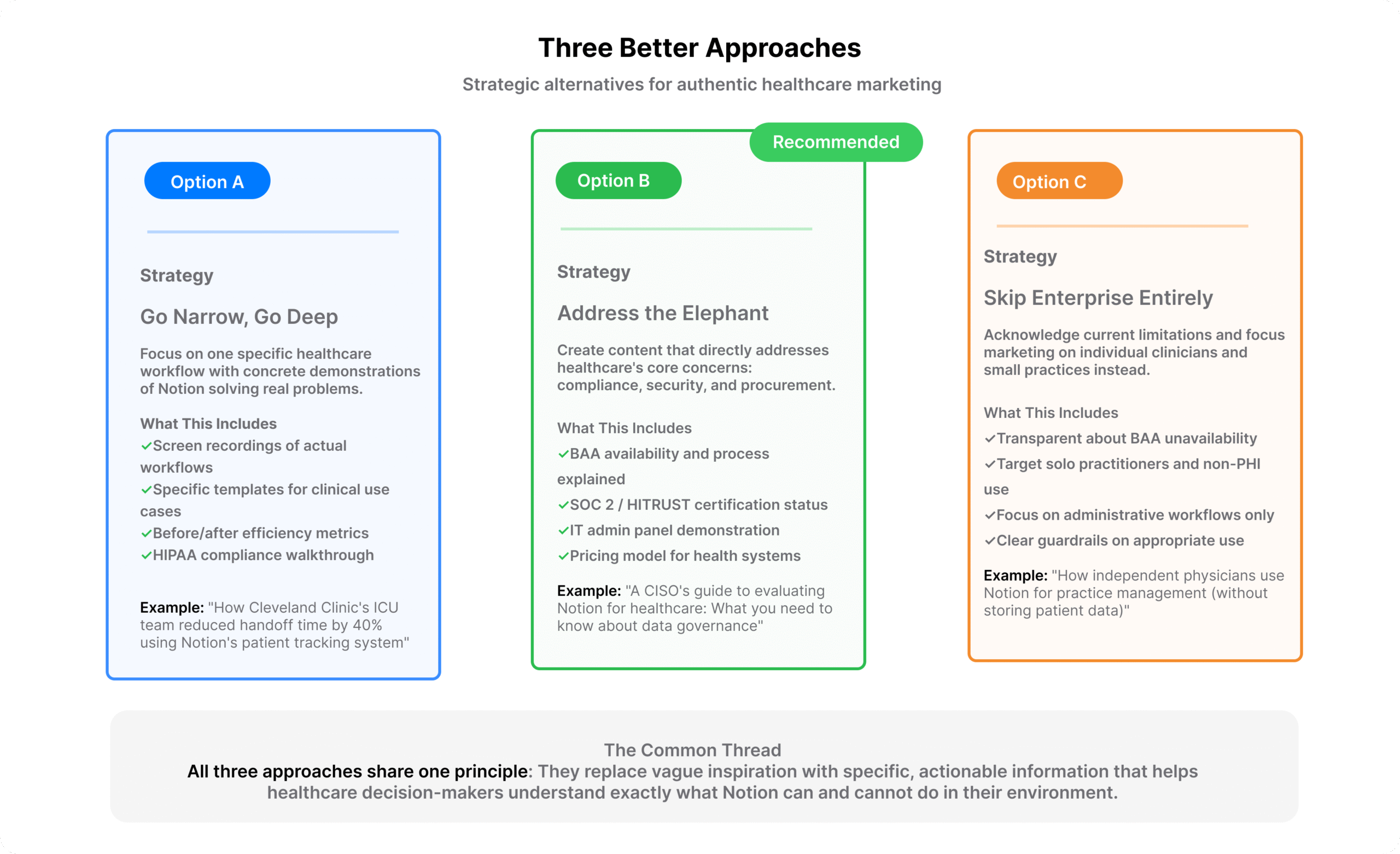
Option A: Comprehensive Case Study (3–4 minutes)
Structure the narrative as follows: problem established → implementation detailed → outcomes quantified → future vision. Include screen recordings showing the governance database. Additionally, provide concrete metrics: “reduced protocol review time from six hours to 45 minutes.” Feature multiple voices—clinicians, IT security, Dr Phillips. Show before/after workflow comparison. Importantly, explain compliance validation. Provide template download CTAs.
Option B: Social Proof Snippet (30–45 seconds)
Lead with a single memorable quote paired with visual proof. “Clinical governance used to be a handbrake. Now it’s our growth engine.” Include brief interface footage. Add text overlay: “20+ telehealth protocols, instantly searchable.” Finally, end with a clear card linking to the case study page.
Option C: Educational Explainer (2 minutes)
Structure this as problem-solution education featuring Dr Phillips as expert guide, not isolated testimonial. Establish the industry challenge. Demonstrate Notion AI solving each pain point. Let Dr Phillips provide expert commentary. Include multiple brief customer quotes. Finally, close with an educational CTA to the healthcare solutions page.
What Notion actually delivered: 89 seconds of philosophy and credentials, zero specifics about the product, no metrics, no demonstration, no CTA.
Why This Matters Now
Notion’s September product launch positions the company as “the world’s most advanced knowledge work agent.” With 50%+ of customers using AI add-ons, the company is betting its next growth phase on AI-powered enterprise adoption.
Yet enterprise marketing—especially in regulated verticals—demands precision, proof, and process. Notably, Notion’s core strength remains user evangelism. That built the valuation moat. It doesn’t, however, scale to healthcare procurement committees.
Community instincts don’t translate to enterprise markets. Your viral growth strategy, your founder authenticity, your “just do it” culture become liabilities when asking hospital CFOs to approve $50k software budgets.
Ultimately, this matters far beyond Notion alone. Every consumer-origin platform pursuing enterprise is learning this lesson expensively: community instincts don’t translate to enterprise markets. Your viral growth strategy, your founder authenticity, your “just do it” culture—these become serious liabilities when you’re asking hospital CFOs to approve $50k software budgets.
Moreover, the video isn’t bad because Notion failed to execute marketing. Rather, it’s instructive because Notion failed to think like an enterprise buyer. This mistake compounds across every touchpoint—from landing pages to sales decks to email campaigns.
Healthcare desperately needs better clinical governance tools. Telehealth desperately needs scalable knowledge management. Notion AI Agent could genuinely transform how medical organisations document and democratise clinical expertise. Strategically, the approach remains sound.
Yet the execution reveals a company still operating on consumer instincts when it needs enterprise discipline.
Sources & Further Reading
Bayleaf Digital, B2B Testimonial Best Practices
Content Beta, SaaS Demo Best Practices
Use Trust, Software Testimonials Research
CNBC, Notion’s Revenue Milestone
Notion, Notion 3.0 Launch Announcement
Lundblad House Productions, Scripted vs Candid Testimonials
Use Trust, Video Testimonial Template Guide
SmartBug Media, Healthcare SaaS Marketing
Health Launchpad, Healthcare Account-Based Marketing
InterTeam Marketing, Healthcare SaaS Case Study