
Marketers are sleepwalking into a boring future with AI.
Microsoft just showed you the alternative—and most people will miss the point.
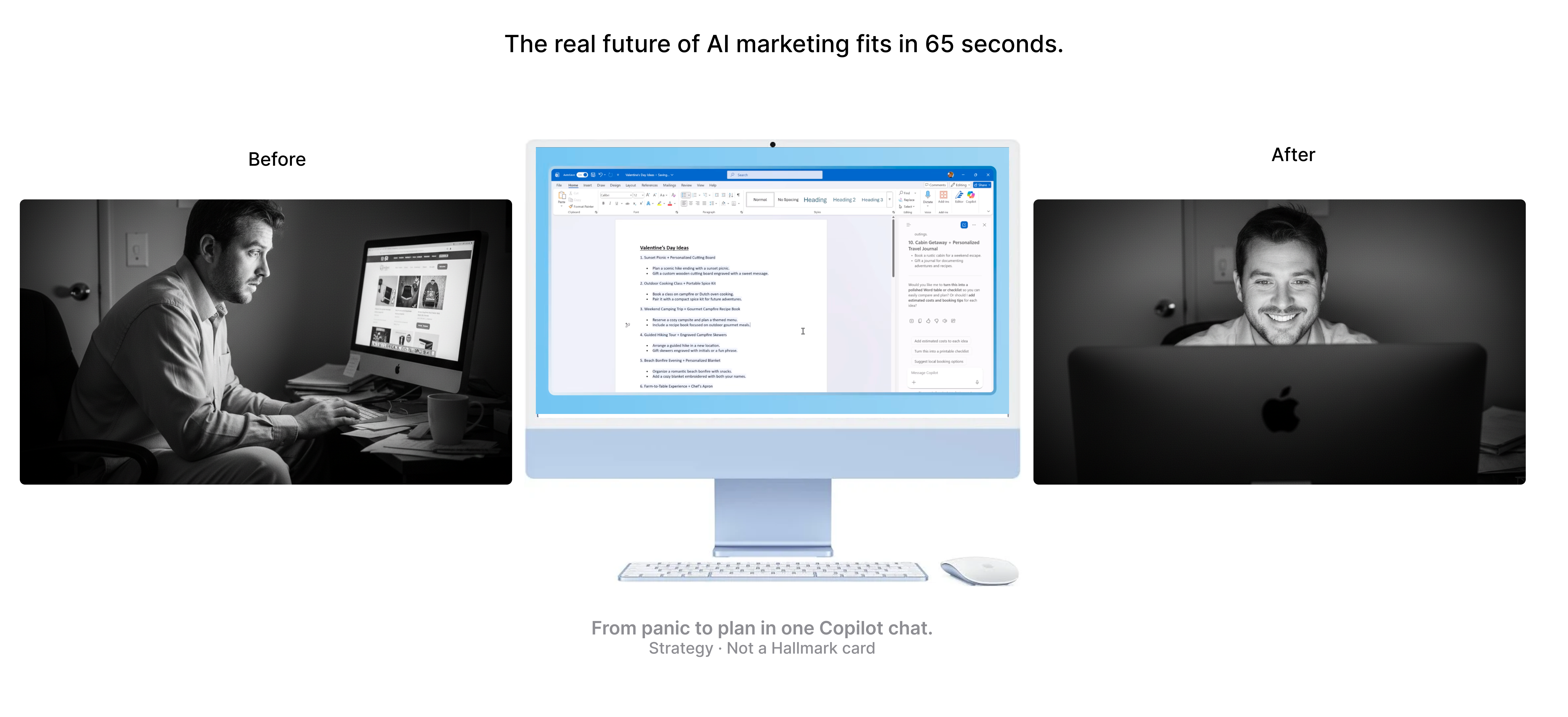
Their new YouTube video, “How to Find Valentine’s Day Gifts Your Partner Will Love,” is a 65‑second tutorial where Copilot in Word chats with you about your partner and then spins your answers into personalised gift ideas. It’s framed as a cute seasonal how‑to. Under the surface, it’s actually a blueprint for where marketing is heading next: from messages to micro‑moments, from campaigns to co‑pilots, from “target audience” to “targeted help”. If you’re still treating AI like a faster copywriter, you’re already behind—especially in a world where the best AI marketing sometimes isn’t about the AI at all.youtube+1[suchetanabauri]
Why this tiny Microsoft video matters
On the surface, the video is painfully simple:
- Open Word, click the Copilot icon.
- Type a prompt: “I need help thinking of creative Valentine’s Day gifts for my partner. Ask me questions one at a time…”[youtube]
- Copilot asks about their hobbies (hiking, cooking, camping), preferred gift type (experience vs object), and then generates tailored ideas.youtube+1
There are no sweeping drone shots. There’s no celebrity. There isn’t even an emotional piano track. Just screen capture, a calm voiceover, and a clear walkthrough.
Yet look at what it quietly nails:
- Timing: Published on 9 February, just before the peak Valentine’s search and purchase window.[about.ads.microsoft][youtube]
- Intent: It hijacks an anxious, high‑stakes moment (“what on earth do I get my partner?”) and answers it with a product use case.
- Behavior change: It doesn’t sell Copilot. Instead, it trains viewers to talk to Copilot in a way that feels natural and high value.
So this isn’t a Valentine’s campaign; it’s product education disguised as seasonal content—exactly the kind of “restraint as strategy” that separates serious AI brands from the ones shouting about features.suchetanabauri+1
The real shift: from storytelling to “situational AI”
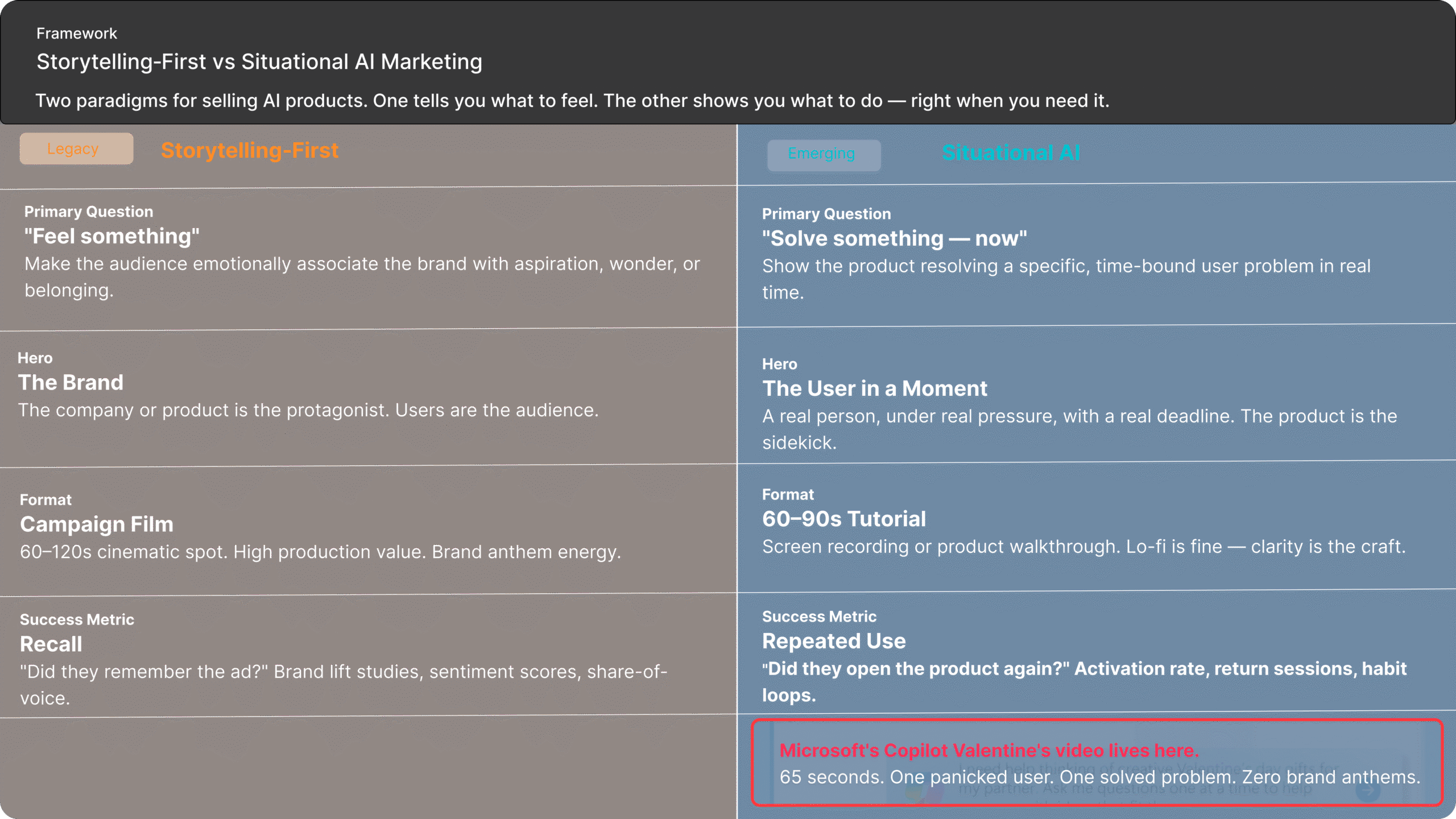
For 20 years, “great marketing” meant better storytelling.
This video doesn’t tell a story. Rather, it inserts itself into a situation.
Here’s the difference:
- Storytelling asks: “How do we make people feel something about our brand?”
- Situational AI asks: “Where are people stuck, and how can our AI literally sit next to them and help?”
Microsoft has clearly decided that Copilot’s edge is not just generative text, but adaptive questioning: in the video, Copilot doesn’t just spit out a list of generic gifts. Instead, it interviews you. It asks one question at a time and shapes its ideas around your answers.youtube+1
That’s a different category of value. It’s not “content at scale.” It’s judgment at scale.
And this isn’t just a Microsoft move. You can see the same pattern in how other platforms are evolving their AI marketing: Google wrestling with the gap between glossy AI promises and messy real‑world usage, OpenAI leaning into sheer reach, and Anthropic leaning into quiet trust. Consequently, marketers need to stop obsessing over what AI says and start caring about what AI asks.suchetanabauri+2
Why now: the Valentine’s test all marketers are failing
Valentine’s Day is underrated as a testbed for AI marketing.
Microsoft’s own advertising data shows that Valentine’s search and conversion behavior is procrastination‑heavy and intent‑rich. Searches build through January and then spike in the final weeks. At first, non‑branded “inspiration” queries like “unique gifts for him” dominate, while last‑minute brand and product searches explode just before 14 February.theabaagency+2
On top of that:
- Personalisation and “sentimental” gifts are growing search themes, not generic flowers and chocolates.adzooma+1
- Valentine’s is no longer just for couples; Microsoft’s own Copilot content emphasises friends, family, even solo self‑care plans.techcommunity.microsoft+1
Put simply, consumers are:
- Last‑minute,
- Overwhelmed,
- Searching for ideas, not SKUs,
- And looking for something that feels like it was chosen for this person, not “for her” in general.microsoft+2
Most Valentine’s campaigns respond with:
- The same pink‑washed hero image.
- A “Top 10 Gifts for…” listicle.
- A “shop the edit” carousel.
By contrast, Microsoft responds with: “Open Copilot and have a conversation about someone you love.”[techcommunity.microsoft]youtube+1
That’s the bar now—for any brand that claims to take AI marketing best practices seriously, not just AI‑native companies.[suchetanabauri]
What Microsoft actually teaches marketers here
If you strip the video down, you get four lessons marketers should steal immediately.
1. Market the use case, not the feature
The video description doesn’t open with “Copilot is an AI‑powered assistant in Microsoft Word.” Instead, it opens with: “See how Microsoft 365 Copilot in Word can help you brainstorm thoughtful Valentine’s Day ideas for your partner.”youtube+1
That phrasing does three things:
- Names a scary, specific job (brainstorm thoughtful gifts).
- Keeps the hero as you, not the AI.
- Smuggles the product into the solution, not the headline.
Yes, Copilot’s “feature” is chat‑based AI in Word. However, the marketed use case is “coping with the social pressure of Valentine’s Day without being a lazy gift‑card person”.
Marketers should be mapping their AI capabilities to emotionally loaded jobs‑to‑be‑done with this level of precision. That’s the same strategic muscle you flex when you reposition an AI product as a “thinking partner” instead of just another tool.[suchetanabauri]
2. Show the dance, not just the output
Every lazy AI demo shows the before (“Write me a blog post about X”) and the after (a wall of text).
Microsoft flips it. In this case, the most interesting part of the video is the middle: the questions. Copilot asks about hobbies, preferences, and gift types; the user refines, corrects, adds detail.youtube+1
By showing the back‑and‑forth, Microsoft is quietly telling viewers:
- It’s okay if your first prompt is rough.
- You don’t need “prompt engineering”.
- The value comes from collaborating, not “getting it right in one shot”.
Crucially, that’s exactly the anxiety normal users have with AI tools right now. This video doesn’t say “don’t worry”; it demonstrates that there’s nothing to get wrong.
Once you see this pattern, it’s hard to unsee. Claude’s “thinking partner” film does the same thing emotionally: it sells the feeling of working alongside AI, with almost no interface on screen. The execution differs, but the principle is the same—experience over feature list.[suchetanabauri]
3. Attach the funnel to an actual calendar
Microsoft doesn’t treat Valentine’s content as a “social asset”. Instead, it’s part of a multi‑year, multi‑surface push.
Back in 2025, they published “Plan the perfect Valentine’s Day with Copilot,” showing prompts for date ideas, solo plans, and gift brainstorming across different relationship types. Since then, they’ve shipped Edge guides on planning Valentine’s dates with Copilot, generic “get gift ideas with AI” content, and a broader gift‑ideas Copilot video that covers occasions and budgets beyond Valentine’s.linkedin+3[youtube]
This 2026 Word video is another tile in that mosaic. It’s:
- Timed just before the peak search spike.[about.ads.microsoft][youtube]
- Ultra‑short, perfect for YouTube and embedded reuse.
- Linked directly to trial (“Try it now in Word”; “No Microsoft 365 subscription? Try free for one month.”).youtube+1
So it’s not “a Valentine’s campaign.” It’s a seasonal on‑ramp into a permanent AI habit—the same way good SEO & web copy should be built from intent backwards, not from keywords forwards.[suchetanabauri]
4. Make the “AI brand” feel like everyday life
Microsoft’s big Copilot work (Super Bowl spot, “Everyday AI companion,” “Be the Pilot” campaign) is about emotional positioning: AI as your co‑driver, not your overlord.[youtube]techcommunity.microsoft+1
This Word video is where that rhetoric cashes out.
There’s no hype language. You don’t hear “revolutionary generative model.” Instead, you get a line like: “Sometimes the best ideas come from a little chat.” It’s everyday, almost boring. And that’s the point.youtube+1
If your AI experiences always feel like “a big moment,” users won’t integrate them into small moments. Over time, the long‑term winner is the brand whose AI feels like reaching for a pen. That’s where AI brand strategy stops being a slide and starts being a lived experience.[suchetanabauri]
Where marketers are still getting AI wrong
Most AI marketing right now falls into one of three traps.
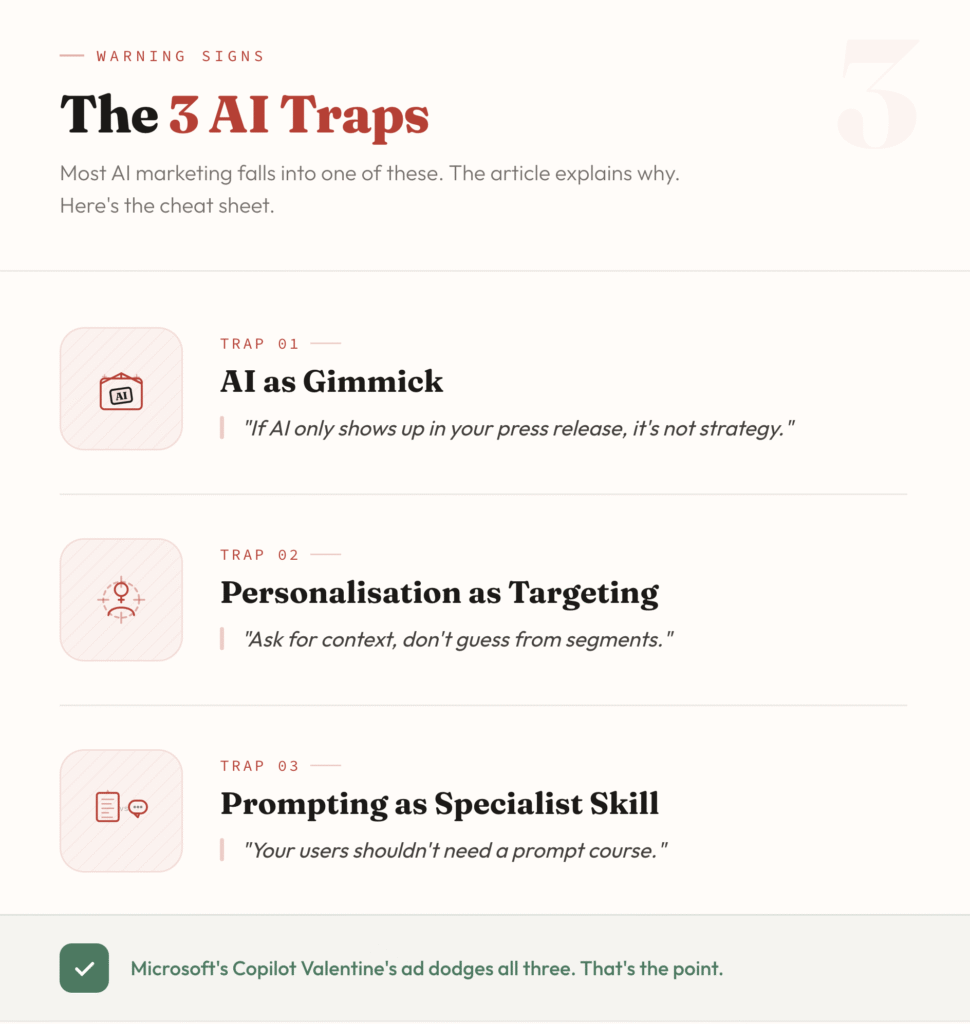
Trap 1: AI as a gimmick in the ad, not the product
You’ve seen the pattern:
- Brand makes an ad “with AI”.
- They boast in the press release about using GenAI tools in the creative process.
- The actual customer experience remains unchanged.
Microsoft is doing the reverse. Here, the ad is the product. The “creative idea” is not a tagline; it’s a use case you can replicate in under two minutes.youtube+1
If your AI story lives in your PR, not in your onboarding flows, you’re wasting everyone’s time. The contrast with Anthropic’s restraint is useful here: one shows almost no product at all, the other shows nothing but the product—but both are anchored in how AI feels to use.[suchetanabauri]
Trap 2: Personalisation as targeting, not collaboration
Marketers have treated “personalisation” as better targeting for decades: segment the audience, tweak the copy, maybe change a hero image.theabaagency+1
However, notice what Copilot does in the video: it does not infer; it asks. It doesn’t assume “male, 30s, Valentine’s, must want watches and whiskey.” Instead, it says: tell me what they like, one thing at a time. Then it builds from there.youtube+1
In other Microsoft materials, they explicitly promote prompts like:
- “I want to plan a self‑care day at home for myself on Valentine’s Day.”[techcommunity.microsoft]
- “She doesn’t like jewelry, and she’s allergic to nuts. What gifts could I get her?”[techcommunity.microsoft]
That’s personalisation as co‑creation, not surveillance. AI makes this level of “white‑glove service” possible at scale. But it only works if you design the experience around questions, not just audience attributes.
Trap 3: Treating “prompting” as a specialist skill
A lot of B2B AI content is weirdly intimidating. You get threads full of “secret prompts,” “mega‑prompts,” and prompt templates with more structure than a legal contract.
This video takes the opposite stance. The sample prompt is recognisable, human, messy: “I need help thinking of creative Valentine’s Day gifts for my partner. Ask me questions one at a time…”[youtube]
There are no frameworks. There’s no “as a marketing strategist, act like…” pseudo‑theatre. Instead, you see a direct request, plus a simple instruction about the shape of the interaction (“ask me questions one at a time”).
The message to users is: You already know how to talk like this. That’s how you accelerate adoption—and it’s why the most sophisticated AI marketing often looks deceptively simple on the surface.suchetanabauri+1
So what do you actually do with this?
Here’s how to steal the right lessons from Microsoft’s Valentine’s play—and avoid becoming another indistinguishable “AI‑powered” brand.
1. Build a calendar of AI situations, not just campaign moments
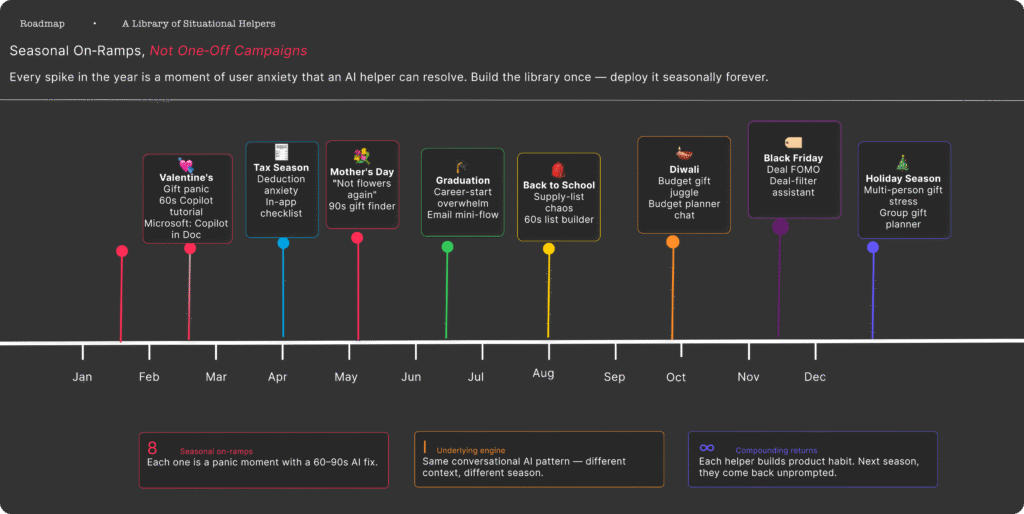
Pull up your marketing calendar. For each key date, ask:
- What’s the high‑stress, high‑search moment around this date?
- What would it look like for our AI (or product) to sit next to someone at that moment and help?
For example:
- Tax season: “Walk me through what I can write off as a freelance designer this year.”
- College admissions: “Help my kid choose between these three schools based on distance, cost, and culture.”
- Monsoon onset in India: “Help me adjust my monthly budget for higher electricity and commute costs.”
Microsoft’s internal content does exactly this: “Plan the perfect Valentine’s Day with Copilot” suggests prompts for partners, friends, coworkers, and solo plans, all grounded in real situations. The Word video is the zoomed‑in version of one such prompt: the nervous partner shopping for a gift.microsoft+1youtube+1
Your job is to identify those situations for your category and then design micro‑tutorials (60–90 seconds) that show, not tell, how to navigate them with your product. If you want those micro‑moments to actually rank and convert, this is where proper SEO‑driven web copy—not just thought leadership—starts pulling its weight.[suchetanabauri]
2. Design your AI experience around questions
If your product uses AI, sit down with your product team and audit the interaction:
- Where does the system ask the user nothing and just guess?
- Where could it ask a simple, clarifying question instead?
From there, borrow Microsoft’s constraints:
- One question at a time.
- Plain language.
- Each question directly influences the outcome.
Next, mirror that in your marketing content. Don’t just show the “prompt” and the “answer”. Show the conversation arc.
If your product doesn’t have an AI layer yet, you can still market around “guided questioning”:
- On‑site quiz flows.
- Landing pages that ask one key question per section instead of blasting visitors with inputs.
- Email sequences that start with “hit reply and tell us X,” then use that to customise follow‑ups.
The underlying shift is the same: stop pretending you already know everything about the user. Ask, then respond. That’s as true in founder‑led marketing as it is in enterprise SaaS: the brands that win are the ones that look like they’re listening.[suchetanabauri]
3. Treat AI onboarding as core brand storytelling
Microsoft has a huge brand platform for Copilot (“everyday AI companion”), but the trust will be won or lost in tiny onboarding moments like this video.
So use that as your pattern:
- Don’t wait for a brand film budget.
- Produce short, scrappy, highly specific tutorials that show AI in action for real‑life tasks.
- Anchor each in a moment where people are highly emotional and highly motivated (Valentine’s, moving house, first job, first child, job loss).
You don’t need a “creative platform” to start. What you need is:
- A clear situation.
- A real screen.
- A human voiceover that sounds like a friend, not a product marketer.
If you want help turning these micro‑moments into actual launch campaigns and lifecycle sequences instead of one‑off “content drops,” this is exactly the kind of work a focused email and campaigns strategy is built to support.[suchetanabauri]
4. Anchor AI creatively in search and ads, not just in content
Microsoft isn’t just pushing AI through organic videos. Their own Microsoft Ads guidance on Valentine’s suggests leaning into:
- Non‑branded “inspiration” searches early.
- Heavier budget and more competitive CPCs closer to the day.
- The growing demand for personalised and “sentimental” gifts.adzooma+2
Because of this, if you’re building AI‑powered experiences or content like this, you should wire them into your media:
- Build search and social ads around “stuck” queries: “don’t know what to get him,” “last‑minute Valentine’s gift,” “unique gift for foodie girlfriend”.
- Instead of sending traffic straight to a product grid, send them to an AI‑guided flow (or, at minimum, a quiz that mimics that experience).
- Use rich formats (multimedia ads, video) to show the conversational flow, not just explain it.theabaagency+1
If your AI stays locked inside product UI while your ads talk in abstractions, you’re missing the whole point. And if your site copy isn’t aligned to those spikes and flows, you’re leaving both search traffic and conversions on the table.[suchetanabauri]
5. Expand beyond couples—because Microsoft will
One place the Word video is arguably weaker than Microsoft’s written content: it only talks about “your partner”.youtube+1
However, their 2025 Valentine’s blog goes out of its way to include:
- Friends and Galentine’s events.
- Families.
- Self‑care days for people spending it alone.linkedin+1
That’s a smart correction to the cultural reality of Valentine’s—and a bigger addressable market.
If you’re in any gifting, experiences, or lifestyle category, this is an opportunity:
- Don’t just build AI flows around romantic relationships.
- Show how your experience adapts to who the user cares about (friends, colleagues, kids, themselves).
In AI terms, that means:
- Asking up front: “Who is this for?”
- Adapting the tone, constraints, and ideas based on that answer.
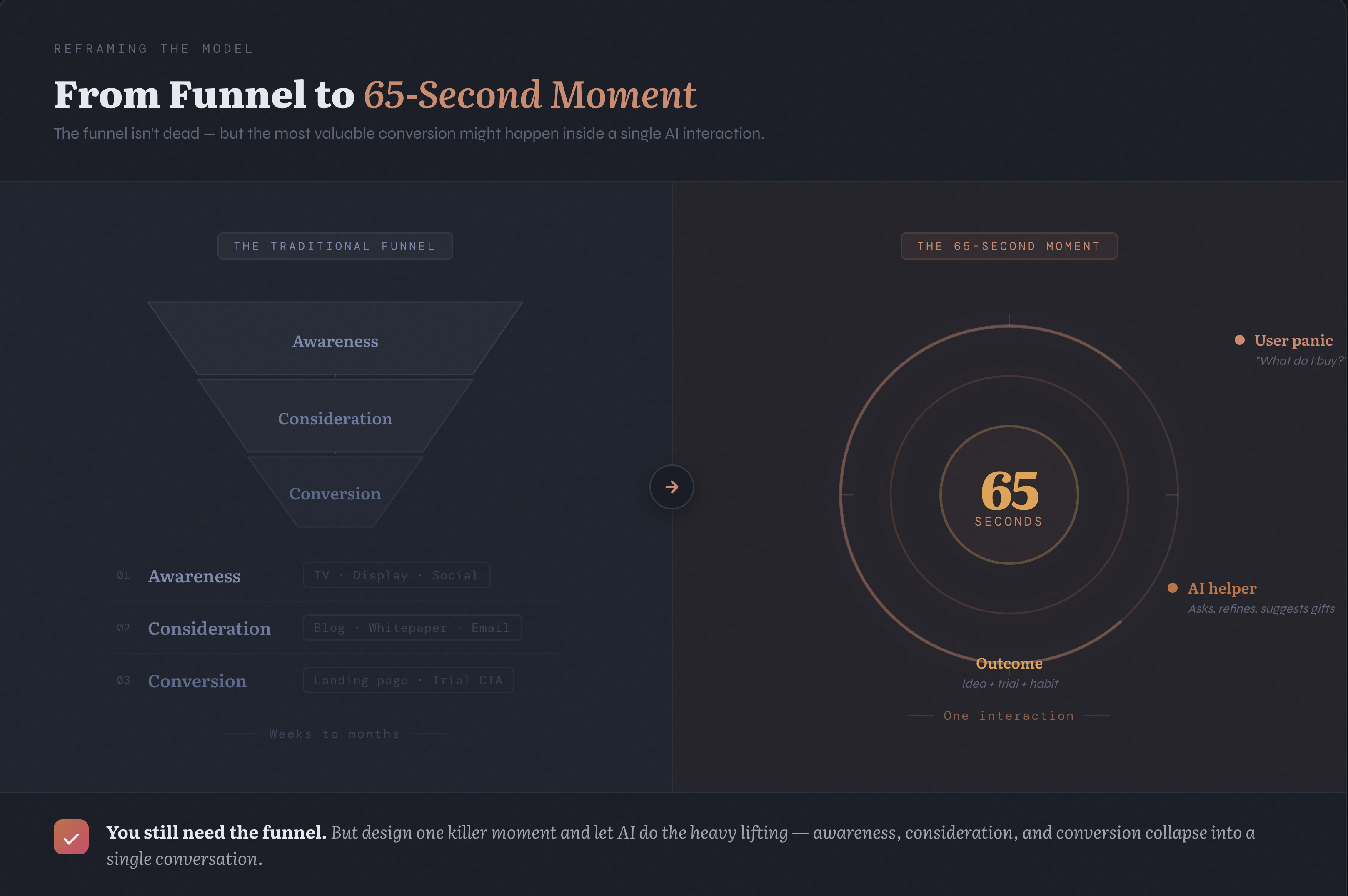
In marketing terms, it means your Valentine’s campaign doesn’t die on 15 February. Instead, it becomes a template for every emotionally charged occasion: promotions, break‑ups, new jobs, burnout, moving country. That same logic applies when you design founder‑led marketing or tech‑marketing plays around real, messy user moments rather than clean funnel diagrams.suchetanabauri+1
The uncomfortable question: where does this leave “brand”?
If AI‑powered helpers like Copilot become the primary way people navigate overloaded decisions, where does that leave brand marketing?
Microsoft’s answer, implied in this campaign, is: brand lives in the quality of the help.
Think about what this video teaches viewers, subtly:
- Copilot is gentle. It asks, it doesn’t judge.youtube+1
- Copilot is curious. It doesn’t assume; it clarifies.
- Copilot is thoughtful. It pushes you toward intentional gifts, not default ones.[techcommunity.microsoft]youtube+1
All of those are brand attributes—expressed not in a manifesto, but in interaction design.
If your AI experience is brusque, confusing, or generic, no amount of beautiful brand film will rescue you. As a result, the AI will be your brand.
To put it bluntly: if you’re a marketer, you should care as much about the default prompts and system questions in your AI interface as you do about your tagline. Soon, more people will see the former than the latter. And if your copy across the rest of your site doesn’t back that experience up—from landing pages to nurture sequences—you’re building a leaky funnel on top of a strong idea.suchetanabauri+1
How to pitch this kind of work internally
One final, practical angle: how do you sell “tiny, situational AI content” to leadership who are still chasing big campaign moments?
Steal Microsoft’s structure:
- Lead with seasonal, search‑backed urgency.
“Valentine’s‑related searches spike in the last two weeks, especially for personalised gifts and inspiration queries.”about.ads.microsoft+1 - Show the category friction.
“People are overwhelmed, late, and anxious about choosing the ‘right’ thing.” - Propose a concrete AI use case.
“We’ll release a 60‑second tutorial where our AI walks someone through choosing a gift for a specific person, asking a few simple questions and generating ideas.” - Tie it directly to product and trial.
“At the end, they can click straight into the flow and use it—no extra account, no extra steps.” - Position it as a reusable asset.
“We re‑skin the same format for Mother’s Day, graduation, Diwali, end‑of‑year teacher gifts…”
You’re not pitching a one‑off Valentine’s video. Instead, you’re pitching a library of situational AI helpers, each anchored in real human moments. Microsoft has started building that library with Copilot around gifting and Valentine’s; other brands will follow. If you’re a founder or marketing leader trying to sell this inside a skeptical org, this sits in the same bucket as any founder‑led marketing play: you’re making a bet on how your customers actually behave, not how your org chart wishes they did.youtube+1suchetanabauri+2
If you take nothing else from that Microsoft video, take this:
The future of marketing in an AI‑saturated world is not who can shout the loudest about their model. It’s who can quietly show up, in the right 65 seconds of someone’s life, and help them not feel like an idiot in front of someone they care about.
So build for those 65 seconds, wire them into your campaigns, search, and copy—and the rest of your funnel will have a fighting chance.
External sources
- How to Find Valentine’s Day Gifts Your Partner Will Love | Microsoft 365
- 5 key insights for your Valentine’s Day campaigns
- Plan the perfect Valentine’s Day with Copilot
- Microsoft 365 Insider Program – Plan the perfect Valentine’s Day with Copilot (LinkedIn)
- How to Plan the Perfect Valentine’s Day Date (Microsoft Edge Learning Center)
- Get Gift Ideas with Copilot | Microsoft Edge
- Gifting Ideas (Microsoft 365 Copilot video)
- Boost Valentine’s Sales with Microsoft Ads Strategies
- Roses And ROI: Growing Sales This Valentine’s Day With Microsoft Advertising
- Microsoft Game Day Commercial | Copilot: Your everyday AI companion
- ANNOUNCEMENT: Launch of new Copilot campaign, “Be the Pilot”
Your own site (internal links)
- Claude’s “Thinking Partner” Video Is a Masterclass in Restraint
- The Pixel Paradox: Dispatches from a Digital Native’s Divided Attention
- How Gemini Translation Changes Marketing
- Email and Campaigns
- SEO & Web Copy
- Tech Marketing – Archive
- AI brand strategy – Archive
- Founder-Led Marketing – Archive
- FMCG marketing analysis – Archive