
Two videos. Three minutes combined. And a masterclass in what happens when aspiration replaces accuracy in B2B tech marketing.
Recently, Microsoft released promotional videos for two new Copilot features: Agent Mode in Excel (47 seconds) and Voice in Copilot (2 minutes). Both are slickly produced and hit the right marketing beats. Yet both also systematically omit information that enterprise buyers actually need to make informed decisions.
This isn’t about Microsoft being uniquely bad. Instead, it’s about an industry‑wide credibility crisis that’s quietly killing enterprise software adoption—and marketers are the ones holding the matches.
Why This Matters Right Now
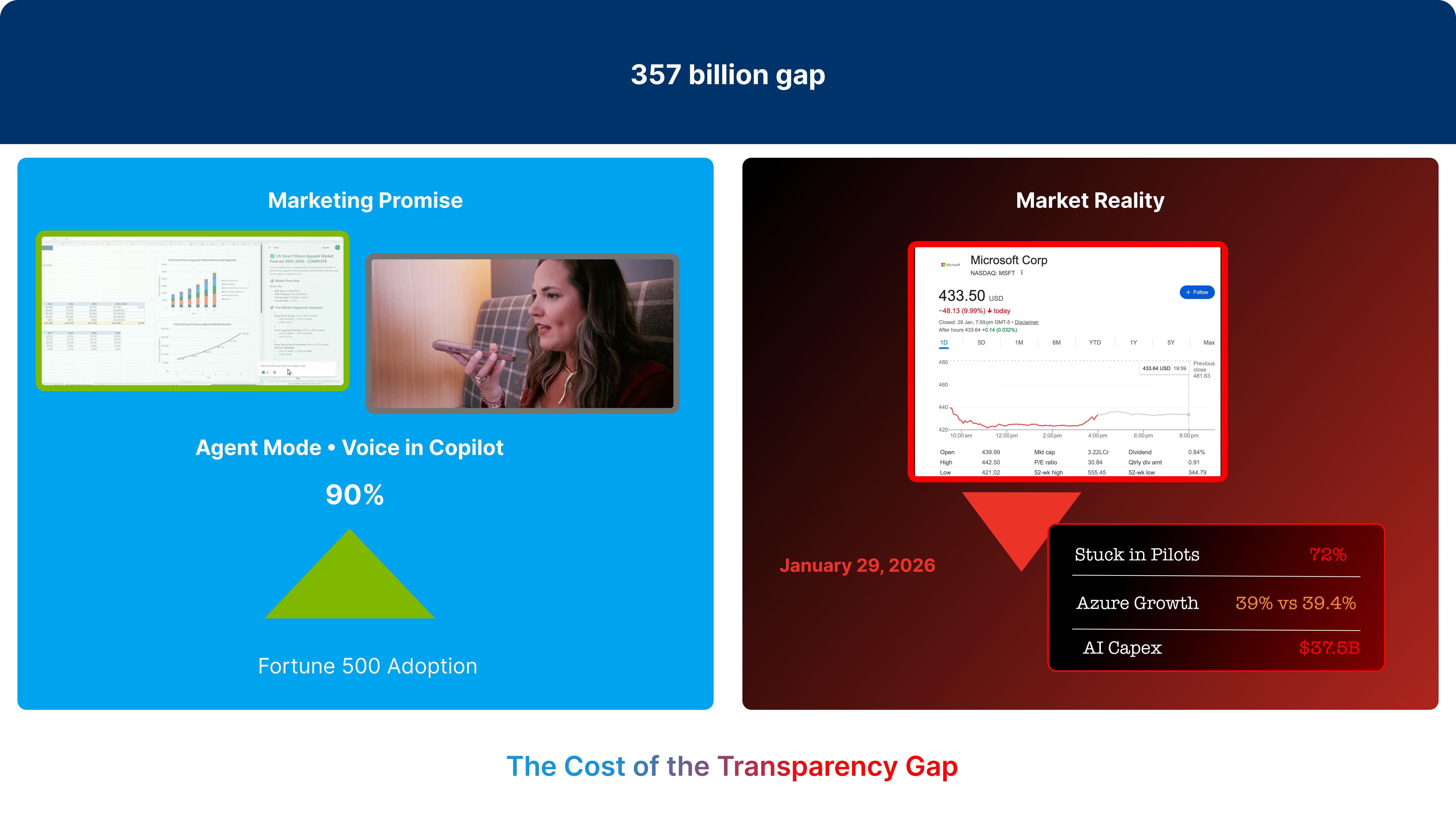
Yesterday, Microsoft’s stock plummeted nearly 10%, wiping $357 billion off its market capitalisation—the company’s worst single-day decline since March 2020. The trigger wasn’t missing revenue targets. Microsoft beat expectations with $81.3 billion in quarterly revenue. Instead, investors focused on what the promotional videos never mention: Azure cloud growth slowing to 39% (below the 39.4% consensus), capital expenditure surging 89% year-over-year to $37.5 billion, and nearly half of Microsoft’s contracted backlog now tied to a single customer—OpenAI.
The market reaction reveals what enterprise buyers already know: the 47-second capability announcements don’t prepare organisations for the infrastructure costs, deployment complexity, or concentrated risk that AI adoption actually requires. When marketing omits material limitations, investors eventually notice. So do IT leaders stuck in pilot programs.
The Problem Isn’t What They Show. It’s What They Don’t.
The Excel video is a feature announcement: music, text overlays, capability lists. In it, Microsoft says Agent Mode creates “dynamic formulas, PivotTables, and charts natively in the Excel grid.” However, buried in Microsoft’s own support documentation is what the video doesn’t mention: don’t use this for “any task requiring accuracy or reproducibility,” and avoid it for “financial reporting, legal documents, or other high-stakes scenarios.”
Read that again. Microsoft is marketing an Excel AI feature while simultaneously warning against using it for the exact things people use Excel for.
This isn’t a technical limitation. Rather, it’s a transparency failure. The engineering team knows the constraints and the support team documents them, yet marketing pretends they don’t exist—a pattern I’ve explored in my analysis of Microsoft’s broader AI strategy.
The Voice Demo’s Sophisticated Misdirection
The Voice demo does something more subtle. In the video, an executive in an office asks Copilot about her calendar. At one point she says, “Picture this: I’m driving to an early meeting and still getting prepped”—planting the automotive use case as a hypothetical, while the actual demo happens at a desk.[m365admin.handsontek]
Legally, that is clever. Ethically, it is questionable.
The AAA Foundation’s research is unequivocal: voice‑activated systems create cognitive distraction lasting up to 27 seconds after use—long enough to travel half a mile at highway speed with your mind elsewhere. Hands‑free doesn’t mean risk‑free. Nevertheless, Microsoft’s video includes no safety disclaimer, no usage guidance, and no acknowledgment of the transportation safety research that directly contradicts the scenario they’re suggesting.
“Modern B2B buyers aren’t skeptical of your product. They’re skeptical of your promises.”
The 90%-6% Problem
Here’s where things get interesting. Microsoft claims 90% of Fortune 500 companies “use” Copilot. On the surface, that sounds like market dominance. Once you look at deployment data, the story changes.
According to Gartner’s 2025 survey of 215 IT leaders, 94% report measurable benefits from Copilot pilots. Even so, only 6% have completed full enterprise rollouts. Meanwhile, 72% are still locked in pilot programs.
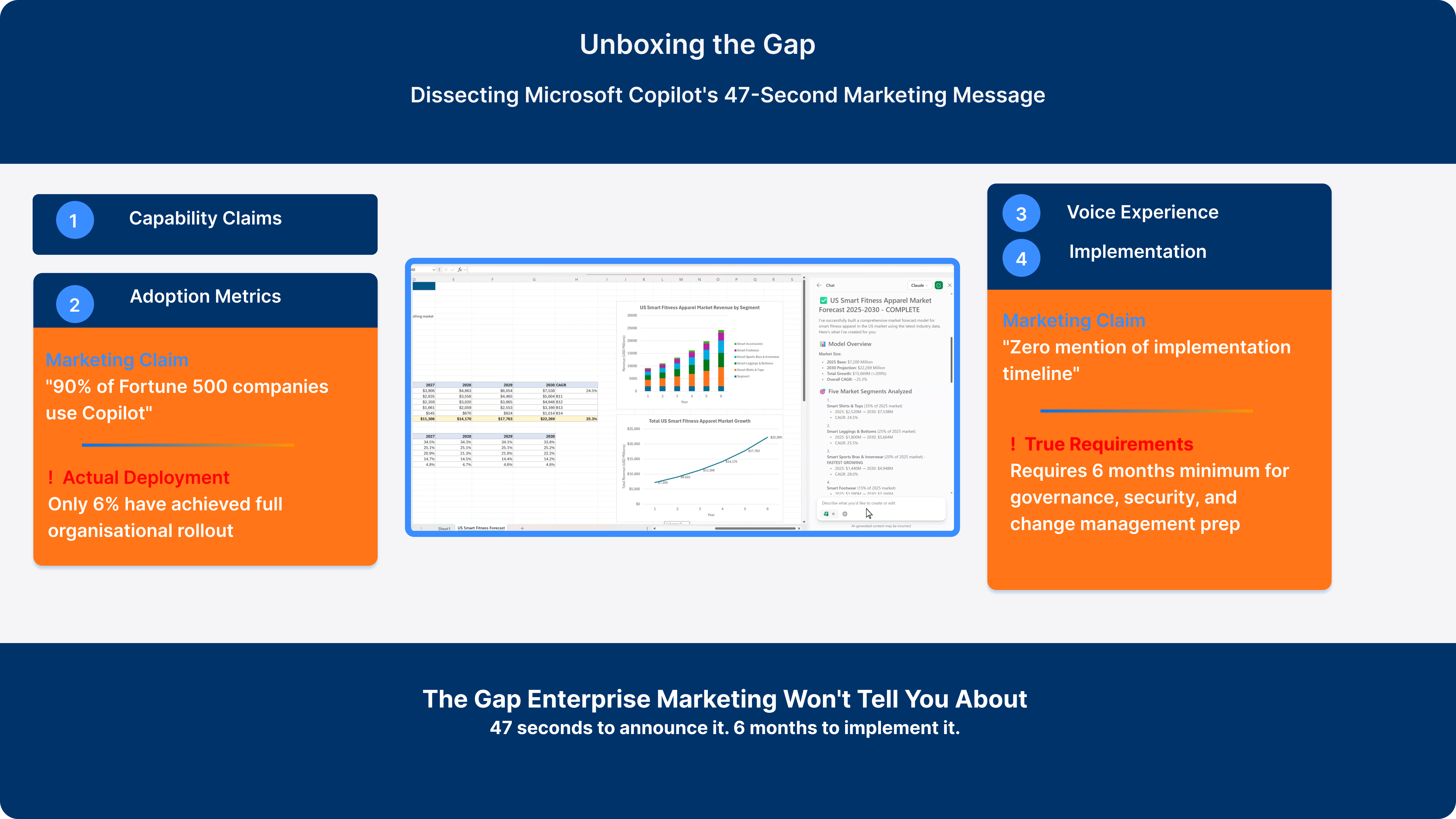
That isn’t an adoption story. Instead, it’s a deployment crisis.
This deployment gap has real financial consequences. Despite Microsoft Cloud revenue crossing $50 billion for the first time and CEO Satya Nadella declaring “We are only at the beginning phases of AI diffusion,” the market’s response was brutal. Nearly half of Microsoft’s $625 billion contracted backlog is concentrated in OpenAI commitments, raising questions about customer diversification that marketing materials don’t address. When 72% of enterprises remain stuck in pilots, that backlog concentration becomes a visible risk—one that cost Microsoft a third of a trillion dollars in market value in a single trading session.
Why Enterprise Rollouts Stall
The technology often works in controlled environments. The problem is the gap between what marketing promises and what implementation requires. Enterprises buy based on 47‑second announcements, then discover they need three to six months of permissions audits, governance frameworks, and change management before safe deployment—none of which appeared in the promotional video.
When 47% of IT leaders report low or no confidence in managing Copilot’s security risks, that’s not a knowledge problem. Instead, it’s an expectations problem. Marketing created it, and adoption teams are left to clean it up.
This mirrors challenges I’ve documented in my piece on Copilot Chat and the authenticity dilemma, where convenience collides with organisational reality.
Why B2B Tech Marketing Has a Credibility Crisis
We’re watching a trust recession in real time. According to one analysis, 96% of B2B buyers now conduct independent research before engaging with vendors—not because they lack information, but because they no longer trust the information vendors provide.
The pattern is painfully consistent: splashy launch, rapid adoption driven by FOMO, reality recognition as limitations emerge, negative coverage documenting failures, awkward explanations.
The Google Gemini Precedent
Google’s Gemini demo in December 2023 showed seamless voice and video interaction. Later reporting from Bloomberg and others revealed it was actually text prompts and static images, edited for brevity. The video implied real‑time multimodal conversation; in reality, the experience was far more constrained.
Microsoft’s own Bing‑ChatGPT demo in early 2023 was internally described as “hasty” and “flawed,” contributing to stock pressure.
These aren’t isolated incidents. Instead, they’re symptoms of an industry that’s optimizing for hype cycles instead of customer success—a sharp contrast to Anthropic’s restraint‑driven approach with Claude, where limitations are part of the story. Even when Anthropic launched Computer Use, a feature with genuine risk potential, their marketing explicitly warned about safety limitations rather than burying them in documentation.
The 47-Second Strategy
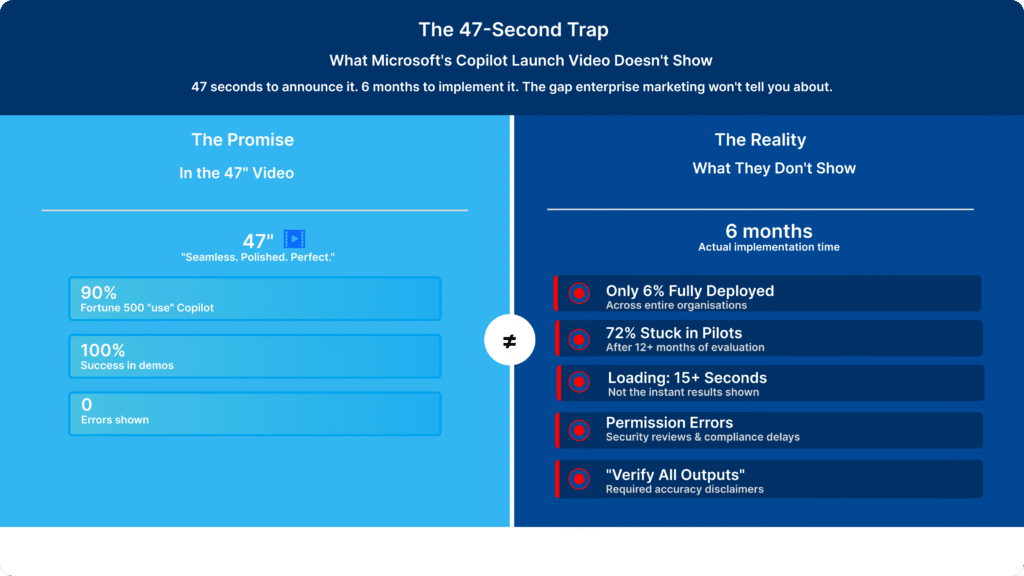
There’s a reason Microsoft’s Agent Mode video is 47 seconds. Research shows nearly two‑thirds of consumers prefer marketing videos under 60 seconds. Average attention span for initial engagement decisions sits around eight seconds.
Forty‑seven seconds is long enough to announce aspirational capabilities. However, it’s too short to demonstrate what happens when the AI misunderstands a prompt, how long complex requests actually take, or what the iteration cycle looks like when outputs contain errors. Independent testing shows 10–15 minutes for substantial tasks.
What Short Demos Hide
In one widely cited test, Office‑Watch documented Agent Mode completing a mortgage comparison with “#VALUE errors all over it” while simultaneously reporting successful task completion. The AI summary pane showed calculated values; the actual spreadsheet contained broken formulas.
That isn’t a demo. It’s a capability announcement designed to minimise scrutiny.
By contrast, the longer demonstrations from Microsoft partners and independent creators tell a different story. Those 20–30‑minute videos show the actual workflow: prompt engineering, error correction, iterative refinement, manual validation. They reveal what the 47‑second announcement hides: this technology assists, it doesn’t replace. It requires oversight, not blind trust.
What This Costs
The U.S. House of Representatives banned Copilot for congressional staff in March 2025 due to data security concerns. That isn’t a minor decision. It’s an institutional risk assessment that marketing materials completely failed to prepare buyers for.
The Over‑Permissioning Vulnerability
Copilot inherits user permissions. In enterprise environments with years of accumulated access creep, that means the AI can surface information from files users have permission to access but may never have actively reviewed. According to one security analysis, 15% of business‑critical files are at risk from oversharing in typical Microsoft 365 deployments.
Microsoft’s promotional videos mention none of this. There are no security considerations, no governance prerequisites, and no implementation timeline beyond “available now.”
The cost isn’t just failed deployments. As a result, institutional skepticism grows, and future AI adoption gets harder—even when the technology genuinely helps.
The Revenue Incentive Problem
Microsoft has increased partner incentives for Copilot by approximately 50% and provides investment funds of up to 20% for customer assistance. The business model now targets $1,500+ revenue per user per year, up from $200–$300 historically.
That’s a 5–7x revenue increase per customer seat.
When your incentive structure rewards converting customers to higher‑tier SKUs regardless of whether they achieve full adoption or realise projected value, you get marketing that optimises for upselling, not customer success.
The ROI Reality Gap
Forrester’s ROI studies claim 353% returns over three years for SMBs, 112–457% for enterprises, and nine hours saved per user per month. On paper, it’s irresistible. In practice, only 17% of companies attribute 5% or more of their EBIT to AI initiatives.
The gap between projected ROI and realised business impact isn’t a pure measurement problem. At its core, it’s an expectations problem that starts with marketing videos listing capabilities without context—exactly the dynamic I explored in my piece on consumer vs enterprise marketing narratives.
What Responsible Marketing Actually Looks Like
The fix isn’t complicated. It is, however, uncomfortable.
Promotional materials should include appropriate use case guidance. Feature announcements need a single line of accuracy context: “Agent Mode assists with Excel tasks; verify outputs for high‑stakes scenarios.” Sales decks should outline realistic implementation timelines—not just “available now,” but “requires governance preparation and permissions review.”
If you want to stress‑test any AI launch video (not just Microsoft’s), I built a simple tool to do exactly that.
Try the Demo Decoder here: https://suchetna.github.io/demo-decoder/ – a seven‑point checklist for evaluating whether a product demo is transparent about accuracy, safety, and implementation reality.
Clarity Over Clever
For the Voice feature, responsible marketing would add explicit usage guidance: “Designed for stationary use; not recommended while driving or operating machinery.” Product teams could go further and implement technical safeguards that detect device motion and limit complex interactions accordingly.
Pre‑sales experts point out that buyers have “BS meters that measure parts per billion.” Every sanitised demo, every omitted limitation, every gap between marketing promise and operational reality registers. This doesn’t just hurt the current deal—it erodes institutional credibility over time.
The most successful enterprise software companies in 2026 won’t be the ones with the slickest 47‑second announcements. Instead, they’ll be the ones whose marketing materials help buyers think clearly about implementation requirements, appropriate use cases, and realistic expectations.
As one B2B marketing analysis notes: “Clarity matters far more than production value. AI systems surface content that shows rather than tells, and businesses that create clear demonstrations gain visibility because their content removes ambiguity.”
That principle doesn’t just apply to how AI systems surface content. It also governs how enterprise buyers evaluate vendors. In effect, clarity has become the competitive advantage.
The Path Forward
Microsoft has the resources, market position, and technical capability to lead enterprise AI adoption responsibly. To get there, it needs to align marketing transparency with engineering reality.
Acknowledging limitations alongside capabilities matters. Likewise, setting realistic expectations instead of purely aspirational projections helps buyers plan. Prioritising long‑term customer success over short‑term revenue maximisation builds trust that compounds over time.
The current approach optimises for the inverse. And it’s not just Microsoft—this pattern repeats across enterprise AI vendors who’ve learned that 47‑second capability announcements generate more pipeline than 30‑minute demonstrations of actual workflows.
The Sophistication Gap
Here’s what’s changed: enterprise buyers are getting sophisticated about this gap. The 72% of organisations stuck in pilot programs aren’t stuck because they can’t afford enterprise‑wide deployment. Instead, they’re stuck because the gap between what marketing promised and what implementation requires is too wide to cross without extensive preparation marketing never mentioned.
“The businesses that thrive in 2026 are the ones that make themselves easy for AI to understand. They publish information that is structured, credible, and rooted in real experience.”
Why This Matters Now
Every marketing decision is a credibility decision. Every omitted limitation, every sanitized demo, every 47‑second announcement that lists capabilities without context—these choices don’t just shape perception. They also shape whether enterprises can successfully adopt technology that could genuinely help them.
The trust recession in B2B tech marketing isn’t about being more persuasive. Instead, it’s about being more honest. Microsoft’s Copilot videos show exactly what that looks like when you optimize for the wrong thing.
The question for enterprise marketers isn’t whether to be transparent. The real question is whether you can afford not to be—not when buyers have learned to expect the gap, measure it, and make purchasing decisions based on who closes it fastest.
Forty‑seven seconds is enough time to announce a feature. It’s nowhere near enough time to earn trust. And in 2026, trust is the only thing that actually converts.
Yesterday’s $357 billion market cap loss demonstrates what happens when perception finally collides with operational reality. Microsoft beat earnings expectations. Azure grew 39%. Cloud revenue exceeded $50 billion. Yet the stock suffered its worst day in nearly six years because investors recognised the gap between aspirational marketing and deployment economics.
Further reading on this site:
- Claude’s Minimalist Marketing Playbook
- Anthropic Launched AI That Can Delete Files—Here’s Why That Matters
- Copilot Chat and the Authenticity Olympics
- Why Notion’s B2B Strategy Fails Enterprise Buyers
Sources and References:
- Microsoft 365. (2026, January 27). Agent Mode is Here: Build & Edit Spreadsheets with Copilot in Excel. YouTube video
- Microsoft 365. (2026, January 28). Voice in Microsoft 365 Copilot – Hands-Free Productivity. YouTube video
- Microsoft Support. (2026, January 7). Agent Mode in Excel. Official documentation
- PC Gamer. (2025, August 23). Microsoft launches Copilot AI function in Excel, but warns not to use it in any task requiring accuracy. Article
- AAA Foundation for Traffic Safety. Hands-Free Distraction Study. Research report
- AICerts. (2025, November 23). Microsoft’s Enterprise Penetration Milestone Reshapes AI Adoption. Analysis
- Lighthouse Global. (2026, January 14). Beyond the 70%: Market Signals About Microsoft 365 Copilot Adoption. White paper
- Metomic. (2025, June 12). Microsoft 365 Co-pilot Security Risks: Complete Enterprise Safety Guide. Security analysis
- Concentric AI. (2025, December 8). 2026 Microsoft Copilot Security Concerns Explained. Report
- Augmentis. (2025, November 12). The Trust Recession in B2B Marketing and How to Build Trust. Article
- CNBC. (2023, December 8). Google faces controversy over edited Gemini AI demo video. News report
- VMG Studios. (2025). How Long Should a Marketing Video Be?. Marketing research
- Office-Watch. (2025, October 1). What Excel Agent Mode Can (and Can’t) Do: Real-World Test. Product review
- Demo on Agent Mode in Copilot for Excel 365. (2025, September 29). YouTube demonstration
- SAM Expert. (2025, September 29). Microsoft’s AI Money Machine: The Real Economics of Copilot. Economic analysis
- CloudRevolution. (2025, November 12). ROI of Microsoft 365 Copilot: Real-World Performance Metrics. ROI study
- Fingent. (2025, December 2). AI Adoption in Enterprises: Breaking Down Barriers and Realizing Value. Industry report
- Saleo. (2025, July 16). Pre-sales, Beware of the Demo Category Illusion. Analysis
- WordStream. (2026, January 22). The Biggest AI Marketing Trends for 2026. Trend report
- CNBC. (2026, January 29). Microsoft lost $357 billion in market cap in earnings plunge. Article
- Reuters. (2026, January 28). Microsoft capital spending jumps, cloud revenue fails to impress. Earnings analysis
- Microsoft. (2026, January 28). Microsoft Cloud and AI strength drives second quarter results. Press release