
Zohran Mamdani won New York’s mayoral race with Bollywood aesthetics and 20 million-view Reels about chicken and rice sold from street carts. Likewise, media outlets exploded with analysis of his visual genius. They covered his Instagram dominance over Andrew Cuomo. They examined his TikTok fluency. Furthermore, they praised the bodega-inspired typography. Everyone wants to replicate the vibe.
Yet here’s what nobody’s seriously examining. Who’s actually building his administration? It’s an entirely female-led transition team. Remarkably, this team breaks one of politics’ most stubborn precedents.
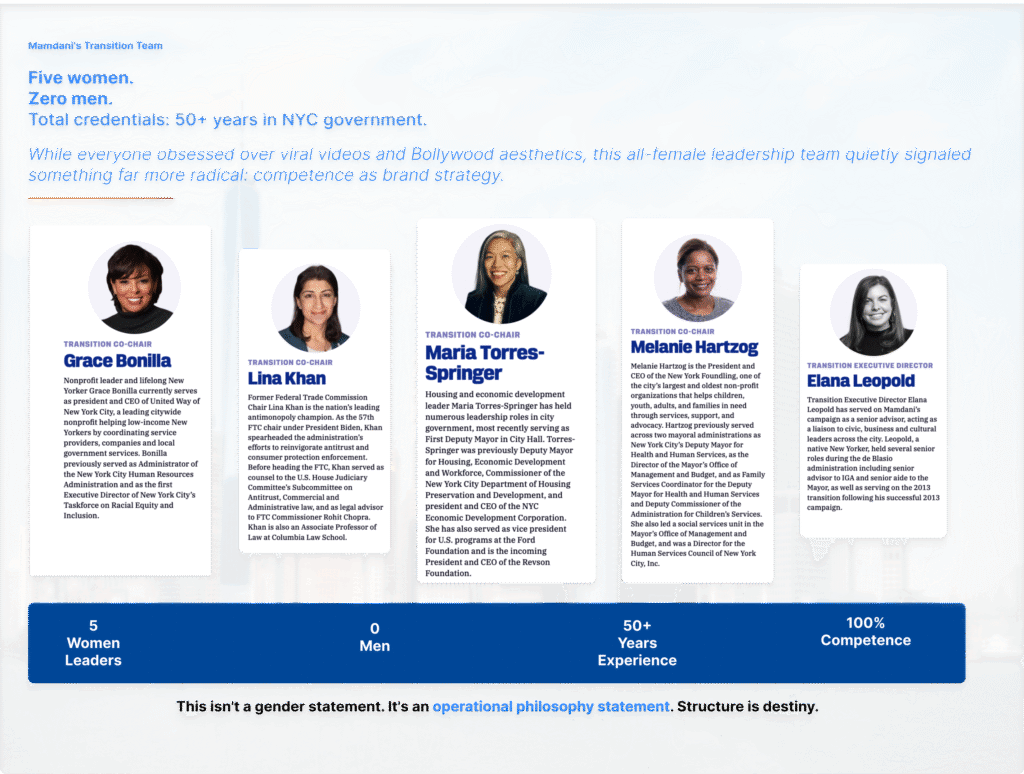
On the morning after his victory, Mamdani announced five women to lead his transition to City Hall. Notably, three of them have already held major positions as deputy mayor, FTC chair, and first deputy mayor. There are no men. In fact, there is not even a single male co-chair. Additionally, the executive director is Elana Leopold, a political strategist. Lina Khan, the former Federal Trade Commission chair, joins her. Maria Torres-Springer, who served as First Deputy Mayor, also joins the team. Grace Bonilla, president and CEO of United Way of New York City, rounds out the leadership. So does Melanie Hartzog, the former deputy mayor for health and human services.
For marketers obsessed with campaign mechanics, this decision means something important. It reveals something far more consequential than a viral aesthetic. Rather, it’s a deliberate statement about execution, not just messaging.
Let’s unpack what this leadership team composition tells us about power, authenticity, and why competitors probably didn’t notice this move.
The Strategic Blindspot: Content vs. Structure
The 2024-2025 political marketing discourse centres on one narrative. It’s about innovation in how you communicate. Mamdani’s campaign is Exhibit A.
For instance, TechCrunch profiles celebrated Melted Solids, the creative duo of Debbie Saslaw and Anthony DiMieri. They’re revolutionary for their documentary-style, hyperlocal video approaches. Similarly, AdWeek ran features on the blue-and-orange colour palette’s genius. New York magazine analysed his ability to speak directly to working-class voters. He used platforms that establishment politicians abandoned.
All of this analysis is correct. But here’s the problem: it’s incomplete. It reveals a structural blindness in how the marketing industry evaluates campaign success.
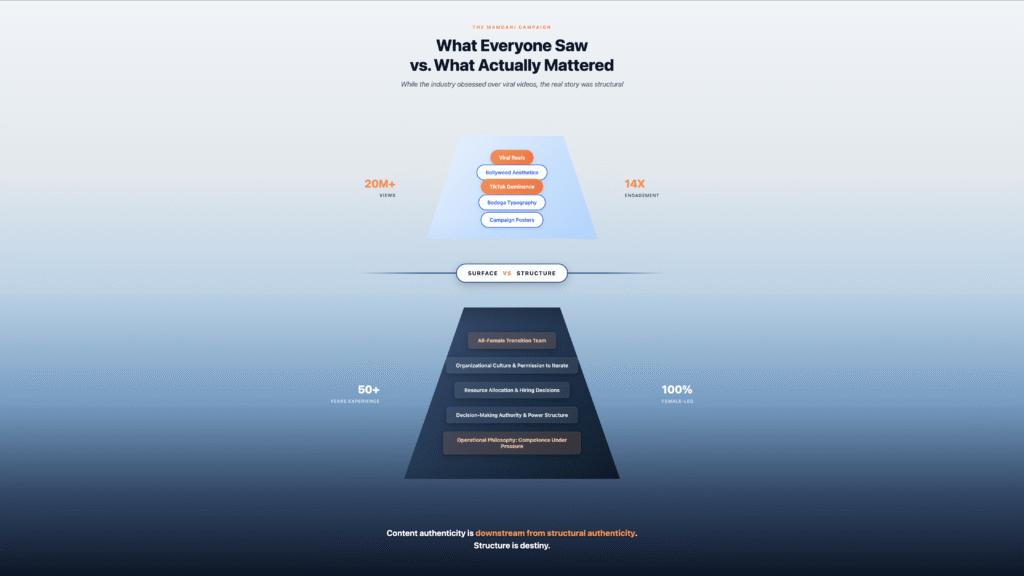
Most analyses assume something false. They assume content strategy and creative execution are somehow separable from organisational structure. However, that’s wrong.
The Content Creation Reality
Melted Solids produced content that worked because Mamdani’s campaign had functional organisational culture. The team could iterate on ideas. They took creative risks. Moreover, they distributed rapidly across platforms. As a result, the content succeeded because it had institutional permission to exist.
Think about this carefully. Mamdani’s transition team composition suggests something crucial. He understands what most political campaigns—and most corporate marketing organisations—have missed. Therefore, content authenticity is downstream from structural authenticity.
In other words, you can’t fake genuine work. Audiences sense when decisions are made top-down versus collaboratively.
Why All-Female Leadership Signals Competence
Most analysis breaks down into performative hand-wringing about “diversity.” Nevertheless, that misses the actual business case entirely.
Research from MIT compared female-led and male-led scientific research teams. Here’s what they found: female-led teams generate 2.2-3.1% more novel ideas. Moreover, they generate 1.9-3.1% more disruptive ideas. However, they face significant systemic undervaluation of their work. Why does this happen? Because gender-diverse teams produce more innovative solutions. Consequently, they’re forced to challenge conventional wisdom simply to be taken seriously.
In politics and governance, this translates directly. The women Mamdani appointed aren’t there for optics. Therefore, they’re there because they’ve solved harder problems with fewer resources and less political protection.
Track Records That Matter
Consider Torres-Springer. Specifically, she led housing development during two mayoral administrations. Importantly, she navigated competing interests between developers, tenant unions, and civic groups. Khan, serving as FTC chair, waged the most aggressive antitrust campaign against tech monopolies in two decades. Notably, she couldn’t have won through conventional channels.
Bonilla managed the city’s human resources apparatus. Additionally, she directed a racial equity taskforce during police reform debates. Hartzog faced different challenges. For example, she balanced budget constraints against mounting social services demand across multiple city administrations.
These aren’t “diversity hires.” Rather, these are people selected because they’ve navigated governance environments even more hostile than Mamdani faces. Admittedly, Trump’s threats to defund New York are testing that assumption right now.
Here’s the key insight for marketing organisations: when you build a campaign in genuinely uncertain conditions, female-led teams ask better questions. What could go wrong? Why? Ultimately, they’ve survived worse odds. That’s not bias. That’s pattern recognition.
Competence as Brand Insurance
New York City’s media establishment questions whether Mamdani is experienced enough to govern. He’s 34. He’s a state assemblyman. Furthermore, he ran on policy platforms that establishment figures immediately labelled “unfeasible”. These include city-run grocery stores, universal childcare, and free public transit.
By appointing a transition team stocked with seasoned government leaders, Mamdani does more than delegate. Instead, he purchases credibility insurance.
Every major metropolitan newspaper reads this announcement carefully. So do institutional investors, real estate developers, and federal agency stakeholders. All of them recalibrate their risk assessment immediately. For instance, Khan’s presence signals that monopolistic corporate behaviour will face active scrutiny. Torres-Springer signals continuity on housing policy. This matters more to NYC institutional stability than any other single issue.
How Structural Choices Signal Values
Bonilla signals commitment to serving low-income New Yorkers. Moreover, she does this through concrete nonprofit partnerships, not rhetorical gestures. Therefore, this is political marketing at a different register entirely. It’s not “selling” the candidate through content. Instead, it’s de-risking the candidate through structural signalling.
For B2B marketing teams: this is what sophistication looks like.
You don’t convince sceptics by producing slicker content. Rather, you convince them by demonstrating institutional competence embedded into your operational structure.
Mamdani’s campaign succeeded partially through viral videos. Yet it will succeed or fail in governance based on whether his transition team can actually execute.
The Melted Solids Parallel: Creativity Requires Female Leadership
Here’s a detail that deserves careful attention. Melted Solids, the production company behind Mamdani’s most viral campaign videos, was founded by Debbie Saslaw and Anthony DiMieri. Functionally, it operates as a female-led creative studio.
Saslaw previously worked at HBO. Specifically, she was one of the platform’s first digital content producers. During the “pivot-to-video” era, she developed strategic understanding of how platforms reward content. DiMieri brought technical production chops. Moreover, he brought long-term involvement in Bernie Sanders’ media strategy. Together, they built something neither could have alone.
Consequently, they created a production company understanding both platform algorithm mechanics and narrative strategies. These strategies make progressive politics emotionally resonant. This reaches audiences who otherwise ignore politics entirely. The approach works because it’s collaborative, not hierarchical.
Why Collaboration Beats Top-Down Direction
The videos worked because they weren’t trying to convince anyone of anything. Instead, they showed working-class New Yorkers describing their own problems. In their own language. Mamdani appeared as a person responding to problems. He wasn’t a politician performing concern. That’s not just a creative insight. Rather, it’s an operational philosophy. And it requires permission from the top of the organisation.
Mamdani gave Melted Solids that permission. The studio executed through structures requiring collaboration and iteration. For instance, DiMieri described the candidate as “incredibly adaptive and excited” about ideas. These emerged in group chats. They didn’t come from top-down directives. This matters because it reveals the organisational culture.
That’s female-led creative culture in practice. It’s collaborative. It’s iterative. It grants permission. It’s outcome-focused. It doesn’t centre ego.
As a result, it produces better work faster.
For a very different—but equally people-powered—take on how algorithms and cultural fluency intersect, read my analysis of Swiggy Wiggy 3.0’s people-powered marketing playbook.
Platform Dominance ≠ Demographic Reach
Here’s where the marketing mythology breaks down most spectacularly.
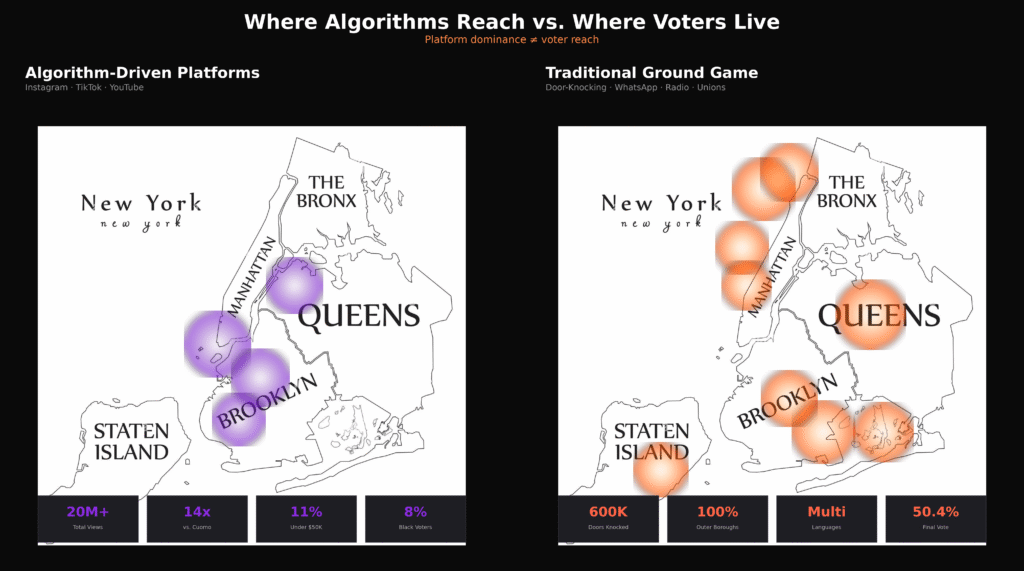
Mamdani’s Instagram engagement rate was 14 times Cuomo’s during June 2025. Additionally, his social media mentions outnumbered Cuomo’s 30-to-1. His TikToks accumulated hundreds of millions of impressions. Yet by May 2025, something shifted. Mamdani was virtually unknown to voters earning under $50,000 annually. Cuomo maintained 47% support. Mamdani had just 11%. Among Black voters, he placed third at 8%, whilst Cuomo held 50%.
This disconnect reveals the marketing industry’s catastrophic blind spot.
Algorithm-driven platforms create asymmetric visibility. In other words, they reach some audiences brilliantly while missing others entirely.
The Ground Game Reality
Here’s the uncomfortable truth: if your target audience doesn’t use Instagram Reels, TikTok, or YouTube, social media dominance means nothing. Full stop.
Nevertheless, Mamdani eventually closed these gaps. How? Through traditional ground organising. Specifically, his campaign deployed multilingual WhatsApp outreach, traditional door-knocking (600,000 doors knocked), radio spots, and old-school organising relationships. These included unions and tenant associations. That’s not sexy. It’s not a case study. Rather, it’s the actual work of democratic campaigning. And it’s what social media metrics obscure completely.
For corporate marketing teams: if you measure campaign success primarily through social media metrics, you’re measuring distribution to people already predisposed to care about your brand. You’re not measuring whether you’ve moved the needle with audiences who require different channels, different language, and different proof points.
If you measure campaign success primarily through social media metrics, you’re measuring distribution to people already predisposed to care about your brand.
Mamdani’s all-women transition team exists to solve this problem at scale. For instance, Khan brings antitrust expertise that reaches people through financial and trade press. Torres-Springer brings housing development credentials that reach real estate professionals. These credentials reach architectural journalists too. Bonilla brings nonprofit sector credibility that reaches community-based organisations. Therefore, together they represent distribution to audiences Instagram can’t reach.
They won’t help Mamdani go viral on TikTok. Rather, they’ll help him govern in ways that institutional stakeholders take seriously. That’s a different kind of viral. It’s slow-moving. It’s trust-based. It’s operationally resilient. And ultimately, it matters more.
The Structural Lesson for Agencies
The marketing industry has optimised around one thing: producing compelling communications artefacts. Think campaigns, videos, landing pages, social media copy. The entire infrastructure—creative boutiques, media buying firms, production companies—exists to generate and distribute these artefacts quickly and cheaply.
What has this industry catastrophically failed to do? Embed operational competence alongside creative excellence. In fact, the two are treated as separate disciplines entirely.
The marketing industry has catastrophically failed to embed operational competence alongside creative excellence.
The Four Elements of Success
Mamdani’s campaign succeeded because it had four elements working together:
- Creative excellence (Melted Solids producing emotionally resonant content)
- Operational infrastructure (Manychat automation driving 77,000 DMs, 20,000+ clicks, 10,000+ email captures)
- Structural credibility (An all-women transition team signalling competence to institutional stakeholders)
- Ground game integration (Social media engagement feeding into neighbourhood-level organising)
Most campaigns optimise for #1 and maybe #2. However, Mamdani’s campaign optimised for all four. Critically, each element reinforced the others.
Now his transition team is building operational coherence at a different scale. Not producing viral content. Instead, producing governance outcomes. This distinction matters enormously.
For corporate marketing teams: this represents the difference between two models. First, a communications team that reports to the CMO. It’s optimised for campaign production. Second, communications strategy embedded into operational decision-making at the C-level. It’s optimised for sustained brand credibility. Most organisations don’t even recognise this distinction.
The all-women transition team isn’t a gender statement. Rather, it’s an operational philosophy statement.
Mamdani selected people with track records of executing under radical uncertainty. They’ve navigated competing stakeholder pressure. That they happen to be women reflects something important. It reflects what kinds of people develop these skills at scale. The real insight is structural.
Competence under pressure is the actual product being sold to New York’s voters. Everything else is marketing.
Curious how I help brands turn bold strategy into authentic, scalable marketing campaigns? Learn more about my approach here.
Why This Matters: The Authenticity Reckoning
The most important sentence in all victory coverage appeared in a relatively obscure piece. Khan said that “New Yorkers are not just electing a new mayor, but clearly rejecting a politics where outsized corporate power and money too often end up dictating our politics.”
This isn’t marketing copy. Rather, it’s operational philosophy. It comes from someone who just spent four years fighting corporate monopolies. And it reveals what actually motivates this team.
The entire Mamdani campaign rested on one idea. Working-class New Yorkers can feel the difference between authentic and performed politics. Authentic politics? Speaking directly about their problems. Performed politics? Politicians performing empathy for cameras.
When Structure and Message Align
The content strategy worked because it reflected the operational strategy. The campaign was built by people willing to knock on 600,000 doors. They had authentic conversations about rent, childcare, and food costs. Nothing was performative because nothing needed to be performed.
The transition team composition sends the same message at a different register. It says: we’re not just talking about change. We’ve staffed our administration with people who’ve actually created change. They’ve done it under worse circumstances than we currently face. Therefore, you can trust us to deliver.
That’s what authentic governance marketing looks like. It’s not about how you communicate. Rather, it’s about whether your structural decisions back up what you’re saying. When they don’t align, audiences notice immediately.
If you’ve wondered what happens when a campaign nails visual polish but misses operational substance, read my critique of Maybelline’s Mumbai Mirage. It’s a cautionary tale about CGI spectacle without strategic coherence. In fact, it’s the opposite of what Mamdani did.
The Uncomfortable Question for Marketers
If Mamdani had appointed an all-male transition team with identical qualifications, would anyone notice the operational competence? Probably not. Media narrative would focus exclusively on viral videos and visual aesthetic. The structural decision would remain invisible.
Instead, the all-female transition team forced a reckoning.
You can’t simultaneously claim authenticity to working-class New Yorkers whilst staffing your administration with people who look nothing like your constituency.
That’s a structural contradiction. And audiences notice contradictions.
Why Structure Matters More Than Content
The structural diversity became a proxy for operational seriousness. That’s the insight agencies should steal.
Authenticity in marketing isn’t achieved through better copywriting or more relatable videos. Rather, it’s achieved when every structural decision—hiring, resource allocation, reporting lines, decision-making authority—visibly reflects the values you’re claiming to champion.
Mamdani’s campaign succeeded because he embedded progressive values into operational structure. His transition team exists to embed those values into governance structure. The content (Reels, videos, posters) worked because it was downstream from structural authenticity. In other words, the form followed the function.
Most campaigns—and most corporate marketing teams—get this exactly backwards. They produce content first, then retrofit strategy around it.
They hope the messaging will convince people to ignore the structural contradictions. However, it rarely works.
Mamdani did the opposite. First, he built structure. Then he let competent people operate within that structure with permission to iterate. As a result, the content emerged naturally from operational reality. No forced messaging. No performative authenticity. Just real work producing real results.
For another example of message rhythm and where disciplined repetition can hit a bump, here’s my take on KitKat’s “Break the Loop” musical campaign. It’s an audit of what happens when brand consistency meets execution gaps. Spoiler: it doesn’t work as well as we hope.
That’s why the all-women transition team matters more than any single viral video. Because structure is destiny.
Footnotes
Transition Team Announcements
Indian Express, Al Jazeera, Fortune, CNN, Time Magazine. “Zohran Mamdani announces all-women transition team.” November 2025.
https://www.indianexpress.com/ | https://www.aljazeera.com/ | https://fortune.com/
Melted Solids and Creative Strategy
Defector, Milk Karten, CounterPunch. “Melted Solids” case studies and profiles. August-September 2025.
https://defector.com/ | https://milkkarten.net/ | https://counterpunch.org/
Research on Female-Led Teams
MIT. “Female-led teams produce more innovative ideas yet receive less scientific impact.” October 2024.
https://direct.mit.edu/
Policy and Governance Analysis
Politico, NBC News, The New Republic, Britannica. Governance capability and policy platform assessments. June-November 2025.
https://politico.com/ | https://newrepublic.com/ | https://britannica.com/
Demographic and Voter Reach Data
Al Jazeera. “Did Democrat Zohran Mamdani struggle with Black and lower-income voters?” July 2025.
https://www.aljazeera.com/
Ground Game and Organising
The Wire, Telegraph India, ABC News. “Ground Game Analysis.” October-November 2025.
https://m.thewire.in/
Digital Analytics and Automation
Milk Karten. “How Zohran Mamdani drove over 20K clicks from Instagram.” July 2025.
https://milkkarten.net/
Campaign Engagement Metrics
Campaign Trend. “Zohran Mamdani-mania.” August 2025.
https://campaigntrend.com/
Trump Administration Threats
Le Monde. “New York mayoral election: Trump threatens retaliation if Mamdani elected.” November 2025.
https://lemonde.fr/