
If you want to understand the future of the internet in India, stop looking at silicon chips, server farms, or government regulations. Instead, look at two specific advertisements released this month.
In the red corner, we have OpenAI’s first mass-market film for India: a cinematic, sentimental portrait of a kirana store owner facing an existential crisis. In the blue corner, Google’s barrage of rapid-fire vertical videos for its new ‘AI Mode’, answering everything from cricket bat weights to gas connection forms.
On the surface, these are just commercials. But dig deeper, and you’ll see two tech giants pitching fundamentally different visions of the future to the world’s most critical internet market. For marketers watching from the sidelines, this isn’t just a brand war—it is a preview of how consumer behaviour is about to fracture. We are witnessing the divergence of the digital experience into two distinct psychological states: The Utility and The Agency.
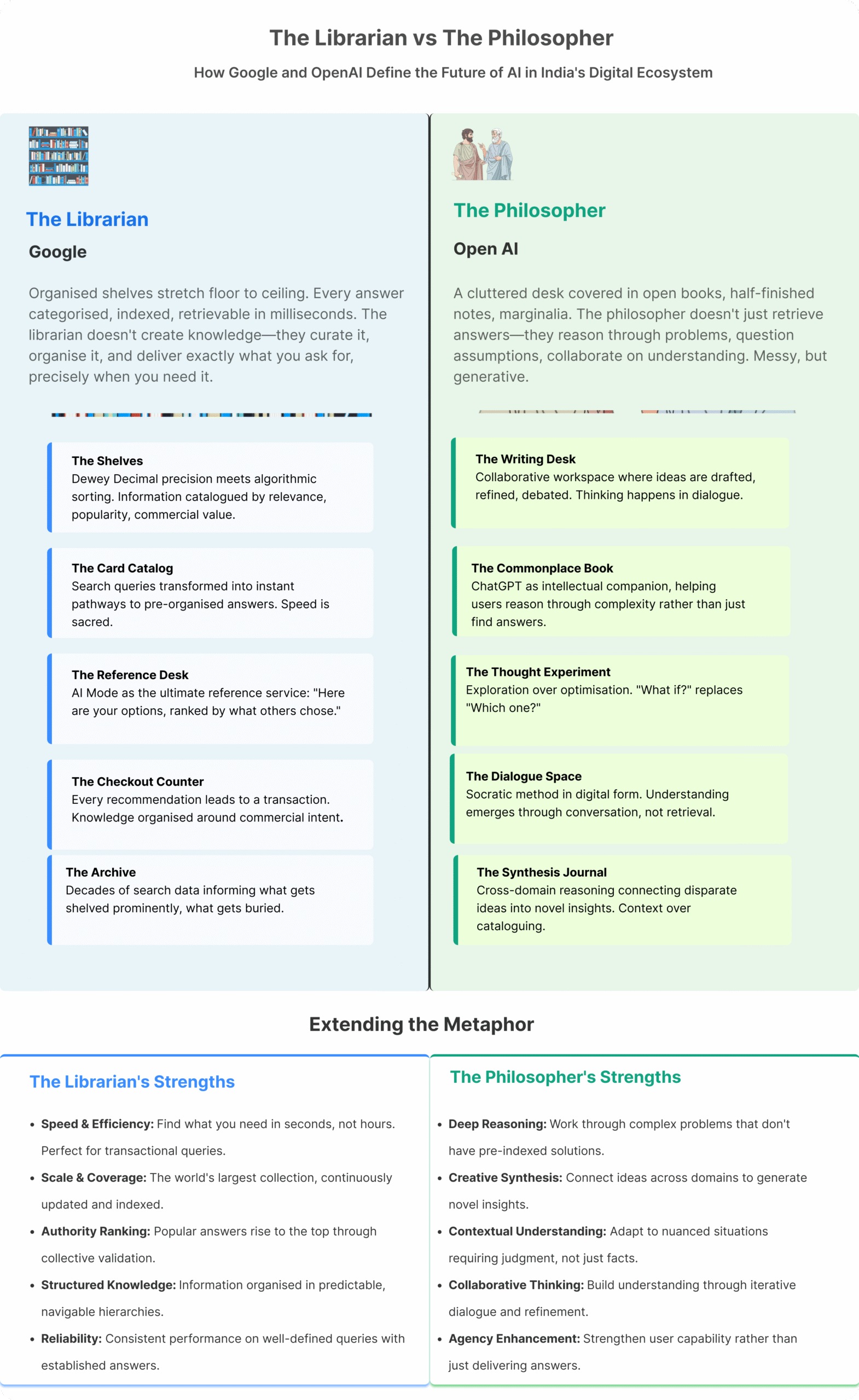
The Librarian: Google’s Commercial Defence of the “How”
For two decades, Google has positioned itself as the world’s Librarian. Theoretically, you ask for a book, and it points you to the right shelf. But let’s be honest: that shelf is rarely neutral. It is increasingly the shelf that paid to be at eye level.
Google is efficient and transactional, yes. But its role has evolved from a neutral arbiter of truth to a commercial broker of answers. Its recent “Search Like Never Before” campaign is a frantic, high-budget attempt to upgrade this directory for the AI age—a struggle that reflects the broader identity crisis I’ve documented in my analysis of The Pixel Paradox: Dispatches from a Digital Native’s Divided Reality.
Google’s campaign is a masterclass in defensive strategy. It identifies the friction points of modern Indian life—bureaucracy, academic pressure, mechanical failures—and positions AI as the grease. The campaign, featuring short, vertical vignettes (a format clearly borrowed from the TikTok/Reels aesthetic), answers the question: “Which?”
- Which law college should I choose? (Often influenced by who is bidding on “law admission” keywords).
- Which cricket bat is right for a beginner? (Likely a Shopping Ad carousel).
- Which form do I need for a gas connection?
The Strategy: Cinematic Gloss on Utility
By enlisting Zoya Akhtar to write and conceptualise the campaign (produced by her agency, Tiger Telly), Google attempts to wrap this commercial machinery in cinematic gloss, a tactic often seen in Amazon’s celebrity marketing strategy. However, despite the narrative polish, the core message remains ruthlessly functional. Google is betting that while Indians might aspire to creativity, what they need is a fix. They are positioning their AI as the ultimate jugaad tool—a digital Swiss Army knife for a chaos-filled nation.
The Trap: The Invisibility of Infrastructure
But there is a trap here. Utility is invisible. We don’t love our electricity providers; we just pay them. By positioning AI as a hyper-efficient utility, Google risks becoming the plumbing of the internet—essential, but unloved and ultimately commodified. As the “blue link” dies, so does the visibility of the brand that serves it.
The Philosopher: OpenAI’s Promise of the “Why”
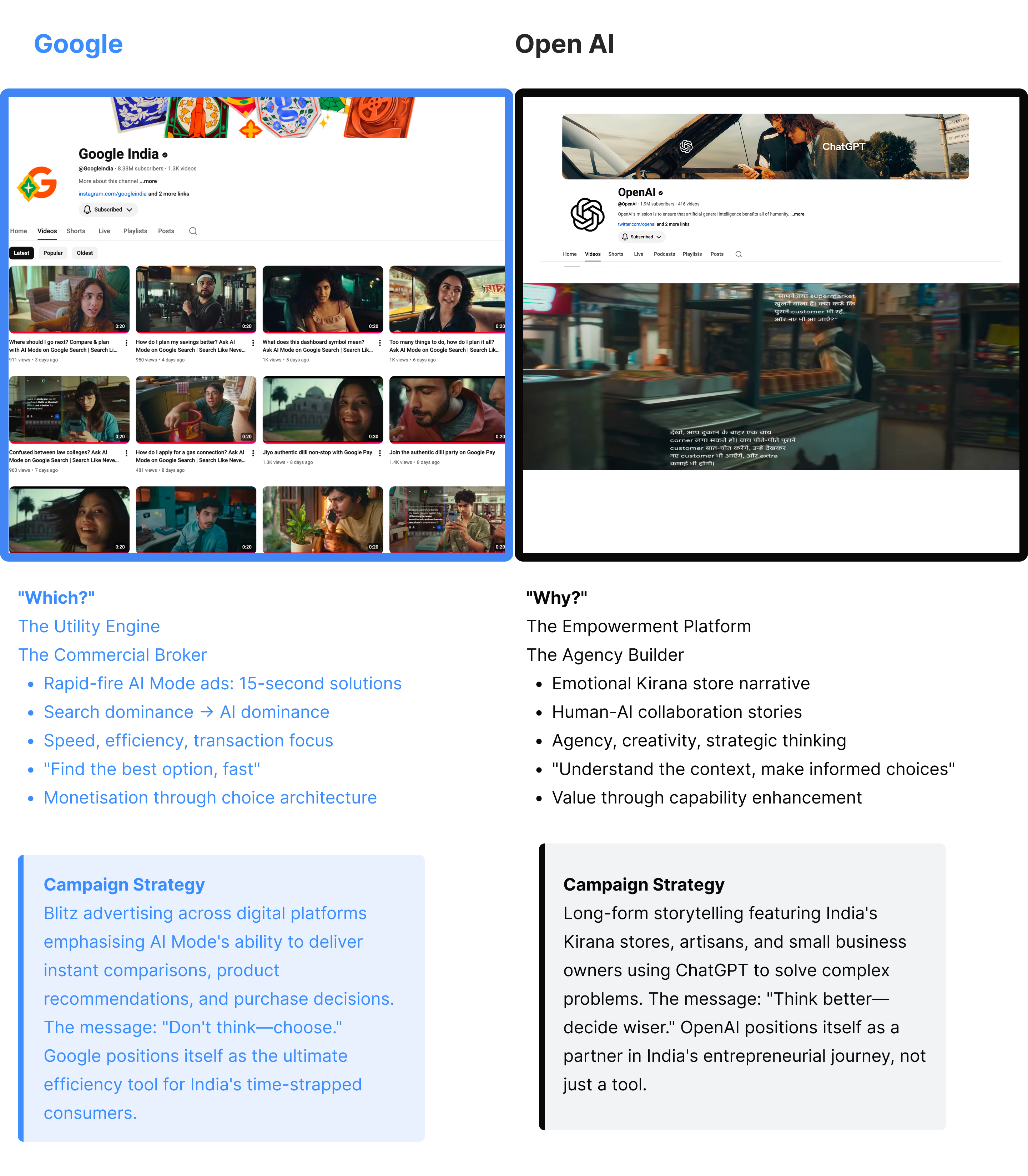
OpenAI, however, isn’t trying to be a better librarian (or ad broker). With its “Turn your hard work into something big” campaign, it is positioning itself as a Philosopher—or perhaps more accurately, a Consultant.
The “Kirana Store” film is a stark departure from typical tech advertising. It features no slick interfaces, no holographic overlays, and no jargon. Instead, it features a man, a counter, and a question. The shopkeeper, facing the threat of a new supermarket, doesn’t ask ChatGPT for “retail trends” or “SEO keywords.” He asks, plain and simple: “Kya karoon?” (What should I do?).
A Seismic Shift in Interaction
This moment marks a turning point in human-computer interaction. He treats the AI not as a search engine, but as a co-founder. The AI’s response—suggesting a chai corner to drive community footfall—is not a retrieval of facts; it is a synthesis of strategy. It taps into the specific cultural texture of Indian commerce, where business is built on relationships (chai-paani), not just transactions.
Agency Over Algorithms
This focus on human dignity and resilience echoes the narrative beats of Swiggy’s “Wiggy 3.0” campaign, which similarly centred on the agency of the everyday worker rather than the mechanics of the app. By framing ChatGPT as a partner that grants agency to the underdog, OpenAI is bypassing the “tech bro” image and going straight for the heart. They are selling confidence.
The Missing Middle: Beyond the Duopoly
While the headlines are dominated by the Google vs. OpenAI showdown, smart marketers know that the AI landscape is not a two-horse race. The “Librarian” and the “Philosopher” are dominant archetypes, but they are not the only tools in the shed.
In fact, reliance on just these two ecosystems is a strategic risk, a concept I explored in my critique of the September smartphone marketing melee. To build a truly resilient marketing stack in 2026, one must consider the “Specialists”:
1. The Artisan: Claude (Anthropic)
If OpenAI is the consultant, Claude is the copywriter. For brands focused on authentic brand storytelling, Claude’s “Sonnet” models have consistently outperformed GPT-4 in nuance, tone, and lack of “AI-ese” (the robotic cadence typical of ChatGPT). As detailed in my Claude Sonnet Marketing Analysis, marketers dealing with long-form thought leadership, sensitive PR communications, or creative fiction should be looking here. Claude doesn’t try to do everything; it tries to write well.
2. The Analyst: Perplexity
While Google offers lists and OpenAI offers ideas, Perplexity offers synthesis. It is the “Research Assistant” that cites its sources. For content marketers, this is critical for trust. In an era where AI hallucinations can destroy brand reputation, Perplexity’s “citation-first” architecture makes it the safer bet for B2B white papers and technical documentation.
3. The Sovereign: Meta Llama (Open Source)
For enterprise brands concerned with data privacy and “renting” their intelligence, the open-source route (led by Meta’s Llama models) is the only viable long-term play. It allows brands to build their own Librarian—one that knows their internal documents, brand guidelines, and customer history better than any public model ever could.
The Cultural Fracture: Jugaad vs. Aspiration
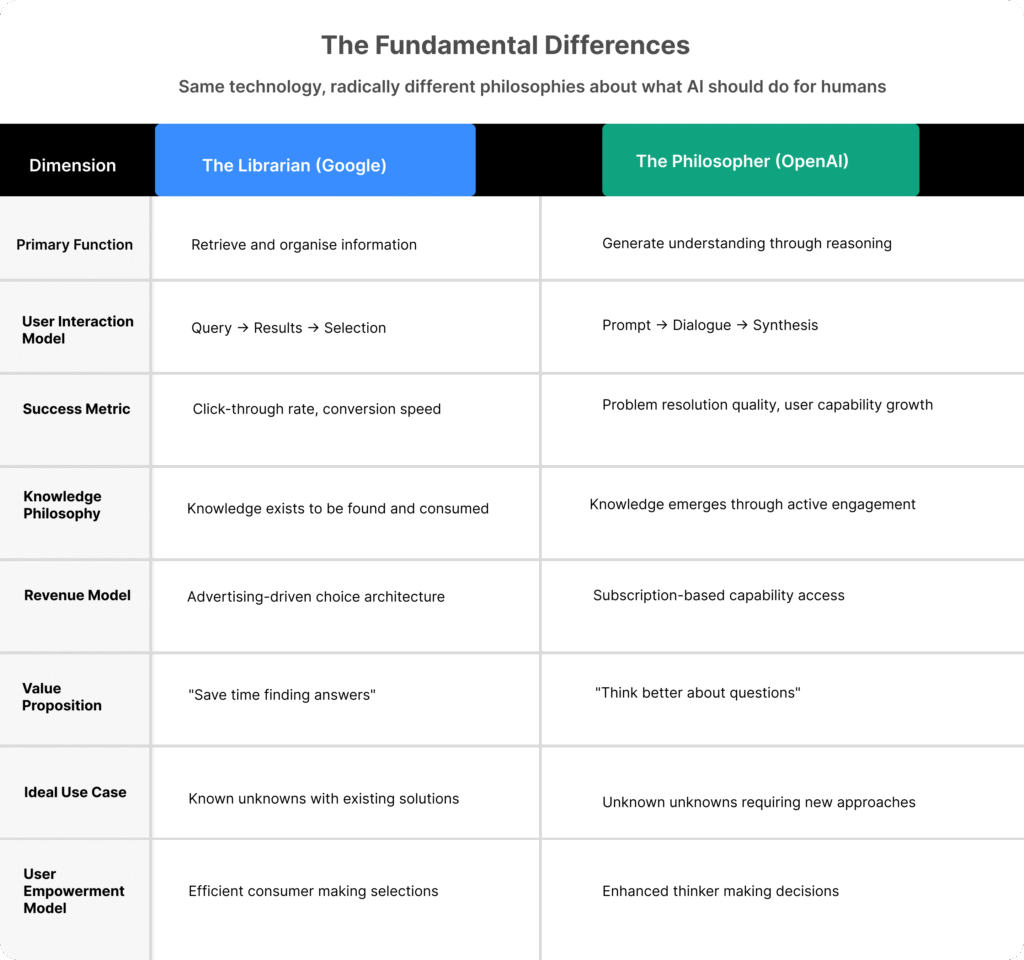
The contrast between these campaigns reveals a split in how these giants view the Indian consumer.
- Google views the user as a “Seeker”: Someone navigating a complex world who needs facts to survive.
- OpenAI views the user as a “Creator”: Someone facing an opportunity gap who needs strategy to thrive.
For the Indian middle class, which is currently oscillating between the anxiety of automation and the aspiration of entrepreneurship, OpenAI’s pitch is seductive. It suggests that AI is not just a tool for homework, but a tool for social mobility. This aligns perfectly with the shifting Indian consumer behaviour, where the desire for “premiumisation” is now being replaced by a desire for “empowerment.”
The 2026 Playbook: Actionable Steps for the Indian Marketer
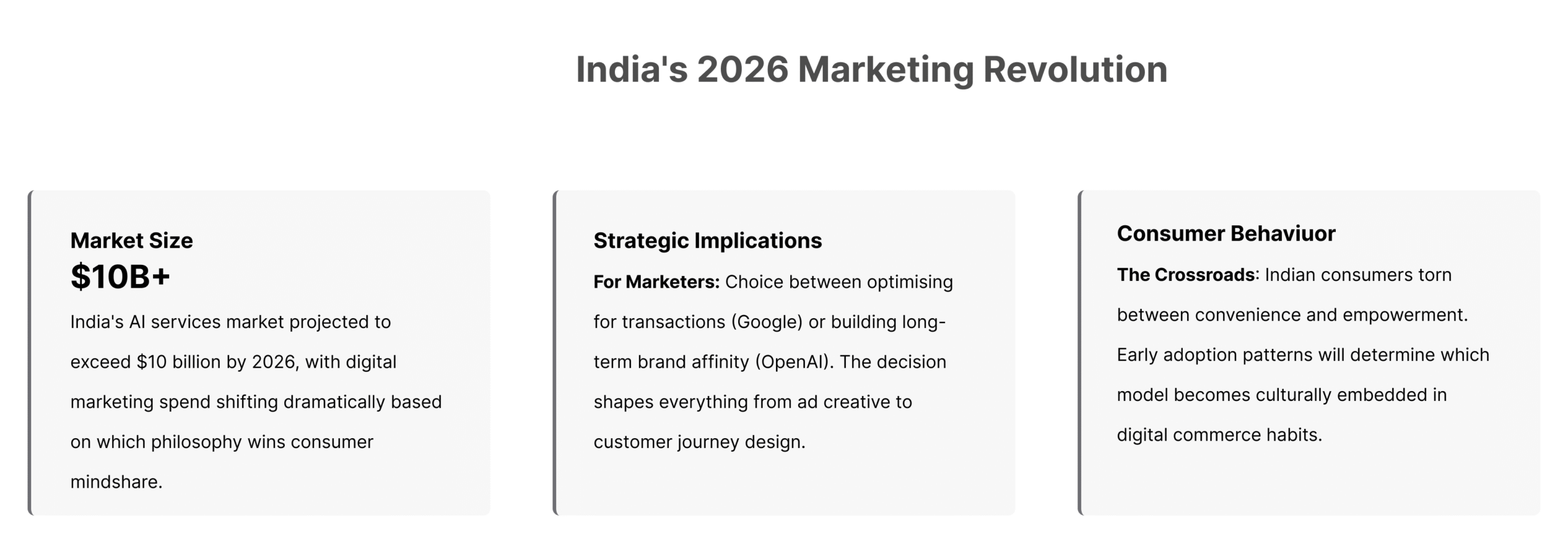
So, how does a CMO navigate this fractured landscape? You cannot simply “buy ads” on these platforms. You must integrate with them. Here is your 5-step playbook for the coming year:
Strategic Shifts: Content and Data
1. Audit Your Content for “Answerability”
The era of the “10 Best Tips for X” blog post is over. Google’s AI Overview will summarise that list and steal your traffic.
- Action: Pivot your content strategy to “First-Party Data” and “Opinion.” AI cannot hallucinate your proprietary customer data or your brand’s unique stance on a controversial issue. Publish reports, case studies, and contrarian takes—things the AI must cite rather than just summarise.
2. Diversify Your AI Portfolio
Don’t let your marketing team become “ChatGPT-dependent.” This creates a “vendor lock-in” that stifles creativity.
- Action: Mandate “Model-Market Fit.” Use Gemini for analyzing spreadsheets and SEO trends (it lives in the Google ecosystem). Use Claude for writing customer emails and newsletters (it sounds more human). Use Midjourney or Flux for visuals. Treat AI models like employees with different skill sets, not interchangeable tools.
3. Move From “Search” to “Discovery”
The “Kirana” ad proves that users are asking AI for ideas, not just links.
- Action: Optimise your brand for context, not just keywords. If you sell paint, don’t just rank for “blue paint.” Train your brand presence to appear when a user asks, “How do I make my small living room feel bigger?” The answer is “Blue Paint,” but the query was about design strategy. Your content must bridge that gap.
Technical Shifts: Agents and Humans
4. Build “Agent-Ready” APIs
In the near future, AI agents will book tickets, order groceries, and schedule appointments without human intervention.
- Action: Ensure your booking systems, product catalogues, and inventory data are machine-readable. If a user tells their AI assistant to “Book a table at a quiet Italian restaurant,” your restaurant will only be chosen if the AI can read your “live availability” and “ambience tags” via an API.
5. Humanise the Last Mile
As AI takes over the “Utility” (the middle of the funnel), the “Human Connection” (the bottom of the funnel) becomes your premium differentiator.
- Action: Reinvest the money you save on AI-driven content generation into better human customer service. As noted in the Zendesk 2025 CX Trends Report, 81% of Indian consumers want more human interaction as AI grows. Let the bots handle the forms; let your people handle the feelings.
The Verdict: The Hybrid Future
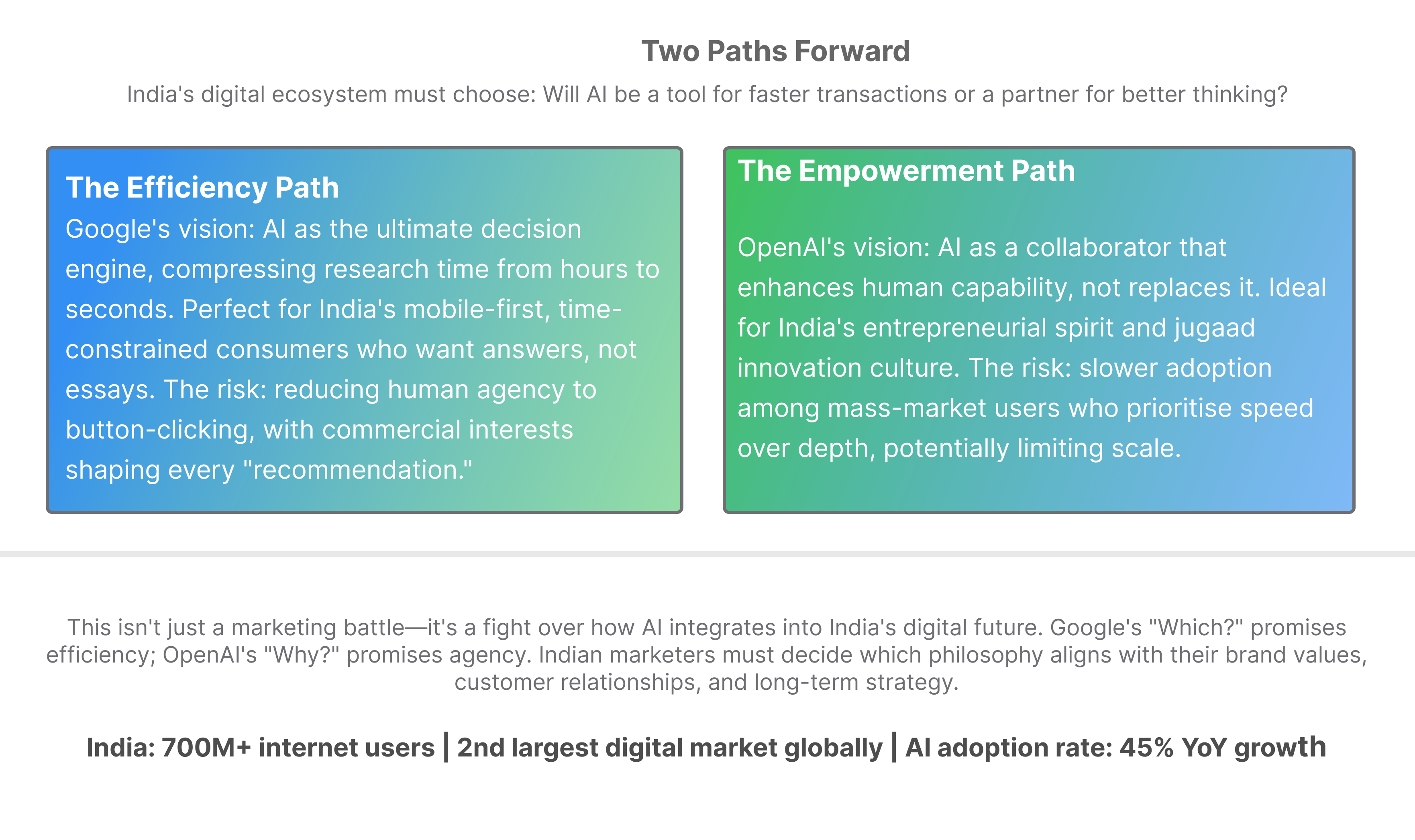
As we head into 2026, the battle lines are drawn. Google is fighting to keep the internet a place where you find things. OpenAI is trying to turn it into a place where you create things.
However, the reality for the Indian marketer is that this is not a zero-sum game. The smart money is on a hybrid approach.
- Use Google’s ecosystem to capture the high-intent, “I need it now” traffic. This is where you solve immediate problems—the dashboard symbols, the admission forms, the quick purchases.
- Look to OpenAI’s model for your brand building. Be the partner, not just the product. Create campaigns that empower your users to do more, rather than just buy more.
The Librarian helps us survive the chaos. The Philosopher helps us transcend it. In a market as complex as India, we will always need both—but we will only love one.
References & Further Reading
- Internal Analysis:
- External Sources:
- “AI: A Collaborator, Not a Creator” – Google India’s Shekar Khosla (Storyboard18)
- Google Introduces AI Mode to Users in India (TechCrunch)
- Google Partners with Tiger Telly for New Campaign (AdGully)
- Google Collaborates with Tiger Telly (Campaign India)
- Google’s AI Mode Will Fundamentally Redefine Digital Ad Industry (Campaign India)
- AI Mode Update: Going Beyond Information to Intelligence (Google Blog)