
On December 11, Google launched live speech-to-speech translation across 70 languages in its Translate app. The technology uses Gemini 2.5 Flash Native Audio. Consequently, the feature rolled out first in India, Mexico, and the United States. These three markets share a crucial trait: linguistic fragmentation either determines market access or creates competitive moats worth billions.
If your initial reaction was “that’s nice,” you’re underestimating what just shifted.
This isn’t a product upgrade. Instead, it’s infrastructure that makes multilingual customer experience scalable at a cost and quality threshold that didn’t exist 72 hours ago.
Therefore, for digital marketers operating in linguistically fragmented markets, the strategic question isn’t whether this matters. Rather, it’s whether you’ll build on top of it before your competitors do.
Why Now? The $13.5 Billion Translation Layer Nobody Wants to Pay For
The artificial intelligence translation market is projected to reach $13.5 billion by 2033. Moreover, it’s expanding at a compound annual growth rate of 22.3%. Live speech translation specifically is expected to hit $1.8 billion by 2025. Additionally, voice preservation technologies are achieving 40% adoption in international communication contexts.
These aren’t speculative figures. Instead, they reflect actual commercial behaviour.
Seventy-five percent of consumers are more likely to purchase from brands offering support in their native language. Not “prefer”—more likely to purchase. That’s conversion mechanics, not sentiment. Furthermore, forty percent will never buy from websites in languages other than their own.
The Real Cost of Multilingual Support
The economics are stark. Companies investing in multilingual content are 1.5 times more likely to grow revenue. Additionally, they see an average return of $25 per dollar spent on language services.
When e-commerce platforms implement localised websites and customer support, they report 30% increases in conversion rates. Moreover, first-call resolution improves by 45% when customers receive support in their native language. Simultaneously, customer satisfaction jumps 72%.
Until now, the cost of achieving this at scale has been prohibitive. Specifically, human translation services cost anywhere from $8 to $60 per hour depending on complexity and geography. Even machine translation APIs charge $10 to $25 per million characters. For a company operating customer support across multiple languages in real-time, those costs compound rapidly.
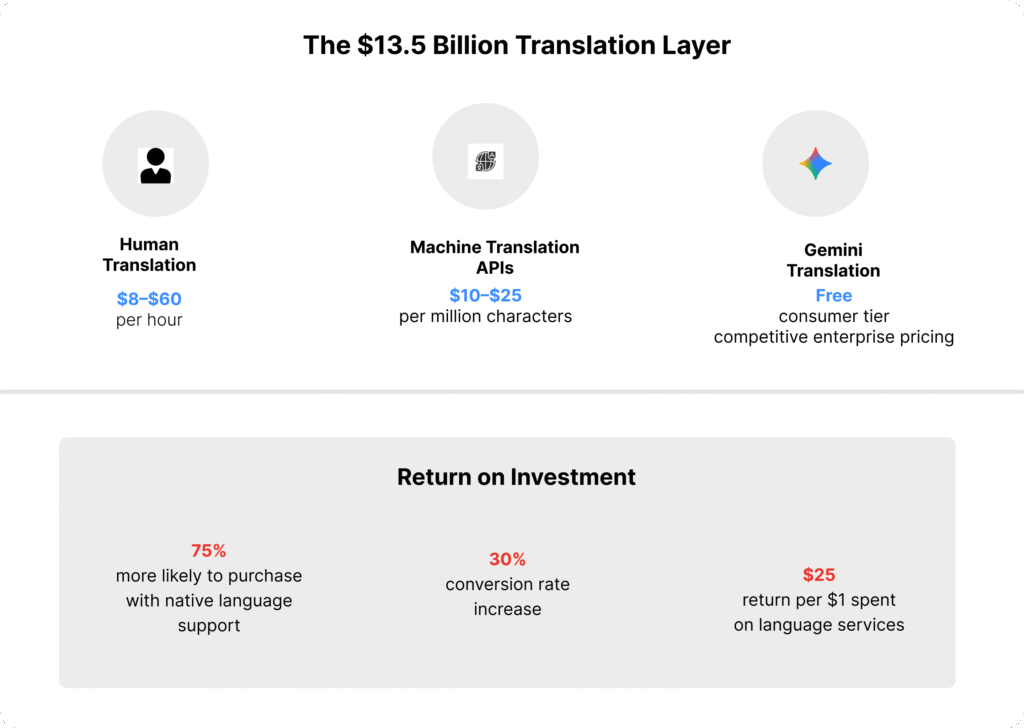
Google’s Gemini translation—free in the consumer app—fundamentally changes the cost structure. Enterprise pricing will likely compete with existing Cloud Translation rates. More importantly, it does something previous translation tools consistently failed at: preserving tone, emphasis, and cadence.
The Tonal Fidelity Gambit: Why Preserved Intonation Isn’t a Feature, It’s the Entire Strategy
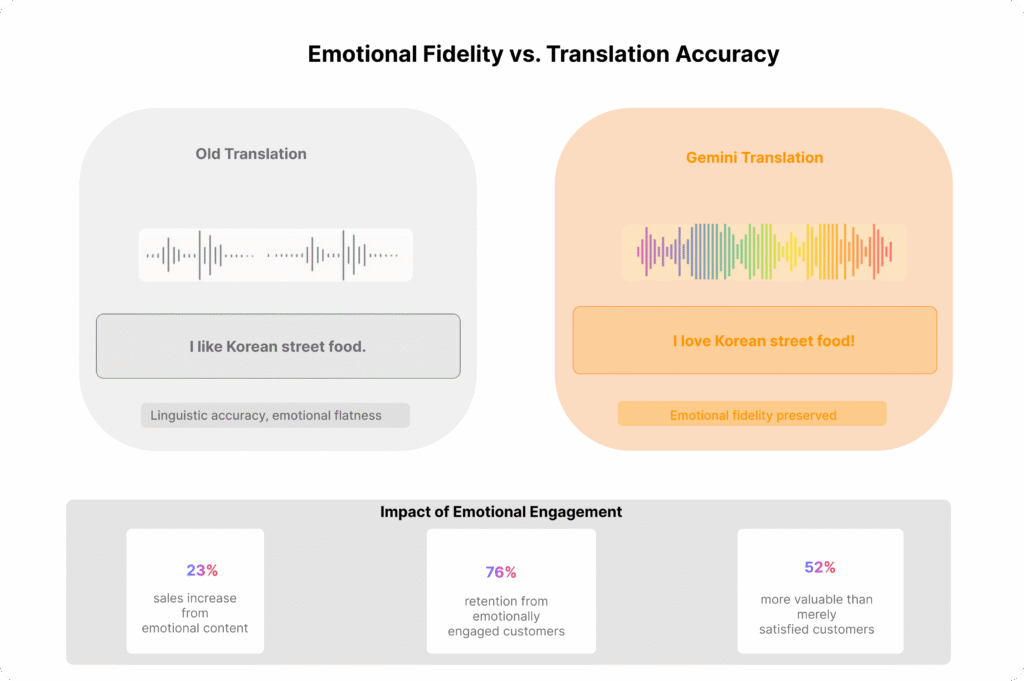
The genuinely clever aspect of Google’s positioning isn’t the 70-language capability. Instead, it’s the explicit focus on preserving intonation, pacing, and pitch. Consequently, the demonstration video deliberately highlights how emotional inflection survives translation. Examples include enthusiasm about Korean street food and nostalgia for Christmas markets in Germany.
This directly addresses the historical failure mode of machine translation: flattening human expression into robotic monotone. Translation quality impacts brand perception across every customer touchpoint. Accurate, culturally appropriate translation builds trust. As a result, it makes international audiences feel comfortable and connected to the brand.
Poor translation, however, damages credibility and makes brands appear unprofessional. Just a single mistranslation can tarnish years of credibility.
Why Emotional Connection Drives Revenue
The distinction between translation accuracy and emotional fidelity matters. Research on emotional marketing confirms that advertisements with above-average emotional response generate 23% increases in sales volume. Furthermore, emotionally charged content vastly outperforms rational messaging—31% versus 16%.
Brands that make customers feel appreciated, happy, and valued see 76% retention, 80% increased spend, and 87% recommendation rates. Moreover, emotionally engaged customers are 52% more valuable than merely satisfied ones.
Google has understood that translation isn’t merely a linguistic problem. Rather, it’s an emotional fidelity problem.
For brands operating in multilingual markets, this means communication infrastructure that doesn’t strip affect from messaging.
A customer service interaction, a sales pitch, a tutorial video: all can now traverse language barriers without sacrificing the tonal cues that establish trust.
This approach contrasts sharply with Google’s recent Pixel marketing strategies. In those campaigns, specifications became subtext and feelings became headline. However, they often excluded non-English speaking users through English-only AI features. The Gemini translation launch suggests Google is finally addressing this blind spot.
India as Ground Zero: The 870 Million User Laboratory
Google’s decision to launch simultaneously in India, the United States, and Mexico is deliberate cartography. India represents the most linguistically fragmented large market on Earth. It has 22 officially recognised languages and hundreds of dialects. Additionally, the population is increasingly accessing digital services in vernacular rather than English.
The Vernacular Internet Explosion
The data on India’s digital language revolution is unambiguous.
By 2024, 870 million internet users—98% of the total—accessed the internet in Indic languages. Among urban users, 57% now prefer consuming content in regional languages.
The Indian-language internet user base grew at a compound annual growth rate of 41% between 2011 and 2016. Consequently, it surpassed English users by 2016.
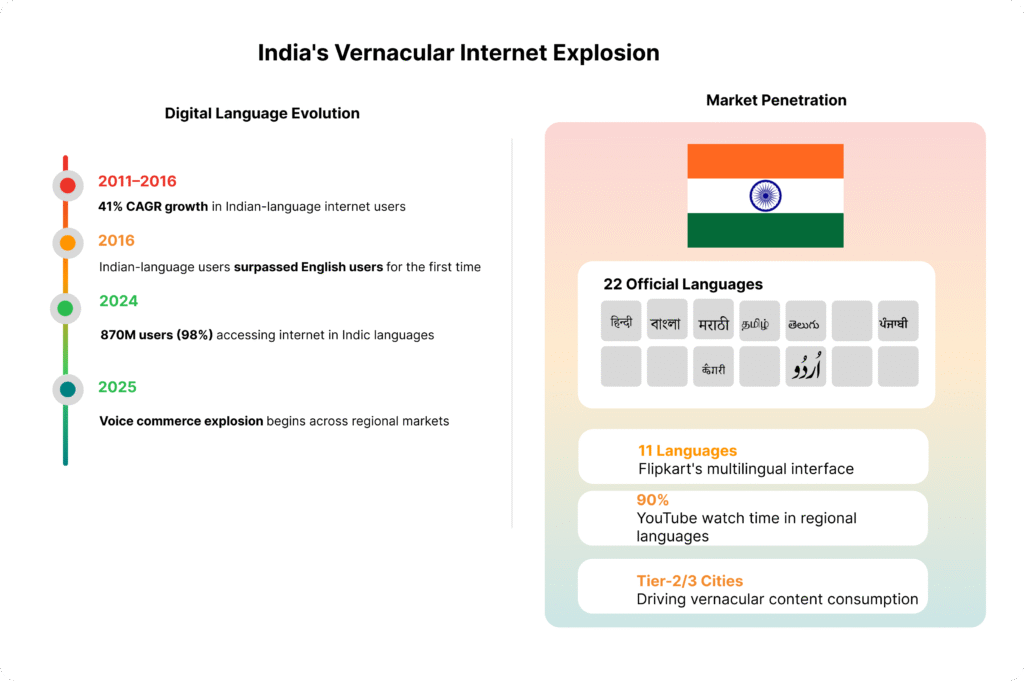
The commercial implications are profound. E-commerce in local languages is growing at a 32% CAGR. This growth is expected to add 120 million users. Similarly, digital payments in vernacular interfaces are expanding at 30% CAGR, with 175 million consumers projected to use them. Regional-language content generates 90% of YouTube watch time in India.
Real Business Impact: The Flipkart Case Study
Flipkart, India’s largest e-commerce platform, now offers browsing and shopping in 11 different languages.
The company reports that 20% of new customers came through its vernacular interface. Additionally, 95% of users who opted for regional languages continuing to use them.
Engagement with vernacular creators grew 30% year-on-year.
Research confirms that 68% of Indian internet users consider local-language digital content more reliable than English. Moreover, they’re 2.5 times more likely to engage with content in their native language.
Brands offering regional-language product videos report that over 70% of new internet users prefer consuming content in local languages. Consequently, this drives engagement, trust, and sales across tier-2 and tier-3 cities.
For digital marketing professionals targeting India, Google’s Gemini translation fundamentally alters the economics of localisation. Previously, creating campaigns across Hindi, Bengali, Tamil, Telugu, and Marathi required expensive human translation. Alternatively, brands risked voice degradation through automated tools. Gemini’s speech translation offers a third path: scalable localisation that retains emotional resonance. However, this assumes it delivers on the preservation-of-tone promise.
Southeast Asia and Latin America: The Next Frontiers Where Language Determines Market Access
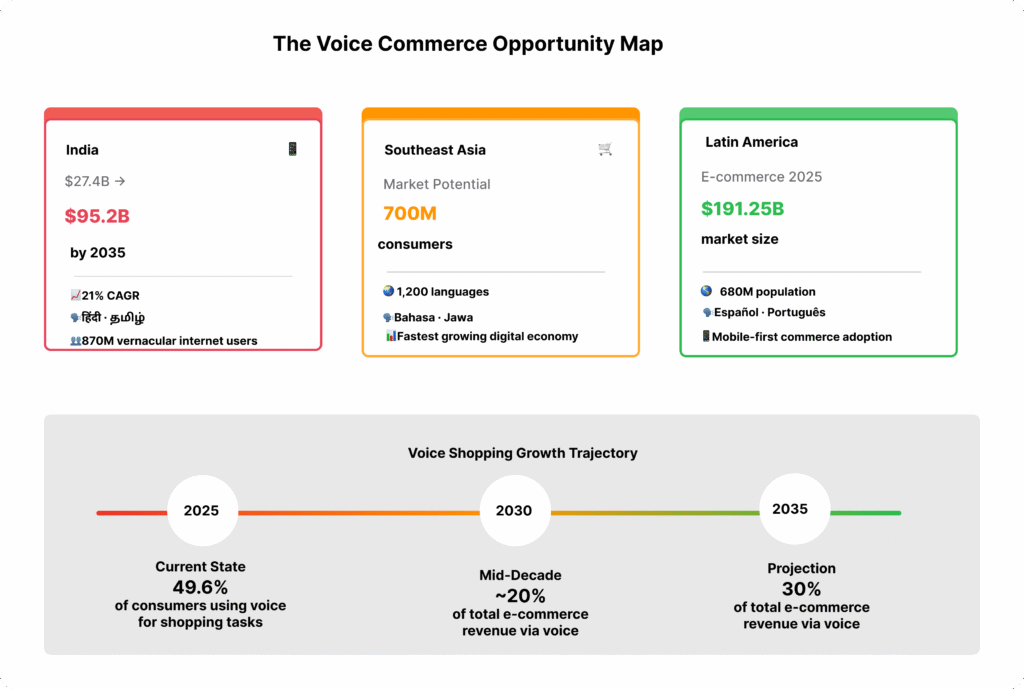
While India serves as Google’s primary laboratory, the strategic logic extends across linguistically fragmented high-growth markets. Southeast Asia, home to over 1,200 languages across 700 million consumers, presents similar challenges.
Indonesia alone has 98 million Javanese speakers. Regional languages are used daily by 70% of the population, despite Indonesian serving as the lingua franca. E-commerce platforms that added Javanese support reduced customer complaints by 22%.
Latin America’s E-Commerce Explosion
Latin America presents analogous dynamics. E-commerce is projected to reach $191.25 billion in 2025. This represents 12.2% annual growth—1.5 times faster than the global average. The region demands “cultural, linguistic, and financial fluency.”
Voice-enabled shopping is expected to reach $5 billion in transactions by 2025 in Latin America. Amazon Echo and Google Home are expanding language capabilities for regional accents and dialects. Seventy percent of online purchases in the region now occur on mobile devices. This figure is projected to hit 85% by 2025.
Voice Commerce as the Next Battleground: Why Real-Time Translation Unlocks $95 Billion
Google’s timing coincides with the explosive growth of voice commerce. The market is projected to expand from $27.4 billion in 2025 to $95.2 billion by 2035. Voice-enabled ordering dominates applications requiring faster commerce execution. It caters to 49.6% of use cases.
India is witnessing the fastest growth, projected to expand at a 21% CAGR through 2035. This growth is driven by smartphone adoption, affordable internet access, and regional language-enabled voice assistants. These assistants are penetrating tier-2 and tier-3 cities.
The Voice Shopping Advantage
Voice shoppers are 4.31% more likely to make purchases compared to social media shoppers. Eleven percent of consumers make impulsive purchases through voice assistants. Seventy-one percent prefer conducting queries via voice rather than typing. Moreover, voice shopping is projected to account for 30% of e-commerce revenue by 2030.
Yet voice commerce’s potential is constrained by the same linguistic barriers that plague text-based interfaces. Multi-lingual voice platforms in smart ecosystems will drive the market’s acceleration from 2030 to 2035. They will contribute 65% of total decade growth. The retail and e-commerce segment holds 57.5% of the voice commerce market in 2025. This is driven by consumer demand for frictionless checkout experiences and personalized promotions.
For marketers, the convergence of voice commerce adoption and real-time translation infrastructure creates a narrow window. Brands that integrate Gemini-powered translation into voice-enabled customer support, e-commerce, and content localization will gain meaningful time advantages. They’ll outpace competitors still operating manual translation workflows.
What to Do Next: The Strategic Imperative for Marketing Teams
The competitive battlefield is no longer feature parity. Instead, it’s emotional fidelity across linguistic boundaries. Companies controlling the translation layer will own customer relationships in fragmented markets. Here’s what digital marketing professionals should prioritize:
1. Audit Localisation Economics
Calculate the current cost per language for customer support, e-commerce content, and marketing materials. Then, compare against projected costs using AI-powered translation with tonal preservation. Identify markets where linguistic barriers currently limit penetration. Model revenue impact of native-language experiences with emotional fidelity.
For guidance on building customer experience strategies that start with research, examine how authentic customer feedback increases trust. This includes multilingual reviews, which boost conversion.
2. Prioritise Markets by Linguistic Fragmentation
India, Southeast Asia, and Latin America present the highest ROI opportunities. Within these regions, focus on languages with high commercial density but low current service availability. Examples include Javanese in Indonesia, Cebuano in the Philippines, and regional variants in Mexico and Brazil.
Learn from Google’s DigiKavach campaign. It successfully used culturally resonant storytelling and vernacular appeal. As a result, it reached tier-2 and tier-3 Indian cities.
3. Test Voice Commerce Integration
Voice-enabled shopping represents the fastest-growing channel. Adoption rates are accelerating in emerging markets. Pilot programs integrating real-time translation into voice interfaces for customer support and product discovery will establish early-mover advantages. This should happen before market saturation.
4. Measure Emotional Engagement, Not Just Satisfaction
Traditional customer satisfaction scores are insufficient. Instead, track emotional loyalty metrics. These include Net Emotional Value, Customer Emotional Loyalty, and emotional engagement scores. This assesses whether multilingual experiences create the depth of connection that drives retention and lifetime value.
This parallels lessons from analysing AI product launches. In those cases, emotional resonance often matters more than technical specifications.
5. Prepare for Commodification
Translation capabilities will become table stakes within 18 to 24 months. Competitors will adopt similar infrastructure.
The sustainable competitive advantage lies not in having multilingual support. Rather, it’s in cultural fluency at scale.
This means understanding regional nuances, adapting brand voice across languages, and creating experiences that feel locally native rather than translated.
As I’ve explored in my analysis of September’s smartphone marketing chaos, authenticity and genuine problem-solving trump superficial localization. Every time.
The Window Is Narrower Than It Appears
Google’s Gemini translation launch won’t be remembered for the technology itself. Instead, it will be remembered as the moment when translation infrastructure became invisible. The ability to preserve tone, emotion, and cultural nuance across 70 languages became as unremarkable as internet connectivity.
The brands that recognise this shift early will own the multilingual future. They’ll reorient their customer experience strategies accordingly. Those that don’t will find themselves trapped in shrinking English-language markets.
They’ll wonder why their competitors seem to effortlessly operate at scale across linguistic boundaries they can’t navigate.
The AI translation market hitting $13.5 billion by 2033 is less interesting than what that figure represents. It’s the collective acknowledgment by global businesses that language barriers are expensive. Customers reward emotional resonance. Scalable infrastructure for multilingual experience is now commercially viable.
Language isn’t a feature. It’s the foundation. And as of December 11, the cost of ignoring that foundation just went up considerably.
For more analysis of how AI is reshaping marketing strategy, explore my examination of how AI-generated content impacts creativity and whether tool sprawl is creating productivity delusion.
Sources
Market Research & Statistics:
- AI in Language Translation Market projections — Market.us
- AI Speech Translation trends 2025 — Kudo AI
- Multilingual Support ROI analysis — Translated
- ROI of multilingual customer experience — Berlitz
- Data-driven language solutions — Bilingual Global
- Customer service outsourcing costs — SupportYourApp
- Machine translation API pricing — Machine Translation
- Voice Commerce Services Market forecast — Future Market Insights
- Voice commerce popularity metrics — SentiSight
Google Gemini Translation Launch:
- Official Google announcement — Google Blog (Dec 11, 2025)
- Gemini translation feature overview — Times of AI
- Demonstration video — Google YouTube
Emotional Marketing & Brand Perception:
- Translation impact on brand perception — Rephraserz
- Quality translation in global marketing — TranslateByHumans
- Emotional marketing effectiveness — Noble Studios
- Emotion metrics for customer loyalty — Forrester
India Digital Language Market:
- India internet users 2025 projection — Business Standard
- Indic languages driving growth — Business Standard
- KPMG & Google language study — KPMG
- Regional languages online growth — Social Beat
- Regional language video content — BossWallah
- Flipkart vernacular strategy — Apparel Resources
- Flipkart language interface impact — Indian Retailer
- Regional language content reliability — Atom Comm
- Vernacular language engagement — India AI
Global Market Dynamics:
- Southeast Asia linguistic landscape — LinkedIn
- Latin America e-commerce forecast — eMarketer
- Latin America digital transformation — Uniqbe
Related Articles from suchetanabauri.com:
- The Pixel Paradox: Google marketing analysis
- The Dolly Effect: Localization economics
- Amazon Five Star Theater: Authenticity in marketing
- Google DigiKavach campaign analysis
- Claude Sonnet marketing analysis
- September smartphone marketing analysis
- AI-generated content and creativity
- Tool sprawl productivity analysis