
The tech giant’s fan contest has brilliant timing and terrible execution. Here’s what marketers can learn from a campaign that promises viral AI creativity but delivers a masterclass in how to exclude your target audience.
Twenty-three million Indians created their first AI image in 15 days last August. However, they weren’t designing marketing materials or generating corporate presentations. Instead, they were using Google Gemini’s “Nano Banana” feature to put themselves on magazine covers, turn their children into astronauts, and reimagine family photos as Bollywood movie posters1.
For two weeks, India’s social media feeds exploded with AI-edited selfies. Everyone from Bollywood stars to state chief ministers joined in2. As a result, Google’s market share in India surged to 52%, crushing ChatGPT’s dominance in a matter of weeks3.
So when Google India launched its “Most Extreme Fan Contest” on 25 January, the strategic logic seemed flawless. Cricket fans design outrageous supporter costumes using Gemini and compete for T20 World Cup tickets. Moreover, the prize validates participants’ creative effort—winners attend matches wearing physical versions of their AI-created costume, manufactured by Google.
Cricket is India’s secular religion. AI image generation has proven viral appeal. What could go wrong?
Everything, as it turns out.
Attribution Error That Cost ₹270 Crore
Google confused “people will use free AI for entertainment” with “people will navigate multi-step contest mechanics requiring platform mastery, creative iteration, social media coordination, and public brand advocacy.”
Consequently, the campaign is a £29.7 million lesson in how brands still fundamentally misunderstand friction in the age of AI. Google committed ₹270 crore for three years of cricket sponsorship, including this T20 activation plus the Indian Premier League4.
Impeccable Timing, Catastrophic Execution
Google’s cricket investment capitalises on one of the most consequential regulatory shifts in Indian advertising history.
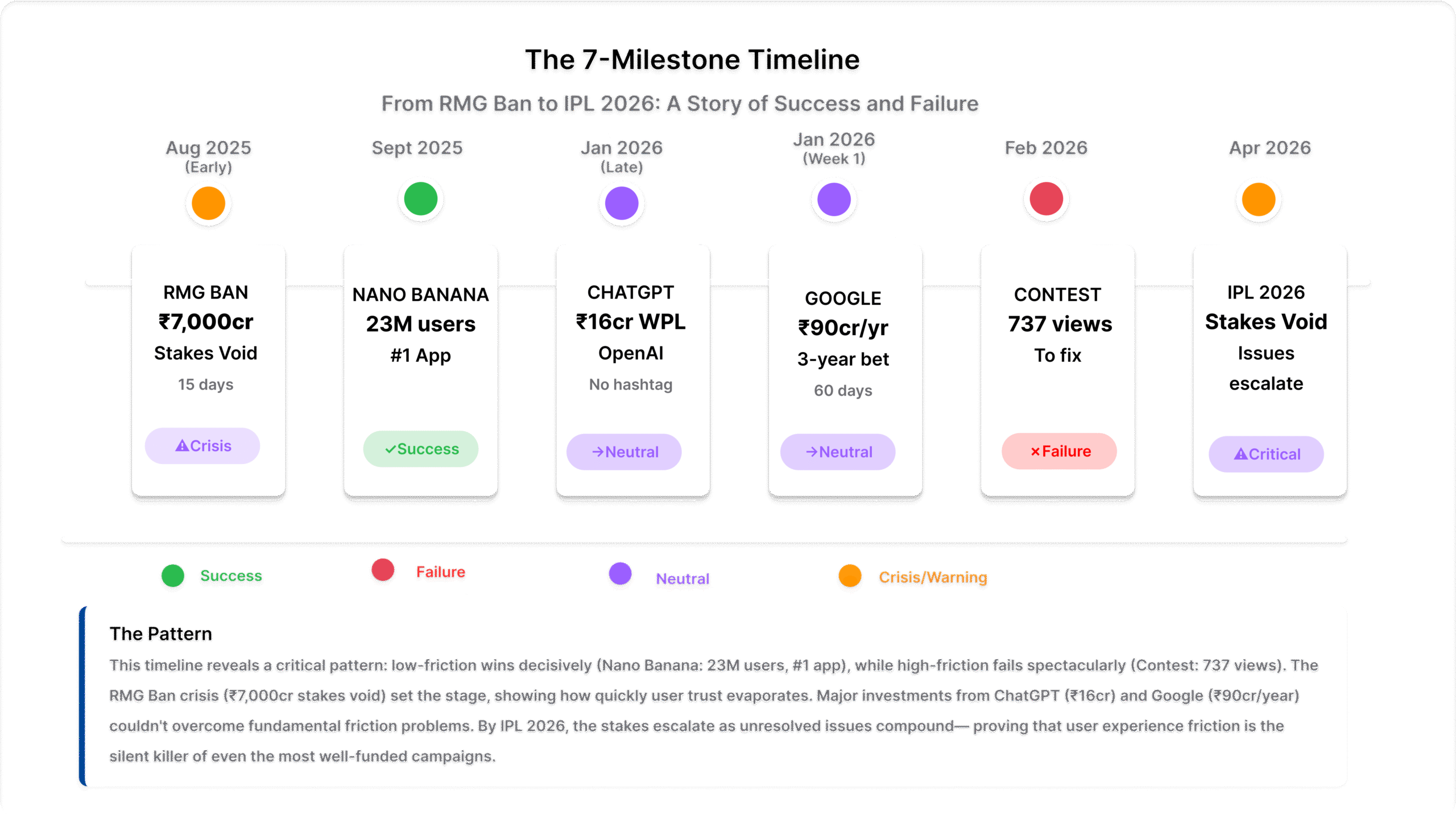
In August 2025, India’s Promotion and Regulation of Online Gaming Bill effectively banned real-money gaming (RMG) advertising. As a result, the ban wiped out approximately ₹7,000 crore in annual cricket sponsorship revenue5.
Fantasy sports platforms like Dream11 held a ₹358 crore jersey sponsorship with the Board of Control for Cricket in India. They exited abruptly6. In total, RMG companies had contributed roughly 40% of IPL advertising revenues7.
Their sudden disappearance created unprecedented commercial inventory.
Meanwhile, AI companies needed mass-market visibility. The timing was perfect.
AI Cricket Wars Begin
AI brands are rushing to fill the void. For instance, OpenAI’s ChatGPT signed a ₹16 crore Women’s Premier League deal. In response, Google countered with ₹90 crore annually for IPL principal partnership8.
This isn’t incremental sponsorship testing. Instead, AI companies are declaring that cricket has become the primary battleground for consumer mindshare in the world’s largest AI adoption market.
India accounts for over 2.2 billion AI app downloads9.
Regulatory opportunity is real. Nevertheless, the execution gap is staggering.
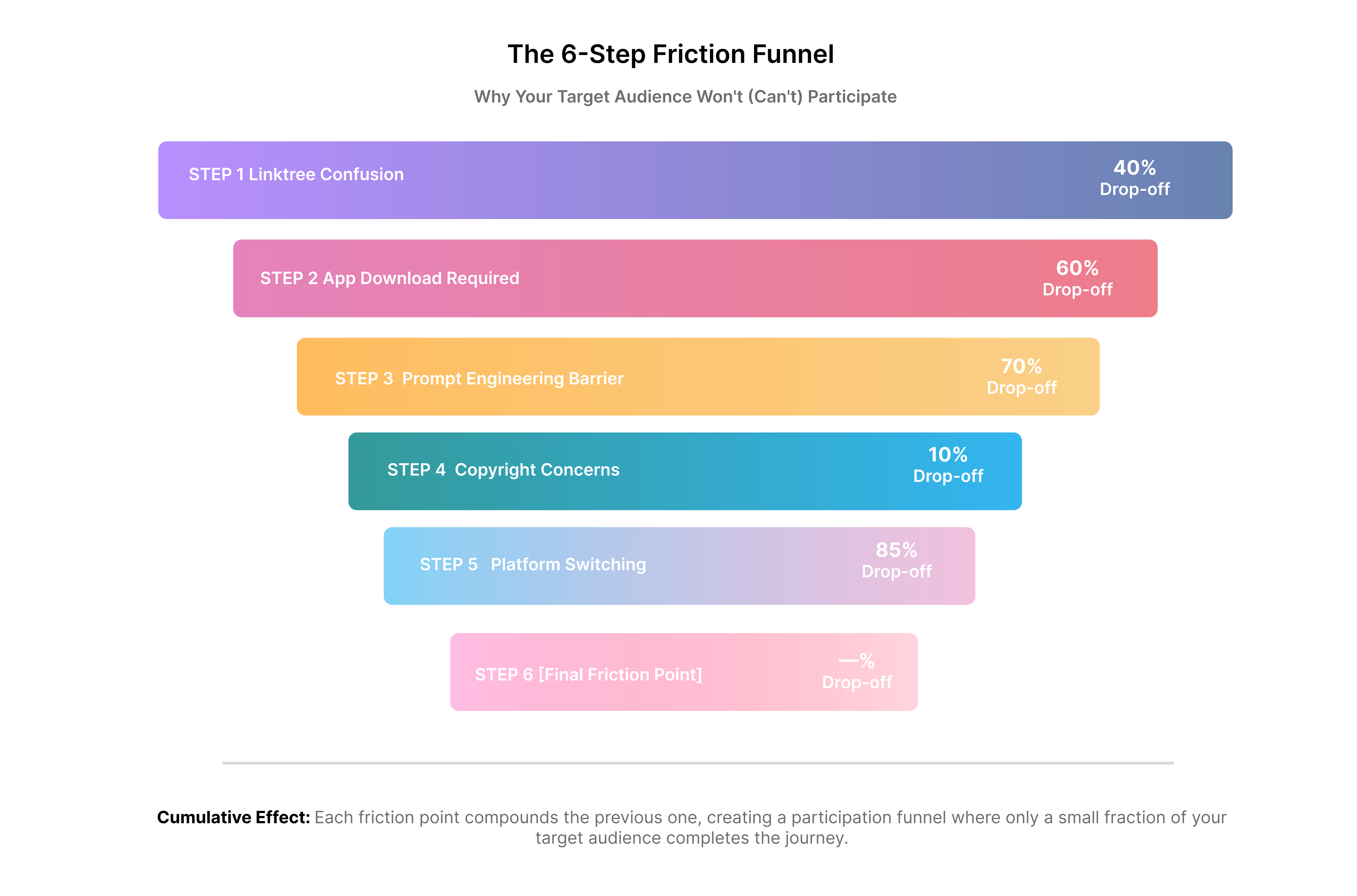
Why Your Target Audience Won’t (Can’t) Participate
Contest mechanism sounds simple: create a costume design in Gemini, share it on social media tagging @GoogleIndia, and potentially win World Cup tickets plus a physical version of your creation.
However, let’s walk through what this actually requires from a typical Indian cricket fan.
Step One: Hidden Linktree Barrier
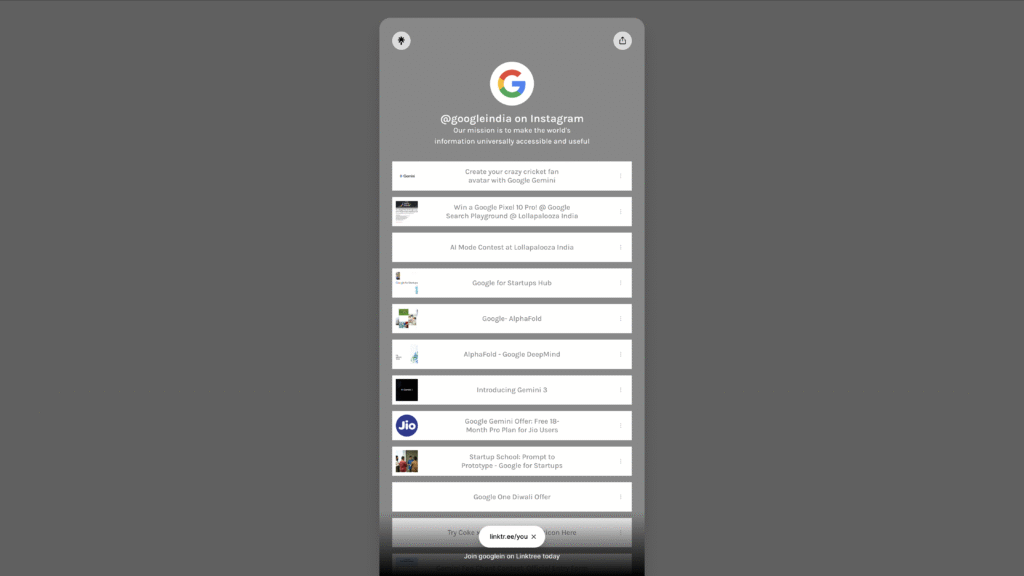
Before participants even reach Gemini, they encounter an unexpected obstacle: Google India’s Instagram bio doesn’t link directly to the contest. Instead, it redirects to a Linktree page aggregating 10+ simultaneous campaigns—the T20 contest, “Fund My Wild Ideas” (₹1 crore student campus initiative), AI Mode in Google Search, general Gemini product links, and various other Google initiatives.
Why This Matters
Cognitive overload strikes immediately. Users expecting a direct path to contest entry instead face a menu of options. Which link is the actual contest? Is it “Google Gemini” (product page) or something contest-specific? Many click the wrong link, land on generic product pages, and abandon.
Attribution Nightmare
Linktree can track clicks, but attributing them specifically to contest entries becomes nearly impossible. Did visitors come for the cricket campaign or other promotions? Google’s measurement challenge starts here—before users even attempt participation.
Campaign Visibility Dilution
Contest isn’t prominently featured; it’s buried among competing priorities. Every other campaign on that Linktree fragments attention and reduces the cricket contest’s conversion potential.
Moreover, this multi-campaign aggregation explains why Google likely won’t publish participation numbers. Separating genuine contest interest from general Gemini exploration requires sophisticated analytics they may prefer to keep private.
Step Two: Confused Product Interface
Assuming you find the correct link, you now need to access Gemini. If you’re not already a user, you must download the app, create a Google account, and navigate an interface that user research confirms suffers from problems.
Specifically, the platform has “poor discoverability of AI features” and “multiple poorly differentiated AI products” that leave newcomers confused10.
“The platform provides minimal contextual help or tooltips explaining how to use advanced features.”11
One user experience study documented how even an experienced Google Assistant user couldn’t figure out basic Gemini functions. Inadequate onboarding support explains why.
Step Three: Prompt Engineering Paradox
Here’s where Google’s campaign reveals its central tension: generating a basic costume design is easier than you’d think. “Make me a cricket superhero” produces results. “Blue and gold warrior vibes” generates something. Your first attempt might be good enough to share.
However, getting results that might actually win requires understanding detailed specification language.
Gemini itself acknowledges this gap. When users ask for better outputs, the platform provides coaching like this:
“A hyper-realistic, vibrant photo transformed into a futuristic cricket-themed warrior. She has Sachin Tendulkar’s iconic short, curly hairstyle. She is wearing a tight, shimmering blue bodysuit with glowing orange lightning-bolt patterns, metallic silver armor with spikes on the shoulders, detailed gauntlets, and high-tech leg guards with glowing circuit patterns…”
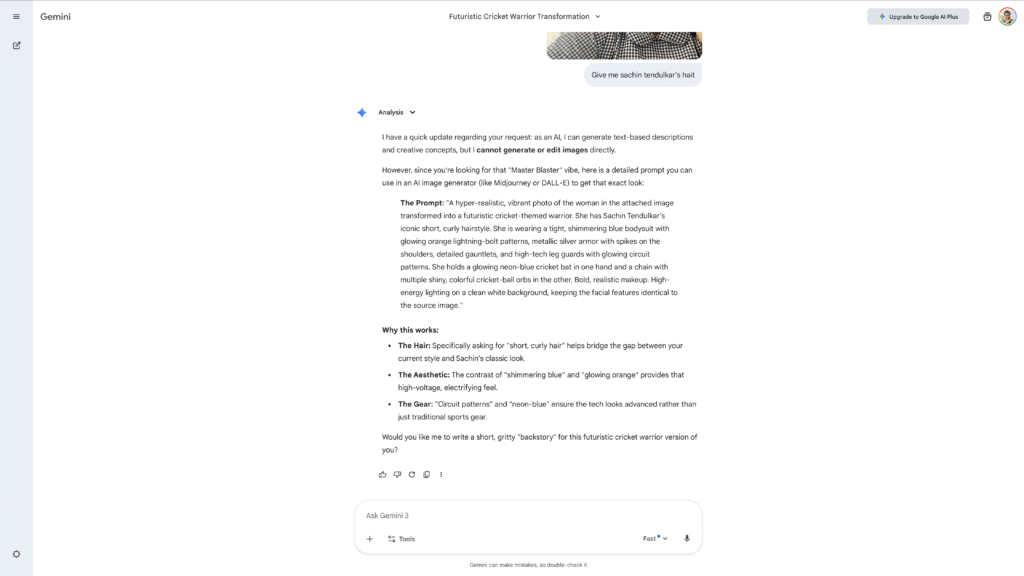
That’s 150+ words of precise technical specification. Notice the sophistication required:
- Hair Details: “Specifically asking for ‘short, curly hair’ helps bridge the gap between your current style and Sachin’s classic look.”
- Aesthetic Choices: “The contrast of ‘shimmering blue’ and ‘glowing orange’ provides that high-voltage, electrifying feel.”
- Gear Specifications: “‘Circuit patterns’ and ‘neon-blue’ ensure the tech looks advanced rather than just traditional sports gear.”
Barrier masquerading as helpfulness—Gemini is essentially saying: “You can do this, but here’s the professional-grade specification you need to understand.”
Quality Gap Problem
Most casual users will get acceptable-but-not-stunning first attempts. Some will iterate to improve them. Most won’t.
Consequently, the friction here isn’t impossibility—it’s the gap between “good enough to post” and “good enough to win.”
A self-fulfilling prophecy emerges: casual entries accumulate, but only technically proficient users’ entries look polished enough to actually win contests. Which means casual users rationally conclude “why bother?”
Furthermore, iteration takes time. Refining a design from “decent” to “competition-worthy” requires 30-60 minutes of prompt adjustments, style experimentation, and output comparison. That’s a significant investment for uncertain payoff.
Step Four: Copyright Void
Additionally, AI-generated content receives no copyright protection under current law. Anyone can copy winning designs without consequence12.
“Content created solely by AI receives no copyright protection under current law, meaning anyone can copy, modify, and reuse winning designs without Google’s permission.”
Moreover, participants must also avoid creating imagery incorporating religious symbols, political messages, or copyrighted intellectual property. Think Bollywood characters or IPL team logos. Any of these could expose Google to reputation or legal risk.
Step Five: Platform Switching Death Spiral
Here’s the real killer: you see the campaign on Instagram. You need to open Gemini to create. Then return to Instagram to post. Then tag @GoogleIndia correctly. Then ensure your post meets eligibility criteria.
Each platform switch represents a 40-60% abandonment risk13. Three switches? You’ve lost 85%+ of initially interested users.
Why platform switching kills participation:
- Context collapse: Each switch requires re-remembering what you were doing and why
- Cognitive load: Opening new apps, logging in, navigating interfaces
- Motivation decay: The longer the process, the more time to reconsider “Is this worth it?”
- Technical friction: Screenshots, downloads, file management between apps
User behaviour, not laziness—when effort exceeds perceived reward, we abandon tasks. It’s fundamental psychology.
Step Six: Social Sharing Anxiety
Finally, you must publicly post your creation. This introduces the most underestimated friction: social anxiety.
“Will my friends think this is foolish?”
“What if my costume design looks amateur compared to others?”
“Do I really want cricket brands in my Instagram aesthetic?”
For private entertainment (Nano Banana selfies shared in family WhatsApp groups), this barrier doesn’t exist. For public brand advocacy (posting with @GoogleIndia tags), it’s substantial.
Friction Gradient
Research on contest participation is unambiguous: each additional requirement exponentially reduces completion rates13.
“Multi-step creative contests achieve 40-60% higher abandonment than single-action entries.”
These contests require content creation, quality iteration, platform coordination, and social sharing14. Consequently, Google’s campaign falls squarely into the highest-friction category.
Participation is effectively restricted to existing Gemini power users who need no persuasion to adopt the platform. Product-led marketing theatre—a campaign that looks like mass-market engagement but functionally operates as customer appreciation for early adopters.
Pattern Recognition: Tech Giants Confusing Capability With Desire
This friction problem echoes patterns we’ve seen elsewhere.
For example, in Apple’s iPhone 17 Pro marketing, the brand assumed technical specifications would sell themselves without addressing genuine user needs.
Similarly, Google makes the same mistake here. AI capability automatically translates to user desire—that’s the assumption. And that casual cricket fans naturally think of themselves as content creators (they don’t—they’re content consumers).
Celebrity Strategy: Famous Faces, Zero Authenticity
Campaign film features Ravi Shastri (former India cricket coach), Jemimah Rodrigues (India women’s cricket star), and Farah Khan (Bollywood choreographer famous for 2013’s “Dil Jumping Japang” IPL dance campaign)15.
It’s a strategic cast—cricket authority, rising women’s sports equity, Bollywood nostalgia. Yet all deployed in the most superficial way possible.
Ravi Shastri: Transactional Ambassador
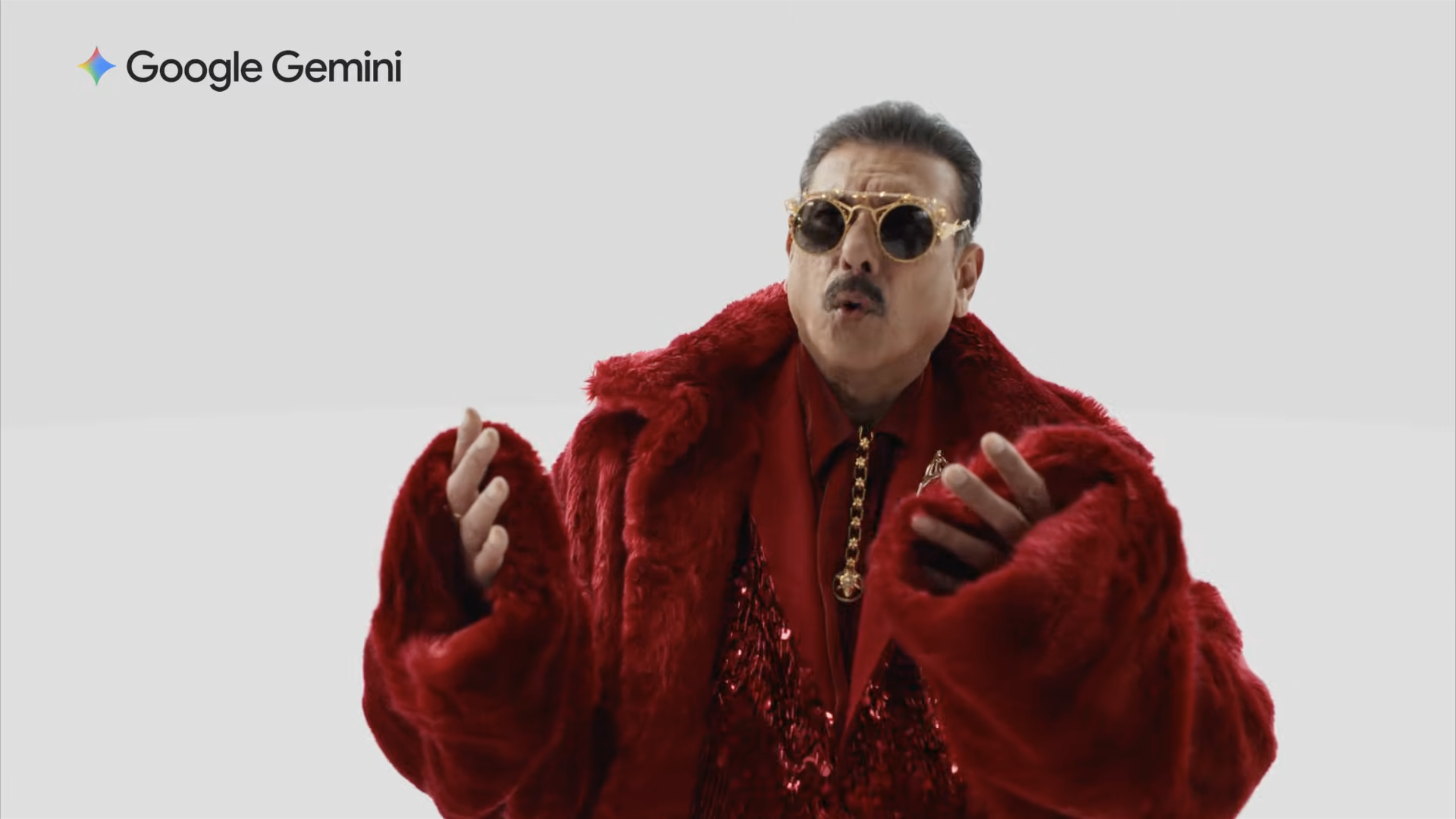
Shastri brings unimpeachable cricket credentials. However, his recent brand ambassador portfolio includes Dubai real estate. He appears briefly to critique AI-generated costumes16.
Nevertheless, he provides no evidence of using Gemini in daily life. Nor does he demonstrate understanding of AI technology beyond this scripted role. Furthermore, he offers no reason viewers should trust his endorsement beyond generic celebrity credibility.
“Eighty-one percent of consumers believe celebrity brand deals lack credibility, with authenticity indicators including pre-existing product usage and transparent disclosure—not transactional cameos.”17
Jemimah Rodrigues: Underutilised Authenticity
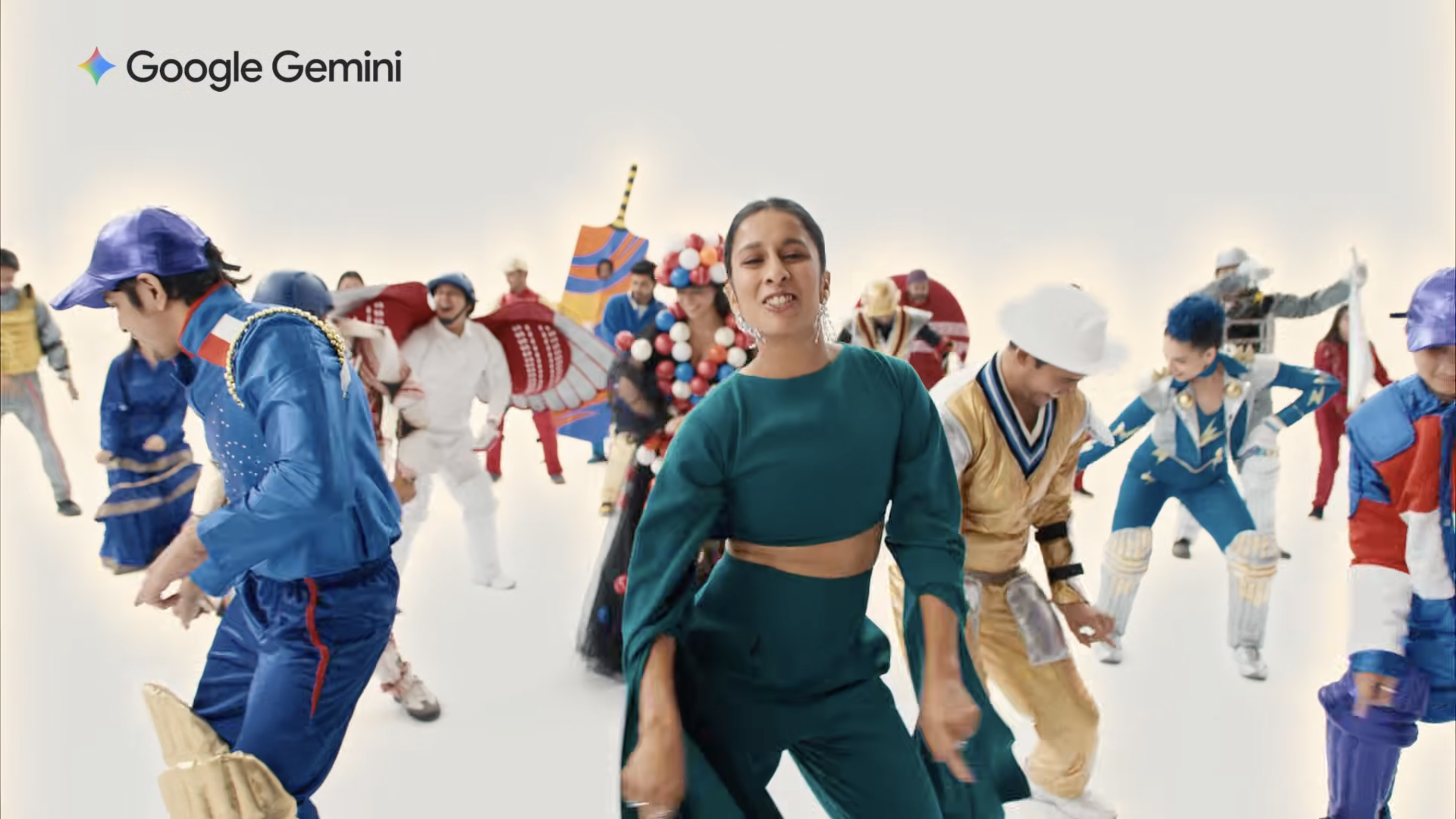
In contrast, Rodrigues represents the campaign’s strongest authenticity potential.
Following India’s 2025 Women’s T20 World Cup victory, her brand value surged 100%. Consequently, endorsement fees now range from ₹75 lakh to ₹1.5 crore18.
Her current partnerships demonstrate strategic selectivity. For instance, NXTFACE skincare aligns with the Women’s T20 League. Meanwhile, Tvarra helmets? She holds investor equity there.
Yet the campaign underutilises this asset. Rodrigues is positioned as a supporting character reacting to others’ avatars—not demonstrating how AI empowers her own creative expression or showing the process of iterating on prompts to get results she loves.
Farah Khan: Nostalgia as Double-Edged Sword
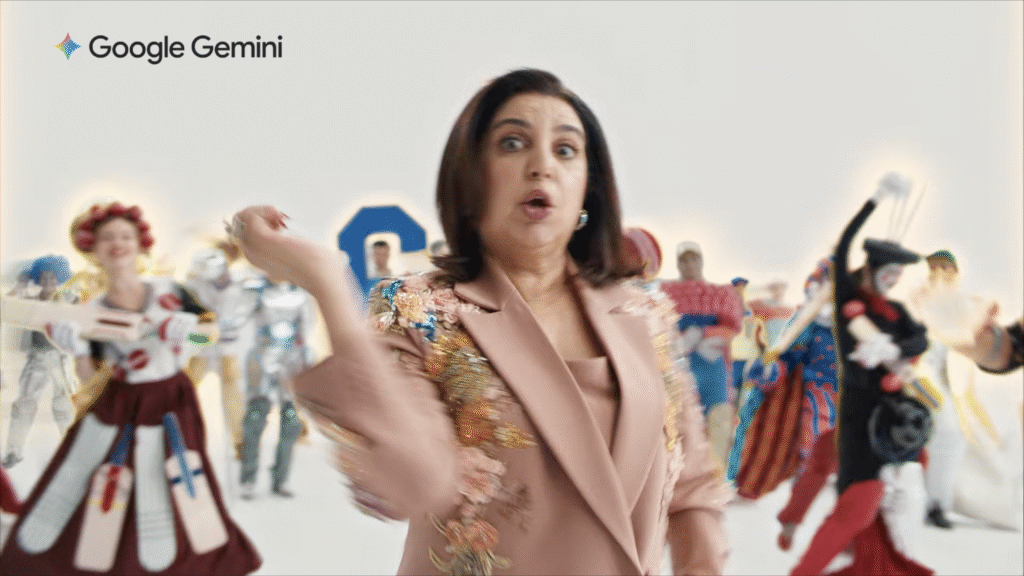
Similarly, Khan’s casting explicitly evokes 2013 nostalgia. Her “Dil Jumping Japang” choreography became a national phenomenon by transforming cricket viewing into participatory entertainment19.
However, nostalgia cuts both ways. Whilst older millennials may appreciate the callback, Gen Z audiences—Gemini’s core adoption demographic—have no direct memory of that campaign. For them, Khan represents Bollywood establishment, not digital-native creativity.
Fundamental Problem
Ultimately, none of these celebrities model the behaviour the campaign seeks to drive.
Research on celebrity versus influencer marketing reveals an important distinction. Traditional celebrities excel at broad reach and aspirational branding. In contrast, influencers deliver higher authenticity through genuine product usage20.
Therefore, Google’s campaign falls into an awkward middle ground.
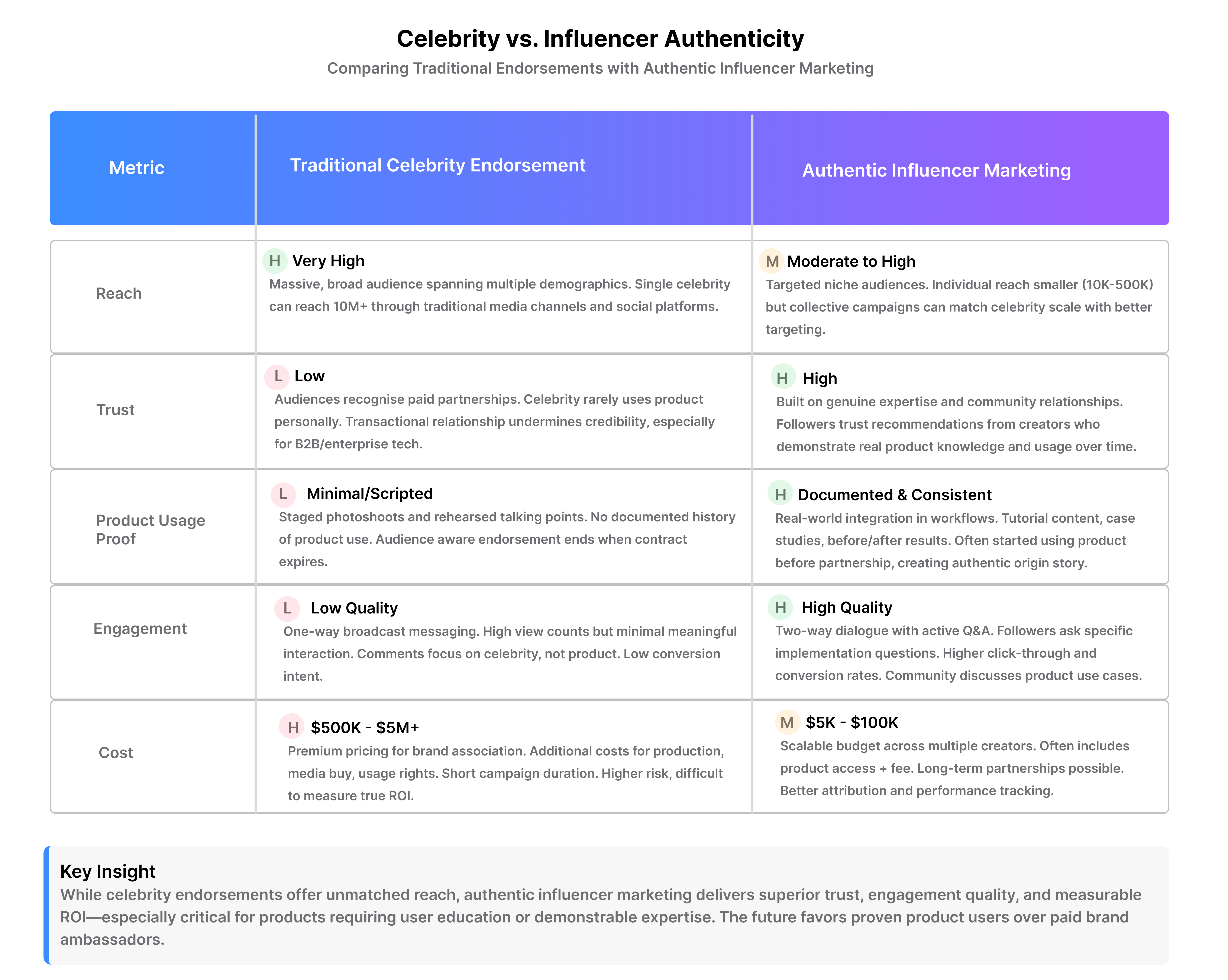
Celebrities are famous enough for mass awareness. But not authentic enough for persuasive endorsement.
What Would Work: Documented Creative Journeys
Instead of scripted endorsements, imagine:
- Jemimah’s 7-day prompt journey: Daily Instagram Stories showing her iterating on costume ideas. Day 1: “Wait, how do I make this look good?” Day 3: “Okay this is getting better.” Day 7: “I’m actually proud of this.” Real frustration, genuine discovery, authentic pride.
- Ravi Shastri as fellow learner: Position him competing alongside fans, showing that cricket legends also figure out new technology. “First attempt: terrible. Let me try again…” This vulnerability creates connection, not distance.
- Farah Khan’s dance-costume combo: Extend the contest to “design your costume, then choreograph your entrance dance.” Leverage her authentic expertise whilst integrating Gemini as creative tool, not celebrity prop.
Swiggy Contrast
Compare this to Swiggy’s Wiggy 3.0 campaign, which turned delivery partners into brand heroes through authentic talent showcases.
Swiggy’s participants genuinely wanted to perform. In contrast, Google’s celebrities are performing a script about AI they may never use. Difference is palpable.
UGC Illusion: When AI-Generated Content Isn’t Really “Yours”
User-generated content campaigns promise extraordinary performance. Specifically, UGC earns 28% higher engagement than branded content. Moreover, UGC posts generate 6.9 times more engagement than brand-produced materials21.
In fact, ninety-three percent of marketers confirm UGC outperforms traditional content across measured metrics22.
But here’s the philosophical tension: is a Gemini-designed costume genuine fan expression or Google’s marketing dressed up as UGC?
Mediation Problem
AI-generated content occupies ambiguous territory. Specifically, it’s created by users but mediated through corporate technology. That technology interprets prompts, applies aesthetic filters, and makes countless micro-decisions about composition, colour, and style.
As a result, the final image reflects Google’s algorithms as much as the user’s creative vision.
Meanwhile, as consumers become more sceptical of AI-generated content, problems emerge. Content is increasingly labelled “slop” that lacks human creativity. Consequently, associating brand campaigns with synthetic imagery could erode rather than enhance authenticity23.
Ownership Psychology
This matters for participation psychology. Specifically, UGC campaigns succeed when participants feel genuine ownership over their creations.
Photo contests asking fans to share pictures of themselves wearing team jerseys work because the effort is personal—their face, their outfit, their moment.
In contrast, AI costume generation introduces abstraction that weakens emotional investment. If Gemini misinterprets your prompt and produces something unrecognisable, do you feel proud sharing it? Or frustrated that the technology failed to capture your vision?
Amazon Contrast: Authentic Mess Beats Algorithmic Polish
Amazon’s Five Star Theater campaign succeeds precisely because it celebrates unfiltered human expression. Real customer reviews performed theatrically.
Reviews feel authentic because they’re messy, specific, and genuinely human.
Google’s campaign, by contrast, filters human creativity through AI interpretation. A layer of mediation emerges that weakens the authenticity signal.
Hybrid Solution
Campaign would benefit from hybrid mechanics. For instance, consider this: “Design your dream costume in Gemini, then recreate a portion of it physically and share a photo combining your AI design with your real-world interpretation.”
Even just face paint or a cardboard prop would work. Consequently, this bridges the authenticity gap, demonstrating that AI augments rather than replaces human creativity.
Furthermore, this hybrid approach solves the quality gap problem. Amateur AI designs paired with genuine human effort create authenticity that polished-only entries lack.
What Google Should Have Done (And What You Should Do Instead)
Campaign’s strategic positioning remains sound. Specifically, leveraging cricket’s cultural primacy to drive AI adoption at mass-market scale makes sense.
However, the execution gaps are fixable. Here are interventions that reduce friction without sacrificing creative ambition.
Implement Guided Creation
Launch an in-app “Contest Mode” with templated starting points—offering 20-30 pre-designed costume bases users can customise rather than creating from scratch.
Prompt suggestion engines that auto-complete when users struggle would help tremendously. One-tap social sharing that auto-composes posts with proper hashtags (requiring only approval to publish) eliminates platform switching friction entirely.
This approach preserves creative freedom whilst eliminating technical barriers.
Replace Scripts With Real Journeys
Campaign needs authentic documentation rather than scripted endorsements. Film Jemimah Rodrigues iterating on costume ideas over seven days, showing real frustration with early prompts whilst capturing her discovering features and arriving at a final design she genuinely loves.
Daily Instagram Stories demystifying AI creativity would work brilliantly. Position Ravi Shastri as a fellow participant whose design competes alongside fans’ entries, demonstrating that cricket legends also learn new technology.
Extending the contest to include “dance moves to match your costume” leverages Farah Khan’s authentic expertise whilst integrating Gemini as the creative enabler.
Transform Contests Into Features
Send push notifications for every T20 World Cup match, inviting users to generate quick costumes supporting their team. Make them shareable as Instagram Stories with live match scores overlaid.
Let users vote on favourite designs, creating social gameplay extending beyond contest deadlines. Meanwhile, document the physical costume fabrication process for winners—validation that Google honours commitments whilst creating compelling content.
Fix Discovery Funnel
Remove Linktree aggregation entirely for major campaigns. Instagram bio should link directly to the contest landing page during the promotion period. Every click lost to navigation confusion is a potential participant abandoned.
If multi-campaign aggregation is unavoidable, use clear visual hierarchy and descriptive labels: “T20 Fan Contest – ENTER HERE” not ambiguous “Google Gemini” links.
Better yet, leverage Instagram’s multiple bio links feature (available for business accounts) to show the contest prominently without Linktree mediation.
Address Brand Safety Proactively
Show clear examples of acceptable versus prohibited content. Subject all finalists to manual review assessing creativity, cultural appropriateness, and brand alignment.
Explicitly state that contest entries grant Google usage rights—protecting against participant IP disputes. Finally, ensure winning designs represent India’s geographic, linguistic, and cultural diversity.
Enable Private Entries
Remove the public posting requirement. Allow users to submit directly through Gemini without social media sharing. Google can then amplify finalists’ designs as owned content, giving participants exposure without forcing social anxiety.
Dramatically reduces friction whilst maintaining Google’s content supply. Moreover, it acknowledges that most cricket fans are content consumers, not creators eager for public attention.
Learning From Past Success
This approach mirrors lessons from Google’s DigiKavach campaign. That campaign succeeded by embedding crucial information within culturally resonant narratives. Importantly, it didn’t force users through complex onboarding or public sharing requirements.
Measurement Problem Nobody’s Discussing
Here’s the uncomfortable question: how will Google know if this campaign worked?
Sports sponsorship ROI is notoriously difficult to quantify. Typically, campaigns optimise for broad, indirect outcomes—awareness, loyalty, emotional association—rather than direct attribution24.
Furthermore, cricket sponsorships particularly challenge traditional metrics. Impact manifests across multiple channels: stadium presence, broadcast media, social amplification, merchandising, long-term brand equity. Therefore, isolated campaign attribution becomes nearly impossible25.
Attribution Impossibility
Without pre-campaign baseline measurements, control groups, and geo-experiments isolating the contest’s incremental impact, claims of campaign effectiveness rest on correlation rather than causation.
For instance, if Gemini’s market share increases from 52% to 55% during the campaign period, what caused it? Multiple factors could explain growth: the T20 contest specifically, the broader IPL sponsorship announcement, product improvements, competitor missteps, or organic growth trajectory.
Linktree Attribution Black Hole
Linktree aggregation compounds measurement challenges exponentially. Clicks tracked to that page could represent:
- Contest-interested users who never find the right link
- General Gemini exploration unrelated to cricket
- Users investigating other campaigns (“Fund My Wild Ideas,” AI Mode)
- Accidental clicks from Instagram scrolling
Separating genuine contest intent from ambient traffic requires analytics sophistication most brands lack. Google almost certainly can’t isolate which Linktree visitors became actual contest participants versus general product explorers.
Consequently, any “success metrics” published later will likely conflate multiple initiatives, making the cricket contest’s specific contribution unknowable.
What Rigorous Measurement Requires
Brand lift studies and conversion lift experiments require splitting audiences into exposed and unexposed cohorts. Comparing metrics like brand awareness, search volume, and conversions then determines adverts’ true incremental effectiveness26.
Rigorous measurement for this contest demands three critical elements:
- Geographic holdout markets where contest promotion is withheld for comparison.
- User cohort segmentation tracking whether participants exhibit higher 90-day retention than matched non-participants.
- Brand recall panels surveying representative samples before, during, and after the campaign.
Vanity Metrics Trap
Google’s public communications emphasise creative concept and celebrity involvement rather than measurement rigour. Consequently, this suggests metrics may prioritise vanity indicators over actionable business insights.
Vanity indicators include: total contest entries, social media impressions, hashtag reach.
Actionable business insights, by contrast, include: cost per acquisition, lifetime value of participants, incremental app engagement, 90-day retention rates.
“Without rigorous measurement infrastructure, the campaign risks becoming an expensive branding exercise justified post-hoc through carefully selected metrics rather than a data-driven growth initiative.”
Therefore, the campaign risks becoming exactly that—an expensive branding exercise, not a data-driven growth initiative held accountable to ROI thresholds.
Telling Silence
As of publication, Google hasn’t disclosed participation numbers—itself a telling indicator. Brands eager to trumpet success typically share milestones (“100K entries in 48 hours!”). Silence often signals underwhelming results or strategic ambiguity that allows claiming “success” without hard evidence.
Real-Time Validation: Week One Results
The analysis above isn’t theoretical speculation. It’s unfolding in real-time.
As of publication—one week post-launch—the campaign’s official YouTube video promoting the contest has attracted 737 views. For context, Google India’s typical campaign videos garner 50,000-500,000 views within days. Tech product launches from competitors routinely achieve millions.
Seven hundred thirty-seven views for a ₹270 crore investment.
Instagram tells a similar story. Despite celebrity involvement and multi-platform promotion, #CraziestFanContest shows minimal organic traction. No trending hashtag. No viral user-generated entries flooding feeds. Just the official campaign materials and scattered participation attempts.
Google hasn’t published participation numbers—itself a telling indicator. Brands eager to trumpet success typically share milestones within 48-72 hours (“10K entries overnight!”). Silence suggests underwhelming response or measurement challenges outlined above.
The contrast to Nano Banana is instructive. Within seven days of that feature’s launch, Gemini topped both iOS and Android charts. Daily downloads surged 667%. Chief ministers and Bollywood stars joined organically, without scripted campaigns.
This cricket contest? Different technology (Gemini), different execution (high friction), vastly different results.
The friction analysis predicted this outcome. Now we’re watching it materialise.
Why This Matters Beyond Google
This contest isn’t an isolated misstep. Rather, it’s symptomatic of how AI brands approach consumer marketing in 2026.
Pattern Across AI Marketing
Conflating product capability with user willingness, mistaking early adopter enthusiasm for mainstream appetite, and designing campaigns that celebrate technology rather than solving human problems—these mistakes recur across AI marketing in 2026.
Nano Banana Fallacy
Google’s misjudgement stems from a fundamental attribution error.
Nano Banana went viral with minimal marketing. Twenty-three million users in 15 days, purely through product-led growth. Consequently, Google assumed that cricket + AI would automatically generate similar velocity.
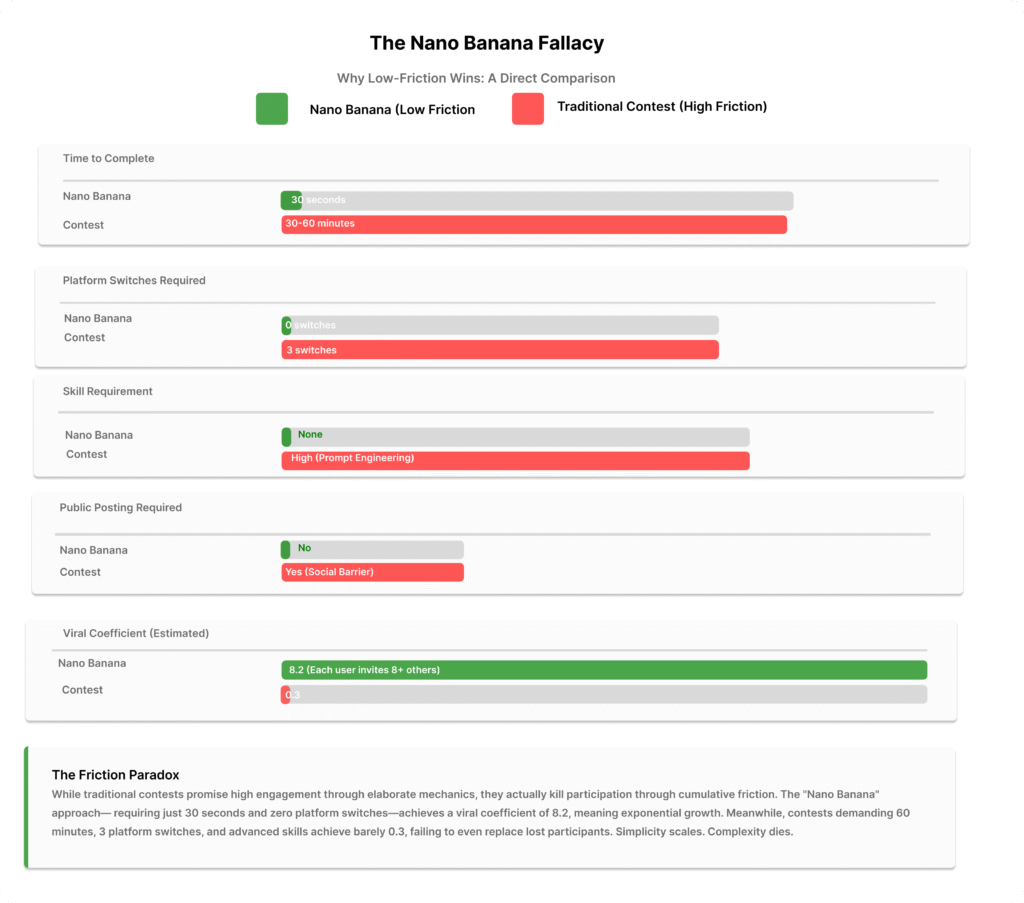
However, Nano Banana succeeded because it required near-zero cognitive load. Tap a photo, select an effect, instantly share. Friction was so low that experimentation cost nothing beyond 30 seconds of curiosity. No platform switching. No public posting requirement. No quality anxiety. No Linktree navigation menu.
High-Commitment Trap
This contest, in contrast, demands the opposite. Sustained attention. Quality iteration to competitive standards. Platform switching (Instagram → Gemini → Instagram). Public brand advocacy. Comfort with ambiguous contest outcomes. Will my entry win? Will the judges appreciate my creative vision?
That’s not a product-led viral loop. Rather, it’s a high-commitment marketing funnel disguised as casual entertainment.
Capability-Desirability Gap
This distinction matters for every marketer navigating AI integration in 2026.
Advanced technology enables capabilities previously impossible—generating custom imagery, personalising content at scale, automating creative production.
However, capability doesn’t equal desirability. Similarly, novelty doesn’t equal utility. And most critically: low-friction entertainment doesn’t equal high-friction public creativity.
What Nike Gets Right
As explored in Nike’s “Why Do It?” campaign analysis, the brands winning in 2025-26 validate human doubt and emotion rather than celebrating technological capability.
Nike asks “why” before “how”. Google, by comparison, jumps straight to execution without addressing motivation.
Three Questions for Your Campaign
Ask yourself these essential questions before launching your next AI-integrated campaign:
- Does your campaign require users to learn your product, or does your product make participation effortless?
- Does your celebrity endorser model the behaviour you seek, or merely endorse it from afar?
- Does your contest mechanic build skills users value beyond your brand, or create artificial barriers that filter for technical confidence rather than genuine enthusiasm?
Beta Test Window Closes Soon
Google has the resources, talent, and market position to correct these deficiencies. However, the IPL 2026 season begins in April. Stakes escalate dramatically then.
Learning Opportunity
T20 World Cup campaign functions as a beta test—offering learning opportunities before Google’s full ₹90 crore annual commitment activates.
Two Paths Forward
Will leadership treat this as a measurement-driven experiment requiring ruthless optimisation, or as a creative showcase where metrics matter less than aesthetics?
Institutional learning strengthens Google’s AI market leadership. Alternative? Impressive sizzle reels with indeterminate business impact.
For an organisation competing against OpenAI’s relentless product velocity and Microsoft’s enterprise distribution power, indeterminate impact is inadequate. Google’s ₹270 crore bet on cricket demands accountability matching its ambition.
Universal Lessons
Rest of us should watch carefully.
What This Teaches Every Marketer
Mistakes Google makes at ₹270 crore scale, most brands make at every budget level—confusing attention with engagement, celebrity with authenticity, product features with customer value, and most dangerously, confusing product capability with user motivation.
Real Transformation Requirement
AI will transform marketing. But only if we stop designing campaigns for the technology and start designing for the humans who might—if we remove enough friction—actually use it.
Core Lesson
Lesson isn’t “AI contests don’t work.” It’s “understand your users’ tolerance for friction, and design accordingly.” Nano Banana succeeded because it asked for 30 seconds. This contest asks for 30 minutes plus public vulnerability. That’s the difference between viral growth and expensive theatre.
Related Reading
- Brand Anthem in the Age of Algorithms: Swiggy Wiggy 3.0 Campaign – How authentic employee advocacy creates deeper engagement than celebrity endorsements
- Amazon Five Star Theater: Why Authenticity Wins – When real customer voices beat polished brand messaging
- Google DigiKavach Campaign Analysis – What happens when Google gets cultural embedding right
- Apple’s iPhone 17 Pro Marketing: A Critical Campaign Analysis – Another tech giant confusing features with benefits
- Nike’s “Why Do It?” Campaign – Purpose-first marketing that validates human emotion over technological capability