
Let’s be honest with ourselves: Google’s Flow campaign isn’t really about “teaching creators”. It’s about quietly resetting what counts as filmmaking – and we, the marketers, are being drafted in as unpaid early adopters.
Those shiny In the Flow videos with Heather Cooper and Meta Puppet aren’t just feel‑good creator content. They’re a blueprint for a new production pipeline where our briefs become prose, our cameras become prompts, and our decks are expected to move.
If we make campaigns for a living, that should thrill us. It should also make us a little sick to the stomach.
“Copy needs to read like story direction. Storyboards need to exist as AI‑ready prose.”
The new brief is a screenplay
Watch Heather Cooper talk through her prompts in Heather Cooper on AI Filmmaking with Flow | In the Flow. Very quickly it sounds less like a YouTube tutorial and more like a DP talking to a director.
She doesn’t ask the model to “make it cinematic”. She reaches for phrases like:
- “Subtle imperfections”
- “Natural skin texture”
- “Natural light falloff”
- “Muted colours”
- “Gliding” instead of “moving”
- Different points of view, 3D immersive shots, shifts in time of day
This is film language sneaking into copywriting. The Heather episode quietly teaches a new literacy: our words are our lens.
The companion film, Meta Puppet on AI Filmmaking with Flow | In the Flow, handles the other half of the craft: story and coverage. The argument is blunt: tools will change, but coverage, character and structure will not. We’re asked to think in angles, scenes and emotional beats again.
- Write a full story block from beginning to end – character, stakes, conflict – and feed that to Flow as narrative context.
- Plan coverage: wides, close‑ups, over‑the‑shoulders, inserts, cutaways.
- Let those written cues act as scaffolding for prompts and shots.
Put the two together and you get the shape of Google’s ask:
“If we want AI to direct for us, we have to start writing like directors.”
In the launch post for Flow and Veo 3, Google talks about “co‑creating with filmmakers”, “democratising cinematic storytelling”, and wrapping it all in watermarking and safety layers in tools like Flow – Google Labs, Veo and Meet Flow: AI‑powered filmmaking with Veo 3. On paper, it reads like a neat win‑win: more access, more polish, more control. From inside a marketing team, though, the story feels very different. Our timelines compress, our pitches grow more visual, our unpaid pre‑vis quietly expands – and the more fluent we become with Flow, the easier it is for everyone else in the room to forget that this is still real production work.
How the old pipeline collapses
The traditional split – strategy doc → script → treatment → storyboard → animatic – starts to look quaint. A single flexible text object now has to:
- Generate proof‑of‑concept films inside Flow, powered by Veo 3 and Gemini
- Double up as pitch material for clients and internal stakeholders
- Evolve into production assets, not just moodboards
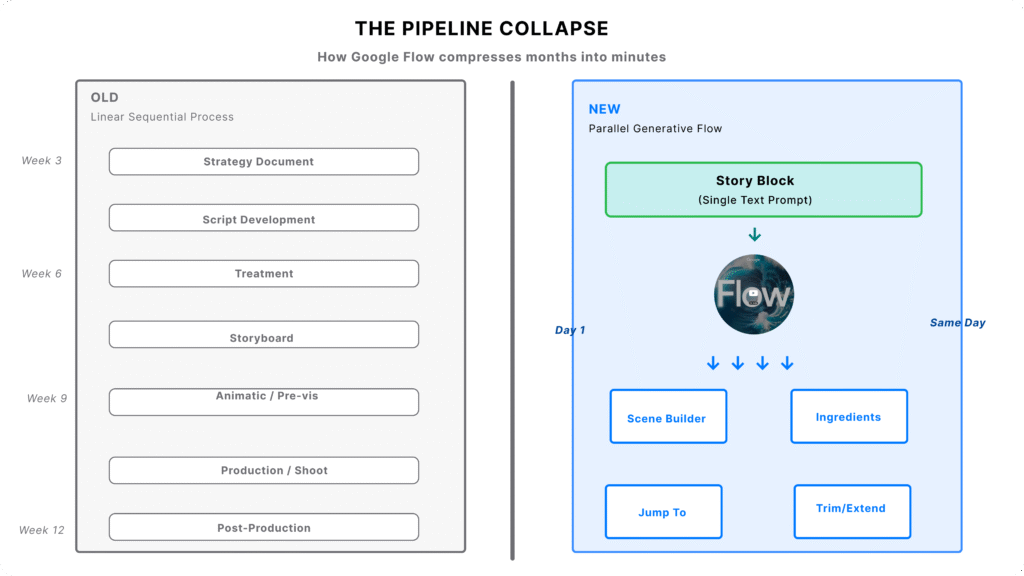
That’s exactly how Google frames the product in Meet Flow: AI‑powered filmmaking with Veo 3 and on Flow – Google Labs. Flow is positioned as the generative layer that sits between script and timeline – the place where language turns into moving image.
In practice, Flow behaves less like a magic button and more like an editor’s timeline. There’s a Scene Builder where we arrange clips sequentially, reusable “Ingredients” for characters and locations we want to keep consistent, Camera Controls to add movement without rewriting prompts, and a Jump To feature that uses Gemini to understand how the last shot ended and generate the next one seamlessly. That’s not a toy – that’s a lightweight production suite in the browser. And it’s asking us to think like editors from the moment we write the brief.
For anyone who has ever insisted that “good copy is direction”, Flow is that idea made literal.
This plugs straight into the way I broke down campaigns like Swiggy’s big brand anthem work in Brand Anthem in the Age of Algorithms: Swiggy Wiggy 3.0 Campaign and the Playbook for People‑Powered Marketing. I have already mapped narrative, emotional spine, musical phrasing and visual beats. Flow simply insists that the copy itself be ready to drop into a generative pipeline – and that we understand the editing decisions baked into every word.
Don’t just brief it. Show it.
In Meta Puppet on AI Filmmaking with Flow | In the Flow, the creator says the line every account manager secretly fears:
“If you are pitching something, don’t just talk about it – create it and show them.”
From a marketer’s point of view, that’s intoxicating.
A throwaway line – “someone firing a shot at the moon” – can become a stylised moving proof‑of‑concept in minutes. Research into film references, lenses and stocks can run through the Gemini video generation overview, then those looks are tested straight inside Flow. Once a character design lands, that image can be reused as a starting point across scenes, keeping continuity as locations, backgrounds or camera moves change – exactly the kind of workflow Google outlines in Meet Flow: AI‑powered filmmaking with Veo 3.
For big studios and agencies, it feels like pre‑vis and animatics, just compressed into a laptop. For smaller teams, it’s an entirely new capability.
Why marketers are racing to adopt
Several forces are pushing us towards this way of working.
Pitch stakes go up the moment one or two agencies start dropping Flow‑generated sequences into decks. Static slides suddenly look half‑finished.
Timelines tighten as creators and tools hint that “anything you can imagine, you can pretty much do” with the right prompts. The old three‑week concept cushion feels harder to defend.
Most importantly, pre‑vis moves upstream. Strategy stops at “what’s the idea?” less often. We have to ask “what does this feel like as a 15‑second sequence?” right at the start.
I’ve already explored how brands choreograph emotional beats to fit a season and a mood in In the Warm Steam of the Monsoon, a Cup of Tea—and a Campaign—Find Their Moment. That same sense of rhythm now has to live inside the moving parts of a deck, not just in the final film.
The shadow side: unpaid creative work
Here’s the bit we don’t like admitting to ourselves.
Near‑finished filmic prototypes are creeping into earlier and earlier stages of the process. Some of those ideas will never be approved, never see a studio, never leave Figma or Notion. The labour, however, stays on our timesheets.
But here’s the harder truth: even with Flow cutting production time from weeks to days, a serious pre‑vis piece still takes a week or two. Story blocking, testing Ingredients, fixing continuity glitches, tweaking camera moves, smoothing over artefacts. We’ve swapped crew time for copy time – and we’re starting to treat that swap as free.
Internal teams and small studios, especially in India, are already feeling pressure to “just run a quick Flow test” to sell a concept. Those hours – a week’s worth – disappear into a space clients start to see as table stakes. A “rough visualisation” becomes the baseline expectation. Then it becomes the pitch requirement. Then it becomes table stakes for every deck.
“We’ve all watched a ‘rough visualisation’ magically become the expectation for every pitch.”
What we’re not doing is billing for it. Or tracking it. Or building it into scopes as paid work.
If we run teams, this is a policy moment. Either we decide, explicitly, when AI‑driven pre‑vis is paid work – and build that into proposals – or we quietly donate a week at a time to impress a room with a moving deck. The efficiency gains are real. The labour, though, is still labour.
The creative ceiling is rising – and narrowing
Heather’s budget comments land hard because they’re true. Not everyone has access to drones, museums or big location shoots. Flow plus Veo 3 promise to flatten that playing field. That narrative runs through Heather Cooper on AI Filmmaking with Flow | In the Flow, Google’s launch post, and explainers like Google’s new filmmaking tool Flow adds editing tools and some consistency to AI‑generated video.
With Flow backed by Veo, we can:
- Shift day into night with AI‑driven restyling and time‑lapse
- Animate still photographs into convincing camera moves
- Stage tidal waves, battle scenes and set‑pieces that would be impractical or impossible to shoot
Meta Puppet talks about the same possibilities: chase scenes, high production value sequences, quick‑cut montage, right alongside “funny cat videos” and social content. Spectacle is no longer locked behind money.
The aesthetic homogenisation problem
The ceiling rises. Something else happens too: the visual field narrows.
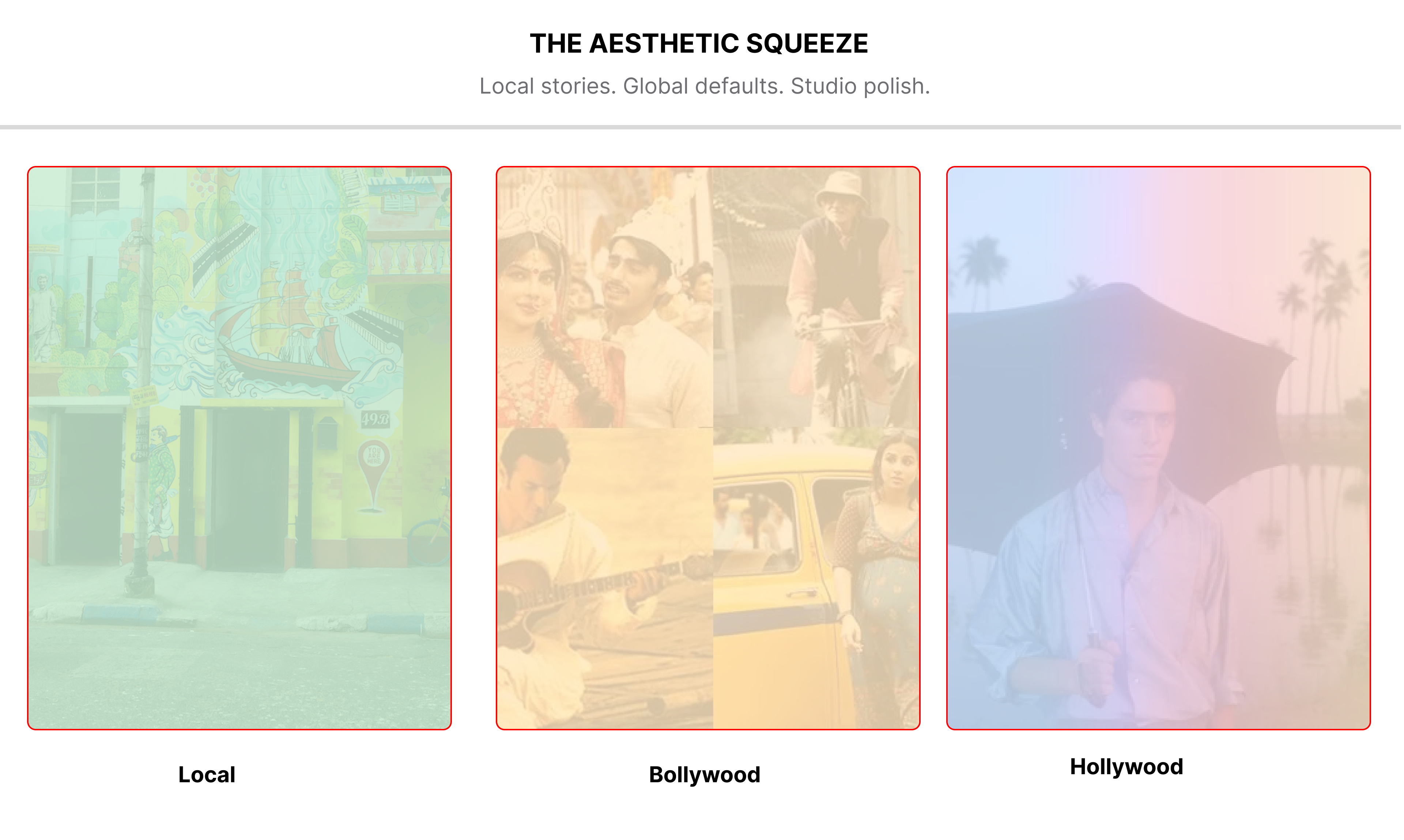
“Ancient Israel” rendered in muted tones with soft natural light. Coastal cities in golden hour haze. Familiar lens flares and depth‑of‑field from prestige TV. The grammar of blockbuster cinema becomes the default setting. Product pages like Veo and guides such as The Ultimate Filmmaker’s Hack? Google Flow Explained lean heavily on that vocabulary.
For Indian brands and creators, that creates a very specific tension.
On the upside:
- Regional brands can imagine cinematic storytelling without hauling crews to Ladakh or Goa.
- Smaller agencies can compete visually with global shops at the prototyping stage if they master story blocks and shot language.
- D2C brands can graduate from stitched‑together product demos to ad films that feel like OTT trailers.
On the downside:
- Shared defaults give us “AI Bollywood”: global, slightly desaturated, strangely placeless.
- Local rhythms and micro‑gestures – the things you celebrate in When a Biscuit Became a Love Letter – blur into generic “good cinematography”.
- Visual cultures of Indian cities, small towns and rituals risk being collapsed into a handful of stock looks, a concern already raised in pieces like Google’s Flow AI Could Change Film Industry Forever!.
“Spectacle is no longer locked behind budget. The risk is that it’s locked behind a single aesthetic.”
We’ve seen this play out before: Instagram filters, flat illustrations, the airbrushed perfection you pull apart in The Pixel‑Perfect Lie: Maybelline’s Mumbai Mirage. Flow doesn’t just tweak colour; it controls motion, atmosphere, even time of day.
So the question shifts. It’s no longer “should we use AI video?” It becomes: what kind of visual culture are we quietly standardising?
The ethics gap in Google’s story
The In the Flow series feels gentle and human. It’s also very careful.
In Heather Cooper on AI Filmmaking with Flow | In the Flow, we learn how to ask for natural skin, subtle imperfections and realistic light falloff. We don’t hear much about:
- How those “natural” settings treat different skin tones
- What appears when we prompt “Indian village”, “African city” or “queer couple in their 50s”
- Whose footage, faces and visual traditions sit inside the training data – questions surfaced in Google’s Flow AI Could Change Film Industry Forever!
The labour question nobody’s asking
In Meta Puppet on AI Filmmaking with Flow | In the Flow, the emphasis is on dialogue, emotion and getting closer to “mainstream filmmaking”. Very little is said about work.
Open questions hang there for our industry:
- When an AI system helps us animate or restyle a performance, who owns that performance?
- How many junior roles – storyboard artists, junior compositors, assistant editors – are quietly being re‑labelled “AI‑assisted” and then removed, a fear that sits just under the surface in Google’s new filmmaking tool Flow adds editing tools and some consistency to AI‑generated video?
Those aren’t edge cases. They’re brand‑reputation triggers waiting to fire.
We’re a few missteps away from:
- A creator publicly recognising “their” style or face in a brand’s Flow‑driven film
- A “neutral” prompt that produces stereotypical or biased imagery, making it into a live campaign
- A labour dispute exposing how many junior crew roles disappeared into “Flow plus one senior creative”
Tech press is already circling these themes across AI video tools in general, as Google’s Flow AI Could Change Film Industry Forever! shows. Flow currently wears a friendly “tool for filmmakers” badge. That perception can change quickly.
What our AI use policy should cover
Experimentation isn’t a get‑out clause. If we’re using Flow, we need guardrails.
At the very least, those guardrails should spell out:
- Prompts we won’t use, especially where lived experience and representation are concerned
- Places where human talent is non‑negotiable, even if AI can produce a decent fake
- Principles for crediting and compensating people when AI tools reduce crew size or reshape roles
This isn’t a totally new muscle. In Brand Anthem in the Age of Algorithms: Swiggy Wiggy 3.0 Campaign and the Playbook for People‑Powered Marketing and Break the Loop, Mind the Bump: A Wry Audit of KitKat’s Latest Musical Break, I have already argued for people‑powered marketing and for remembering the humans who make and receive the work. Flow raises the stakes, that’s all.
“We’re not just deciding what to automate. We’re deciding whose work we make invisible.”
Flow as a new kind of walled garden
From a product standpoint, Flow is a clever move.
The stack looks roughly like this:
- Veo and Veo 3.1 as the core video models
- Gemini for research, scripting and prompting, as described in the Gemini video generation overview
- A workflow layer – Flow – Google Labs – sitting on top
Google’s pitch in Meet Flow: AI‑powered filmmaking with Veo 3 leans hard on one promise: consistency. Characters, lighting and styles that survive across shots. Earlier generations of video models struggled badly with that.
Flow also fits neatly into Google’s bigger story: AI Studio, YouTube, Ads, maybe Workspace down the line.
Product lock‑in, softly sold
The In the Flow series makes this machinery feel almost invisible. We meet warm, articulate creators, not dashboards and quotas. The story is about “dreaming bigger”, not “centralise your production on our stack”.
That’s precisely why we should pay attention.
Before we treat Flow as default, it’s worth asking:
- What happens to assets if pricing, quotas or content policies change?
- How portable are projects – beyond final renders – if we ever need to move away from Flow?
- Which skills are we actually training: broadly transferable craft, or habits locked to one interface and one vendor?
We’ve lived this movie before. Publishers who went all‑in on one social algorithm. Indie brands whose entire funnel lived on a single marketplace. Creators wiped out by one tweak to recommendation logic.
Flow is not evil. It’s just infrastructure. The danger lies in forgetting that.
“Flow is powerful. The answer isn’t blanket refusal. The answer is deliberate use.”
We should be treating Flow as:
- One layer in a broader stack, not the stack
- A fast prototyping and experimentation engine, not the only path to final output
- A context where story and promptcraft skills transfer easily to the next tool
The In the Flow films do a neat narrative trick: they encourage us to see Flow as craft, not infrastructure. The infrastructure reality still sits underneath.
What we should actually do now
Enough diagnosis. What does acting like grown‑ups look like?
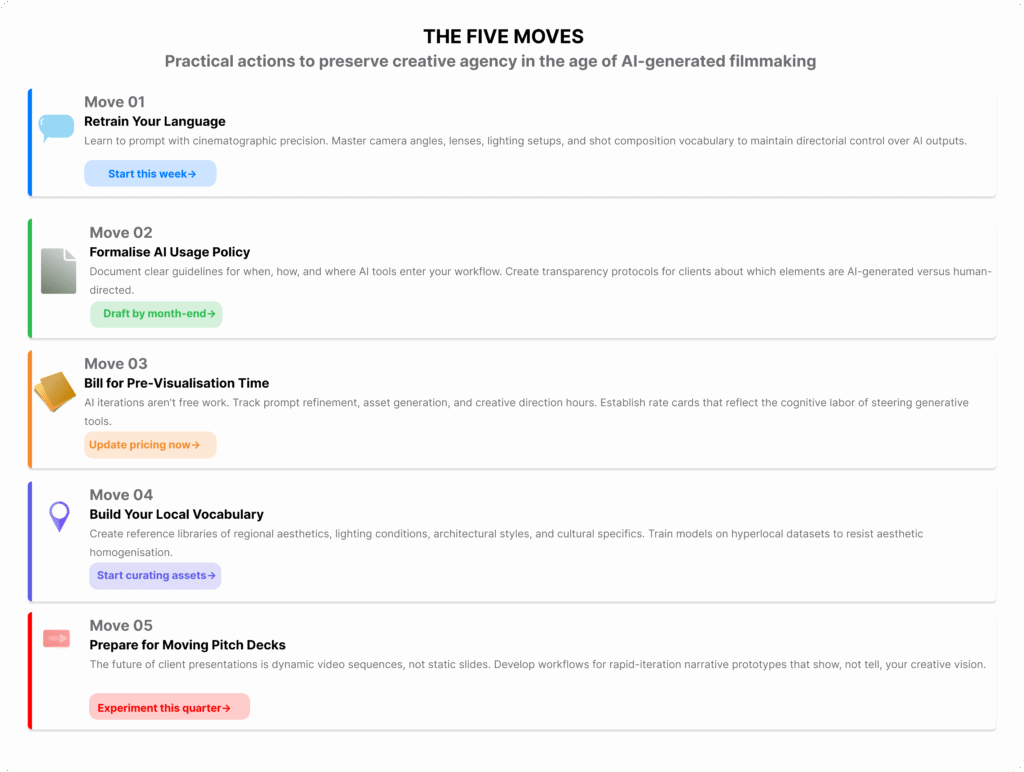
1. Retrain our teams’ language, not just their tools
Heather Cooper on AI Filmmaking with Flow | In the Flow is basically a free masterclass in prompt‑level direction.
We can use it deliberately:
- Build shared vocabularies that encode cinematography: verbs for movement (“gliding”, “lurking”, “stumbling”), lens cues (“wide, slightly distorted”, “compressed telephoto”), time‑of‑day descriptors, texture words.
- Get strategists and creatives to co‑write story blocks the way Meta Puppet suggests – full, emotionally coherent paragraphs that Flow can use as context.
- Use AI video outputs in internal sessions to show how micro‑changes in wording shift pacing and tone.
Those skills outlive any particular tool. They’re the same muscles you flex in Break the Loop, Mind the Bump: A Wry Audit of KitKat’s Latest Musical Break, when you pull a TVC apart beat by beat.
2. Write down where we will (and won’t) use AI video
Policies sound dull. They’re also how we avoid being surprised by our own work.
A simple internal document can spell out:
- Where AI‑generated sequences are acceptable: internal pre‑vis, experiments, some social formats with clear disclosure
- Where they’re off‑limits or heavily restricted: sensitive topics, politics, anything too close to deepfake territory
- What level of human oversight is non‑negotiable: creative leadership, legal and DEI review, even external eyes for high‑stakes campaigns
Once that exists, it needs to show up in scopes and client conversations. Quiet pilots have a way of turning into “standard process” unless someone draws a line.
3. Treat AI pre‑vis as billable creativity
An AI‑generated film inside a pitch deck is still film.
If we treat it as garnish, we end up working for free. Better options exist:
- Create explicit line items for AI‑assisted concept films, akin to animatics or motion tests.
- Track the hours and show clients how this speeds up later production or improves clarity.
- Make the value explicit in proposals: this is part of the craft, not a party trick.
Moving decks are coming. The question is whether we get paid, credited and resourced for them.
4. Build a local as well as global visual vocabulary
Global tools will flatten local nuance if we let them.
Counter that by:
- Prompting with local festivals, neighbourhoods and weather patterns: monsoon steam, Mumbai locals at rush hour, Chennai’s punishing noon light.
- Bringing in local filmmakers, photographers and artists to review how AI‑generated visuals handle place, class, gender and culture.
- Logging prompts that consistently produce lazy or stereotypical imagery and adding them to a denylist.
Think of this as brand‑safe prompting with a cultural spine. It’s the same instinct that drove The Alchemy of Animated Heritage: How a Brazilian Studio and a Small Boy With Gloved Hands Disrupted India’s Paint Wars: highly specific aesthetics can shake a whole category.
5. Prepare for “moving decks” as the norm
Creator‑facing explainers like Google Flow: The AI Tool That Makes Pro Video Creation… are already selling the idea that anyone can produce “pro‑level” video with Flow. That marketing doesn’t stop at creators; it seeps into client expectations too.
We can either brace for that or be blindsided by it.
Practical prep looks like this:
- Hire or upskill at least one “AI film editor” – someone who can operate Flow and its peers, but also understands story and brand.
- Train account and strategy teams to think in sequences and transitions as naturally as they think in headlines and hooks.
- Rehearse how we frame AI‑generated prototypes in the room: “This is the mood and pace, not a guarantee of cast, wardrobe or location.”
Teams that treat AI films as structured arguments, not just eye‑candy dropped on the final slide, will squeeze the most value from them.
“Treat AI film as argument, not garnish. The sequence is the strategy.”
The uncomfortable truth: this is mainstream filmmaking now
Meta Puppet suggests proper narrative filmmaking with AI will only really arrive when we have stories with emotional stakes, characters we care about, believable dialogue. Watch what Flow is already capable of in the hands of motivated creators, and that threshold starts to feel very close.
The technology is already good enough to sit in real pipelines:
- As pre‑vis and animatics for traditional shoots
- As final output for social and performance creative
- As experimental storytelling for brands willing to own the weirdness
Google’s own work around Flow is warm, polished and deliberately non‑threatening. Heather Cooper on AI Filmmaking with Flow | In the Flow, Meta Puppet on AI Filmmaking with Flow | In the Flow and Meet Flow: AI‑powered filmmaking with Veo 3 all work hard to make this feel like an evolution, not a rupture.
We don’t get that comfort.
As marketers, we have to decide:
- What kind of visual culture we’re reinforcing when we plug into tools like Flow
- What kind of labour ecosystem we’re helping to build around “AI‑assisted” production
- Whether our teams’ creativity is being squeezed into whatever Veo 3 and Flow currently handle best, or genuinely expanded by them
For someone already dissecting how algorithms bend culture – from food delivery anthems to beauty billboards – this is simply the next frontier. The tools are here. The only live question is whether our next deck treats them as magic, or as material.
Footnotes (hyperlinked sources)
Google / product ecosystem
- Heather Cooper on AI Filmmaking with Flow | In the Flow
- Meta Puppet on AI Filmmaking with Flow | In the Flow
- Meet Flow: AI‑powered filmmaking with Veo 3
- Flow – Google Labs
- Veo
- Gemini video generation overview
Commentary on Flow, Veo and AI video
- Google’s new filmmaking tool Flow adds editing tools and some consistency to AI‑generated video
- The Ultimate Filmmaker’s Hack? Google Flow Explained
- Google’s Flow AI Could Change Film Industry Forever!
- Google Flow: The AI Tool That Makes Pro Video Creation…
My related articles
- Brand Anthem in the Age of Algorithms: Swiggy Wiggy 3.0 Campaign and the Playbook for People‑Powered Marketing
- In the Warm Steam of the Monsoon, a Cup of Tea—and a Campaign—Find Their Moment
- Break the Loop, Mind the Bump: A Wry Audit of KitKat’s Latest Musical Break
- When a Biscuit Became a Love Letter
- The Alchemy of Animated Heritage: How a Brazilian Studio and a Small Boy With Gloved Hands Disrupted India’s Paint Wars
- The Pixel‑Perfect Lie: Maybelline’s Mumbai Mirage