
Two videos. Released within 24 hours of each other. One runs 40 seconds, the other nearly six minutes. Both are trying to convince the same audience—developers—to trust their latest AI models. But they couldn’t be more different in approach.
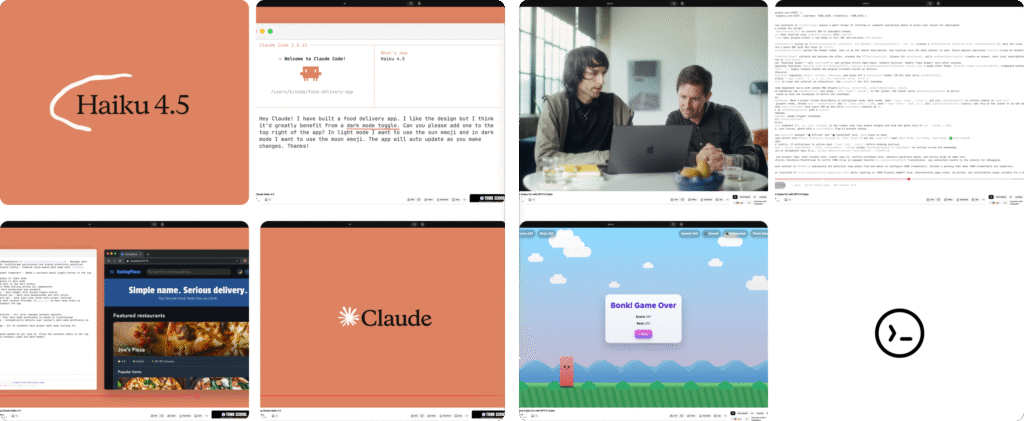
On 15 October, Anthropic dropped a video for Claude Haiku 4.5 that feels like abstract art¹. Forty seconds of visual minimalism. Three words: “Heat. Heat. N.” Then silence. The YouTube description does all the work—performance benchmarks, pricing comparisons, technical specifications. The video itself refuses to explain anything.
A day earlier, OpenAI released a five-minute tutorial showing two engineers turning a single-player game multiplayer using their new GPT-5 Codex CLI². Real people, real workspace, real deployment. They even play the finished game together at the end.
Why now? Because we’ve reached a pivotal moment in developer marketing. The question is no longer whether AI coding tools work—84% of developers already use them³. The question is which ones deserve their cognitive investment. And these videos reveal two radically different theories about how to earn that trust.
When Less Becomes More
Anthropic’s approach borders on experimental. In an era where marketing teams measure success in engagement metrics and watch-time, they’ve created something deliberately unwatchable. The video doesn’t demonstrate Claude’s capabilities. It doesn’t show a user interface. It doesn’t even speak to the camera.
This isn’t marketing negligence—it’s marketing philosophy. By refusing to explain, Anthropic signals that their audience doesn’t need spoon-feeding⁴.
If you’re sophisticated enough to evaluate frontier AI models, you’ll test them yourself. The video exists purely to announce availability, trusting that technical buyers will migrate to benchmark comparisons and pricing pages.
This approach continues the strategic positioning established in Anthropic’s “Keep Thinking” campaign—a brand platform built around problem-solvers who see AI as a thinking partner rather than a shortcut⁵.
That campaign acknowledged AI anxiety whilst positioning Claude as the thoughtful alternative. This Haiku 4.5 video distils that philosophy into pure essence: if you understand the problem space, you don’t need storytelling.
The gamble is enormous. Developer attention spans are notoriously short⁶. A 40-second video risks being scrolled past entirely.
But Anthropic seems to be betting on earned media rather than direct engagement. The video functions as a conversation starter for technical journalists and developer influencers—visual shorthand for “something significant just dropped.”
But as Anthropic’s tagline declares: “What was recently at the frontier is now cheaper and faster.”¹⁸ It’s a value proposition so concrete that Anthropic’s CPO Mike Krieger describes Haiku 4.5 as exceeding “expectations for its size”⁶—the sort of understated assessment that resonates with technical buyers who distrust hyperbole.
The Tutorial as Trust Signal
OpenAI’s video takes the opposite approach: radical transparency. Five minutes of unedited workflow. Two engineers, Eason Goodale and Romain Huet, narrating their every move as they demonstrate Codex CLI’s capabilities².
This isn’t polished marketing—it’s developer relations disguised as content. The production values hover deliberately between professional and documentary. There’s natural conversation. Screen sharing. Even a moment where they test approval modes and deployment permissions in real time.
The choice reflects a deeper understanding of developer psychology. Developers distrust marketing polish⁷. They want technical depth from people who write production code. By foregrounding their own engineers, OpenAI outsources credibility to their technical team.
This builds on OpenAI’s broader marketing strategy of positioning their AI as an intimate assistant across everyday moments⁸. But where that campaign targeted general users, the Codex CLI video speaks directly to the technical community with unvarnished proof of capability.
The extended runtime serves another purpose. It positions Codex CLI not as a product you evaluate in seconds, but as a workflow you invest time learning.
As Eason Goodale states in the demo: “GPT-5-Codex… is really good for any sort of coding task”²—a breadth claim that the video substantiates through demonstration rather than assertion. OpenAI’s official messaging goes further: “Forget autocomplete—this is agent-complete.”¹⁵⁸
The video’s educational tone mirrors how 62% of developers prefer long-form video as their primary learning method⁶.
The risk is different but equally real. Developers have learned to distrust demos that unfold too smoothly. The video’s polish—multiple camera angles, seamless editing, perfect deployment—might trigger the scepticism it aims to quell.
What Developers Actually Want
Both videos succeed because they understand a fundamental truth about their audience: developers evaluate authenticity not by production roughness, but by technical substance⁹.
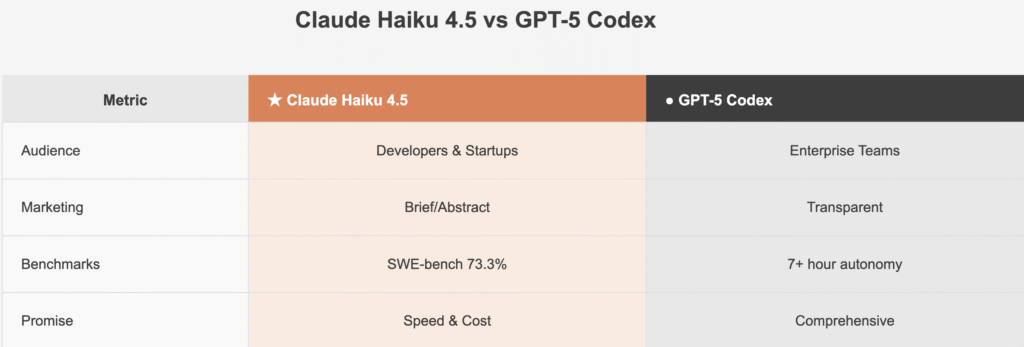
Anthropic’s minimalism works because it centres measurable performance. Claude Haiku 4.5 offers 73.3% on SWE-bench Verified, one-third the cost of Claude Sonnet 4, twice the speed¹.
These aren’t marketing claims—they’re verifiable benchmarks. The video trusts developers to value specifications over storytelling.
As explored in my analysis of Claude Sonnet 4.5’s launch, Anthropic has consistently delivered demos that demonstrate rather than promise¹⁰. This Haiku video continues that tradition by reducing the demo to pure metadata—letting the specifications speak louder than any visual presentation could.
OpenAI’s maximalism works because it addresses the developer community’s most persistent concern: whether AI tools perform reliably in production workflows². By showing the entire pipeline—planning, approval, deployment, testing—they’re providing receipts for their claims.
Neither approach mentions competitors directly, but both are shaped by competitive context. Anthropic’s pricing comparison implicitly targets OpenAI’s enterprise tiers¹. OpenAI’s platform narrative counters Anthropic’s model-first positioning.
The Agent Architecture Play
Both companies are positioning their tools not as standalone models but as components in multi-agent systems. Mike Krieger’s description is revealing: “We’re giving people a complete agent toolbox where each model has the right combination of intelligence, speed, and cost for different parts of the job.”¹⁶⁰
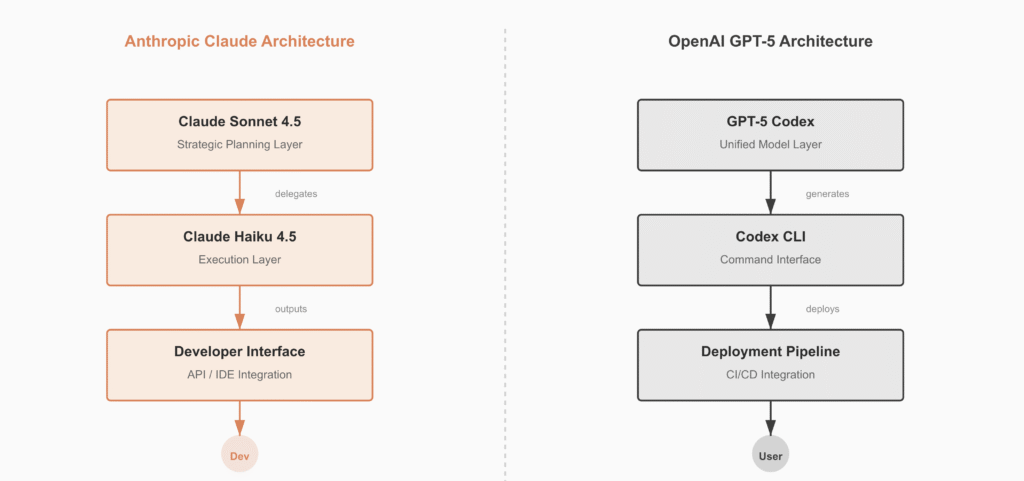
This echoes Romain Huet’s comment in the OpenAI demo: “You sometimes want to use one model for one thing, one model for another.”² Both companies recognise that the future of AI coding isn’t monolithic intelligence—it’s orchestration.
Andrew Filev, CEO of Zencoder, notes that Haiku 4.5 is “unlocking an entirely new set of use cases”¹⁶⁰—a sentiment that applies equally to OpenAI’s platform approach. The question is which company’s architecture developers will adopt as their orchestration layer.
The Trust Economy
What’s fascinating is how both videos navigate the same structural challenge: developer trust is earned through multiple positive interactions¹¹. A single video won’t convince anyone to switch tools. But it can signal whether a company understands their audience.
Anthropic’s video signals respect for developer intelligence. OpenAI’s signals respect for developer scepticism. Both are valid entry points into longer trust-building processes.
The evidence suggests this matters enormously. Research shows that 97% of B2B tech marketing leaders view developer marketing as crucial for growth⁹. But traditional marketing tactics actively repel this audience. Developers trust peer recommendations over brand messaging. They prioritise educational content over promotional content. They need to see code, not concepts.
Broader Context: The Platform Wars
These videos arrive at a moment when both companies are aggressively expanding their platforms. Anthropic now serves over 300,000 business customers, up from under 1,000 just two years ago¹².
OpenAI has integrated GPT-5 Codex across Codex CLI, IDE extensions, GitHub workflows, and ChatGPT mobile¹³.
Sam Altman’s enthusiasm was palpable in his announcement: “GPT-5-Codex is here: a version of GPT-5 better at agentic coding. It is faster, smarter, and has new capabilities.”¹⁵⁸ Within hours of launch, he noted that “GPT-5-Codex already ~40% of traffic for Codex”¹⁶¹—a metric that reveals OpenAI’s confidence in adoption velocity.
The timing—15 October for Anthropic, 14 October for OpenAI—suggests both companies are monitoring each other’s release calendars with precision. But the videos themselves reveal different competitive anxieties.
Anthropic positions Haiku 4.5 against its own Sonnet 4 model, emphasising cost and speed parity at a fraction of the price¹⁴. The implicit target isn’t OpenAI—it’s the budget-constrained developer or startup evaluating whether frontier intelligence is economically viable. By offering Haiku 4.5 free to all Claude.ai users, Anthropic is making a land-grab play for mindshare amongst developers who might have dismissed Claude as enterprise-oriented.
OpenAI’s video, meanwhile, positions Codex CLI as the orchestration layer for multi-agent systems—not just a single model, but a platform where GPT-5-Codex coordinates sub-agents, handles deployments, and integrates with third-party tools². This is platform thinking, not product thinking.
Implications for Marketers
These videos offer three lessons for anyone marketing to technical audiences:
Brevity can be ideology. Anthropic proves that omission can be a positioning strategy. By refusing to explain, you signal confidence in your audience’s sophistication. This only works if your product genuinely delivers on measurable benchmarks.
Education builds trust. OpenAI demonstrates that extended runtime is viable if it delivers genuine educational value. Developers will tolerate length when it teaches them workflow integration.
Authenticity is structural. Both videos succeed because they centre technical substance over brand storytelling. Developers evaluate authenticity through specifications, capabilities, and proof—not production values.
This mirrors patterns I’ve observed across other AI product launches—the most effective campaigns respect the intelligence of their technical audiences whilst addressing their specific scepticism.
The Verdict
Neither video will win awards for creativity. But both will likely succeed in their primary mission: converting technical evaluation into product adoption.
Anthropic’s approach respects the developer’s time and intelligence. OpenAI’s respects their scepticism and need for proof. Both are betting on different aspects of developer psychology, but both understand the fundamental equation: in developer marketing, trust trumps engagement every time.
The real test isn’t YouTube metrics—it’s adoption curves. And in that race, the most effective marketing is simply the product that works. These videos understand that truth, even if they express it completely differently.
The broader lesson? When marketing to sceptical technical audiences, your strategy should match your product philosophy. If you’re selling frontier performance, act like it. If you’re selling comprehensive platforms, teach like it. But whatever you do, don’t try to charm developers who just want to see the code.
Related Reading
- The Claude Conundrum: Deconstructing Anthropic’s “Keep Thinking” Campaign
- Claude Sonnet 4.5: A New Standard in AI Marketing
- OpenAI Marketing Strategy: When AI Tries to Be Your Lifestyle Companion
- AI Product Launch Analysis
References:
Anthropic, “Introducing Claude Haiku 4.5,” 15 October 2025
OpenAI, “Using OpenAI Codex CLI with GPT-5-Codex,” 14 October 2025
VentureBeat, “Anthropic is giving away its powerful Claude Haiku 4.5 AI,” 15 October 2025
InfoQ, “OpenAI Releases GPT-5-Codex Optimized for Complex,” 21 September 2025
Creative Salon, “Anthropic Positions ‘Claude’ as the Problem Solver’s AI,” 18 September 2025
Draft.dev, “How to Create Effective Video Content for Developers,” 15 September 2025
Daily.dev, “Earn trust, not impressions,” 15 May 2025
OpenAI, “How people are using ChatGPT,” 14 September 2025
Daily.dev, “5 Ways to Build Trust Through Developer-Focused Advertising,” 16 February 2025
Anthropic, “Claude Sonnet 4.5,” 28 September 2025
Iron Horse, “What Is Developer Marketing?” 2022
Creative Salon, “Anthropic’s ‘Keep Thinking’ campaign,” 19 September 2025
OpenAI, “GPT-5 System Card Addendum: GPT-5-Codex,” 14 September 2025
CNBC, “Anthropic launches Claude Haiku 4.5,” 15 October 2025