
AI didn’t just walk into customer support last year. It kicked the door in, took the front desk job and told everyone it would make things “more human”.
Claude’s new customer story featuring Lyft is the cleanest version of that pitch so far: customer resolution time cut by 87%, issues dropping from 30‑plus minutes to seconds, “millions saved” and reinvested in upskilling support agents and preventing burnout. The video is smooth, the numbers are crisp, and the narrative is exactly what boards want to hear.
“The wrong move is to copy the slogan. The right move is to copy the discipline—and fix the gaps this Claude–Lyft case leaves open.”
If you’re a CMO or a UX‑systems lead, you’re going to be asked: “Where’s our 87%?”
The wrong move is to copy the slogan. The right move is to copy the discipline—and fix the gaps this Claude–Lyft story leaves open.
This piece is a reaction to that campaign, but it’s really about you: what to take, what to leave, and how to tell an AI support story that will still look honest two years from now.
1. Why the Claude–Lyft story lands so hard
The official narrative
Let’s start with what Anthropic and Lyft actually say.
In the campaign video on Claude’s channel, Elyse Hovanesian, Product Lead for AI in Support at Lyft, sets up the crisis like this:
“Back in 2023, we were facing a really difficult time at support at Lyft. Rider base increased, our driver base was increasing, and this was super exciting for Lyft, but it felt like our current support system was not set up to handle this well… Our support queues were getting a bit overwhelmed… It was just a long time to wait and get an issue resolved for our riders and our drivers.”[youtube]
She explains that the team looked at “a lot of different models”, but that “Claude’s personality is really what stuck out”. When she reviewed transcripts, there was “this more organic feeling”, and “customers were conversing more and opening up about the issues that they were having”.[youtube]
Then comes the punchline: “Customer resolution time decreased by 87%. So something that would have taken 30 plus minutes, that now is resolved in a matter of seconds.” She calls this “a transformational shift for Lyft customer support”.[youtube]
Finally, she closes the loop on costs and labour: “Through using Claude for our AI assistant, we have been able to save millions of dollars on the support side that we’ve specifically focused on reinvesting back into our support agents… to upskill them, to avoid burnout… empowering our agents to spend more time on the issues that require human care and infusing that layer of empathy and care, that’s really important to us at Lyft.”[youtube]
“Claude’s Lyft case sells AI as both cost‑cutter and conscience: 87% faster support, ‘millions saved’, and somehow more empathy too.”
On paper, it’s the perfect AI‑era case study:
- clear pain (overwhelmed queues, tired agents)
- clear bet (pick the “most human” model)
- clear win (87% improvement, millions saved)
- clear conscience (“we reinvested in people”).
If you’ve read my breakdown of OpenAI’s enterprise marketing, this structure will feel familiar. The demo is not just about capability, it’s about workflows, anxiety and transformation in a tidy two‑minute arc.[linkedin]
Why this structure works so well
That is exactly why Claude’s Lyft story should be treated as a live pattern, not a one‑off. If you only chase the 87% without understanding what sits under it, you will end up optimising for the wrong things.
“If your AI story can be reduced to ‘we’re faster and more human’, assume every competitor will say the same thing by Q4.”
Take for CMOs: What you need is: we’re faster, more human and more honest about what we changed.
2. The system they actually built
AI at the front door
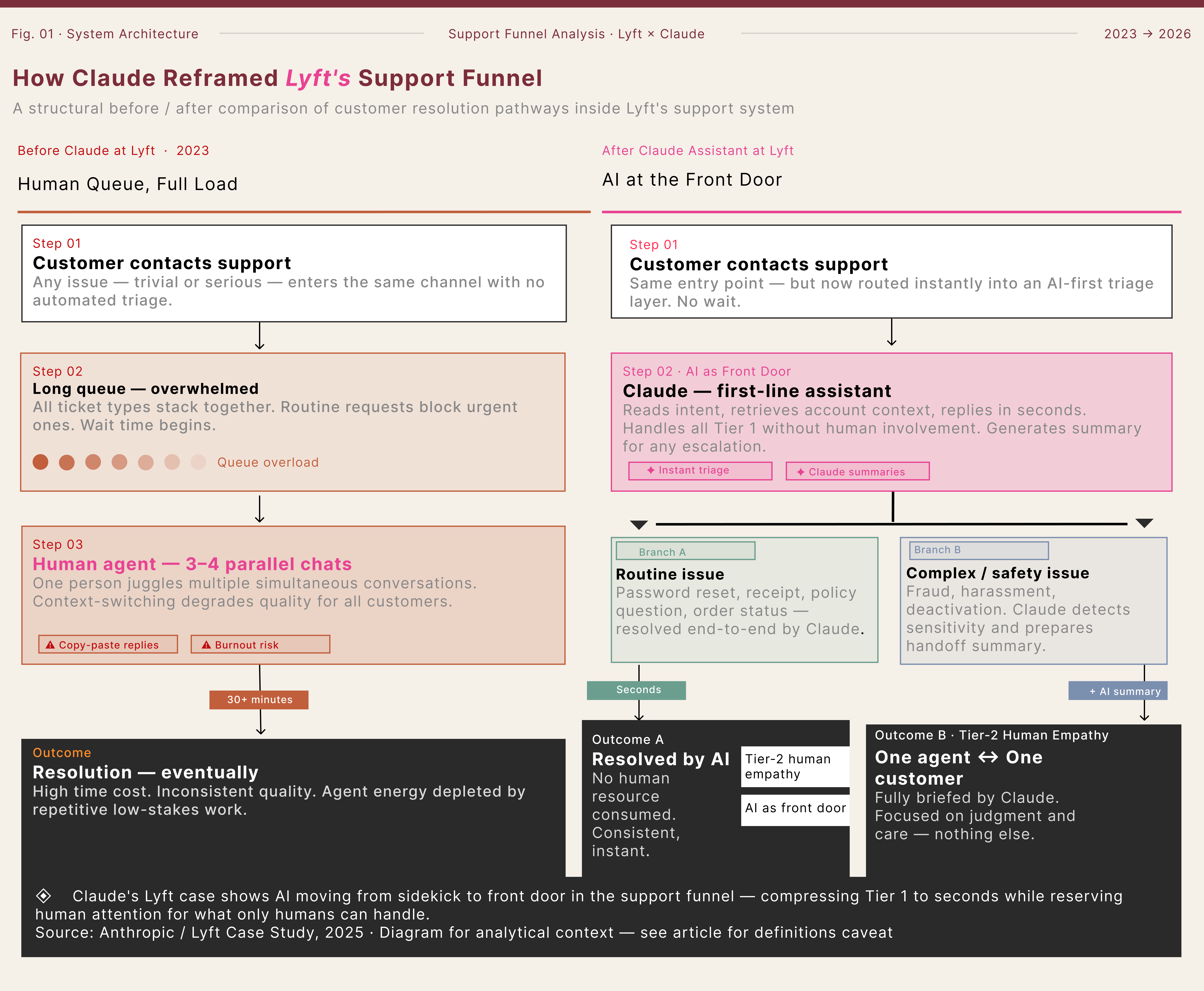
Strip away the campaign gloss and you can see a clear system under the hood.
From Claude’s customer story and the video, the new support architecture at Lyft looks like this:
AI is now the default front door.
Riders and drivers start with a Claude‑powered assistant for most support needs: fare questions, driver onboarding, ride issues, policy clarifications. It greets them by name and invites them to talk in natural language.
AI does triage and resolution.
Claude does not just collect information and hand off. It tries to resolve as many cases as possible itself: pulling policy, account data and previous trips to produce an answer or action.
Humans handle “Tier 2 empathy”.
When an issue “requires human judgment” or “care and empathy”—safety concerns, complex disputes, nuanced edge cases—the system routes the customer to human agents. Those agents see a structured summary and, crucially, now handle one customer at a time instead of three or four.
“This isn’t ‘we added a bot’. It’s ‘we changed who gets to decide what counts as enough help’.”
How Claude frames reinvestment
Claude’s case study emphasises that AI‑powered support at Lyft “saved millions of dollars” and that Lyft “specifically” reinvested those savings into upskilling agents and avoiding burnout. It also highlights Lyft Silver, a simplified app and higher‑touch support experience for older riders, as one of the programmes this efficiency helps fund.
That is your blueprint for turning “we saved money” into “we invested in people who need us”.
If you’ve read my piece on Apple’s iPhone 17 Pro campaign, you’ll recognise the pattern. A tightly controlled system change (USB‑C, battery life, AI features) gets framed as pure consumer upside, while the power shift underneath barely features.[suchetanabauri]
The real power shift in support
However, we should be clear about what changed inside Lyft’s support:
- Before: humans were the default interface. Workflow tooling was heavy, but a person in a seat controlled tone, escalation and exceptions.
- After: Claude now owns first contact and the majority of resolutions. Humans act as specialists who see only the cases the system labels as complex or risky.
This is not “we added a bot”. It is “we changed who gets to decide what counts as enough help”.
“Once AI sits at the front door, everything else—metrics, escalation, trust—flows from that decision.”
For UX‑systems leads: your key design decision is not “use AI vs don’t use AI”. It is “who sits at the front door?”
3. The 87% trap
The hero metric
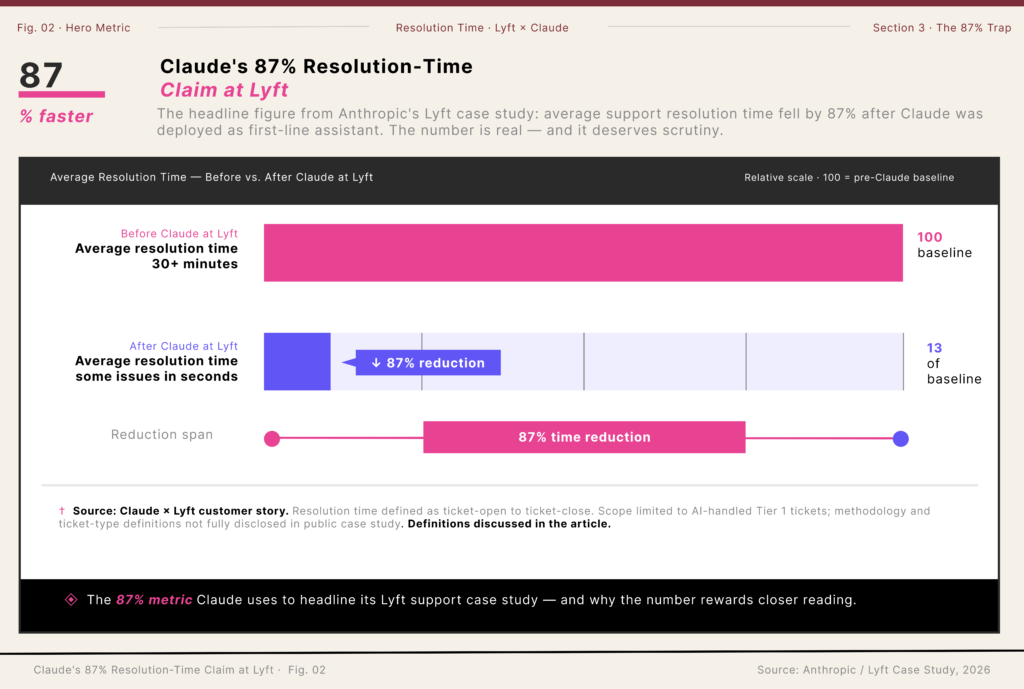
Let’s talk about that 87%.
The number appears across Claude’s video, the customer story and coverage in outlets like TechCrunch and the Verge. It stays consistent: “customer service resolution time reduced by 87%. So something that would have taken 30 plus minutes now sometimes is even resolved in a matter of seconds.”
From a comms point of view, that is perfect. From a product and UX point of view, it triggers three questions.
What exactly are you timing?
The Claude case study does not spell out whether this is:
- total time from “I open support” to “I’m done”
- only active handling time
- or some internal workflow metric.
TechCrunch notes that an issue is marked as resolved when a customer answers “yes” to the chatbot’s “Did we resolve your issue?” question. That strongly suggests at least part of this metric relies on self‑reported closure.
Therefore, you could slash “handling time” while keeping customers in queues or on hold for just as long. The headline number alone does not prevent that.
What counts as “resolved”?
That “yes/no” pattern is standard, but also fragile:[techcrunch]
- some customers tap “yes” just to move on
- others may not realise that “no” leads anywhere useful
- the phrasing itself nudges them towards closure.
Consequently, a very “successful” Claude deployment could still leave people unhappy or under‑compensated in ways your metric never sees.
Which tickets are in scope?
There is no breakdown of which categories feed into that 87%. The Verge points out that the Claude assistant at Lyft handles “the most frequently asked support questions” and escalates more complex issues. That makes sense, yet it also means:
- routine, low‑stakes tickets probably see huge improvements
- high‑stakes, complex cases may see weaker gains—or even longer times if escalation takes more steps.
If you’ve followed my critique of Anthropic’s “anti‑hype” strategy, this should ring a bell. The company is pivoting from “promise miracles” to “promise measurable competence”. The 87% figure is a textbook “competence metric”. That is progress—but only if accurate definitions sit behind the number.[linkedin]
“The deeper lesson from Claude’s Lyft story isn’t ‘find a big number’. It’s ‘treat that number as a product decision, not just a PR line’.”
The discipline you actually need
If you’re a CMO, ask yourself this before you sign off on your own “X% faster with AI” line:
- Can I say, in one sentence, what we’re measuring?
- Can I publish one quality metric next to this speed metric—CSAT, NPS for support, re‑contact rate?
- Can I live with this number being scrutinised by analysts who do not work for us?
If the answer to any of those is “not yet”, your problem is not marketing. It is measurement.
4. AI didn’t remove emotional labour. It concentrated it.
The official labour story
Claude’s story with Lyft spends a lot of time on the humans behind the interface.
Before AI, support agents appear buried in volume: multiple chats at once, rigid workflows, copy‑pasted messages, little time to understand context, visible signs of burnout. After Claude, the promise flips. Agents:
- handle one customer at a time
- read rich summaries from Claude
- have time to understand the full story
- can “see a real career path at Lyft” rather than a dead‑end support role.
On top of that, the campaign claims that the “millions of dollars” saved have been reinvested into upskilling agents and preventing burnout.
As a counter‑narrative to “AI is here to fire your support team”, this is smart. It also aligns with what I argued in my thread on AI and marketing careers: the value shifts to higher‑order work rather than disappearing.[linkedin]
What really happens to the work
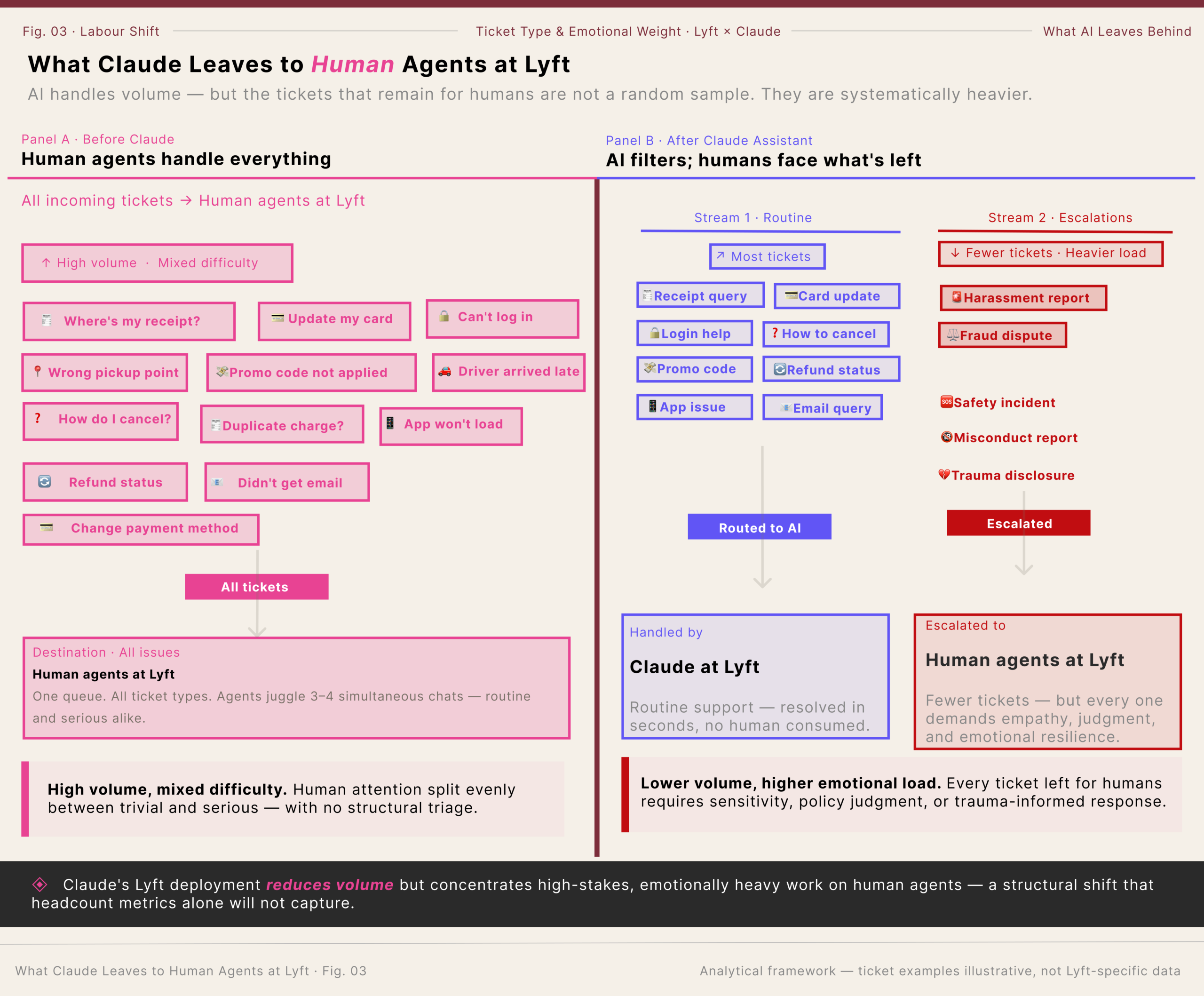
However, from a systems perspective, that is not the whole story.
Once Claude eats the easy tickets, your human agents see a very different mix of work:
- more safety incidents
- more harassment, discrimination and violence reports
- more complex fraud and chargeback cases
- more customers who already feel frustrated because the bot could not help.
In other words: fewer tickets, more trauma.
If you ignore that shift, you do not “fix burnout”. Instead, you move it up the complexity ladder.
Claude’s materials hint at the solution—training, time per customer, clearer career paths—but do not share data on agent churn, mental health or progression. Viewers will notice that gap.
“AI can reduce ticket volume and still increase burnout if every remaining ticket is harder, heavier and more adversarial.”
How to design for emotional load
If you’re a CMO, do not stop at the slide that says “we’re reinvesting in our people”. Ask for:
- examples of new roles, ladders and pay bands
- real numbers on support team churn before and after AI
- concrete plans for dealing with more high‑stakes, emotionally heavy cases.
If you’re a UX‑systems lead, design for this explicitly:
- give agents control over when to pull AI in and when to switch it off
- rotate people through less intense queues rather than locking them into the worst tickets
- bring agent feedback into your definition of “AI‑appropriate” vs “human‑only” cases.
Otherwise you will tell a “burnout prevention” story while quietly building an emotional‑labour pressure cooker.
5. “Claude’s personality” is a design contract, not a flourish
Why personality became a selling point
One genuinely interesting move in this campaign is the focus on personality.
Claude and Lyft say they tested multiple models and picked Claude not only for accuracy, but also for “tone and persona that represented our brand” and for avoiding the “dreadful chatbot that no one wants to interact with”. Hovanesian says Claude’s personality “stuck out”: it felt “organic”, and customers “were conversing more and opening up about the issues they were having”.[youtube]
That language matters. It marks a shift from “which model is smartest?” to “which model feels like us?”
If you’ve read my analysis of Anthropic’s anti‑hype positioning, you’ll recognise the through‑line. Anthropic is selling Claude as a competent colleague with a grounded personality, not a mystical brain in the cloud. Lyft is buying into that and localising it for support.[linkedin]
The obligations that follow
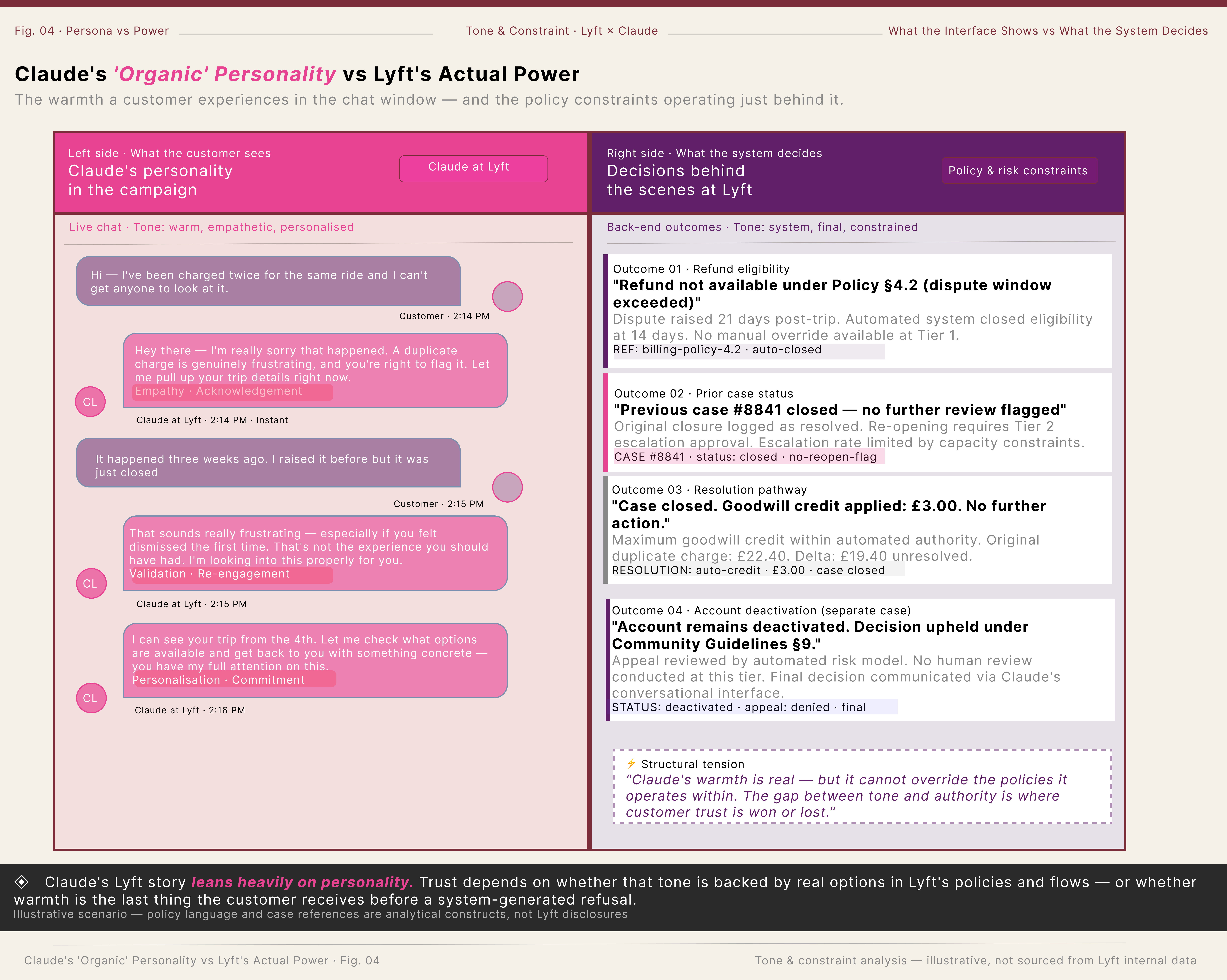
However, the moment you say “our AI has a personality”, you sign a design contract.
- Voice must stay consistent under stress.
It is easy to sound warm when you re‑send a receipt. It is much harder when you enforce an unpopular policy or deal with a safety incident. If your AI “feels human” in the easy moments and suddenly turns cold and legalistic in the hard ones, it will feel more manipulative than a blunt bot. - Empathy must carry real power.
Saying “I’m so sorry that happened to you” and then offering nothing different in terms of resolution is worse than skipping the empathy. Synthetic warmth without meaningful action is exactly where trust dies. - Disclosure must stay clear.
If you design the experience so that people forget they are talking to AI, you do more than smooth UX. You also move into ethically grey territory, particularly in sensitive cases. The Claude–Lyft material says very little about how clearly the assistant is labelled.
“Once you market an AI ‘personality’, you inherit human‑grade expectations for responsibility and care.”
The bar you actually face
For CMOs, the headline is simple: if you lean on “our AI feels human”, people will judge you by human standards. Safety failures, unfair decisions and cold escalations will hit harder, not softer.
For UX leads, treat personality as a constraint, not a flourish:
- bake it into prompts, review criteria and policy, not just into UI text
- train teams to notice when the persona fights with honest communication
- ban synthetic empathy in categories where it feels wrong (serious harm, legal threats, termination).
This is the same bar I argue for in my breakdown of ChatGPT Pulse’s proactive UX: once you act unprompted or with a strong persona, you inherit new duties of care.[linkedin]
6. The invisible UX: escalation, safety and equity
What the campaign shows you
Claude’s Lyft campaign is clever about what it makes visible.
We see:
- riders and drivers greeted by name
- quick resolutions to common issues
- agents talking about more time per customer
- Lyft Silver as a visible “we invested in older riders” story.
What it leaves off‑screen
However, we do not see:
- how a rider moves from Claude to a human
- how many taps, forms or re‑explanations that takes
- what the live safety experience looks like
- how any of this works for non‑English speakers, disabled riders or people in regions with patchy coverage.
Those omissions are not random. They are the places where risk lives.
Escalation friction is a product decision
If reaching a person now takes more effort than it did before AI, you made a bet: the gains in speed and cost outweigh the frustration of people who need a human and cannot get one quickly.
The Verge notes that Lyft’s Claude assistant focuses on frequent questions and escalates “more comprehensive” issues to humans, yet the UX path stays invisible. That may be fine; it may not. The point is that it is a product decision, not an accident.[theverge]
Safety defaults define your ethics
Claude’s story says cases requiring “human judgment” are escalated, but does not spell out which cases those are or how the system detects them. In practice, that comes down to classification rules, keyword triggers and hard “never AI‑only” categories.
If you cannot point to those on a slide—or show them in a spec—you are not in control of your safety UX. The system is.
Equity and performance are not optional
There is nothing in the public material about performance across languages or segments. We already know from other AI deployments that “works fine in English for tech‑savvy users” is not the same as “works for everyone”.
I made a similar argument in my piece on Apple’s “AI for everyone” framing: the inclusivity story only holds if the underlying system actually serves people at the margins.[suchetanabauri]
Pull quote: “If your ‘customer‑obsessed AI’ story never mentions escalation, safety or equity, it’s just a tagline.”
How to make this visible in your own story
What to do instead:
- put your escalation path in front of the user, not behind a “more options” link
- show your board a list of ticket types you hard‑coded as “human‑first”
- instrument and publish basic numbers on language and region performance before you write the case study.
If your “customer‑obsessed AI” story leaves all of this out, it is just a line.
7. Everyone will sell “AI support”. Trust is the differentiator.
The emerging pattern
Zoom out and the Claude–Lyft collaboration looks like a template.
Anthropic’s own announcement frames the Lyft partnership as a blueprint for bringing Claude into real‑world businesses, not just an experiment. TechCrunch and the Verge position it as an overdue upgrade: old chatbots were “limited and infuriatingly bot‑like”. Claude is more “human‑like” and therefore more acceptable.anthropic+2
You can already feel the pitch decks writing themselves:
- high‑volume B2C platform hits support limits
- AI vendor offers a safe, aligned, “on‑brand” model
- cloud vendor offers infra and “agentic” orchestration
- brand ships a story about being more human thanks to automation.
If you’ve followed my writing on Anthropic’s strategic pivot away from hype, Claude’s Lyft case is essentially the customer‑facing proof of that theory. This is what “selling competence, not magic” looks like at scale: concrete metrics, limited scope, and a grounded, almost boring story about tickets and queues.[linkedin]
Pull quote: “You can either bolt AI onto support and hope nobody looks closely, or you can change the brief and design for scrutiny from day one.”
Your choice as a leader
If you’re reading this as a CMO or UX leader, you have two options:
- Play the game as written.
Race to bolt AI into support, find one good‑looking statistic, wrap it in synthetic empathy and hope nobody digs deeper. - Change the brief.
Use AI to fix the parts of support you’re ashamed of and the parts you’ve ignored, and tell a story that holds up when someone looks under the hood.
I’m obviously arguing for the second one.
8. A practical checklist before you launch your own “AI made us more human” story
If you’re under pressure to “do a Claude–Lyft” this year, use this checklist with your team. It comes out of this case and from patterns I’ve seen across OpenAI’s enterprise campaigns, Anthropic’s anti‑hype strategy and recent AI‑driven UX launches.suchetanabauri+2
For CMOs
1. Can you explain your AI support story in one honest sentence?
If your line is “We used AI to cut resolution times by 60% while improving satisfaction,” you should be able to answer:
- how you measured those times
- whose satisfaction improved
- and what changed for the humans doing the work.
If you cannot, you are not ready to put that sentence in a keynote.
2. Are you publishing at least one quality metric next to your speed metric?
Do not just brag about missing minutes. Show something like:
- change in support CSAT
- change in re‑contact rates
- change in complaint escalation or refund fairness.
If those numbers do not look good yet, that is your prioritisation list.
3. Can you show where the savings went?
If AI saved you money, you have three options:
- be honest and say it preserved margins
- stay vague and hope nobody asks
- or ring‑fence some of it for visible, customer‑relevant investments.
Lyft Silver is useful here: “Claude enabled X, which funds Y that our vulnerable users care about.” Find your version of that.
For UX‑systems leads
1. Is AI the default or an option?
If AI is the default front door, you now own:
- where it fails
- how easy it is to bypass
- how well it understands different users.
Decide whether some flows or segments should still start with a human by design.
2. How many steps to a human?
Go through your own support flow and count:
- how many taps it takes to get “talk to a person”
- how many times you must restate your issue.
If it is worse than your pre‑AI flow, you just made life easier for the company and harder for the customer. Either own that decision or fix it.
3. Where is AI not allowed to decide alone?
Make a list of ticket types where:
- AI can summarise but not decide
- AI can propose but not send without human approval
- AI is completely excluded.
Keep that list live. Review it monthly. Do not let it live as an unwritten norm.
4. Have you designed for agents, not just users?
You are rebuilding the tools and flows that shape your support team’s day. Ask:
- do agents feel more in control or less?
- can they override the AI easily?
- are they part of the feedback loop that decides what AI should and should not handle?
If your people feel like they are now cleaning up after the bot rather than partnering with it, you built the wrong system.
Claude and Lyft have given us a slick, well‑told example of AI support done “right”: 87% faster, “more human”, agents re‑energised, older riders better served. It sits neatly alongside the other AI campaigns I’ve critiqued—from OpenAI’s workflow‑driven spots to Apple’s quietly aggressive iPhone 17 Pro narrative.linkedin+1
Pull quote: “The difference between an AI case study and an AI strategy is simple: one survives the first crisis call, the other doesn’t.”
The easy move is to chase their numbers.
The harder, more useful move is to steal their discipline—clear narrative, defined metric, human‑first framing—and then do the work they have not shown yet: publish quality metrics, surface your safety design, and be honest about the labour you are reshaping.
That is the difference between an AI case study and an AI strategy. The case study will get you a headline. The strategy might still look good when someone actually needs help.